
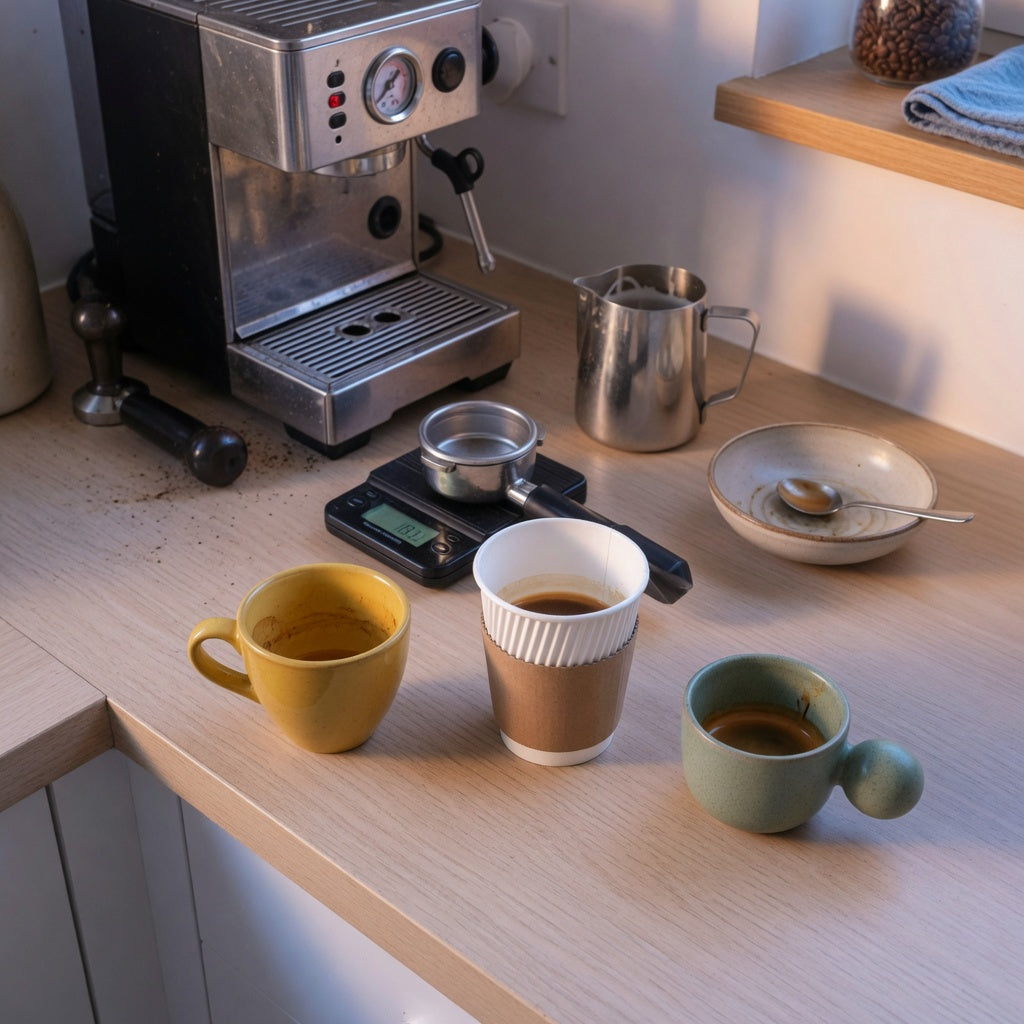
Macchiato Cup Home Coffee Station Practical Purchase Checklist
Reading time: about 9 minutes
A cup can fit beside an espresso machine and still fail the first morning you use it. The handle hits the milk pitcher, the rim will not clear a scale on the drip tray, or a small drink looks lost inside the cup. This macchiato cup home coffee station practical purchase checklist starts with those counter-level problems, then works backward to capacity and visible form.
In our store, we separate the facts we can verify from the details a shopper still needs to confirm. The three options compared here have listed capacities of 170 ml, 200 ml, and 250 ml, with Retro, Pleated, and Ball Handle forms. Capacity does not reveal external dimensions, material, care requirements, or compatibility with a particular espresso machine. Read the current product page for those details, and treat anything not stated there as unknown.
Measure the drink you make, not the name on the menu
Macchiato proportions are not universal. One household may add only a small amount of foam to espresso, while another makes a longer drink with more milk. Choosing from the drink name alone can leave you with too much empty cup or too little carrying headroom.
- Brew your normal recipe. Include the espresso, milk, foam, sweetener, and any final stirring you actually do.
- Record the practical fill line. Afterward, fill the cleaned cup with water to the same level and transfer that water to a marked measuring jug for an approximate finished volume.
- Repeat the test for your larger variation. Test the double shot, guest serving, or milkier version rather than assuming the first result covers every use.
Then decide how much space you want above the drink for carrying, stirring, and foam. For example, a measured 135 ml drink leaves a mathematical difference of 35 ml inside a 170 ml stated capacity. That is only a comparison figure: a listed capacity may be measured at the brim or another reference point, so it does not guarantee 35 ml of usable space below the rim.
170, 200, or 250 ml: where does the extra headroom help?
Use the three capacities as decision points, not as a ranking. More volume is useful only when your recipe needs it.
| Reader situation | Why the capacity may fit | Relevant next step |
|---|---|---|
| Your measured drink stays comfortably below 170 ml, and you want the smallest listed capacity in this comparison. | At 170 ml, it minimizes unused internal volume relative to the other two options. It may still feel generous for espresso with only a small spoonful of foam. | Check the Retro Coffee Tea Cup in 170 ml, then verify its current dimensions, material, and care information. |
| Your drink gets close to 170 ml, or the amount of milk and foam varies from morning to morning. | The 200 ml capacity adds 30 ml of stated volume over the Retro option. Its visible pleated form also gives you a distinct style choice without requiring a jump to 250 ml. | Review the Pleated Coffee Tea Cup in 200 ml and compare the pictured form with your grip and cleaning preferences. |
| Your finished drink approaches 200 ml, or you want room for a longer coffee or a short tea serving. | The 250 ml capacity adds 50 ml over the Pleated cup and 80 ml over the Retro cup. The visible ball-shaped handle is also relevant if that grip form is part of your decision. | Open the Ball Handled Coffee Tea Mug in 250 ml and confirm its total width before ordering. |
A smaller capacity is not proof of a smaller exterior footprint. Wall thickness, body shape, base diameter, and handle projection all affect counter fit. Capacity also cannot predict heat retention; material, wall construction, opening size, and starting temperature matter. We do not rank these cups on either point without corresponding specifications.
Will the cup clear the drip tray, scale, and shelf?
Measure the station in millimeters with every tool in its normal position. Photos and capacity figures are not precise enough for a tight setup.
- Vertical clearance: Measure from the surface that supports the cup, including a scale if you use one, to the machine's lowest fixed spout or overhang.
- Total cup width: Include the handle and enough space for your fingers, not just the diameter of the cup body.
- Working clearance: Check the handle's path beside the steam wand, milk pitcher, grinder, and knock box.
- Base support: Compare the base diameter with the drip-tray grate or slats so the cup will have adequate support.
- Storage clearance: Measure shelf height and depth. Do not assume a cup is stackable unless the product information says so.
If a listing provides external measurements, mark the maximum width and depth on paper and place that template at the station. Rotate it as you would the cup. Capacity alone cannot support a claim that any of these options fits a named appliance, so ask for missing measurements before buying. If the three capacities do not suit the space, compare other forms in our unique coffee mugs collection.
Retro, pleated, or ball handle: which form suits the routine?
Visible form affects how a cup looks and how you approach it, but a product photo cannot prove comfort, temperature, or slip resistance. Keep the decision tied to what can actually be observed.
- Retro form: Start here if a retro appearance suits an open shelf or established station style. Confirm the exact silhouette and handle projection on the product page rather than assuming that retro means short or narrow.
- Pleated form: Choose this direction if you prefer visible surface texture or need to distinguish one person's cup from the rest of the shelf. Depending on the depth of the pleats, recessed areas may take more attention to wipe than a plain exterior.
- Ball handle: Consider this form if you deliberately prefer a rounded handle shape. Confirm the full handle width and pictured finger position; a ball form is not automatically comfortable for every hand or compact on every counter.
We would not claim that pleats guarantee a better wet-hand grip or that a ball handle stays cooler. Those outcomes depend on material, dimensions, surface finish, and use conditions that need separate evidence.
Macchiato cup home coffee station practical purchase checklist
A useful macchiato cup home coffee station practical purchase checklist should expose missing information before checkout. Run through these checks with the station and your usual drink in front of you.
- Measure the finished drink: Use the recipe you make most often, plus the largest variation you regularly serve.
- Choose intentional headroom: Allow space for carrying and foam, but do not automatically buy the largest option.
- Confirm the capacity convention: Check whether the stated milliliters describe brimful or practical capacity. Ask if the page does not say.
- Record external limits: Note maximum cup height, body diameter, base diameter, and total width including the handle.
- Rehearse the workflow: Account for the scale, pitcher, spoon, steam wand, knock box, and route from machine to sink.
- Verify material and care: Do not infer dishwasher or microwave suitability from appearance or from a broad material label.
- Reject the wrong use case: Move to a larger or insulated style if you mainly make iced drinks, large milk drinks, or coffee for commuting.
In our experience, the most useful answer is sometimes to pause. If a product matches the desired capacity but lacks a dimension or care detail that affects daily use, confirm that detail before placing it on a crowded station.
Material, care, and unboxing checks that prevent regrets
Material is a purchasing variable, not a visual guess. Even a description such as ceramic is broad; it does not by itself establish wall thickness, glaze behavior, microwave suitability, or dishwasher care. Use the current listing as the source of truth.
- For routine washing: Use mild dish soap and a nonabrasive sponge if no more specific instructions are provided.
- For dishwasher use: Only use a dishwasher when the current care information permits it. Load the cup so its rim and handle cannot knock against another item during the cycle.
- For temperature changes: Avoid moving a very hot cup directly into cold water unless the care instructions explicitly support that use.
- At unboxing: Check the rim under side light for chips, inspect both handle joints for hairline cracks, and place the cup on a flat, dry counter to check for rocking.
- Before first use: Wash according to the listed instructions and stop using any cup that develops a loose handle, sharp chip, or crack through the body.
These are category inspection points, not claims that the linked products have those defects. For a gift, inspect the cup before wrapping while the packaging and order information are still available. If dishwasher use is approved, leave clearance around the cup during its first cycle and inspect the rim and handle afterward rather than discovering contact damage during a busy morning.
Who should pass on a compact macchiato cup?
If your usual drink is espresso with only a small amount of foam, even 170 ml may look more open than the presentation you want. At the other end, 250 ml is not intended to stand in for a large breakfast latte, an ice-filled coffee, or a full mug of batch-brewed coffee. Measure first and choose a smaller demitasse or larger mug if either better reflects the actual serving.
These options are compared here by compact capacity and visible form, not by insulation. They should not be treated as travel cups without an explicit product claim. A separate larger or insulated vessel is the more practical choice for long commutes, outdoor use, or drinks expected to stay hot for an extended period.
Frequently asked questions
What size macchiato cup should I buy for a home coffee station?
Start with the measured volume of your finished drink. Choose 170 ml if the drink stays comfortably below that figure, 200 ml if it crowds 170 ml, or 250 ml if it regularly approaches 200 ml and needs more headroom. Confirm how the listed capacity is measured before treating the difference as usable space.
Will a 170 ml macchiato cup fit under my espresso machine?
Capacity alone cannot guarantee clearance. The macchiato cup home coffee station practical purchase checklist requires the cup's external height, the available space above the drip tray or scale, and the machine manufacturer's operating-clearance guidance. Confirm all three before ordering for a tight setup.
Are these compact macchiato cups dishwasher and microwave safe?
Do not infer either claim from the cup's appearance, name, or capacity. Check the current material and care details on the individual product page. If dishwasher or microwave suitability is not stated, treat it as unconfirmed and use the more cautious care method.
Which CoffeifyMug cup should I compare first?
Open the 170 ml Retro option if minimal stated capacity is the priority, the 200 ml Pleated option if your drink needs a 30 ml step up, or the 250 ml Ball Handle option if your measured serving approaches 200 ml. Match that capacity to your millimeter measurements, then use the compact and unique mug collection to compare alternatives if any required dimension, material, or care detail remains unresolved.
More from our blog
Read more
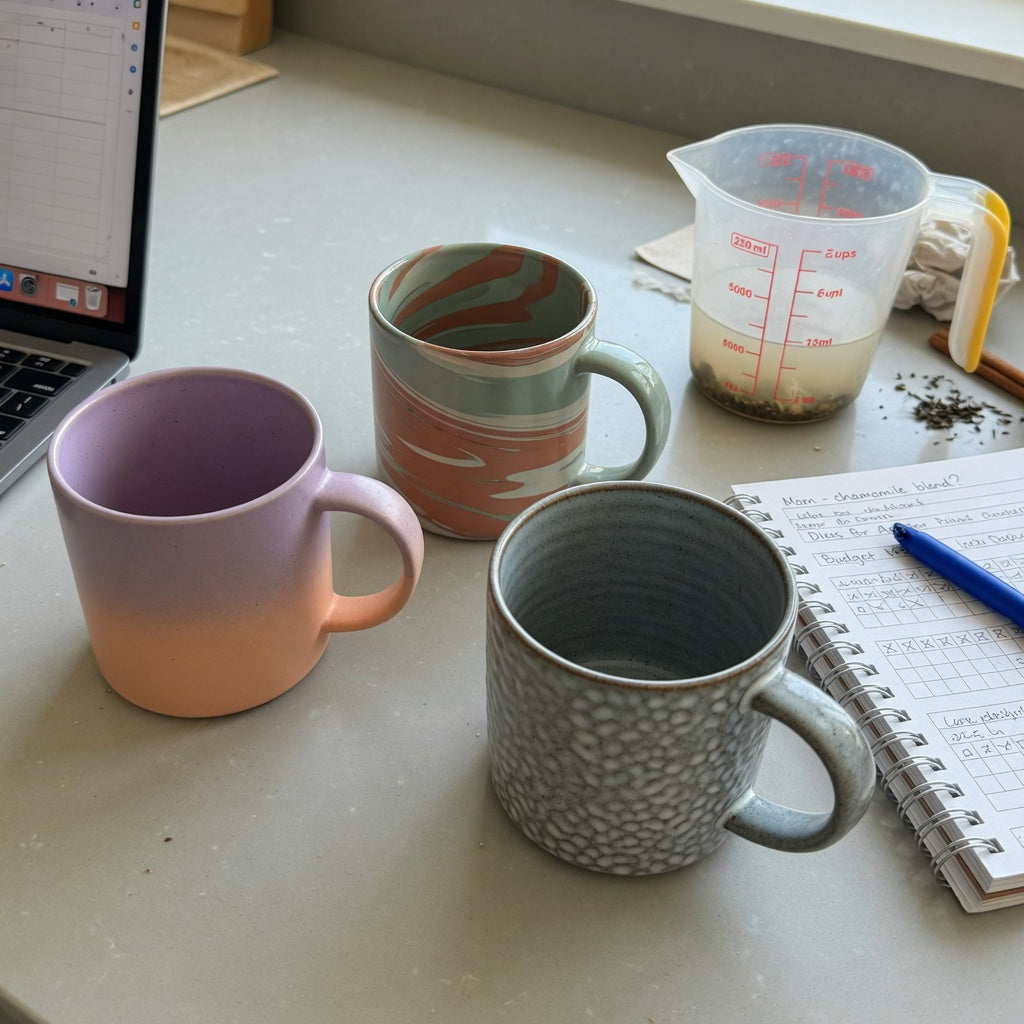
Dandelion Coffee Mug Gift Choice Product Shortlist Guide: Best Fit
Compare the 400 ml Gradient and Flow with the 480 ml Rock using the recipient's pour size, grip habits, desk space, and care expectations. Each option includes a reason to choose it, a reason to sk...
Read more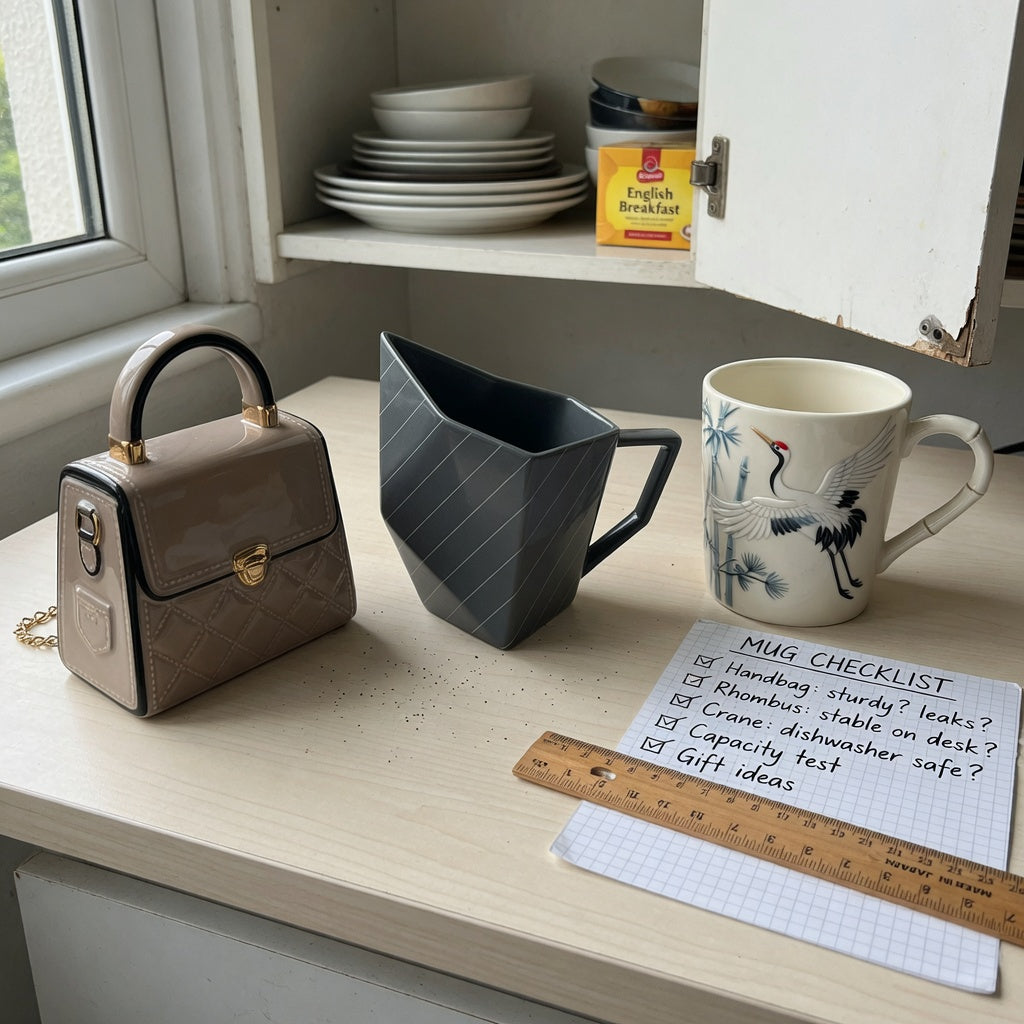
Unique Coffee Mugs for Gifts Gift Choice Practical Purchase Checklist
Match a recipient's coffee or tea routine to the Handbag, Rhombus, or Crane design. This checklist separates listing facts from the size, care, storage, grip, and unboxing details a gift buyer stil...
Read more
Leave a comment
This site is protected by hCaptcha and the hCaptcha Privacy Policy and Terms of Service apply.