
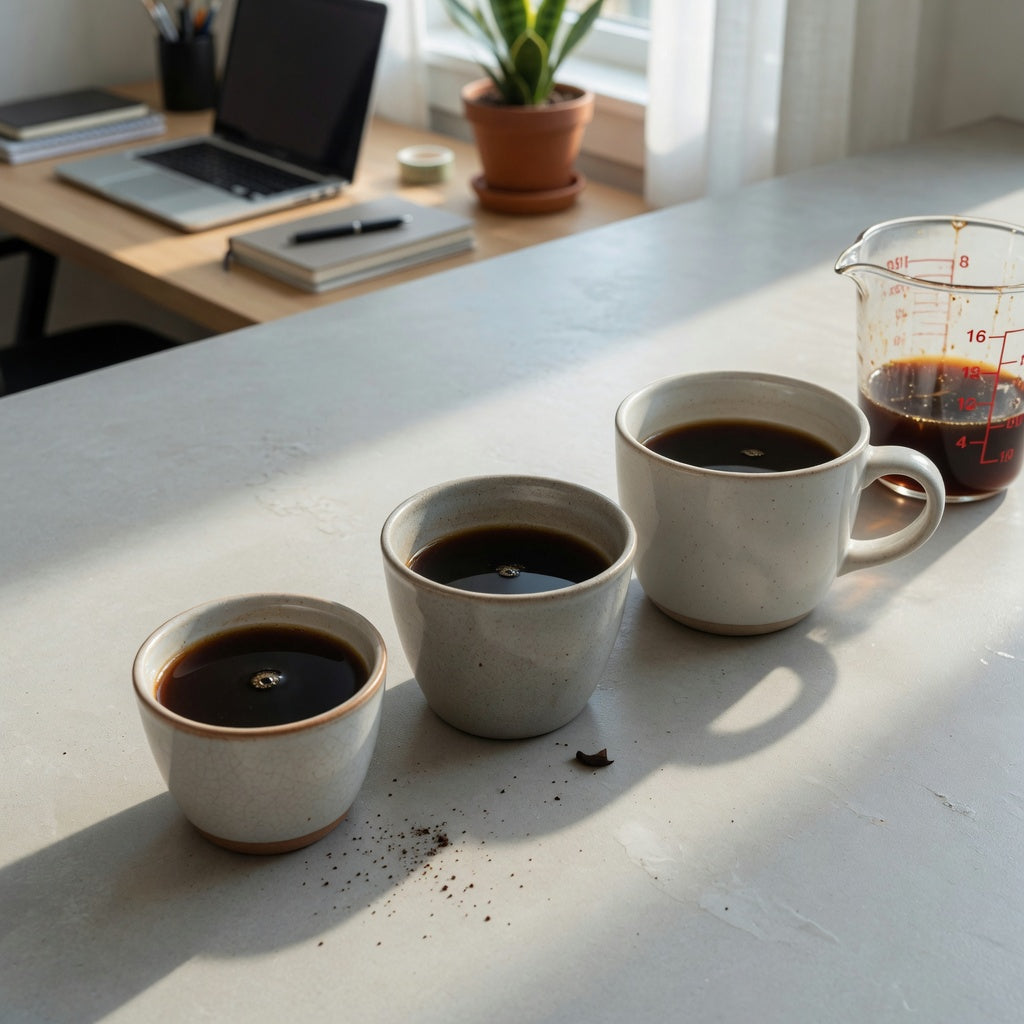
Lungo Coffee Cup Size Decision Guide: 170, 200 or 270 ml?
Reading time: about 9 minutes
A cup can look correctly sized on a product page, then feel uncomfortably full during the walk from the kitchen counter to an office desk. This lungo coffee cup size decision guide compares CoffeifyMug's three verified current capacities: the Retro at 170 ml, the Pleated at 200 ml and the Emerald at 270 ml. The useful question is not which capacity is universally correct. It is which one leaves enough unused volume above your own measured pour.
In our store, we keep this comparison deliberately narrow because capacity cannot answer every product question. We do not treat any of these figures as a universal lungo serving standard, and we do not promise compatibility with a coffee machine, shelf or cup holder. External dimensions, material, handle clearance, empty weight and care directions are separate details to confirm on the current product listing.
Using this lungo coffee cup size decision guide for headroom
For this comparison, headroom means the nominal unused capacity left after you add your total liquid. The planning calculation is simple: subtract your measured pour from the cup's listed capacity. If two cups hold the same amount of liquid, the one with the higher listed capacity has more nominal volume remaining before the stated limit.
Planning formula: listed capacity minus final measured pour equals nominal headroom.
Nominal headroom is not the same as a guaranteed vertical distance from the liquid to the rim. A cup's internal profile affects how that unused volume looks, so we do not convert the millilitre difference into a centimetre measurement or a spill-proof claim. Still, the calculation gives shoppers a consistent way to compare these three options.
- Measure the completed pour. Use a marked kitchen measuring jug rather than estimating by eye.
- Include every added liquid. Measure the amount that will actually be in the cup, not an earlier stage of preparation.
- Subtract that total from 170, 200 and 270 ml. The results show the nominal headroom available in each option.
- Consider the route. A cup that remains beside the kitchen counter may need less margin than one carried through the house to a desk.
We find this method more useful than selecting the largest number automatically. It turns the decision into a comparison based on your routine, while keeping the limitations of listed capacity clear.
When does the 170 ml Retro make practical sense?
The Retro Coffee Tea Cup is the smallest-capacity option in this comparison at 170 ml. It makes sense when your completed pour stays meaningfully below that number and you prefer a closer capacity match instead of paying for unused volume you do not expect to use. This can suit shorter seated coffee breaks and routines where refilling is not an inconvenience.
The trade-off appears as your pour approaches 170 ml. Every additional millilitre reduces the nominal margin above the liquid. If your measured total is already close to the listed capacity, the Retro is not a practical choice for someone who wants generous headroom during a kitchen-to-desk walk.
For a gift, choose the Retro only when you have a reasonable idea of the recipient's usual amount. A smaller listed capacity can look appealing in an unboxing, but appearance does not solve a mismatch between the recipient's pour and the available headroom. Capacity also does not confirm the cup's physical footprint, so check the product page if shelf or desk space is a deciding factor.
Who should choose the 200 ml Pleated middle option?
The Pleated Coffee Tea Cup has a listed capacity of 200 ml. That is 30 ml more than the Retro and 70 ml less than the Emerald. It is the logical middle choice when 170 ml leaves less headroom than you want, but your measured routine does not justify moving all the way to 270 ml.
That extra 30 ml has a clear effect when the same amount is poured into both smaller options. It becomes 30 ml of additional nominal unused capacity in the Pleated. For someone who carries a cup across a room, moves between a kitchen and home office, or occasionally varies the final amount, that middle step can offer useful flexibility without choosing the largest listed capacity.
The Pleated is not automatically the best all-purpose choice. If your completed pour sits close to 200 ml, the available margin will still be limited. If your regular amount remains comfortably below 170 ml, the additional capacity may not solve a real problem. Use the difference because your measurement supports it, not because the middle option merely feels like the safest compromise.
When is the 270 ml Emerald the useful larger option?
The Emerald Coffee Tea Mug is listed at 270 ml. It provides 70 ml more capacity than the Pleated and 100 ml more than the Retro. For the same measured pour, those differences become additional nominal headroom.
This option makes the strongest case for shoppers whose normal total sits too close to the limits of the smaller cups. It can also suit someone who wants the option of pouring more while retaining a chosen margin below the listed capacity. If that larger pour replaces a refill, it may reduce interruptions during a long period at an office desk, but that depends on how much you actually choose to add.
The Emerald is not automatically better because it has the largest number. If you normally pour a small amount and prefer a closer-fitting vessel, much of the capacity may remain unused. A higher capacity also does not prove that the mug will fit a particular shelf, machine area or crowded workspace. Check the current listing for physical dimensions and other product details before treating capacity as a fit guarantee.
What does the same 150 ml pour leave in each cup?
A 150 ml example makes the capacity differences easy to see without presenting that amount as a drink standard. It is only a sample calculation. Replace it with your own final measured volume before deciding.
| Current option | Listed capacity | Nominal headroom after 150 ml | Decision signal |
|---|---|---|---|
| Retro | 170 ml | 20 ml | A close capacity match with limited nominal margin |
| Pleated | 200 ml | 50 ml | 30 ml more margin than the Retro |
| Emerald | 270 ml | 120 ml | The most nominal margin of the three options |
This table is the arithmetic at the centre of our lungo coffee cup size decision guide. It does not recommend a 150 ml serving, predict the visible rim gap or claim that any size prevents spills. It shows how the same personal pour interacts with three verified listed capacities.
If your measured total is different, repeat the subtraction. A shopper pouring less than the example gains more nominal headroom in every cup. A shopper pouring more gains less. Once the total exceeds a listed capacity, that option is no longer suitable for holding the full amount.
Which daily habits should break a tie between 170, 200 and 270 ml?
Capacity arithmetic creates the shortlist. Your routine decides which result is actually useful. These are the practical questions we use when helping shoppers compare smaller and larger options:
- How much is in the finished cup? Measure after all liquid has been added. An incomplete measurement can push you toward a size that looks adequate on paper but leaves less headroom in use.
- How often does the cup move? A stationary cup on a dining table creates a different decision from one repeatedly carried between a kitchen counter and office desk.
- Are refills welcome or disruptive? The larger option permits a larger total amount at the same nominal headroom, but it only changes refill frequency if you use that capacity.
- Do physical dimensions matter? Do not use millilitres as a substitute for height, width, base size or handle clearance. Confirm those details on the selected product page.
- Is a specific care method required? Capacity does not indicate dishwasher or microwave suitability. Check the current care directions rather than inferring them from the product name or size.
- Is the cup a gift? A known pour habit supports a precise choice. If the recipient's routine is unclear, review the product listings and avoid presenting any one capacity as universally suitable.
The main mistake we see is trying to make one variable answer every question. Listed capacity can compare volume and nominal headroom. It cannot establish material, care compatibility, physical fit or personal comfort by itself.
A quick at-home check before ordering
You do not need specialist equipment to make a useful capacity comparison. A marked measuring jug and one normal drink preparation are enough to establish a realistic starting point.
- Prepare the amount you normally intend to put in the cup.
- Measure the complete liquid total in millilitres.
- Subtract that figure from 170, 200 and 270 ml.
- Remove any option that leaves less nominal headroom than you are comfortable carrying.
- Open the remaining product pages and verify non-capacity details such as dimensions, material and care instructions.
If your home and office routines use different amounts, run the calculation for both. You may find that one capacity covers both routines, or that two different sizes serve distinct purposes. After making the shortlist, browse CoffeifyMug's collection of unique coffee mugs to compare the current product styles without losing sight of the capacity calculation.
Frequently asked questions
How do I use the lungo coffee cup size decision guide if I do not know my pour volume?
Prepare your drink as usual, including any liquid added before you start drinking, and transfer it to a marked measuring jug. Compare that final figure with 170, 200 and 270 ml. The difference between your measurement and each listed capacity is the nominal headroom for that option.
Is a 170 ml lungo cup too small?
Not necessarily. The Retro can be practical when your measured total stays comfortably below 170 ml and you do not need a larger capacity for fewer refills. It becomes a poor fit when your regular amount approaches 170 ml and you still expect noticeable headroom.
Should I choose 200 or 270 ml for an office desk?
Choose 200 ml if it accommodates your measured pour with an acceptable margin and you are comfortable with your current refill pattern. Choose 270 ml if you need 70 ml more listed capacity for additional headroom or a larger total amount. Check the product dimensions separately because capacity does not guarantee desk fit.
Does a 270 ml cup always provide more headroom than a 170 ml cup?
For the same amount of liquid, the 270 ml Emerald provides 100 ml more nominal unused capacity than the 170 ml Retro. The visible vertical gap can still differ with the internal shape of each cup. No amount of listed headroom makes a cup spill-proof during movement.
Where can I compare the current 170, 200 and 270 ml options?
Start with CoffeifyMug's current coffee mug collection. Bring your measured pour figure, compare it with 170, 200 and 270 ml, and shortlist only the options that leave your preferred nominal headroom. Then verify the remaining physical and care details on the individual product page before ordering.
More from our blog
Read more
Cafe Au Lait Mug Size Decision Guide: 400, 440, or 480 ml
Compare CoffeifyMug's 400, 440, and 480 ml options using your measured pour, preferred headspace, handle comfort, available space, and refill habits.
Read more
Ceramic Glazed Coffee Mugs Size Decision Guide: 400-480 ml
Compare CoffeifyMug's listed 400 ml, 440 ml, and 480 ml glazed ceramic mugs by measured pour, headroom, storage, desk fit, care, and gifting. See where each capacity helps and where size alone cann...
Read more
Leave a comment
This site is protected by hCaptcha and the hCaptcha Privacy Policy and Terms of Service apply.