
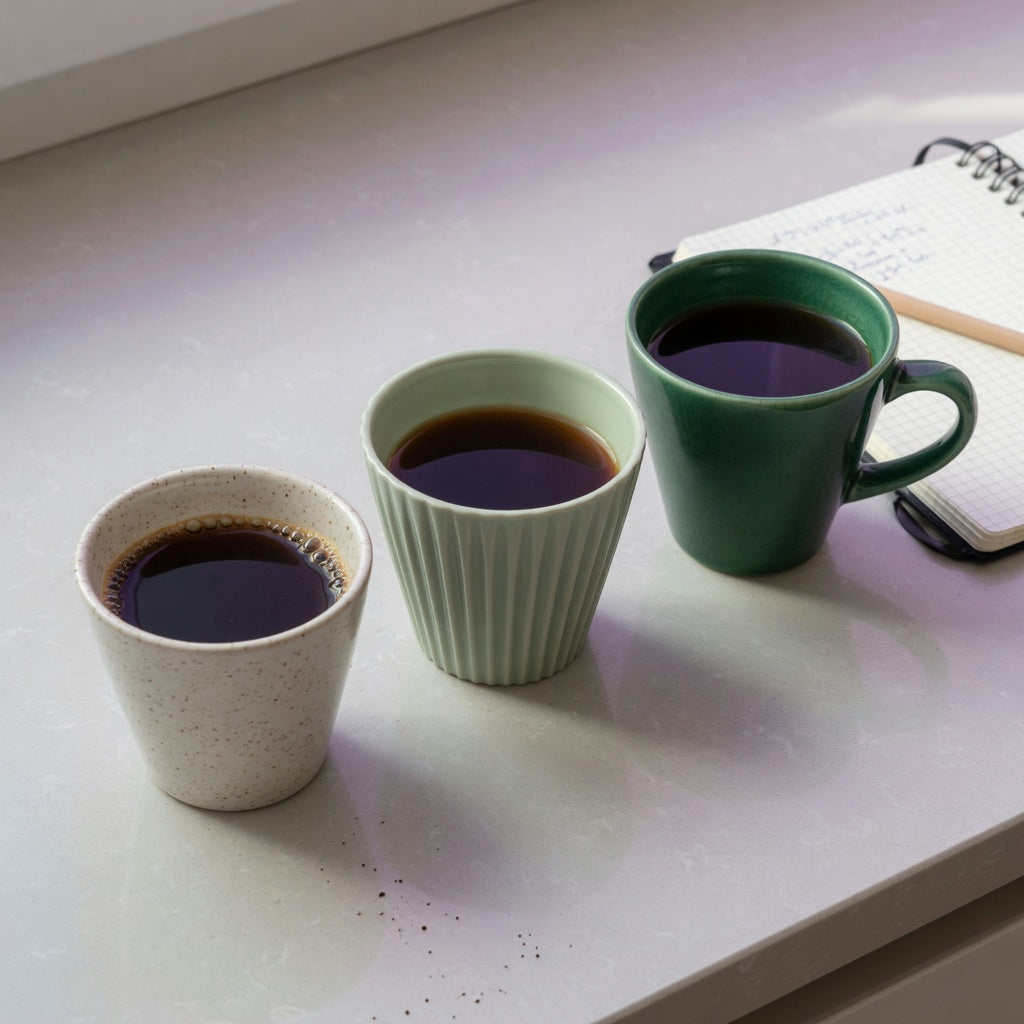
Lungo Coffee Cup First Time Buyer Product Shortlist Guide
Reading time: about 9 minutes
A cup can look roomy in a product photo and still feel uncomfortably full during the walk from a kitchen counter to an office desk. The deciding number is not a generic lungo size. It is your completed pour compared with the cup's listed capacity. This lungo coffee cup first time buyer product shortlist guide uses only the catalog facts we can verify: Retro 170 ml, Pleated 200 ml, and Emerald 270 ml. Headroom is treated as a personal planning margin, not a promised fill line.
In our store, the mismatch we work hardest to prevent is a shopper choosing by appearance before checking volume. Because we handle and sell this category, our team separates verified specifications from assumptions. We do not claim a universal lungo volume, coffee-machine fit, spill resistance, heat retention, or drink-specific performance for any of these cups.
Which facts belong on a first-purchase lungo shortlist?
A useful shortlist starts with your routine, not an estimated serving size from someone else's kitchen. Record four details before comparing products.
- Your completed drink volume. Prepare the drink exactly as you normally serve it, including water, milk, or other additions made after brewing. Measure the result in a heat-safe graduated vessel.
- The cup's listed capacity. The verified values in this group are 170 ml, 200 ml, and 270 ml. We treat those as listing values, not recommended fill targets.
- Your preferred volume margin. A cup carried past a doorway or up stairs may call for more unused capacity than one that stays beside the coffee station.
- Your purchase blockers. Material, external dimensions, care directions, handle clearance, and included pieces matter, but they cannot be used as comparison facts unless the current listing states them.
Shortlist calculation: listed capacity minus your measured completed drink equals a nominal volume margin. It does not equal a measured distance from the coffee surface to the rim, and it does not guarantee protection from spills.
Product photos can help with style, but they are not rulers. A photo cannot establish height, widest diameter, base diameter, empty weight, material composition, or appliance-safe care. If one of those details controls your purchase, verify it on the current product page or ask our store before ordering.
170 ml, 200 ml, and 270 ml: what changes for the same pour?
The three options form clear capacity steps. The Pleated adds 30 ml over the Retro. The Emerald adds another 70 ml over the Pleated and 100 ml over the Retro. Those differences are the basis of this comparison.
| Option | Verified listed capacity | Position in the shortlist | Reason to keep it | Reason to remove it |
|---|---|---|---|---|
| Retro | 170 ml | Lowest listed capacity | Your completed drink sits comfortably below 170 ml and you prefer less unused capacity | Your drink approaches 170 ml or varies after additions |
| Pleated | 200 ml | 30 ml above Retro and 70 ml below Emerald | You need more nominal margin than 170 ml provides without moving directly to 270 ml | Your completed drink sits close to 200 ml or you want a much larger buffer |
| Emerald | 270 ml | Highest listed capacity | You need the largest nominal volume margin among these three options | You prefer capacity closer to a smaller measured drink or require verified outer dimensions |
Consider a purely personal example. If your completed drink measures 150 ml, subtracting it from the listed capacities leaves nominal margins of 20 ml in the Retro, 50 ml in the Pleated, and 120 ml in the Emerald. That arithmetic does not make 150 ml a standard lungo serving, nor does it describe the physical gap at the rim. Cup geometry affects visible headspace, and the supplied facts do not include the measurements needed to compare that geometry.
Lungo coffee cup first time buyer product shortlist guide for three routines
Each recommendation below starts with a real use situation, explains why the capacity fits, and states the reason to skip it. Measure first. Then open the matching product page.
A measured shorter pour that stays near the coffee station
Your final drink consistently sits below 170 ml, and the cup normally stays on the kitchen counter or a nearby table. Put the Retro 170 ml coffee and tea cup on the shortlist because it has the lowest listed capacity of the three. Choose it if your calculation still leaves the margin you want. Skip it if your volume is close to 170 ml, changes from day to day, or includes additions you have not measured.
A changing morning pour carried to an office desk
Your completed drink varies slightly, or the 170 ml calculation leaves less margin than you want for the walk to your desk. The Pleated 200 ml coffee and tea cup is the rational middle option because it adds 30 ml of listed capacity over the Retro without moving to 270 ml. Choose it when your measured total fits below 200 ml with your preferred buffer. Skip it if your drink regularly approaches that capacity. The extra volume does not make the cup spillproof.
A larger completed drink with every addition counted
Your usual drink and all additions are already measured, and 200 ml does not leave enough nominal margin. The Emerald 270 ml coffee and tea mug supplies the highest listed capacity in this shortlist, adding 70 ml over the Pleated. Choose it for that numerical buffer. Skip it if your drink is much smaller and you prefer a closer capacity match, or if shelf fit depends on external measurements that the supplied facts do not verify.
Office desks, tight kitchen shelves, and gifts: which check rules a cup out?
- For an office desk: measure the drink after every addition and consider the actual route from the coffee station. If the Retro leaves a narrow calculated margin, move to the Pleated or Emerald based on your numbers. Capacity can create more unused volume, but it cannot prevent a spill.
- For a tight kitchen shelf: do not translate milliliters into height or width. A 270 ml cup may differ physically from a 170 ml cup, but capacity alone cannot tell you by how much. If the current product page does not provide the dimensions you need, none of the three can be given a shelf-fit guarantee.
- For a gift: ask about the recipient's usual drink volume and care habits before choosing. If those details are unknown and visual style matters more than a close capacity match, start with the unique coffee mugs collection, then verify the selected listing rather than guessing during gift unboxing.
A missing specification is not automatically a problem. It becomes a problem when that specification controls your decision. Someone with an open shelf may accept unknown outer dimensions; a buyer working with a fixed cabinet opening should not.
Material, millimeter dimensions, and care: which unknowns can stop the order?
The verified source facts for this comparison do not establish material composition, height, rim diameter, base diameter, empty weight, wall thickness, handle clearance, dishwasher compatibility, or microwave compatibility. We will not infer those details from a glossy finish, a product name, or a photograph.
- Before checkout, read the current listing. Look for explicit material, dimensions, piece count, and care directions. Ask our store if a detail you need is missing.
- During unboxing, inspect the drinking rim. Set aside a cup with a visible chip, sharp edge, or crack before using it.
- Check the handle attachment. Look at both points where the handle meets the body. A visible hairline crack at either joint deserves attention before the cup is filled.
- Test the base on a flat, dry counter. The empty cup should sit steadily rather than rock. This is a receiving check for any cup, not a claim that these products have a known defect.
- Read the care line before the first wash. If dishwasher or microwave compatibility is not stated, ask before using either appliance. A first dishwasher cycle is not a useful compatibility test.
These checks protect the purchase without inventing performance claims. They also separate a capacity mismatch, which can be prevented before ordering, from an arrival issue that should be handled under the store's current policy.
When does a different mug style make more sense?
Leave this three-cup shortlist if your measured drink falls outside the useful range for all three, or if style, material, exact dimensions, or care instructions matter more than the verified capacity comparison. The CoffeifyMug unique coffee mugs collection gives you other designs to inspect, but the collection page itself is not proof of a specific feature. Open each product listing and repeat the same verification process.
This shortlist is not suitable for a buyer who requires a coffee-machine clearance guarantee, exact stackability, a lid or saucer, a published heat-retention result, or confirmed appliance compatibility. None of the supplied facts supports those promises. A different cup style with the required specification stated plainly would suit that buyer better.
Your two-minute decision check before checkout
- Measure your normal completed drink in milliliters. If the routine varies, record both a smaller and larger day.
- Subtract that volume from 170 ml, 200 ml, and 270 ml.
- Remove any option that does not leave your preferred nominal margin.
- Verify material, external dimensions, care directions, included pieces, and the current store policy if any of them affect the purchase.
- Keep one primary option and one backup. The primary should match your measured routine; the backup should solve the clearest limitation of the first.
Use the lungo coffee cup first time buyer product shortlist guide as a filter, not a fit or performance promise. Open the matching Retro, Pleated, or Emerald page above. If every option leaves a capacity or specification problem, return to the collection and compare only listings that answer the missing question.
Frequently asked questions
What capacity should a first-time lungo cup buyer choose?
There is no universal capacity that suits every lungo routine. Measure your completed drink, including additions, and compare it with 170 ml, 200 ml, and 270 ml. Choose the smallest option that still leaves the personal volume margin you want.
How do I calculate headroom from a listed cup capacity?
Subtract your completed drink volume from the listed capacity to estimate a nominal volume margin. For a 150 ml drink, the calculation leaves 20 ml in the Retro, 50 ml in the Pleated, and 120 ml in the Emerald. This does not measure the physical distance to the rim or guarantee spill resistance.
Does the lungo coffee cup first time buyer product shortlist guide guarantee coffee-machine fit?
No. Machine fit depends on external cup dimensions and the available equipment clearance, neither of which is established by capacity alone. Verify both measurements before buying if the cup must sit beneath specific equipment.
Are the Retro, Pleated, and Emerald cups dishwasher- or microwave-safe?
The verified facts supplied for this comparison do not establish dishwasher or microwave compatibility. Read the current care instructions on the selected product page or ask our store before using either appliance. Do not infer appliance safety from the cup's appearance.
What should I do if none of the three capacities works?
Do not force a choice simply because the shortlist is short. Write down the capacity or specification you still need, then browse the unique coffee mugs collection. Open only the listings that can be checked against that requirement before checkout.
More from our blog
Read more
Oversized Ceramic Coffee Mugs First Time Buyer Product Shortlist Guide
First-time buyers can compare machine clearance, handle fit, ceramic care, and three CoffeifyMug styles. This shortlist also flags every detail that should remain an unknown unless the current prod...
Read more
Green Ceramic Coffee Mugs First Time Buyer Product Shortlist Guide
Build a first-purchase shortlist around stated capacity, handle clearance, base footprint, cabinet fit, glaze, and care instructions. We compare three CoffeifyMug listings by scenario while clearly...
Read more
Leave a comment
This site is protected by hCaptcha and the hCaptcha Privacy Policy and Terms of Service apply.