
Large Unique Coffee Mugs First Time Buyer Product Shortlist Guide
Reading time: about 9 minutes
A mug can look generously sized in a product photo and still fail at 7:30 the next morning. It catches under the coffee machine, crowds the keyboard, or leaves too little room for your fingers once it is full. That is the job of a large unique coffee mugs first time buyer product shortlist guide: turn an appealing product page into a set of practical fit checks before the first brew.
We use that sequence in our store because dimensions, handling, and care usually determine whether a distinctive mug becomes a daily favorite or stays at the back of the cabinet. Start by opening our current collection of unique coffee mugs, then compare only the candidates that suit your primary setting. The measurement, material, and care advice below is general category guidance. The linked product page remains the source of truth for each mug's current specifications.
How should a large unique coffee mugs first time buyer product shortlist guide narrow the field?
A useful shortlist does not begin by ranking colors. It begins with one real use case and a few non-negotiable constraints. For a first purchase, we recommend reducing the decision to two or three mugs through this order:
- Name the setting. Decide where the mug will spend most of its time: beside a keyboard, under a coffee machine, on an open kitchen shelf, or inside a gift box.
- Record the physical limits. Measure available height, desk footprint, cabinet depth, and the dimensions of a mug handle that already feels comfortable.
- Verify the listing. Look for stated capacity, overall dimensions, material, care instructions, and clear photos of the rim, handle, base, and decoration.
- Remove unresolved risks. If microwave use or low-shelf clearance is essential and the page does not answer that question, contact the store or remove the mug from the shortlist.
The practical value of a large unique coffee mugs first time buyer product shortlist guide is that an unknown becomes a reason to pause, not an invitation to guess. Style should break a tie between compatible options. It should not hide a fit problem.
Which dimensions decide desk, cabinet, and coffee-machine fit?
Product photos can show proportions, but they cannot tell you how the mug relates to your shelf or hand. Measure a mug that already works in your space and compare these fields on each listing:
| Listing detail | What to confirm | Real-world test |
|---|---|---|
| Capacity | An explicit ounce or milliliter figure, plus any indication of whether it is brim capacity. | Compare it with the amount you normally pour, leaving room for carrying, milk, or foam. |
| Overall height | The distance from the base to the highest point. | Measure from an espresso-machine drip tray to the spout and from a counter to the shelf above it. |
| Base and widest point | Base diameter and total width including the handle or sculpted details. | Check the space beside your keyboard, coaster, mug warmer, or other mugs in the cabinet. |
| Handle opening | Interior height and width if provided, not just the outside shape. | Compare it with a handle that accommodates your usual two-finger, three-finger, or full-hand grip. |
| Empty weight | The mug's dry weight when the listing provides it. | Remember that the drink adds more weight. This matters for one-handed lifting and wrist comfort. |
If a critical measurement is absent, call it unknown. A hand in a lifestyle photo is not a measuring scale, and a close camera angle can make a moderate mug look much larger. Tight cabinets, compact brewers, and crowded desks require actual dimensions.
What should material, glaze, and care wording tell you?
Material terminology affects weight, heat retention, surface feel, and care, but buyers should use only the wording stated on the product page. These are the details our team checks before recommending any mug for frequent use:
- Body material: Ceramic is a broad category. If a listing says only ceramic, it does not tell you whether the body is stoneware, porcelain, earthenware, or another ceramic type.
- Glazed and unglazed areas: Look closely at the rim, interior, handle, and foot ring. A rough exposed foot can mark a delicate desk, while textured exteriors may require more attention during hand washing.
- Microwave guidance: Use the microwave only when the current listing explicitly permits it. Color alone cannot reveal the composition of a decorative finish.
- Dishwasher guidance: Confirm a dishwasher statement rather than assuming all mugs share the same care. Sculpted recesses and deep foot rings can also retain rinse water and may need to be tipped out before storage.
- Decoration: A golden-looking accent does not automatically mean real gold or metallic content. It is still a reason to verify the care instructions if reheating is part of your routine.
Distinctive profiles also tend to be less predictable for stacking than plain cylinders. That is a category trade-off, not a claim about every mug in this shortlist. If nesting, microwave reheating, or automatic dishwasher cleaning is a daily requirement, make those pass-or-fail checks before choosing a design.
Which of these three mugs matches your actual use case?
Product-specific rule: use each linked page for current capacity, dimensions, material, and care. A product name and its photos can guide a style decision, but they should never be used to invent performance details.
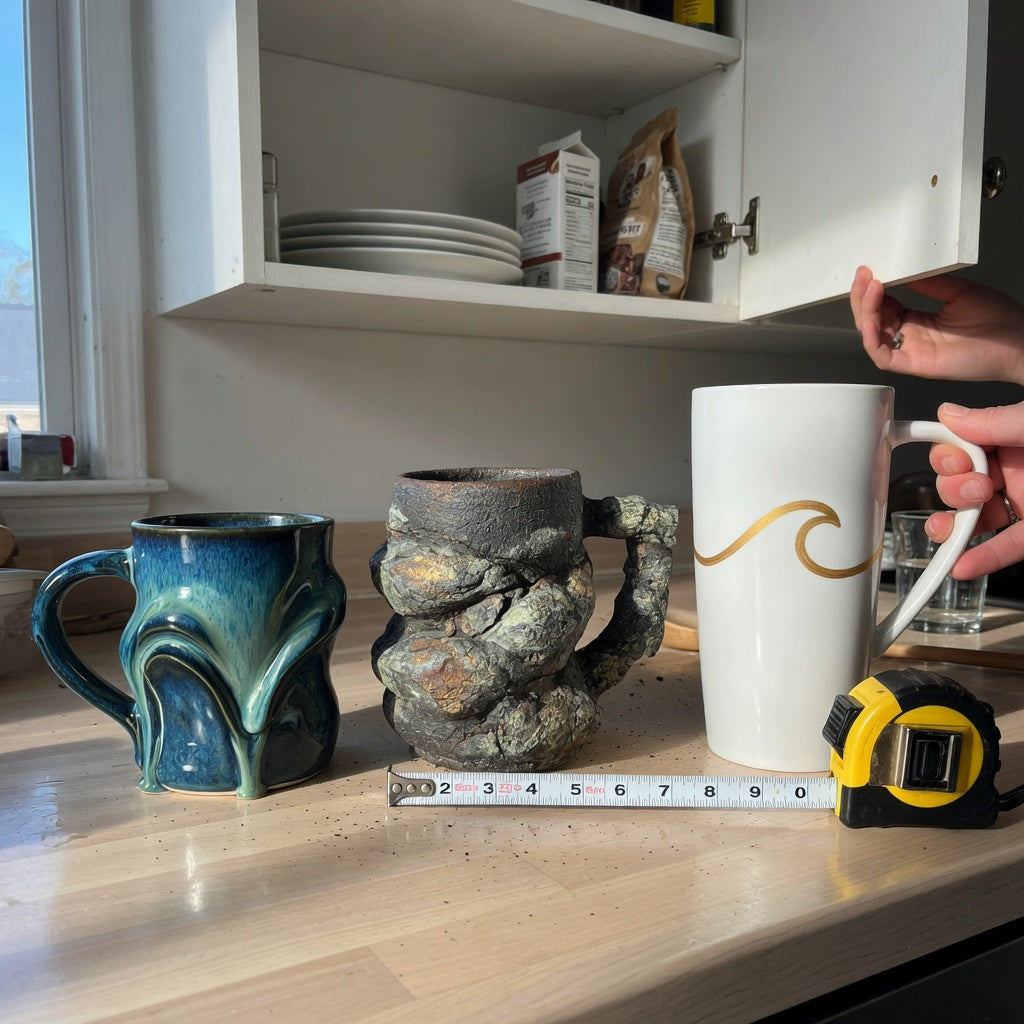
The Flow: a style-first candidate for daily use
Reader situation: You want a distinctive mug for a desk or open kitchen counter, and the visual treatment shown on The Flow product page is the main reason it caught your attention.
Why it makes the shortlist: It gives you a design-led candidate to compare against more thematic or taller options. Choose it if the current capacity, total width, handle clearance, and care directions all fit your routine. Skip it if you need guaranteed stackability, travel features, or a specific care method that the listing does not confirm. The word Flow does not establish volume, weight, or handling by itself.
The Rock: for a buyer who wants a stronger visual theme
Reader situation: You are shopping for a statement mug or a gift, and a rock-referenced design suits the recipient better than a conventional cylindrical cup.
Why it makes the shortlist: The current listing for The Rock gives you a clearly themed option to inspect. Choose it if the page's photos and stated specifications match the recipient's grip, storage space, and cleaning habits. Skip it for someone who prefers understated matching tableware or needs a mug that nests with an existing set. Do not infer extra weight, stability, or durability from the name Rock; those points require stated specifications.
White Golden Waves Tall: for open vertical space and a tall look
Reader situation: You specifically want a tall mug with a white and golden-wave presentation, and you have room beneath the shelf or brewer where it will be used.
Why it makes the shortlist: The name of the White Golden Waves Tall Coffee Tea Mug identifies the tall format and visible style cues without requiring us to infer them. Choose it after confirming exact height, capacity, handle fit, and care on the page. Skip it if vertical clearance is tight, you rely on stacking, or microwave use is mandatory and the listing does not explicitly approve it. Golden describes the design; it does not by itself establish the decoration's material.
What should you inspect before the first coffee or dishwasher cycle?
An unboxing check takes a few minutes and is easier before the mug has been used. We follow the same basic routine for a personal order and for a mug that will be wrapped as a gift:
- Set it on a flat, dry counter. Check for unexpected rocking and inspect the base for debris or a rough patch that could scratch the surface.
- Use bright side lighting. Examine the rim, interior, handle junctions, and base for chips, hairline cracks, glaze crazing, unexpected pinholes, or exposed sharp areas.
- Test the empty grip. Make sure your fingers clear the handle and that decorative details do not press into your knuckles.
- Fill it with cool water over a sink. Use your normal drink level, then test lifting, carrying, and setting it down. This reveals balance and filled weight without starting with a hot drink.
- Read the care directions again. Do not use a microwave or dishwasher as an experiment when the listing or packaging leaves that care method unresolved.
For a gift, perform the visual and stability checks before wrapping. A dramatic unboxing loses its value if the recipient immediately finds a chipped rim or discovers that the mug will not fit beneath the machine they use every morning.
Which unknowns should remove a mug from your shortlist?
Not every missing detail carries the same risk. Match the unknown to your routine and decide before ordering:
- Remove the mug now if height is unknown and your brewer clearance is tight, or if microwave safety is unconfirmed and reheating is essential.
- Ask before buying if capacity, material, handle dimensions, or care wording will materially affect daily use.
- Keep it as a style candidate if all practical requirements pass and the only remaining decision is between visual designs.
- Choose another product category if you need a locking lid, car cup-holder fit, backpack transport, or reliable nesting. A travel mug or standard stackable cup is better suited to those jobs.
If none of the three options clears your must-have checks, return to the broader unique mug selection. That is a useful result. A shortlist is supposed to remove poor fits, not force a winner.
Frequently asked questions
What should a first-time buyer verify before choosing a large unique coffee mug?
A large unique coffee mugs first time buyer product shortlist guide should verify capacity, overall height, base and total width, handle clearance, material wording, and care instructions. Start with the detail most likely to make the mug unusable in your setting, such as brewer clearance or microwave compatibility.
How large should my first oversized coffee mug be?
There is no universal best capacity. Measure the comfortable fill of a mug you already use, then look for an explicit ounce or milliliter figure on the candidate's page. If the listing does not distinguish brim capacity from a practical fill, leave room for carrying, milk, or foam.
Can I microwave a mug with golden decoration?
Only use it in a microwave if the product page or supplied care information explicitly says that you can. The word golden describes appearance and does not prove what the decoration contains. If microwave guidance is absent, do not infer compatibility from the photos.
Is The Flow or The Rock better for a small office desk?
The names alone cannot answer that question. Compare each listing's base diameter, total width including the handle, empty weight, and stated capacity against the free area beside your keyboard. Rock does not automatically mean stable, and Flow does not automatically mean lightweight.
Are these mugs suitable for stacking or travel?
Do not assume that a unique profile will stack or fit a vehicle cup holder. If nesting, a spill-resistant lid, or bag transport is essential, choose a product page that explicitly shows and states those features. A standard travel mug will usually be the more practical category.
For the final comparison, record five things from a mug that already works: comfortable fill, overall height, base width, widest width with the handle, and required care method. Apply those numbers to one candidate page at a time, or compare the full unique coffee mug collection, and buy only after every must-have field has a clear answer.
More from our blog
Read more
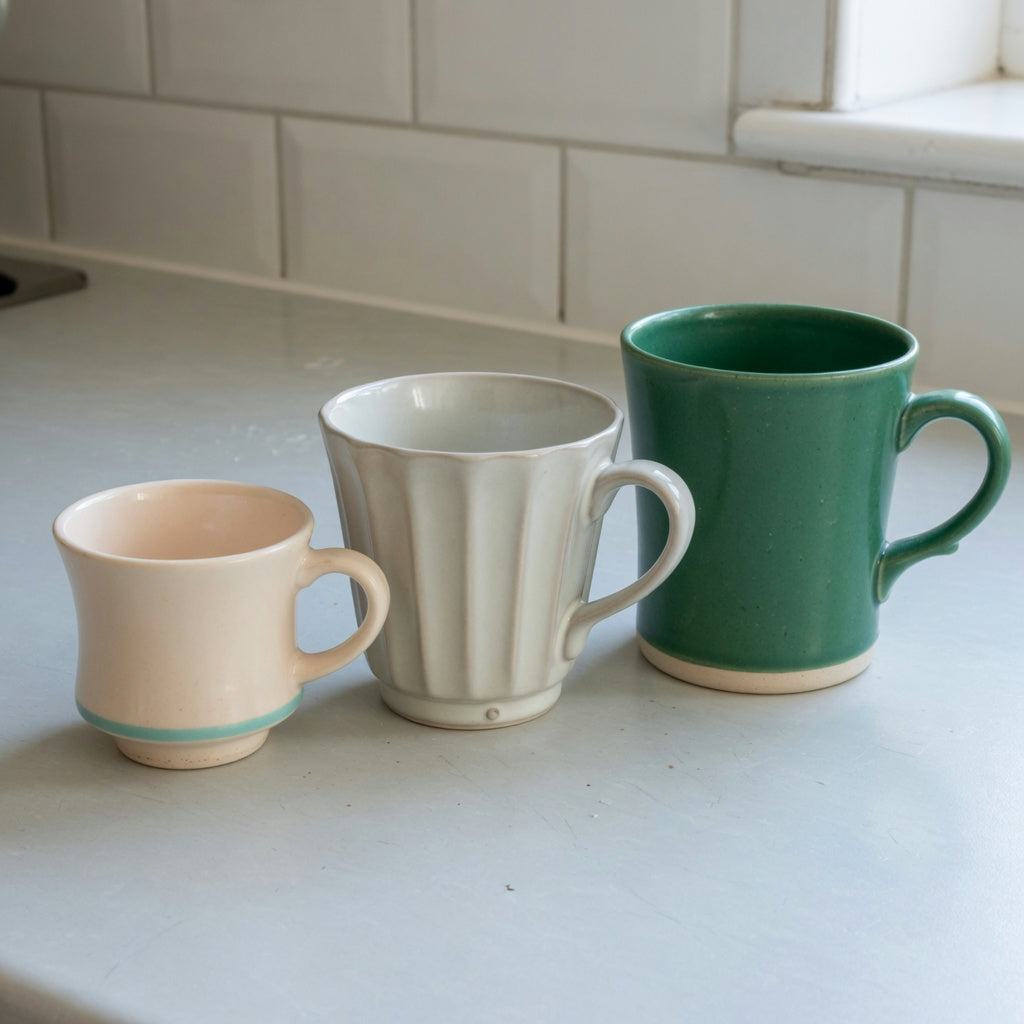
Eggnog Mug First Time Buyer Product Shortlist Guide: 3 Sizes
Compare the verified Retro 170 ml, Pleated 200 ml, and Emerald 270 ml options by stated capacity, visible shape, and actual serving scenario. This shortlist also flags material, dimensions, care, a...
Read more
Vintage Pottery Coffee Mugs First Time Buyer Product Shortlist Guide
A practical filter for checking capacity, dimensions, handle fit, care instructions, and finish before buying. Compare three CoffeifyMug styles by kitchen, desk, and gift use, with clear reasons to...
Read more
Leave a comment
This site is protected by hCaptcha and the hCaptcha Privacy Policy and Terms of Service apply.