
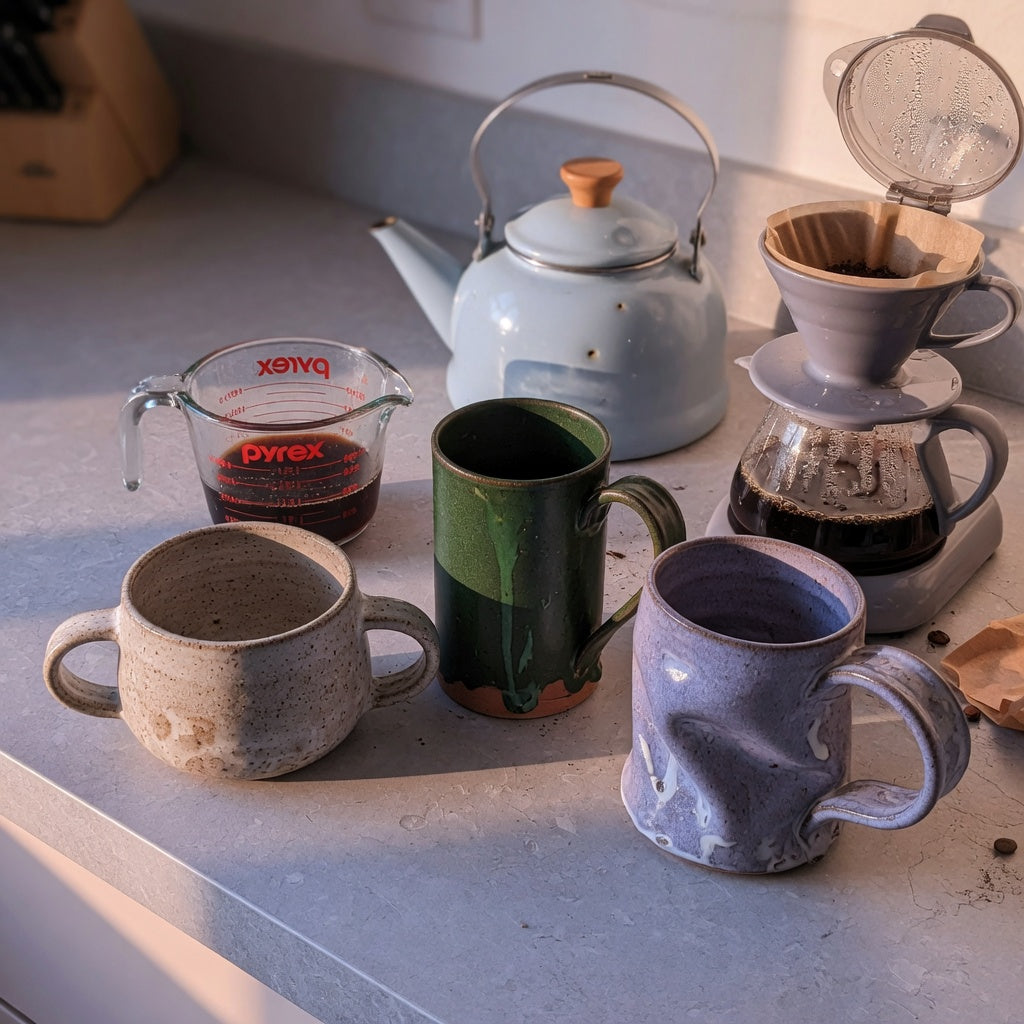
Large Unique Ceramic Coffee Mugs: What to Compare First
Reading time: about 13 minutes
Large unique ceramic coffee mugs disappoint people at our counter in a familiar order: the single-serve lid stops short of the rim, a handle that looked generous in the photo takes only two fingers, and the walk back to the desk ends with coffee on a wrist. The listing looked generous. The kitchen did not agree.
Shoppers using that search are usually comparing oversized ceramic, stoneware, or porcelain cups, often handmade or finished in reactive and kiln-altered glazes so no two pieces look identical. Category listings commonly mention capacities from the high teens into the high 20s of ounces, big handles, microwave and dishwasher lines, and gift use. None of those words tells you the comfortable pour, the full weight, or whether the inside surface is meant for a daily hot drink. Our team keeps that general guidance separate from any one product page. Only the current listing can state a number, a dimension, or a care symbol.
How much of a printed ounce count survives milk and a desk walk?
Ceramic capacity is usually measured to the brim, or very near it. A drink you can carry stops short of that line. You need headspace so the surface does not slosh, and more room if you add milk, creamer, or ice. A mug listed in the low 20s can drink like an ordinary large cup once that margin is gone. A mug in the high 20s can still be the right call if you take coffee black and want one long pour instead of a refill.
In our experience, the complaint is rarely that the mug is tiny. It is that the mug is full before the drink is finished the way that person makes it. On any current page, separate three ideas:
- Brim capacity versus drinking fill. If the page gives one ounce figure, treat it as a maximum until the listing says otherwise.
- What you add. Creamer, oat milk, and ice all take volume. Soup, oatmeal, and cereal need still more freeboard so a spoon does not push liquid over the rim.
- How you carry it. A wide, full mug spills more easily than a narrower one with the same ounce claim. Rim diameter matters as much as the number.
There is no single published gap between brim and sip that we can honestly subtract for every shape. Pour your usual drink into a measuring cup once. That personal number beats a lifestyle photo. If you already own a diner mug you like, set the two rims side by side when the new one arrives. Jumbo ounces often hide in width, not in an extra inch of height, and width is what sloshes.
Handle opening, full weight, and which listing to open first
Large is not one shape. A wide bowl, a tall cylinder, and a sculptural body can share a similar ounce claim and feel nothing alike once they hold hot coffee. Weight stacks quickly. Clay plus a high-teen or 20-plus ounce fill is a real lift for a smaller hand, a sore wrist, or a long walk from the kitchen. A big handle opening helps a large hand only when the grip is thick enough to feel secure and the join looks sound when the mug is full. Hairline cracks like to start at the upper handle attachment. We cannot judge that from a styled photograph.
If you are already in our unique coffee mugs collection, these three listings are comparison points, not sizes we are assigning from the outside. Open the page and verify every spec there:
- A daily coffee or tea mug, starting with The Flow. Read The Flow coffee and tea mug for capacity, height, handle opening, material wording, and the care line. If one of those is missing, the page has not answered that question yet.
- A second silhouette, and weight is the worry. Open The Rock coffee and tea mug and ask the same questions. If you need a light cup to carry across an office all morning, do not assume this listing, or any oversized ceramic cup, is that mug until weight and capacity are printed. Ceramic is a poor car-console and backpack material either way.
- The brewer is the constraint. Start with the White Golden Waves tall coffee and tea mug. The word tall is in the name, so height is the first figure to find on that page. It is not a measurement we can supply from here. Compare your brewer gap and your shelf with the printed height. If height is missing, pause.
None of these should be treated as a travel cup, and none is cup-holder ready just because the photo looks sturdy. A mug that lives on an open counter can be heavier and wider than one that has to ride in a bag. If the hand, the shelf, and the machine do not match any of those three, keep browsing the collection instead of forcing a silhouette.
Why ceramic, stoneware, and porcelain names do not predict heat
Shoppers treat those words like performance grades. They are clay and firing families, and marketing uses them loosely. Porcelain is often fired hotter and can look thinner at the rim. Stoneware is a common body for heavier everyday mugs. Ceramic covers both, plus other clay bodies. None of those names, alone, tells you wall thickness, whether the outside will burn a hand, or how long coffee stays warm.
Heat in the hand is a different problem from heat in the drink. A full oversized mug presses a lot of hot liquid against the wall. After a boiling pour, or after a short microwave cycle, the exterior and even the handle can be uncomfortable. Some pieces feel fine. Some do not. Pages rarely measure that, so we treat a comfortable handle as a day-one test, not a guarantee. If you cannot hold it, it is not a daily driver, however good the glaze looks on the shelf.
What these bodies are not good for is thermal shock. A cold mug moved straight into high heat, or boiling water poured into a cup that just came in from a winter car, is how crazing, cracks, and loose handles start. Crazing is that fine crackle in the glaze. It looks delicate, then stains with coffee. Follow the maker's temperature guidance. If the page is silent, do not invent a safe range, and do not use the mug as a mini baking dish.
Microwave, dishwasher, metallic trim, and food contact
Buyers fold these into one sentence. They fail in different ways, and a unique or handmade finish can pass one and miss another.
- Microwave. Look for an explicit microwave-safe line. Gold, platinum, luster, and other metallic decoration can spark or scorch. Handmade does not mean unsafe, and it does not mean safe. If the page does not say, do not microwave it.
- Dishwasher. Alkaline detergent and a crowded heated cycle are hard on glaze, especially reactive color and raised texture. Hand washing is slower and usually kinder. If you will not hand wash, buy only what the maker marks dishwasher safe, and still expect a glossy unique surface to dull sooner than a plain commercial diner mug.
- Food-contact safety. This is about what can move from the glaze into coffee, not about whether the mug survives a cycle. A microwave symbol does not answer it.
Coffee staining on a pale interior is normal with daily use. A scratchy pad makes it worse. A matte interior or an unglazed rim holds oils and is harder to get fully clean, so those surfaces are a weaker choice if several people share one mug. An unglazed foot ring can also scratch a wood counter if you slide a heavy cup across it. Decorative ware is another category. Under 21 CFR 109.16, ceramic that looks usable for food but is only ornamental has to be permanently marked not for food use, with specified warning language, or it has to have a hole through the potential food-contact surface. If you see that warning or that hole, it is not a coffee mug. Do not use it for tea either.
Why large unique ceramic coffee mugs rarely match the photo
Unique, on a ceramic mug, usually means the glaze was allowed to move. Reactive glazes and kiln-altered finishes change with temperature, kiln atmosphere, and where the piece sat in the firing. The same batch can come out lighter, darker, or more mottled than the hero photo. When the maker says variation is part of the piece, a different color is not automatically a shipping error. It becomes a problem when a gift had to be one exact color and nobody warned the giver.
That is the practical meaning of large unique ceramic coffee mugs with a reactive finish: you are buying a firing result, not a printed pattern. Read for a variation note before you order. If you want a pair, ask whether both can come from the same firing, and accept that matching may still mean cousins rather than twins. Speckle, running glaze, and thin raised lips also chip at the high points first. A delicate rim is a poor fit for a cupboard where cups are stacked rim-down. A beautiful exterior does not replace height, handle, or food-use wording.
A lead-free sticker versus the leach limits that apply
We would rather answer this with documentation than with a slogan. The FDA action level for lead in ceramic cups and mugs is 0.5 micrograms per milliliter of leaching solution. That cups-and-mugs guideline is applied to any one of six units, and the referenced methods include ASTM C738 and specified AOAC procedures. The agency describes cups and mugs as small ceramic hollowware commonly used for coffee or tea above room temperature, normally holding about 8 fluid ounces (240 mL), usually with a handle. That typical size does not put a jumbo mug outside the lead question.
Capacity changes the bucket. Small hollowware means a ceramic article deeper than 25 mm with a capacity under 1.1 liters. Large hollowware means 1.1 liters or more. That line is a bit over 37 US fluid ounces, so a mug in the high teens or 20s can feel huge and still sit under it. Cadmium limits split the same way: 0.5 µg/mL of leaching solution for ceramic small hollowware, and 0.25 µg/mL for ceramic large hollowware, each applied to any one of six units. If brim capacity crosses 1.1 liters, the large-hollowware cadmium figure is the one that applies. Read the listing before you guess which side you are on.
Lead can leach from a ceramic food-contact surface into food and, with continued use, can cause adverse health effects, including chronic lead poisoning. The FDA has also reported traditional pottery labeled lead free that still released extractable lead, sometimes above ceramicware action levels, including contamination from kilns previously used for lead glazes. Ware that shows extractable lead on the policy test should not be labeled Lead Free, and that labeling may be false or misleading. A sticker is not a leach test. If a current CoffeifyMug listing does not state a food-contact claim, do not borrow one from a similarly named mug. Use a different vessel for daily drinks until the page says otherwise.
Brewer clearance, cabinet height, and the soup-mug trade-off
Fit is where jumbo mugs get returned. Single-serve machines close a lid or a housing over the cup. A tall ceramic body often hits that housing even when the ounce count would have been perfect. Measure from the drip tray to the lowest part of the housing, then compare that gap with the mug's listed height. No height on the page is a reason to pause, not a reason to guess from the photo scale.
The same measurement saves a cabinet. Two deep mugs stacked will hit the shelf above. A wide mug steals a whole row. A piece you love and cannot store will live on the counter. That works on an open stretch of counter. It is a bad plan in a one-mug kitchen.
A wide, stable ceramic mug can hold soup, oatmeal, or cereal, and some people buy jumbo cups for exactly that. The trade-off is drinking coffee from a bowl-like rim. The surface cools faster, splashes are easier, and the sip feels awkward if you like a narrower lip. Thick walls plus ice are also a weak iced-coffee setup when the fridge shelf is short, because cold ceramic gets heavy and may not stand beside tall bottles. It will not replace a lidded travel mug on a commute.
If the listing gives one ounce number and never mentions headspace, we treat that number as brim capacity until the page says otherwise.
This is the pass we use when someone is deciding between two oversized cups:
| Check | What to read on the listing | When to walk away |
|---|---|---|
| Usable fill | Ounce claim, and whether it is brim capacity | No number, and you need a specific pour |
| Handle and weight | Handle opening and any weight note | A small grip, or a full mug of this size is too much to lift |
| Care symbols | Microwave, dishwasher, and any metallic warning | You need both appliances and the page is silent |
| Glaze note | Whether reactive or kiln variation is expected | You need an exact color for a set or a gift |
| Food contact | Food-safe wording, not only a lead-free sticker | A not-for-food warning, or no food-use claim for daily drinks |
| Clearance | Height, rim width, and base | No dimensions, plus a tight brewer or cabinet |
Frequently asked questions
Do large unique ceramic coffee mugs hold every ounce the listing advertises?
The printed number is usually a maximum, often close to the brim, not the amount you can carry without spilling. Leave headspace for milk, creamer, or a spoon and the comfortable pour is smaller. If the page never states ounces, treat capacity as unconfirmed until the current listing gives a figure.
Is a big ceramic handle comfortable once the mug is full?
Only if the opening fits your fingers and the full weight is a lift you want to repeat. A wide handle helps a large hand, but a heavy clay body plus a high-teen or 20-plus ounce fill adds up fast. Pages rarely measure comfort, so use the published dimensions, and skip jumbo ceramic if you need a light cup you carry all morning.
Are handmade or uniquely glazed mugs microwave and dishwasher safe?
Not as a category. Microwave safety, dishwasher safety, and food-contact safety are separate claims, and metallic decoration can rule out the microwave even when the clay body is fine. Follow the care line on that specific page. If it is missing, hand wash the mug and do not microwave it.
Will a reactive or kiln-altered glaze look like the photo?
Expect variation. Those glazes move in the firing, so color and mottling often differ from the hero image, and two mugs from one batch may not match. That is acceptable when the maker says so. It is the wrong mug when a gift has to be one precise color.
Is a lead-free label enough for a ceramic mug I drink from every day?
No. The FDA has reported traditional pottery labeled lead free that still leached lead, in some cases above the 0.5 µg/mL cups-and-mugs action level. For daily drinks, look for an actual food-contact claim, and stop if the piece is marked not for food use. A slogan on the outside is not a leach test.
Five minutes on the listing before you add it
Open the current page for the silhouette you are considering, whether that is The Flow, The Rock, or White Golden Waves. If none of those fits the hand and the shelf, keep comparing shapes in the unique coffee mugs collection. Confirm ounces, height, handle, care symbols, a glaze-variation note, and food-use wording. If a fact you need is missing, do not borrow it from a similar mug on another site. Pick the cup that matches the drink you actually make: one long black coffee, a milky pour with room left at the rim, or a soup mug that never has to survive a car cup holder.
More from our blog
Read more

Ceramic Chai Tea Mug: Capacity, Glaze, and Comfort
A ceramic chai tea mug should match the pour you finish, not a printed slogan. We compare the 400 ml, 440 ml, and 480 ml listings and cover handle comfort, glaze questions, and stain care.
Read more
Chai Mug Gift: Size, Comfort, and Care to Compare
Shoppers comparing a chai mug gift need the right capacity, not a slogan. We line up 400, 440, and 480 ml for one milky cup, then the handle, staining, and care checks that decide which listing to ...
Read more
Leave a comment
This site is protected by hCaptcha and the hCaptcha Privacy Policy and Terms of Service apply.