



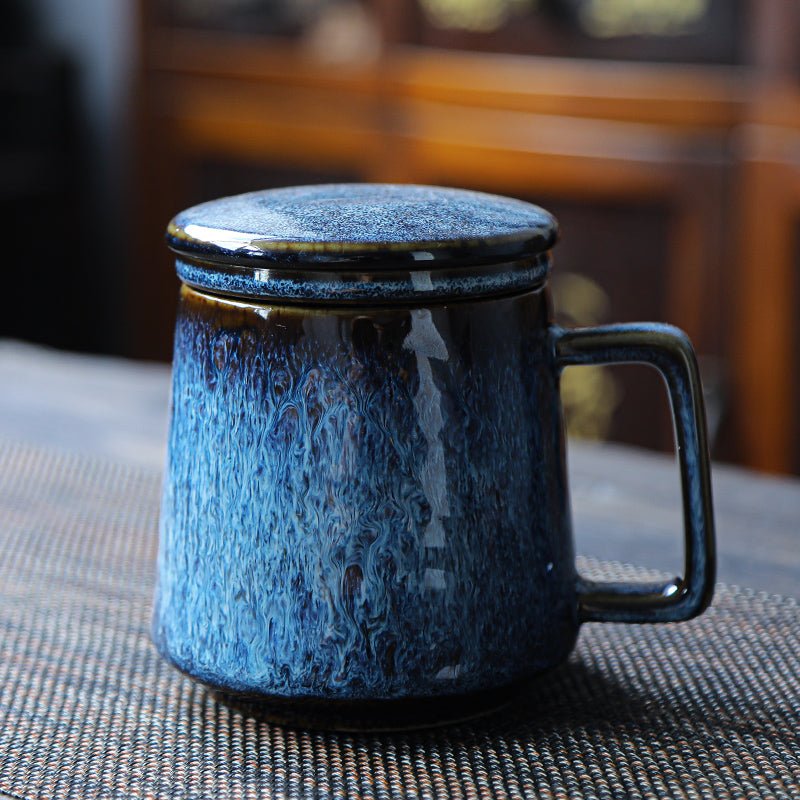
Large Round Coffee Mugs Replacement Purchase Practical Checklist
Reading time: about 10 minutes
The mug that started this article came back to us in two pieces. A customer had dropped her favorite round-bellied cup — a 14-ounce size she used every morning — and every replacement she ordered online was wrong in a different way: too tall for her pod brewer, too narrow in the handle, or so wide at the rim that her pour-over cone rocked. We see some version of that story every week. A large round mug is not simply a bigger standard mug; it changes how you fill it, lift it, store it, and clean it. Before you replace yours, work through this large round coffee mugs replacement purchase practical purchase checklist. It starts with the mug you lost, not with a generic size chart.
The large round coffee mugs replacement purchase practical purchase checklist: five measurements to take first
Take these measurements before you shop. A ruler and a measuring cup will save more time than another hour of scrolling.
- Your real pour, not the mug's capacity. Fill your usual cup with the amount you actually drink — coffee plus milk — and note the level. Add 1 to 1.5 inches of headspace for a wide mug; the broad surface ripples when you walk.
- Brewer clearance. Measure from the drip tray to the spout on your machine. A round body can be shorter than a tall diner mug at the same volume, but “round” does not guarantee a low profile. Check the actual height on the product page or ask us.
- Rim opening versus your dripper or press. Put your dripper base or AeroPress flange on the old mug and mark the contact width. If the new mug’s opening is wider than that base, the device can sink inside the rim.
- Handle opening and knuckle room. Slide your hand through the old handle. You want at least three fingers through the loop and enough standoff that your knuckles do not rest on the hot belly of the mug.
- Base contact. Set the mug on your desk warmer or scale. A recessed foot ring can lift the mug floor away from the heating surface; a flat base makes better contact.
What does a listed “large” capacity actually hold once milk and headspace go in?
Most listings quote brim-full capacity — the absolute volume before liquid spills over the rim. That is not the same as a comfortable working fill. Under NIST Handbook 44, 1 U.S. fluid ounce is 29.57353 milliliters, and a measuring cup is exactly 8 fluid ounces. That conversion matters when a mug is listed in milliliters and your brain works in ounces.
Suppose your morning drink is 8 ounces of coffee plus 2 ounces of milk. That is 10 fluid ounces, or about 296 ml. A 10-ounce mug leaves no margin for a wide, moving surface. A 400 ml mug is about 13.5 fluid ounces brim-full, which leaves a sensible fill line for that drink; it is not a 16-ounce mug in practical terms. This is the gap that trips up most replacement shoppers.
Our current lineup states listed capacities plainly: The Flow at 400 ml, Morning and Night at 440 ml, and The Rock at 480 ml. Each has a visibly rounded silhouette. Here is how those numbers map to common routines, with the caveat that the fill line is a planning estimate, not a guarantee:
| Listed capacity | Approx. brim-full fl oz | Practical fill we would plan for | Reader situation |
|---|---|---|---|
| 400 ml | ~13.5 | 10–11 fl oz | One 8-oz brew plus a splash of milk; small latte. |
| 440 ml | ~14.9 | 12–13 fl oz | 10-oz machine brew with frothed milk; double flat white. |
| 480 ml | ~16.2 | 13.5–14.5 fl oz | 12-oz pour-over with cream; large tea or oatmeal. |
If your old mug was a 12-ounce cup and you drank it near the brim, The Flow starts at the smaller end — check its height and rim width before you commit. If you routinely drink a 10-ounce latte, Morning and Night gives more margin without jumping to the largest body. If you are replacing a mug you already know was too small, The Rock is the first one we would measure. You can compare the rounded profiles side by side in our unique coffee mugs collection.
Will a round body fit under your brewer — and will your dripper sit safely on the rim?
A short, wide body can clear a spout that a tall mug hits. That is the practical advantage of a round profile. But the advantage disappears if the mug is still too tall for your machine, and photos exaggerate how low a mug sits because they are often shot from above. Measure the actual clearance on your counter, then compare it to the height published on the product page. If height is not listed, ask before ordering; we would rather answer a question than process a return.
The wide mouth creates a second issue: not every brewing tool likes a broad rim. A conical pour-over dripper needs its base ring to rest across the opening. If the opening is wider than the base, the cone can sit down inside the mug and rock when you pour. An AeroPress has the same problem in reverse: the flange needs two opposing rim walls to catch. Test your device on the old mug before you shop, and buy the mug that matches that contact width.
Two more fit checks are worth doing now. A wide, round belly is usually a poor match for a car cup holder; treat this shape as a kitchen, desk, or porch mug unless you have measured the holder. And check cabinet height: a large round mug may be short but broad, so it can crowd the shelf in a different direction. If you need a wider base for stability, our notes on ceramic wide bottom coffee mugs go deeper into that trade-off.
How heavy is a full mug, and will the handle clear your knuckles?
Water is heavier than most shoppers expect. One fluid ounce weighs about 29.6 grams, so 14 fluid ounces of coffee is roughly 414 grams — nearly a pound before the mug itself. A thick body can add several hundred grams. We cannot give you a single filled weight for every mug because body thickness varies, but you can weigh your old mug empty, add the liquid weight, and get a realistic number.
Handle geometry matters more on a round mug because the belly curves outward toward the loop. A handle that looks generous in a photo can still put your third and fourth knuckles against hot material. Look for:
- A loop that accepts three fingers without stacking them.
- Enough vertical drop inside the loop that your hand does not slide upward.
- A thumb rest or flattened top curve for counter-torque when the mug is full.
- Enough standoff between the handle and the body that your knuckles are not touching the wall.
The trade-off runs both ways. A very large handle can make an empty mug feel back-heavy, and a slim handle can pinch when the mug is full. If hand fatigue was the reason you retired the old mug, our guide to ceramic coffee mugs with large handles covers the geometry in more detail.
Does a wide mouth keep coffee hot, or cool it too fast?
Both things are true, which is why heat claims are so confusing. A wide, open surface exposes more liquid to room air, so the top of the coffee cools faster than it would in a narrow tumbler. A thick body adds thermal mass, so a full mug can hold heat in the center while the surface cools. If you sip slowly, preheat the mug with hot tap water before you brew; that one step does more than a thicker wall.
A mug warmer can help, but only if the base makes contact. A recessed foot ring or a raised ridge can create an air gap between the mug floor and the warmer. Set the mug on the warmer empty and feel the bottom after a few minutes; if it stays cool, the base is not contacting. And do not expect a wide, unlidded mug to behave like a vacuum travel mug. It is not built for a commute, and it will not hold heat for hours.
Food-contact glaze: what should you verify before the first fill?
This is the part of a replacement purchase that listings often skip. Under FDA CPG 545.450, the action level for leachable lead in ceramic cups and mugs is 0.5 µg/mL of leaching solution. FDA describes cups and mugs as small hollowware made with a handle, normally holding about 240 ml (8 fl oz), and applies the lead guideline to any one of six units tested. For cadmium, CPG 545.400 sets an action level of 0.5 µg/mL for small hollowware and 0.25 µg/mL for large hollowware; a very large vessel near 1.1 L can fall into that large-hollowware category rather than the cup-and-mug category.
“Lead free” is not a test result. FDA has reported imported traditional pottery labeled “Lead Free” that still released extractable lead above the CPG 545.450 action levels in testing. A published pilot study in Food Safety and Risk also found that lead can leach from ceramic mugs into coffee and tea, with results depending on the individual cup. We would ask extra questions about any bright yellow, orange, or red glaze, because cadmium is regulated in ceramicware and those colors are common in decorative finishes.
Also check whether the piece is food-contact ware at all. Under 21 CFR 109.16, ornamental or decorative ceramicware that appears suitable for food must carry a conspicuous “not for food use” warning or a hole through the potential food-contact surface when the rule applies. If a listing cannot tell you whether the glaze is intended for daily coffee, ask the seller for a food-contact statement. We cannot verify glaze chemistry from a photo, and neither can a product page that only says “handmade.”
Care steps that prevent thermal shock and glaze crazing
Large mugs have more surface area and thicker walls, so they expand and contract unevenly when the temperature changes fast. A few habits keep the glaze intact:
- Warm before you brew. Rinse a cold mug with hot tap water before pouring boiling water or fresh coffee into it.
- Skip direct heat. Do not set a ceramic mug on a stovetop burner or put it under a broiler.
- Let it cool before washing. Do not plunge a hot mug into cold water; the rim is the first place to crack.
- Check metallic trim. Gold luster, platinum accents, and metallic rims are a microwave risk. If the mug has them, keep it out of the microwave.
- Read the specific care marks. Dishwasher and microwave claims vary by body and glaze. Confirm them on the product page for the exact mug you are buying, not on a similar-looking listing.
If the glaze is heavily decorated or the mug has a metallic rim, hand washing is the safer default. That is a real limitation, not a sales pitch.
Frequently asked questions
Can a 400 ml mug replace my old 16-ounce mug?
Not ounce for ounce. A 400 ml listed capacity is roughly 13.5 U.S. fluid ounces brim-full, so a comfortable fill is lower than that. If your old mug was a true 16-ounce cup and you filled it near the top, move up to The Rock at 480 ml. This is the step most people skip in a large round coffee mugs replacement purchase practical purchase checklist.
Why does my wide round mug spill when I carry it?
A wide mouth gives the liquid a broad, moving surface, so a mug filled close to the rim will slosh with normal walking. Keep 1 to 1.5 inches of headspace below the rim, and carry the mug with your hand under the base rather than by the handle alone when it is full.
Will a pour-over dripper or AeroPress fit a wide round mug?
It depends on the contact width, not the mug’s ounce rating. Set your dripper base or AeroPress flange on the rim and check whether it spans two opposing walls. If the device can fall inside the opening, that mug is the wrong shape for that brewer.
Are the mugs in your lineup dishwasher and microwave safe?
Check the specific product page for the mug you are buying; we do not treat care claims as interchangeable across glazes and trims. If the listing does not state dishwasher or microwave suitability, hand wash it and keep it out of the microwave until the seller confirms.
More from our blog
Ready to pick your mug? Two ways to save on today's order:
Ordering 1–3 mugs? Get an extra 10% off your 1st order with code 10_OFF Apply 10% Off & Shop Wooden-Handle Mugs →
Gifting 4+ mugs? Buy 3, Get the 4th Free applies automatically at checkout (no code needed; offers do not stack) · Free standard shipping (Nov pre-Christmas delivery: 15–20 calendar days US) · Free replacement if chipped in transit.
Popular mug buying guides: Wooden-Handle Tea Infuser Mugs Compared · Christmas & Secret Santa Mugs 2026 · Espresso & Cortado Cups Guide · Cup & Saucer Gift Sets · All 25 Mugs Spec Table · Mug Size Guide · Shipping & Promo FAQ
FIRST ORDER 10% OFF (CODE: 10_OFF) · OR BUY 3, GET THE 4TH FREE


Read more

Build a Practical 15 Oz Mug Gift Shortlist That Fits the Recipient
A 15 oz ceramic mug label describes brim capacity, not what the recipient can safely carry. This gift-focused shortlist maps real brewing routines to three verified sizes and their trade-offs.
Read more
Coffee Mugs With Big Handles: A Replacement Purchase Checklist
A replacement-focused walkthrough for coffee mugs with big handles: how to judge finger clearance without a measuring tape, weigh loop size against filled weight, and pick between our 250 ml, 400 m...
Read more
Leave a comment
This site is protected by hCaptcha and the hCaptcha Privacy Policy and Terms of Service apply.