
Large Coffee Mug Gift: Capacity, Handle, and Fit
Reading time: about 13 minutes
The box looks generous. The mug is tall, the glaze catches the kitchen light, and the giver is already picturing a slow Sunday. Then the recipient fills it. Knuckles scrape the body, the base will not sit on the usual shelf, and half the coffee is lukewarm before the second email. That is the usual miss with a large coffee mug gift: the object photographs well, and the daily fit was never checked.
We see this at the packing table more often than in styled photos. Someone asks for something big because a standard cup feels skimpy at a desk. Big can mean more coffee, a taller shape, or a novelty that is awkward to live with. In our store we do not treat those as the same order.
Is a large coffee mug gift the right size for how they drink?
Shoppers use the word large loosely. Before you order, pin the size to a pour they already make, not to a photo that makes every mug look oversized.
- Everyday generous cup. Plenty of desk drinkers we talk to are content once milk or a little foam is in the cup, often a 12-16 oz pour. That is a full mug, not a novelty.
- A genuinely large mug. When a customer wants a long desk session, a milky latte, or soup as well as coffee, we start the conversation around 20 oz and up. It should still lift without a grimace.
- A jumbo. Bowl-sized or extremely tall pieces unwrap well and then live at the back of the cabinet. Fine as a joke between close friends. A poor default for a coworker or a housewarming.
Regulators are describing a smaller object than gift copy usually is. FDA describes cups and mugs as small ceramic hollowware, commonly used for coffee or tea, normally but not exclusively about 8 fl oz (240 ml), and made with a handle. A gift you are calling large sits well above that everyday picture. Size here is a use decision, not a legal class.
Height in a product name is not an ounce count. A tall, narrow bowl can hold less than a shorter, wider mug. If the listing prints capacity, use that number. If it only says tall, you do not yet know whether the gift is large.
Brim-full ounces versus the pour they can carry to the table
Listed capacity is often the brim-full measurement. A brim-full mug spills when they add milk, turn toward the fridge, or set the cup on a stack of mail. We subtract headroom before we call a listing big enough.
- Black coffee: a small gap under the rim is enough to walk from the brewer to the table.
- Milk or creamer: leave the amount they usually add. A token splash is not the same as the pour they actually make.
- Latte foam: an open, slightly wider top beats a narrow tankard. Foam needs air above the liquid.
- Iced coffee: ice steals volume. A mug labeled large may only hold a modest drink once the cubes are in.
- Soup or cocoa: look for a stable base and a rim that feels comfortable on the lip, not just a high ounce number.
There is a cooling catch that gift roundups skip. In our experience, a small pour in a huge open ceramic mug meets more cool clay and more air across a wide surface. The drink sits as a shallow layer and loses heat while they answer one message. A modest mug kept closer to full often stays pleasant longer. Bigger is not automatically more generous.
If the current listing does not say whether ounces are brim-full or a practical fill line, treat the number as brim-full and size down in your head. Do not invent a usable figure the page never printed.
Handle room, full weight, and the gap under the brewer
Capacity is only half the fit. The other half is whether the mug can live in their kitchen without a workaround. These are the checks we walk through when a buyer says the recipient has large hands or a low cabinet.
- Handle opening. Product pages rarely print the gap between handle and body. Three fingers should pass without scraping if the recipient has a larger hand. If they already own a mug they like, have them measure that opening and compare. A review that mentions knuckles tells you more than a cropped side photo.
- Full weight. Thick walls plus a large pour are a real load. Some people want a one-hand carry from the machine to the desk. Others will set the mug down immediately. If the listing does not publish empty weight, assume a heavy jumbo is a two-hand piece until you know otherwise. Wrist comfort outlasts the unboxing moment.
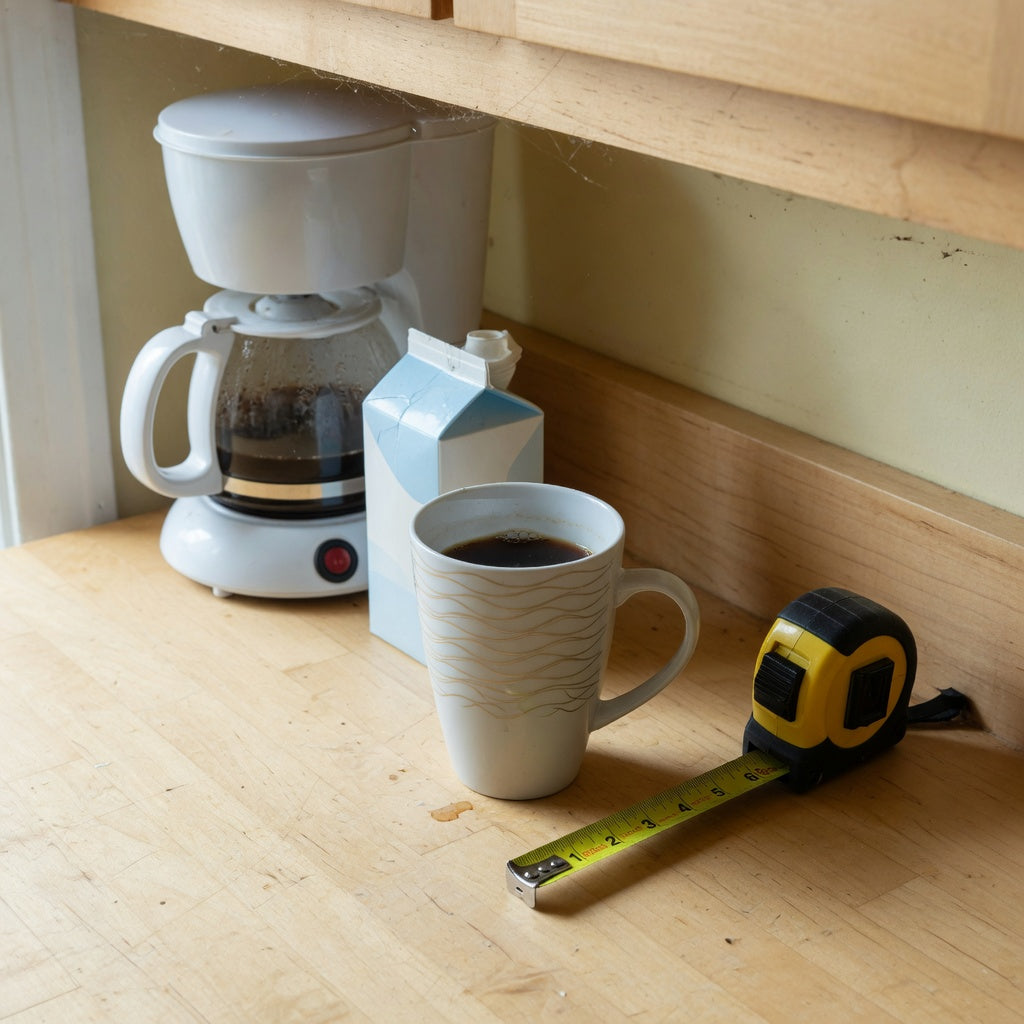
- Brewer and cabinet height. A tall mug that cannot slide under the drip spout gets filled at the sink and dripped across the counter. Measure from the warming plate or drip tray up to the cabinet, then compare that gap with the stated height, if height is stated. If it is not on the page, do not guess from the photo.
- Shelf and dishwasher rack. Tall pieces collide with the rack above or with upper-rack tines. A mug they must hand-wash because it will not fit the machine is a chore, not a treat, unless they already prefer hand-washing.
- Car cup holder. Many wide ceramic bases simply do not drop into a standard holder. If they drink on the drive to work, an open jumbo is the wrong format.
Rim thickness is the quiet complaint we hear after the first week. A very thick lip feels clumsy for tea and for people who notice every sip. A thin, sharp rim chips sooner when it knocks a faucet. Neither extreme is a flaw for everyone. It is a mismatch if you never ask.
Desk drinker, picky rim, or a decorated shelf?
Match the person first, then open the live listing and make the page prove the size. None of these is an automatic jumbo just because it is a coffee or tea mug.
For someone who wants a taller silhouette on a desk or kitchen counter, start with the White Golden Waves Tall Coffee Tea Mug. The name says tall. On the current page, confirm stated capacity, overall height, base width, handle shape, and any dishwasher or microwave marks. If those fields are missing, it is a candidate, not yet a confirmed large coffee mug gift.
When they care more about how the rim meets the mouth than about maximum volume, open The Flow Coffee Tea Mug and run the same checks. This is the better path for a recipient who is particular about every sip and does not want a statement piece that dominates the shelf.
If their shelves already lean decorative and a wave motif will sit with what they own, look at the Golden Waves Kio Coffee Tea Mug. Golden in the title is not proof of metal trim. Read the current description and photos. If a metallic gold or silver finish is shown, or if microwave safety is unstated, do not put it in the microwave.
Do not borrow ounces, clay type, or care icons from a different colorway, an old marketplace listing, or a similar name. Those details can change. If the capacity on the page does not match the pour you wrote down, leave the listing. The unique coffee mugs collection is the wider set to compare against that same checklist.
Open ceramic at home, or a lid for the commute?
A large ceramic mug is a home and desk object. It is not a travel bottle. We say that plainly because the wrong format is the gift that gets thanked and then ignored.
| How they drink | Format that usually fits | What it is not good for |
|---|---|---|
| Kitchen or office desk, coffee or tea sipped over an hour | Open ceramic, sized to a real pour plus headroom | A car cup holder, a backpack, or a lid-on commute |
| Milky latte or cocoa at home | Wider ceramic with room under the rim | A narrow jumbo that spills foam on the first step |
| Iced drinks in warm months | A taller cup only if ice room is real, or a tumbler with a lid | Assuming brim capacity equals the finished drink |
| Drive to work or a long walk | Insulated mug with a lid that seals | Open ceramic, however large the ounces look |
| Soup on the couch | Stable, wider ceramic they can set down easily | A tippy tall mug used one-handed |
Ceramic wins on lip feel, on looking like a gift when it is empty, and on being simple to sip from. It loses heat once the volume is huge and the top is open, and it loses anywhere a lid or a narrow base is required. If they reheat the same cup all morning, an unlidded jumbo is working against them.
Stoneware, porcelain, and a generic ceramic label are not interchangeable in the hand. Stoneware is often thicker and heavier. Porcelain can feel finer at the rim and chips if it is knocked in a crowded sink. None of that is a ranking until you read the body description on the exact listing you are buying. We will not assign a clay type to a mug the page does not name.
Metallic finishes, hot liquid, and leach limits
Gift mugs fail in the microwave more often from decoration than from the clay. On March 21, 2024, the CPSC announced a recall of about 440,500 metallic-coated ceramic mugs sold in 2023 Starbucks-branded holiday gift sets, in 11 oz and 16 oz sizes. If microwaved or filled with extremely hot liquid, those mugs can overheat or break, posing burn and laceration hazards. The agency reported 12 incidents and 10 injuries. Those were not jumbo mugs. A metallic coating was enough.
Care rules we actually give buyers at the counter:
- Follow the dishwasher and microwave marks on the listing or the base. A missing mark is not a yes.
- Keep metal trim, gold or silver bands, and metallic coatings out of the microwave.
- Hand-wash specialty and metallic finishes. The body may survive a cycle. The decoration often fades, pits, or roughens at the lip first.
- Do not fill a coated decorative mug with extremely hot liquid just because it was sold as a gift.
Lead and cadmium are the other question people hesitate to ask about a pretty glaze. FDA's action level for lead leaching from ceramic cups and mugs is 0.5 micrograms per milliliter of leaching solution. For cadmium, the compliance guide sets a guideline of 0.5 micrograms per milliliter of leaching solution for small hollowware, on any one of six units, because acid foods can pull extractable cadmium from ceramicware.
FDA also flags problem pottery rather than every commercial mug: handmade crude or irregular pieces, antiques, damaged or worn ware, items from flea markets or unknown makers, and pieces brightly decorated in orange, red, or yellow. Lead in a glaze or decoration can move into food and drink if the piece was not properly fired. Commercially made everyday pottery is much less likely to be the issue. Washing or boiling does not remove lead that is already in the ware.
A piece labeled decorative, or not for food use, is not a coffee gift. Vintage shop finds and unglazed interiors belong in the same pile: do not use them for hot drinks unless you have food-contact information from the maker. Treat a listing as daily drinkware only when the current page presents it that way. If a page is silent, ask before you wrap it.
Who should skip a jumbo, and how to pack one that fits
Skip the oversized mug when the recipient already has a crowd of unused cups. Another ceramic object will not fix that. Coffee or tea they already brew is kinder. Skip it for a driver, for a galley kitchen with a low cabinet over the machine, and for someone who only wants a small black coffee and resents leftovers. A heavy, tippy mug is also a poor match for small hands or a weak wrist.
Pairing should make the first morning easy, not add a second decision. Their usual beans or tea, a short note on care, and the pour you sized the mug for are enough. A random flavored tin they have never mentioned is how a thoughtful gift becomes clutter. Say whether dishwasher use is expected. If you are unsure, write hand-wash until they read the base.
Pack fragile ceramic as freight, not as a handful of tissue. Double-box it. Put crumpled paper under the base and around the body so the handle is not taking the load. The rim and the handle join are where chips start. Mark the outer box fragile. A gift bag alone is how tall mugs arrive with a crescent missing from the lip.
Before you order, run this list. It is the same one we use when a customer says they want a large coffee mug gift and we ask what happens after the photo.
- Home or desk ceramic, or a lidded mug because they commute?
- Write the pour they drink, then add milk, foam, or ice.
- Compare that number with listed capacity, and assume brim-full unless the page says otherwise.
- Measure brewer clearance, cabinet height, dishwasher rack, and cup-holder width if the car matters.
- Check handle room against their hand, not against the crop of the photo.
- Read dishwasher and microwave statements. Metal present, or microwave safety unstated, means no microwave.
- Reject unknown vintage and anything marked not for food use.
- Open the current White Golden Waves Tall, The Flow, or Golden Waves Kio listing, or the unique coffee mugs collection, and match ounces and care marks to that list. If they do not match, choose a different mug.
Frequently asked questions
How many ounces should a large coffee mug gift actually hold?
Match the recipient, not a trend. A 12-16 oz mug with a little headroom is already a full everyday cup for a lot of home drinkers we help. We treat about 20 oz and up as a large mug, and anything bowl-sized as a jumbo they may not finish. Confirm the number on the current listing, and assume it is brim-full unless the page explains a fill line.
Is the listed capacity the amount they can pour with milk or ice?
Usually it is the volume to the rim, not the comfortable serving. Milk, foam, and ice all take space, and a brim-full mug spills on the walk from the brewer. Leave that headroom in your estimate. A huge mug with a small pour can also cool faster because the drink spreads across more ceramic and more open air.
Will a big ceramic mug fit under the coffee maker or in a car cup holder?
Only if you measure. Tall mugs miss the gap under a cabinet or a drip spout, and wide bases miss standard car holders. If the listing does not print height and base diameter, do not guess from the photo scale. For a commute, choose a lidded travel mug instead of an open ceramic piece.
Can I microwave a decorative mug if the finish looks metallic or gold?
Do not, unless that exact listing says it is microwave safe and shows no metal. Metallic coatings have overheated and broken in recalled gift mugs, even in ordinary 11 oz and 16 oz sizes, causing burns and cuts. Hand-wash gold-tone or specialty decoration, and do not fill a coated mug with extremely hot liquid on a guess.
Could a decorative or handmade mug leach lead or cadmium into a hot drink?
It can if the glaze or decoration was not properly fired, especially handmade irregular ware, antiques, damaged pieces, flea-market finds, and some bright orange, red, or yellow decoration. FDA's action level for lead leaching from ceramic cups and mugs is 0.5 micrograms per milliliter, and the cadmium guideline for small hollowware is 0.5 micrograms per milliliter on any one of six units. Washing does not remove lead already in the pottery. Choose commercially made drinkware with a clear food-use intent, and skip anything labeled decorative only.
More from our blog
Read more

Peppermint Tea Gift Mug: What Buyers Should Compare
A peppermint tea gift mug only works if the size and handle fit how that person actually drinks. We compare The Flow at 400 ml, Morning and Night at 440 ml, and The Rock at 480 ml, then list what t...
Read more
Peppermint tea mug for office: capacity and handle
Shoppers asking for a peppermint tea mug for office use usually want a printed coworker gift or a desk mug they will refill. We compare 400 ml, 440 ml, and 480 ml listings that support tea, plus th...
Read more
Leave a comment
This site is protected by hCaptcha and the hCaptcha Privacy Policy and Terms of Service apply.