
Hot Toddy Mug Storage Fit Guide: 400 ml vs 480 ml
Reading time: about 9 minutes
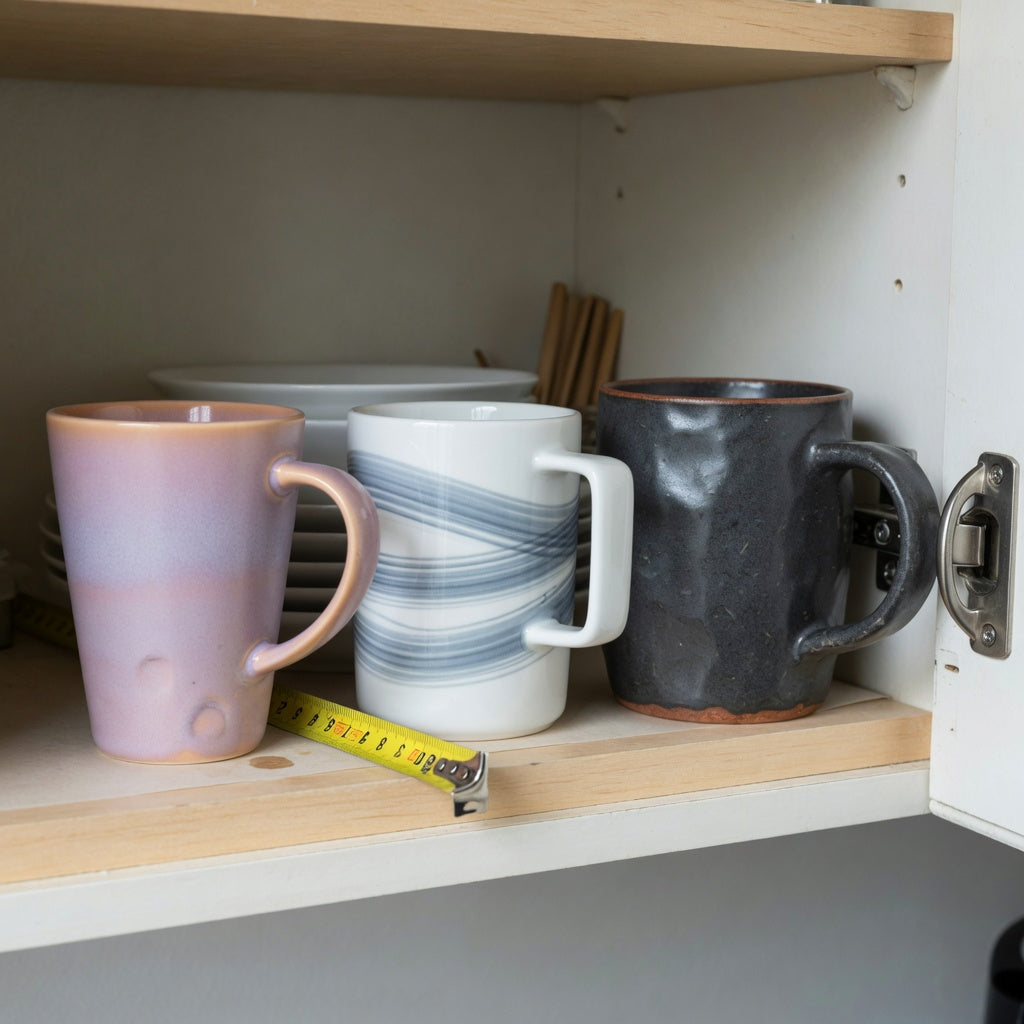
A cabinet door can expose a poor mug fit in one second: the ceramic body clears the shelf, but the handle taps the door before it closes. This hot toddy mug storage fit guide compares the three current CoffeifyMug options by the details that affect that moment: 400 ml versus 480 ml capacity, visible body profile, handle projection, and the space needed around everyday ceramic drinkware.
In our store, we handle and compare mugs with the same practical questions shoppers bring to a kitchen shelf, office cupboard, or drying rack. We do not treat capacity as an outside measurement, and we will not invent height, diameter, or handle-width figures that are not confirmed. The verified capacities are 400 ml for The Gradient, 400 ml for The Flow, and 480 ml for The Rock. Where a full exterior measurement is not shown on a live product page, the reliable next step is to measure your own storage space and use the visible shape only as a relative guide.
What should a hot toddy mug storage fit guide compare?
A mug has several storage dimensions, and only one of them is related to how much liquid it holds. Shoppers often check cabinet height but miss the door, handle, or shelf lip. Before comparing the three designs, separate these five variables:
- Usable shelf depth: Measure from the back panel to the inside face of the closed door, not to the cabinet's front trim. Hinges, door bumpers, and shelf lips can reduce the usable distance.
- Clear height: Measure from the shelf surface to the first obstruction above it. Include any under-shelf rail or overhanging cabinet frame.
- Body footprint: Check the widest part of the ceramic body, not just the base that touches the shelf.
- Overall width with handle: Measure from the body edge opposite the handle to the handle's outermost point. This is often the number that determines whether mugs can sit side by side.
- Lift-out clearance: Leave room for fingers to reach the handle or body without knocking the rim against the shelf above.
| Mug | Listed capacity | Visible storage cue | Best starting situation | Main trade-off |
|---|---|---|---|---|
| The Gradient | 400 ml | Relatively upright profile and a handle that appears closer to the body in current listing views | Tighter closed cabinets, mixed mug rows, or a narrow desk | Less capacity than The Rock, and fit still needs to be checked |
| The Flow | 400 ml | Continuous curved outline with a more open-looking handle | Open shelving or an uncrowded cabinet with side clearance | The handle shape is less forgiving in a tightly packed row |
| The Rock | 480 ml | Fuller visual profile and a substantial-looking handle | A deeper shelf, dedicated counter position, or larger serving preference | The least conservative choice for a cramped upper cabinet |
These are relative observations from the current product forms, not substitutes for exterior measurements. Product images may use different cropping, distance, or camera angles, so pixel width on a screen cannot establish which mug is physically wider.
How do 400 ml and 480 ml capacities change shelf planning?
The Gradient and The Flow share a listed 400 ml capacity, but they should not be treated as the same storage shape. Their visible body and handle profiles differ. That is a useful reminder that milliliters describe holding capacity, not cabinet footprint.
The Rock is listed at 480 ml and suits a shopper who values a larger serving enough to reserve more room for the mug. Its fuller visible form makes it a less cautious choice for an already crowded shelf. The two 400 ml options are the more practical starting point when preserving cabinet space matters more than maximizing volume, but neither is guaranteed to fit without checking the handle and door clearance.
Listed capacity tells you how much the mug is designed to hold. It does not establish exterior width, handle reach, stackability, or specialized temperature performance.
Choose the capacity that matches your normal serving rather than buying extra volume by default. Empty headroom can be useful, but a larger mug that has to live permanently on the counter may be the wrong trade-off for a small kitchen.
How much room should you leave for the handle and cabinet door?
Handle projection is the distance the handle extends beyond the mug body. It can be omitted from a basic height-and-diameter listing, yet it controls side-by-side spacing and whether a closed door catches the mug. A curved body may sit well within the shelf while the handle remains outside the usable depth.
- Find a mug you already own that fits the intended shelf with the door closed.
- Measure its full width from the body edge opposite the handle to the handle's farthest edge.
- Place it at the back of the cabinet and close the door slowly to identify the remaining depth.
- Check whether you can lift it out without scraping the shelf above or striking the next mug.
- Use that successful mug as your physical reference when reviewing the live product pages.
Rotating handles or alternating their direction can make a row more efficient, but only if every mug remains stable and accessible. On an office desk, an open handle can also occupy the same path as a charging cable or mouse cord. On a drying rack, a projecting handle may block a plate slot or knock against neighboring ceramic pieces. Those are placement problems, not product defects, but they affect everyday use.
When is stacking ceramic a bad storage plan?
Do not assume a mug is designed to stack because its base can enter another mug's rim. Capacity does not prove nesting compatibility, and a product photograph does not show whether two pieces settle securely. Decorative ceramic drinkware is better stored in a single layer unless the upper mug sits evenly without pressure or rocking.
Stop stacking if any of these conditions appear:
- The upper mug rocks when the shelf is touched.
- Its base presses against only one part of the lower rim.
- A handle carries weight or rests against another handle.
- Glazed surfaces rub when either mug is removed.
- The stack must lean against the cabinet wall for support.
The rim and handle are exposed contact points, so forcing a tight arrangement creates avoidable chip risk. After washing, store the mugs only when dry and follow the care instructions on the current product listing. This guide does not assume dishwasher, microwave, or other care compatibility that is not stated on the live page.
Which current mug fits a closed cabinet, open shelf, desk, or gift?
Small closed cabinet or narrow office desk: start with The Gradient
If your cabinet door barely clears existing mugs, the 400 ml Gradient mug is the most conservative starting point among these three visible profiles. Its relatively upright body and closer-looking handle suit a tight mixed row better than a more open handle shape. It is not a guaranteed fit, so compare it with a mug that already works in the space before ordering.
Open shelf with side clearance: consider The Flow
The 400 ml Flow mug makes more sense when you have room to appreciate its continuous curve rather than squeezing it between straight-sided cups. An open shelf, counter tray, or uncrowded cabinet gives the handle space and keeps it easy to lift. It is not the strongest choice for a cabinet where the door already touches other handles.
Deeper shelf and larger serving: choose The Rock
The 480 ml Rock mug fits the shopper who wants the largest confirmed capacity in this comparison and has a dedicated place for it. A deep lower shelf or open counter position is more realistic than expecting it to disappear into a tightly packed upper cabinet. If compact storage is the priority, The Rock is not the cautious option.
Gift recipient with unknown storage: compare more than capacity
A mug can look right during a gift unboxing and still be awkward in the recipient's cabinet. If you do not know their shelf depth, a 400 ml option with a restrained profile is generally the more conservative direction, though it still cannot guarantee fit. If the three shapes here do not match the recipient's kitchen or style, compare the other everyday ceramic forms in our unique coffee mugs collection before settling on a gift.
A two-minute shelf check before ordering
Use the actual storage position, not an empty section of countertop, for this check. A mug used every evening should fit where it will be put away after washing.
- Choose the exact shelf, cabinet row, or desk position the mug will occupy.
- Record usable depth to the closed door and clear height to the shelf above.
- Measure the full body-and-handle width of a current mug that fits comfortably.
- Decide whether 400 ml meets your usual serving needs or whether 480 ml is worth reserving more room.
- Review the live product page for any listed exterior dimensions and compare them with your reference mug.
- Plan single-layer storage if the shape is not specifically confirmed to nest securely.
Leave a practical margin rather than matching the cabinet measurement exactly. You need enough room to close the door, grasp the handle, and remove the mug without striking neighboring ceramic pieces.
Frequently asked questions
How do I use this hot toddy mug storage fit guide if dimensions are not listed?
Measure a mug that already fits your shelf, including its full width across the body and handle. Compare that physical reference with the visible product profile and check the live listing for updated dimensions before buying. If the fit appears close, choose the more conservative shape or leave additional cabinet space.
Is a 400 ml mug always easier to store than a 480 ml mug?
No. Capacity measures volume, while storage fit depends on exterior height, body width, base shape, and handle projection. The two 400 ml options in this comparison have different visible profiles, so they may not occupy a cabinet row in the same way.
Which CoffeifyMug shape is the safest starting point for a shallow cabinet?
The Gradient is the most conservative visual starting point because its profile appears relatively upright and its handle reads closer to the body than the more open-looking Flow. That is a relative comparison, not a fit guarantee. Measure usable shelf depth to the inside of the closed door before ordering.
Can I stack The Gradient, The Flow, and The Rock?
Do not assume that any decorative ceramic mug is stackable unless it settles securely without rocking, rubbing, or transferring weight to a handle. A single-layer row is the safer storage plan when nesting has not been confirmed. Never force one mug into another to save shelf space.
Are these mugs suitable replacements for insulated travel cups?
This guide treats them as everyday ceramic drinkware, not sealed travel vessels or specialized temperature equipment. They are not the right category if you need a spill-resistant lid, commute-ready construction, or a specific insulation claim. Choose a purpose-built travel mug for those requirements.
Before ordering, write down four details: usable shelf depth, clear height, overall mug width including the handle, and preferred capacity. Match those notes to The Gradient, The Flow, or The Rock product page. If none leaves a comfortable margin, use our current mug collection to find a shape that suits the cabinet you use every day.
More from our blog
Read more
Green Tea Mug Current Product Facts: 170, 200 and 270 ml Compared
Compare the verified listing facts for the Retro 170 ml, Pleated 200 ml, and Emerald 270 ml options. See how visible shape and refill trade-offs affect the choice, plus which material, dimension, a...
Read more
Ceramic Tea Mug Current Product Facts: Sizes, Shapes, Handles
Compare listing-backed facts for The Flow, Morning Night, and Round ceramic tea mugs, including 310-400 ml capacities, visible profiles, handle shapes, and important details that remain unverified.
Read more
Leave a comment
This site is protected by hCaptcha and the hCaptcha Privacy Policy and Terms of Service apply.