



Home Decor Coffee Mug With Wooden Handle: What to Compare
Reading time: about 13 minutes
The mug looked finished on the tray: pale glaze, a slim wooden handle, the piece people slide forward when guests walk into the kitchen. Then someone asked whether it could ride in the dishwasher with the plates. That is the moment a home decor coffee mug with wooden handle stops being a styling choice and becomes a materials question. In our store the same search returns three different objects: ceramic or glass with a real wood grip, a solid-wood cup, and ordinary ceramic with a printed wood look. Care rules do not cross between them. A lifestyle photo will not tell you which one is in the cart.
Before the glaze wins you over, copy five lines from the current listing. Capacity in ounces and in milliliters. Body material. How the handle is joined. Any dishwasher or microwave limit. Whether the interior is described as suitable for food. A missing line is an unanswered question, not a quiet yes.
Ceramic body, glass wall, or only a wood-colored print?
Shoppers who want a warm, furniture-like mug usually mean the first of these. The other two ride along in the same results, and they cause most of the mismatches we hear about after an unboxing on the kitchen counter.
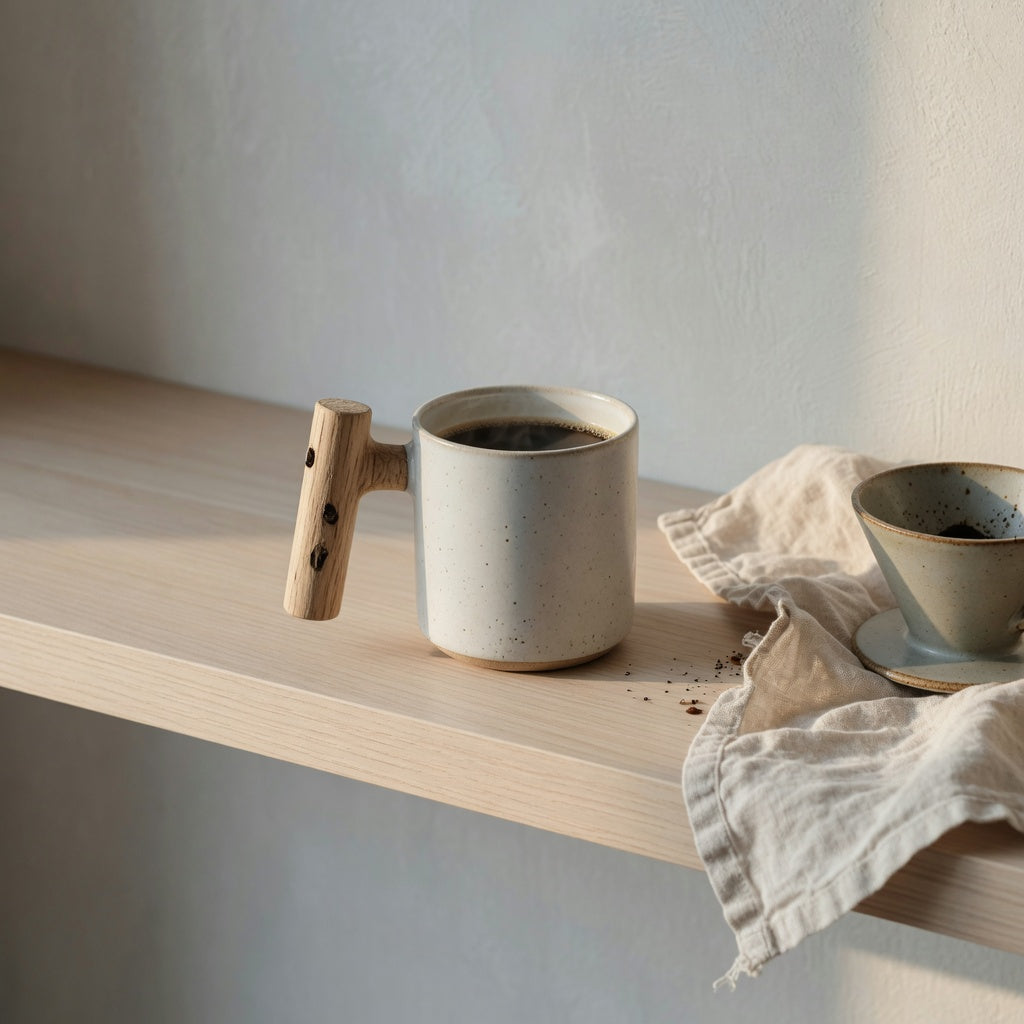
- Ceramic or glass with a real wooden handle. The vessel is drinkware. The wood is the grip and the decor. Japandi shelves, wabi-sabi trays, rustic stoneware, and farmhouse coffee bars all use this look because the handle reads like a small piece of furniture rather than a loop of clay.
- Solid-wood cups. Wood is the interior, sometimes with a lining. Oil, cracks, and food-contact limits belong to the cup itself, not to a short grip.
- Printed wood-look ceramics. There is no real wood to swell, stain, or loosen. You are buying clay and glaze. The wood tone in the photo may be ink.
Real wood next to an irregular or reactive glaze earns a place on an open shelf. It also asks for hand care the rest of a dishwasher-loaded cabinet does not. If every mug in the house has to survive the same cycle, a fully ceramic handle, or a print that only looks like wood, is the more honest match.
For statement drinkware, start with our unique coffee mugs and separate real wood handles from wood-colored glaze. If you already want a coffee and tea mug framed for home decor, open the Mountain Sea II coffee tea mug with wooden handle and read the live listing for material, capacity, and care. Do not borrow those details from a similarly named mug on another site. We do not treat a lifestyle photo as a specification. If capacity, wood species, joint method, or appliance limits are not written on that page, they are still unknown.
Is a home decor coffee mug with wooden handle a daily pour or a shelf piece?
People ask us one combined question. Can it live on the coffee bar and still be the mug used every morning? Sometimes. Volume decides it faster than the glaze does.
Listings in this look run from espresso cups to something nearer a full mug. When a page says 220 ml, that is about 7.4 fluid ounces. A short pour. It can look generous in a product photo and feel small beside the coffee most people drink at a desk. Pages that list 10 ounces and up are a different purchase, even when the handle looks the same. If the page gives both ounces and milliliters, the two figures should agree. Convert a single number before you call it a daily driver. We cannot tell you what the Mountain Sea II holds until you read the capacity line on that listing today.
- Espresso, a tasting, or a small tea. A short cup with a wood handle can be the right volume and still look deliberate on a tray.
- A desk mug of drip coffee. Much under 8 ounces means constant refills. You bought a styling object that holds liquid, not a workday mug.
- Iced drinks. Single-layer ceramic and glass sweat. Condensation runs toward the joint, which is the last place you want standing water on a wooden handle.
Shelf duty is a fair use. A piece that mostly sits out still needs a clear food-use statement if anyone might drink from it on a weekend. A decorative-only warning is a stop sign for beverages, not a caption for the coffee bar. We go further on clay bodies in what to compare on a home decor ceramic mug with a wooden handle.
This style is a weak daily driver if you reheat leftover coffee in the same cup between meetings, or if the household rule is that everything goes in the dishwasher at night. It also disappoints someone expecting a matched set of four identical mugs. glazed and reactive glazes often shift from piece to piece. Confirm on the listing whether variation is part of the design before you promise a uniform row on the shelf.
Will a glued wooden handle survive hot coffee and a wet sink?
Attachment is the failure worth picturing before checkout. Across this category, shoppers describe the same break: the grip was glued, the joint got wet or hot, and the handle came away with a full cup. Some makers mention a pin or another mechanical fastening. Many pages never say which method they used. A vague line that the handle is secure is not a method.
Read the listing for the joint and for care.
- Does it name glue, a pin, a screw, or no method at all?
- Does care say hand wash, no soaking, and dry the joint?
- Do microwave and dishwasher lines match real wood, or were they copied from an all-ceramic mug?
Those appliance claims conflict from one marketplace page to the next. Some wooden-handle listings say the mug is microwave and dishwasher safe. Others say the wood handle will fail in both. Follow the label on the exact mug. Do not average the category, and do not assume our product page says either thing until you see the words.
When the page is vague and the handle is real wood, hand washing is the conservative choice. Do not leave the mug to soak in the sink while dinner gets finished. Water parked in the joint swells wood and loads whatever is holding the grip. Wash with warm water and dish soap, then dry the handle, the junction, and the inside right away. University of Maine Cooperative Extension guidance for wooden cutting boards, another exposed wood surface used around food, makes the same moisture point: excess water can warp or crack wood, glued wood can separate, and some solid wood warps in a dishwasher, so the maker's instructions come first. A mug handle is smaller than a board. The water problem is related, not identical.
If the maker says to condition the exposed wood, use a food-safe mineral oil or beeswax on their schedule. That cutting-board guidance suggests conditioning about monthly and warns that olive oil and vegetable oil can turn sticky and go rancid. Skip those cooking oils on the handle. Do not oil a glazed interior. A grip is not an all-wood cup. If the listing never mentions oil, do not start a conditioning habit on your own.
Skip this construction if guests will grab a wet mug off the drying rack and assume every handle is fired clay. One loose joint and a hot drink is a spill, not a styling problem.
Does a cooler wood grip mean the cup is insulated?
Shoppers like a wood grip because it usually feels cooler than the cup wall, so fingers stay off the hottest clay or glass. That is not insulation. Single-layer glass and ordinary ceramic still heat through. The rim can be too hot to cradle while the handle feels fine. There is no honest keeps-hot duration to quote for this construction. It is not a double-wall travel mug, and we will not invent a minute count for how long coffee stays warm.
If you want a mug that can go back in the microwave at the office, or one you can wrap both hands around without thinking, look for a fully ceramic body or a design the listing actually calls insulated, then read that care label. A wooden handle solves the grip. It does not solve the wall temperature.
What should the listing say about glaze, lead, and food use?
A wooden handle does not answer whether the glaze is fit to drink from. Lead is toxic. It may be present in the glaze or decoration on some traditional pottery, and if that pottery was not manufactured and fired properly, lead can leach into food or drink. Washing or boiling will not remove it.
FDA guidance asks for extra caution with ceramicware that looks glazed and crude or irregular, antique, damaged or worn, bought where you cannot check the maker, or brightly decorated in orange, red, or yellow. The same guidance describes ordinary factory-made pottery as much less likely to have this problem. That is a risk screen, not a score for any mug we sell.
For cups and mugs, FDA compliance policy sets an extractable-lead guideline of 0.5 micrograms per milliliter of leaching solution for any one of six units, using specified lab methods. In that policy, cups and mugs are small ceramic hollowware commonly used for hot drinks such as coffee or tea and normally made with a handle. You will not find that lab figure in a lifestyle photo. You can look for labeling.
Ceramicware that looks suitable for food is treated as foodware unless it carries both a conspicuous stick-on label shoppers can see and a permanent statement on the base, using the message required under 21 CFR 109.16. Wording that the piece is not for food use, including a warning that it may poison food, means it stays empty. Ceramicware that leaches lead should not be labeled lead free. If a home test shows leachable lead, do not cook, serve, or store food or drinks in that pottery.
On the Mountain Sea II page, do not fill blanks from the category. Check whether the current description says the interior is for beverages, whether any decorative-only warning is present, and whether the maker documents glaze safety. Missing the words lead free does not prove a problem. Seeing those words does not prove a test unless the listing itself shows the documentation.
Color shift, slight asymmetry, and reactive glaze are common in decor ceramics. They are also the look that deserves a seller you can contact. Keep any care card that ships in the box. If the mug is mainly a gift for someone who will actually drink from it, the presentation trade-offs in what to compare in a ceramic coffee mug gift for home decor lovers belong in the decision before the wrap does. A handsome box does not change a hand-wash rule or a small capacity.
Why an all-wood cup is not the same purchase as a wood handle
An all-wood coffee mug puts wood on the drinking surface. A ceramic or glass mug with a wooden handle does not, unless the interior is also bare wood, which the listing should say outright.
In the FDA Food Code model for retail and food service, wood and wood wicker may not be used as a food-contact surface except in narrow cases. Hard maple, or an equivalently hard, close-grained wood, may be used for items such as cutting boards, salad bowls, and chopsticks. That is a commercial-kitchen rule. It is not a household ban on a wooden mug handle. It is a reason not to paste restaurant limits, or a cutting-board oil routine, onto a glazed cup.
All-wood cups need their own care page. Some are described as resin-lined and hand wash only. Some are meant to be oiled. A lining inside a carved cup is not a wood grip on porcelain or glass. If low daily maintenance is the real priority, neither an all-wood cup nor a glued wood handle is the easy option. A fully glazed ceramic mug, with a handle made of the same fired body, is.
Checks we use before a wooden-handle mug hits the coffee bar
Run this on any contender, including pages on our site. We would rather you pass on a mug than learn the limits after it is unboxed beside the kettle. The same checks settle whether a home decor coffee mug with wooden handle belongs in the sink, on the shelf, or not in the cart.
| Check | What you want to see | Why it matters |
|---|---|---|
| Construction | Real wood handle, all-wood cup, or printed wood look | Water, heat, and care follow the material you actually bought |
| Capacity | Ounces and milliliters that match | A listing that says 220 ml is about 7.4 oz and frustrates people expecting a full coffee |
| Attachment | Glue, pin, or another joint, if the maker discloses it | A soaked or heated glue joint is a known way these grips fail |
| Appliances | Dishwasher and microwave answered for this exact item | Neighboring listings contradict each other; real wood often means hand wash only |
| Food use | Interior meant for drinks, or a decorative-only warning | Ornamental ceramic is not a coffee mug just because it has a handle |
| Heat | No insulation promise unless the wall is actually double | A cooler wood grip does not keep the cup wall cool |
If the Mountain Sea II listing matches how you actually drink, a careful weekend tea, a display piece you use by hand, or a gift for someone who already hand-washes, the product page is the next stop. Read capacity, joint, appliances, and food-use language there, then decide. If you are still sorting shapes, go back through the unique coffee mugs and set aside anything that only looks like wood, or anything whose care you will not actually follow.
Frequently asked questions
Is a home decor coffee mug with wooden handle dishwasher safe?
Only when that exact listing says so, and only if the claim covers the wood rather than the clay alone. Many wooden-handle mugs are hand wash only because a long soak or dishwasher heat can swell the wood or loosen glue. If the page never mentions the handle, do not treat silence as permission. Check the current Mountain Sea II care line instead of copying a claim from a similar photo.
Can I microwave a coffee mug that has a real wooden handle?
Not unless the care label for that mug clearly allows it. Wood and adhesive do not behave like a handle fired as part of the cup, and some listings warn that the grip can fail. If the page is unclear, reheat the drink in a microwave-safe cup and pour it over. Do not test the joint with a full cup of hot coffee to find out.
Does the wooden handle stay cool while the coffee is hot?
It often feels cooler than the wall of the cup, which is why fingers stay on the wood. Single-layer glass or ceramic still heats up, and the rim can be hot. This construction is not an insulated mug. There is no insulation time worth promising.
Could the glaze on a decorative ceramic mug contain lead?
Some traditional and glazed pottery can leach lead into hot drinks if the glaze was not formulated and fired properly. Be more cautious with irregular glazed pieces, antiques, damaged ware, unknown makers, and bright orange, red, or yellow decoration. Do not drink from anything labeled decorative only. If a lead test shows leachable lead, retire that piece from food use.
Are rustic stoneware mugs with wooden handles too small for regular coffee?
Some are. A listing around 220 ml is about 7.4 ounces, which is closer to a large espresso or a short tea than to a desk mug of drip coffee. Other pages in the same look list 10 ounces and up, or sell tiny espresso cups on purpose. Read the ounces and the milliliters on the exact page, and skip the piece if that volume means constant refills.
Ready to pick your mug? Two ways to save on today's order:
Ordering 1–3 mugs? Get an extra 10% off your 1st order with code 10_OFF Apply 10% Off & Shop Wooden-Handle Mugs →
Gifting 4+ mugs? Buy 3, Get the 4th Free applies automatically at checkout (no code needed; offers do not stack) · Free standard shipping (Nov pre-Christmas delivery: 15–20 calendar days US) · Free replacement if chipped in transit.
Popular mug buying guides: Ceramic Tea Cups & Infuser Mugs · Ceramic Mugs with Lids Compared · Wooden-Handle Tea Infuser Mugs Compared · Christmas & Secret Santa Mugs 2026 · Espresso & Cortado Cups Guide · Cup & Saucer Gift Sets · All 25 Mugs Spec Table · Mug Size Guide · Shipping & Promo FAQ
FIRST ORDER 10% OFF (CODE: 10_OFF) · OR BUY 3, GET THE 4TH FREE


Read more

Shelf to Table Mug Styling Ideas: What Buyers Should Compare
A mug shelf only earns its space if it still looks finished when daily cups move to the table. Compare reach, dust, food-safe use, wall load, and the listing facts to verify before you buy.
Read more
Planet Mug Gift for Coffee and Tea: What to Compare
Compare heat-change coatings with always-visible ceramic prints before you buy a planet mug for coffee or tea. Cup size, wash rules, Pluto versus eight planets, and food-contact glaze claims are th...
Read more
Leave a comment
This site is protected by hCaptcha and the hCaptcha Privacy Policy and Terms of Service apply.