
Green Waves Mug Comparison: 7 Checks Before You Buy
Reading time: about 10 minutes
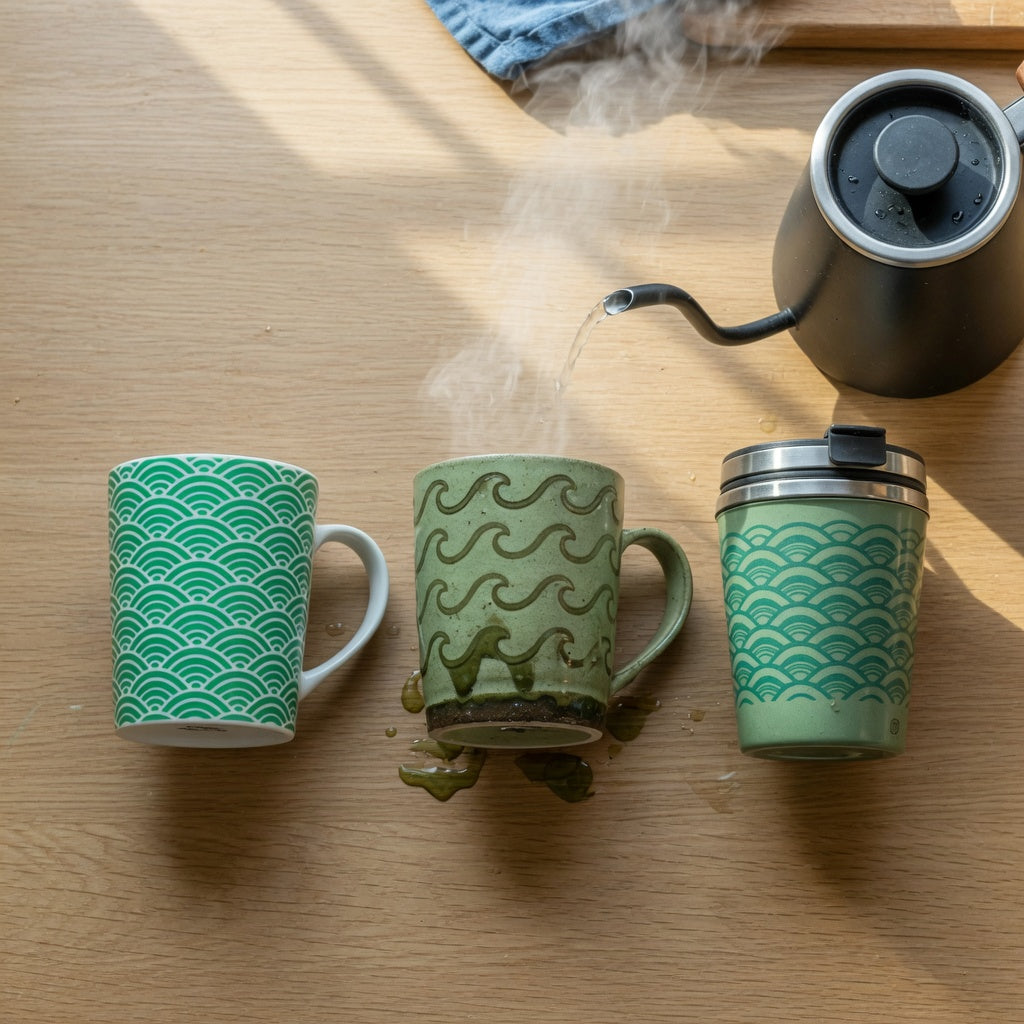
Pull three green wave mugs out of a shipping carton and the product photos stop telling the whole truth. The printed one looks razor-sharp under our stockroom LEDs, then goes noticeably flat under a warm kitchen bulb. The handmade stoneware pools almost black where the glaze thickens near the foot. The lidded travel cup sits visibly wider at the base than the two beside it — which is exactly the detail that decides whether it fits a car cup holder or wobbles in the console.
That gap between photo and daily use is what a proper green waves mug comparison is for. We pack and ship this category every week at CoffeifyMug, and the same questions arrive in order notes: how much will it actually hold, will the design survive the dishwasher, and is the glaze safe for hot coffee every morning. These are the seven checks we walk customers through before they click buy.
Three green wave mug formats, three very different buyers
Almost every wave-pattern mug on the market falls into one of three formats, and each suits a different drinker:
- Printed ceramic art mugs. A green-toned Great Wave motif or abstract coastal waves applied to a ceramic blank. The right pick when the design needs to match the photo — desk sets, couple's gifts, predictable restocks.
- Handmade stoneware with wavy or reactive green glaze. Glaze breaks over ridges and pools in the dips, so no two pieces land the same color. The right pick when a one-off matters more than a matching pair.
- Lidded travel versions. Ceramic or mixed-material cups built for commuting. Worth it only if the lid seal, base diameter, and cleaning routine check out against your actual car and bag.
| Format | Design method | Best fit | Main trade-off |
|---|---|---|---|
| Printed ceramic art mug | Wave artwork applied as a print or decal on a ceramic blank | Gifts, desk sets, matching the listing photo | Surface designs can dull under hard dishwasher cycles |
| Handmade wavy-glaze stoneware | Reactive green glaze fired onto the clay body | One-off pieces, open shelving, tea drinkers who like texture | No two pieces match; glaze can craze under thermal shock |
| Lidded ceramic travel mug | Wave print with a screw or push lid | Commuting, cup holders, desk-to-meeting drinks | Heavier than it looks, not insulated, base may not fit small holders |
If you want a ready-to-gift printed option with a clean wave motif, start with our Green Waves Coffee Tea Mug and confirm the capacity, care, and safety wording on the live listing before deciding. For other coastal and art-forward cups, browse the rest of our unique coffee mugs collection.
Equally worth saying what each format is not. A printed ceramic is the wrong tool for camping kits or a backpack that takes abuse — it will chip. Handmade stoneware frustrates anyone who needs six identical cups for an office pantry. And a ceramic travel mug is not a vacuum-insulated bottle; it is heavier, and it can still crack on tile.
Check 1: advertised capacity vs. the pour you actually drink
Listings like round numbers. Mornings do not cooperate. Most ceramic mugs leave deliberate headroom below the rim so coffee does not slosh on the walk from kettle to desk, which means an 11 oz or 15 oz claim is a ceiling, not your working fill line. Add oat milk, foam, or a steeping basket and the usable volume shrinks again.
When customers ask us which size to order, we ask three things back:
- Do you drink black coffee that can sit close to the rim, or do you load the mug with add-ins?
- Will it sit under a single-serve machine spout without crowding the drip tray?
- Are you measuring by the listing number or by the mug you already use every day?
Run the honest version of this test at home: fill your current favorite mug, note how far below the rim that pour lands, and compare it to the volume stated on the green waves listing. Our 12 oz coffee mug size comparison breaks down how tall versus rounded profiles change pour behavior and machine clearance — the same logic applies here.
Green waves mug comparison, check 2: will the design survive the dishwasher?
Hot liquids are almost never the failure point. Care and print method are. Three systems show up in this category, and they age very differently:
- Sublimation or surface prints. Ink sits in a coating on the blank. Sharp out of the box, but abrasive detergent and high-heat sanitize cycles can dull the wave detail over months of daily washing.
- Kiln-fired decals. The design fuses into the glaze and holds color longer — though metallic accents on some art mugs rule out microwave use entirely, no matter how the clay behaves.
- Reactive and wavy glazes. The color is the glaze itself, fired into the clay. Nothing to fade, but the glaze itself can craze.
This is not a paranoid worry — fading after dishwashing is a standard buyer question for printed wave-art mugs, because a dishwasher-safe rating describes the ceramic body far more reliably than the artwork on top of it. Treat the care line on the listing as a claim to verify rather than a guarantee, and if the design looks like a surface print, default to top-rack or hand washing for the first few weeks.
One defect worth knowing before any green waves purchase: crazing — a web of hairline fractures in the glaze, usually triggered by thermal shock like a hot mug rinsed under cold water. It can be invisible on arrival and surface after a few cycles. If a reactive-glaze mug develops crazing, stop microwaving it and contact the seller, because repeated thermal cycling can widen those lines toward the clay body.
Check 3: lead, cadmium, and food-contact wording that means something
Ceramic drinkware sold for hot beverages should meet leach limits, and there is a concrete benchmark: the FDA's action level for extractable lead from ceramic cups and mugs is 0.5 micrograms per mL of leaching solution, with the limit applying if any one of six units tested exceeds it. That is a regulatory ceiling — not a marketing badge, and not proof that any individual mug was tested.
- Look for explicit lead-free and cadmium-free language tied to drinkware, not décor.
- Prefer listings that state the glaze or print is intended for food contact.
- Treat unmarked pottery labeled as decorative-only as exactly that, however drinkable it looks.
Straight talk from our side of the counter: independent third-party leach-test results for specific wave-design mugs are rare. Manufacturer claims are common; lab documentation attached to an exact SKU is not. If the listing is silent on food safety, ask before you buy — especially for a mug a child will use, or one destined for acidic drinks like lemon tea, which stress glazes harder over time.
Check 4: handle heat, grip width, and where the mug actually lives
A beautiful wave print will not rescue a bad handle. Ceramic transfers heat, so a long microwave reheat can warm even a well-shaped handle; thick-handled stoneware stays more comfortable at the grip because there is more mass between liquid and fingers, but that same mass makes a full mug noticeably heavier. Narrow C-handles that look elegant in photos can pinch larger hands.
Desk realities our customers mention most:
- Low, wide mugs slide under monitor stands; tall latte shapes do not.
- Glossy green glazes show every fingerprint next to a keyboard.
- Textured wave exteriors hide smudges but hold soap film if rinsing is lazy.
Handle dimensions rarely get their own spec line, so check the listing photos and any dimension callouts for handle opening and overall height before ordering — especially as a gift for someone with big hands or a cramped desk.
Check 5: printed consistency vs. handmade one-offs
This is the taste call at the center of every wave-mug decision. Printed mugs win on repeatability: order two and they should match closely enough for a couple's gift. Handmade reactive glazes win on character — no two pieces pool color the same way. That variability is the whole point, and it is also the risk if the recipient expects a photo-perfect twin.
Choose printed when:
- You need a matching pair or a small set.
- The artwork itself is the reason for the purchase.
- You want one listing, one care instruction, one consistent answer.
Choose handmade when:
- The mug is destined for open shelving where a one-off shines.
- Color shifts under different lighting feel intentional, not defective.
- You accept that a replacement may never match.
Gifting either one? Our Green Waves Coffee Tea Mug gift ideas checklist covers recipient habits — office microwave access, dishwasher-only households, open shelving — that matter more than the motif. And if the wave theme appeals but the green palette does not, see our White Golden Waves mug comparison for the same questions in a different color story.
Check 6: when a lidded travel mug earns the commute
Travel versions justify themselves only if three things line up: a lid seal you trust, a base diameter that fits your cup holder, and a cleaning routine you will actually keep. In practice, many ceramic travel mugs run wide at the base, listings often omit the base measurement, and lids add their own headaches — screw threads trap tea oils in the gasket groove, and push lids can spit if the mug is filled too high before a hard brake.
Stay with an open ceramic mug if your drink lives on a desk or kitchen island; a lid you never latch is just another dish to wash. Go lidded only if you regularly leave the house with a hot drink, you have measured your holder, and the listing confirms leak behavior and lid care. A printed wave sleeve does not make a mug insulated — that assumption is the fastest route to a lukewarm commute.
Check 7: run this list against the live product page
Before buying any green waves mug, keep the listing open and confirm:
- Stated capacity, and whether your real pour leaves enough headroom.
- Microwave and dishwasher guidance on that exact page, plus any hand-wash preference for prints.
- Lead-free, cadmium-free, and food-contact wording aimed at drinkware.
- Handle opening and overall height against your hand and your machine clearance.
- Whether you need printed consistency or want handmade variation.
- For travel: base diameter, lid type, and lid cleaning steps.
- The return policy for crazing or transit chips — know your exit before you need one.
When those seven boxes check out, the Green Waves Coffee Tea Mug is the straightforward next step for a printed wave motif, and our unique coffee mugs collection is where to keep comparing if a different format fits your mornings better.
Frequently asked questions
What should a green waves mug comparison include before buying?
Five things: usable fill volume versus the advertised capacity, microwave and dishwasher guidance on the exact listing, lead- and cadmium-free food-contact wording, handle comfort and height, and whether you want a consistent printed design or a one-of-a-kind handmade glaze. Those factors decide daily satisfaction far more than the wave artwork does.
Will the print on a green waves ceramic mug fade in the dishwasher?
It depends on how the design was applied and how aggressive your cycles are. Surface prints can dull under abrasive detergent and high-heat sanitize settings, while kiln-fired decals and in-glaze color hold up better. Check the care line on the current listing and start with top-rack or hand washing if the artwork looks like a surface print.
How much does a green waves mug actually hold compared with the listed size?
Usually a bit less than the number on the page, because mugs need rim clearance so coffee does not slosh in hand, and add-ins like milk foam or a tea bag eat into that space. Measure the pour from the mug you already use, then compare it to the capacity stated on the listing instead of assuming a fill to the brim.
Are green wave ceramic mugs lead-free and safe for hot coffee and tea?
Many modern drinkware listings state lead-free and cadmium-free materials, but that language needs to be confirmed on the specific product page rather than assumed from the category. For reference, the FDA sets an action level of 0.5 micrograms per mL for extractable lead from ceramic cups and mugs under defined leach testing. If documentation is unclear, ask the seller before daily use.
When should I skip a green waves mug and pick something else?
Skip printed ceramics if the mug will ride in a backpack or camp kit — one knock on rock ends it. Skip handmade one-offs if you must match an existing set, and skip lidded ceramic travel mugs if your cup holder is narrow or you want true vacuum insulation. In those cases, start from our unique coffee mugs collection and pick the format that matches the job.
Read more

Unique Coffee Mug for Coffee Lovers: What Buyers Should Compare
We pack and shelve these pieces all week, so this guide compares what actually decides whether a unique coffee mug for coffee lovers stays in rotation: glaze food safety, honest 11–16 oz capacity, ...
Read more
Christmas Mug for Coffee Lovers Home Decor: What Buyers Should Compare
A christmas mug for coffee lovers home decor has to hold a real pour, survive the dishwasher, and still look right on the counter in February. Here is the capacity, material, safety, and styling co...
Read more
Leave a comment
This site is protected by hCaptcha and the hCaptcha Privacy Policy and Terms of Service apply.