
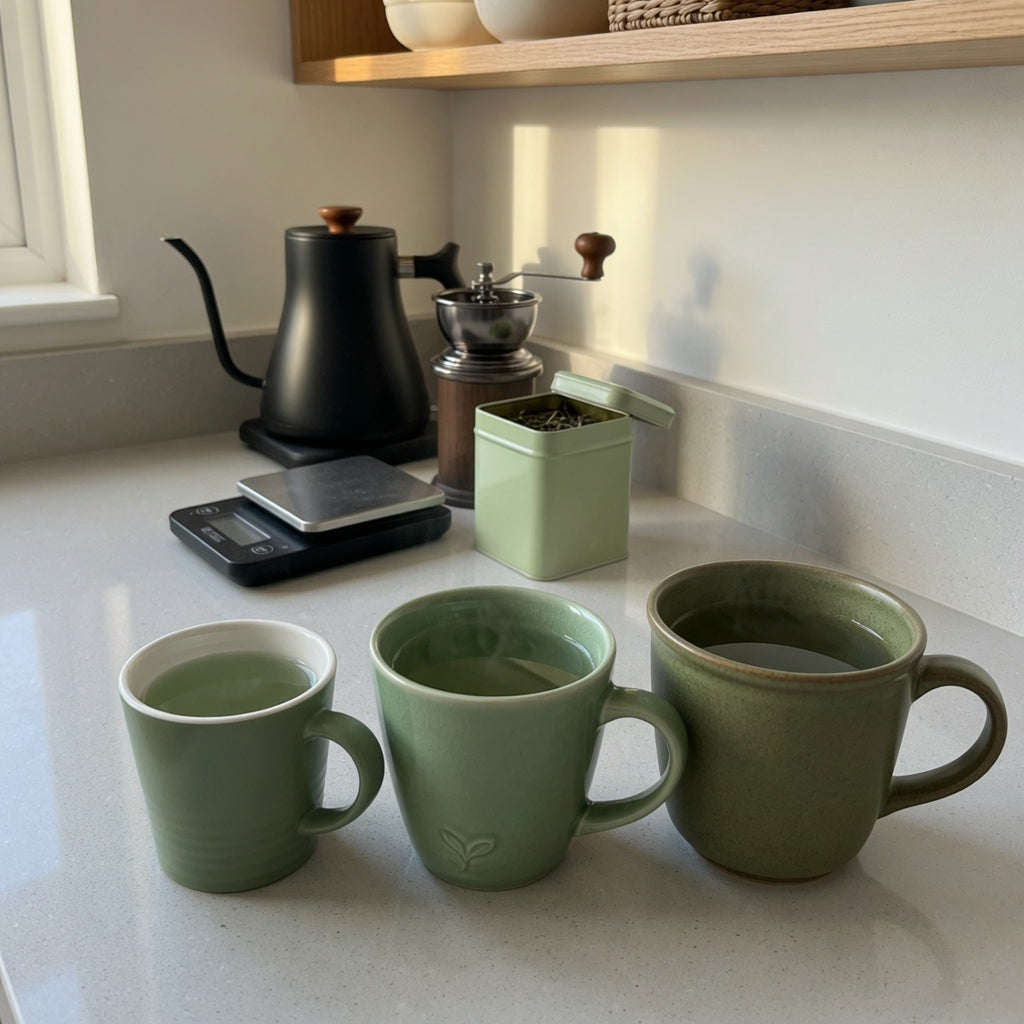
Green Tea Mug Home Coffee Station Practical Purchase Checklist
Reading time: about 9 minutes
The kettle, grinder, scale, filter holder, and spoon tray all fit until the mug arrives. Then its profile crowds a jar, it will not sit where you planned, or the drink is gone before the coffee setup is cleared. Our green tea mug home coffee station practical purchase checklist is designed for that exact counter-level decision: choose by verified listed capacity, the shape visible on the product page, and how often you are willing to refill.
In our experience selling this category, shoppers make better decisions after comparing their real setup rather than imagining an empty counter. This article covers three catalog options: the Retro at 170 ml, the Pleated at 200 ml, and the Emerald at 270 ml. We do not use those capacities to imply external dimensions, heat retention, brewing quality, material, origin, or appliance compatibility. Any care method or specification not stated on a product page should be confirmed before purchase.
How much usable space remains after the coffee gear is set up?
Measure the station while it is in working order. An empty section of counter can be misleading because the grinder lid may need lifting space, a kettle handle needs room to turn, and a scale or dripper may move during preparation. Place those items where you actually use them, then check the area reserved for the green tea mug.
- Measure the clear width: Record the space between the neighboring objects, including room for your fingers to reach the mug.
- Check vertical clearance: Measure from the counter to the shelf or cabinet above it. Do not rely on a product photograph to establish height.
- Follow the lifting path: Make sure the mug can be picked up without passing through a hanging utensil, shelf edge, or kettle handle.
- Check the storage route: If the mug moves between a cupboard and the station, confirm that the handle and visible profile suit that storage location too.
Capacity is not an external dimension. A 170 ml listing does not, by itself, prove that a cup is narrower or shorter than a 270 ml mug. Use the product photography to assess visible shape, and use stated measurements only if they appear on the relevant listing. If exact fit is essential and dimensions are not listed, confirm them before ordering.
Which listed capacity matches your refill routine?
The three verified capacity points give you a useful decision ladder. Test the amounts at home by measuring 170 ml, 200 ml, and 270 ml of water into a vessel you already use. This shows how much drink each number represents in your routine, although it does not establish the external size or practical fill line of another mug.
| Option | Listed capacity | Reader situation | Main trade-off |
|---|---|---|---|
| Retro Coffee Tea Cup | 170 ml | You prefer a smaller pour and do not mind returning to the kettle. | It holds the least of these three options, so frequent drinkers may refill sooner. |
| Pleated Coffee Tea Cup | 200 ml | You want a capacity between the smaller Retro and larger Emerald. | It does not minimize refills as much as the 270 ml option or keep the pour as small as 170 ml. |
| Emerald Coffee Tea Mug | 270 ml | You want the largest listed fill of the three and fewer interruptions. | It gives you more tea to finish per pour, without any implied heat-retention benefit. |
If none of those capacities settles the visual decision, compare the broader unique coffee mugs collection. Keep the same discipline: verify the listed facts on each page instead of assuming that a similar-looking mug has the same volume, dimensions, material, or care instructions.
Which visible shape belongs beside your kettle, jars, and dripper?
Shape affects how a mug looks and moves through a busy station, but product photos should not be treated as scale drawings. The Retro offers a retro cup-style profile, the Pleated is visually defined by its pleated exterior, and the Emerald presents a distinct mug silhouette. Those are useful style cues. They are not substitutes for external measurements.
We recommend comparing each listing with the mug already sitting on your counter. Note where your current mug works and where it causes friction: the handle may project toward the grinder, the body may sit too close to a tea tin, or the rim may be awkward to reach under a shelf. Use the product images to reject an unsuitable visible shape. Confirm dimensions separately if a close fit determines the purchase.
Exterior contours also matter during routine cleanup. A visibly pleated surface has more contours to wipe than a plain-looking surface, but that observation is not a dishwasher or care guarantee. If daily dishwasher cycles are part of your routine, look for explicit care instructions on the product listing before making that a selection factor.
How many refills can a shared coffee station tolerate?
A station used for both coffee and green tea has a workflow problem, not necessarily a compatibility problem. One person may be weighing coffee while another reaches for the kettle, or you may carry the tea to an office desk while leaving the coffee tools in place. Capacity changes how quickly you are likely to return to that shared area.
- Quick side pour: Start with the Retro 170 ml if you deliberately drink a smaller amount and are comfortable refilling. Its reason for consideration is the smallest listed capacity, not an assumed smaller footprint.
- Middle-volume routine: Start with the Pleated 200 ml if 170 ml feels brief but 270 ml is more than you normally finish. It provides a clear numerical midpoint among these options.
- Longer desk or breakfast session: Start with the Emerald 270 ml if avoiding another trip matters more than keeping the serving small. The larger capacity can reduce refills, but it does not promise that the tea stays hot longer.
Your mug choice also does not determine green tea temperature, steeping time, or flavor. Prepare the tea according to its own instructions and the equipment you use. This comparison addresses the container's listed capacity and place in the station, not brewing performance.
Use this green tea mug home coffee station practical purchase checklist
- Reset the station: Put the kettle, grinder, scale, coffee brewer, tea container, and utensils in their normal working positions.
- Measure the current mug: Record its external height, widest point, and handle projection. Note which dimensions work and which cause interference.
- Run the water-volume test: Measure 170 ml, 200 ml, and 270 ml into a vessel you know. Choose the amount you would willingly finish during one session.
- Count likely refills: Decide if returning to the kettle is part of the ritual or an interruption, especially during calls, breakfast, or shared use.
- Compare visible profiles: Review the Retro, Pleated, and Emerald product photography for the shape that suits your station. Do not infer exact scale from photographs.
- Verify purchase-critical unknowns: If material, external dimensions, microwave use, or dishwasher care affects your decision, confirm that information on the listing before ordering.
- Consider the recipient: For a gift, choose according to the recipient's usual serving size and refill habits, not your own. A visually impressive unboxing will not compensate for a capacity they rarely use.
- Inspect after delivery: Before first use, check the rim and body for chips or hairline cracks, inspect the handle joint if present, and place the mug on a level surface to check for an unstable base. Follow the care directions supplied with the product.
Which of the three is the clearest starting point?
Choose Retro 170 ml for deliberate smaller pours
The Retro is the practical starting point for a shopper who likes a shorter serving and accepts more frequent refills. That makes sense for green tea taken alongside coffee rather than as the main drink of a long morning. It is not the strongest choice for someone who already finds kettle trips disruptive, and its capacity should not be used to assume a specific counter footprint.
Choose Pleated 200 ml for a measured middle option
The Pleated fits the shopper who wants more than 170 ml but does not routinely finish 270 ml. Its listed capacity is the reason it occupies the middle position, while its visible pleated treatment provides a separate style decision. If exterior contours are inconvenient to wipe in your routine, a plainer visible shape may suit you better.
Choose Emerald 270 ml to reduce refill frequency
The Emerald is the clearest option for someone who wants the largest listed capacity in this comparison. It suits a longer breakfast or desk session where another trip to the station is inconvenient. It is not ideal if you often leave part of a larger drink unfinished, and the 270 ml listing does not establish insulation or heat retention.
Where does this comparison stop being useful?
These three options cover listed capacities from 170 ml to 270 ml. If you need more than 270 ml, regularly prepare a large iced tea, or want a sealed travel vessel, use a product category that explicitly provides the required volume or features. Do not stretch this checklist into a recommendation for a use it was not built to assess.
The available verified facts also do not support claims about origin, authenticity, material, brewing results, or unlisted care performance. A shopper who needs confirmed microwave use or repeated dishwasher cleaning should wait for explicit care information rather than relying on appearance. The same rule applies to fitting a mug under a particular coffee machine: measure the available space and compare it with stated product dimensions.
Frequently asked questions
What should a green tea mug home coffee station practical purchase checklist include?
Include listed capacity, your preferred number of refills, the visible mug shape, measured counter clearance, and any purchase-critical care requirements. Capacity and shape can narrow the choice, but external dimensions and care compatibility must be verified separately when they are not listed.
Is a 170 ml green tea mug too small for a home coffee station?
It is too small only if 170 ml is less than you normally want before refilling. Measure that amount of water at home and compare it with your usual serving. The Retro 170 ml is best considered by shoppers who actively prefer smaller pours.
Should I choose the Pleated 200 ml or Emerald 270 ml?
Choose the Pleated if 200 ml is closer to the amount you normally finish and its visible exterior suits your setup. Choose the Emerald if the larger 270 ml listed capacity is more useful because you want fewer refills. Neither capacity tells you how long the drink will remain hot.
Can I assume these mugs are dishwasher or microwave safe?
No. Do not infer care compatibility from a mug's appearance, name, or capacity. Check the current product listing for explicit instructions, and confirm the information before purchasing if dishwasher or microwave use is essential.
Can I assume one of these mugs will fit under my coffee machine?
No appliance-fit claim is made here. Measure the machine's available cup clearance and compare it only with confirmed external mug dimensions. If those dimensions are unavailable, contact the store before treating the mug as compatible.
Set your current mug on the station, record the space it uses, and run the 170 ml, 200 ml, and 270 ml water test. Then open the product page that matches your refill preference and verify any remaining size or care requirement before placing the order.
More from our blog
Read more

Green Ceramic Coffee Mugs: Home Station Purchase Checklist
Measure counter clearance, working capacity, handle space, and storage fit before choosing a green ceramic mug. This checklist also explains which product details to verify, common ceramic defect p...
Read more
Wassail Mug Home Coffee Station Practical Purchase Checklist
Measure your usual pour, available counter space, and grip needs before choosing a wassail mug. This checklist compares the verified 400 ml, 440 ml, and 480 ml capacities while identifying the fit ...
Read more
Leave a comment
This site is protected by hCaptcha and the hCaptcha Privacy Policy and Terms of Service apply.