
Green Tea Mug Everyday Mug Rotation Product Shortlist Guide: 3 Sizes
Reading time: about 9 minutes
A mug rotation often breaks down at the drying rack. The cup that calls for another refill during a meeting gets left behind, while a larger option may take more of the cabinet space intended for two daily mugs. This green tea mug everyday mug rotation product shortlist guide starts with that practical friction and compares only three verified variables: listed capacity, visible shape, and refill preference.
As the team that handles and presents these options in our store, we start by asking where the mug waits between pours: on a small kitchen counter, beside a laptop, or in a cabinet where handles already compete for clearance. We do not turn style names into claims about material, care, origin, durability, or tea performance. If a detail is not verified, we treat it as unknown.
Which capacity matches your refill rhythm: 170 ml, 200 ml, or 270 ml?
Start with the serving you actually finish, not the amount you imagine using on an ideal morning. The three listed capacities create a useful progression from frequent smaller pours to fewer larger ones.
| Option | Reason to choose it | Reason to skip it |
|---|---|---|
| Retro 170 ml | You prefer smaller servings and do not mind returning to the kettle during a tea session. | Refill interruptions bother you during calls, reading, or focused work. |
| Pleated 200 ml | You want the middle listed capacity because your routine shifts between short kitchen pours and desk use. | You already know that you strongly prefer either the smallest serving or the fewest refill trips. |
| Emerald 270 ml | You would rather pour more at once and interrupt a work or reading block less often. | You regularly leave part of a larger serving unfinished or prefer returning for smaller pours. |
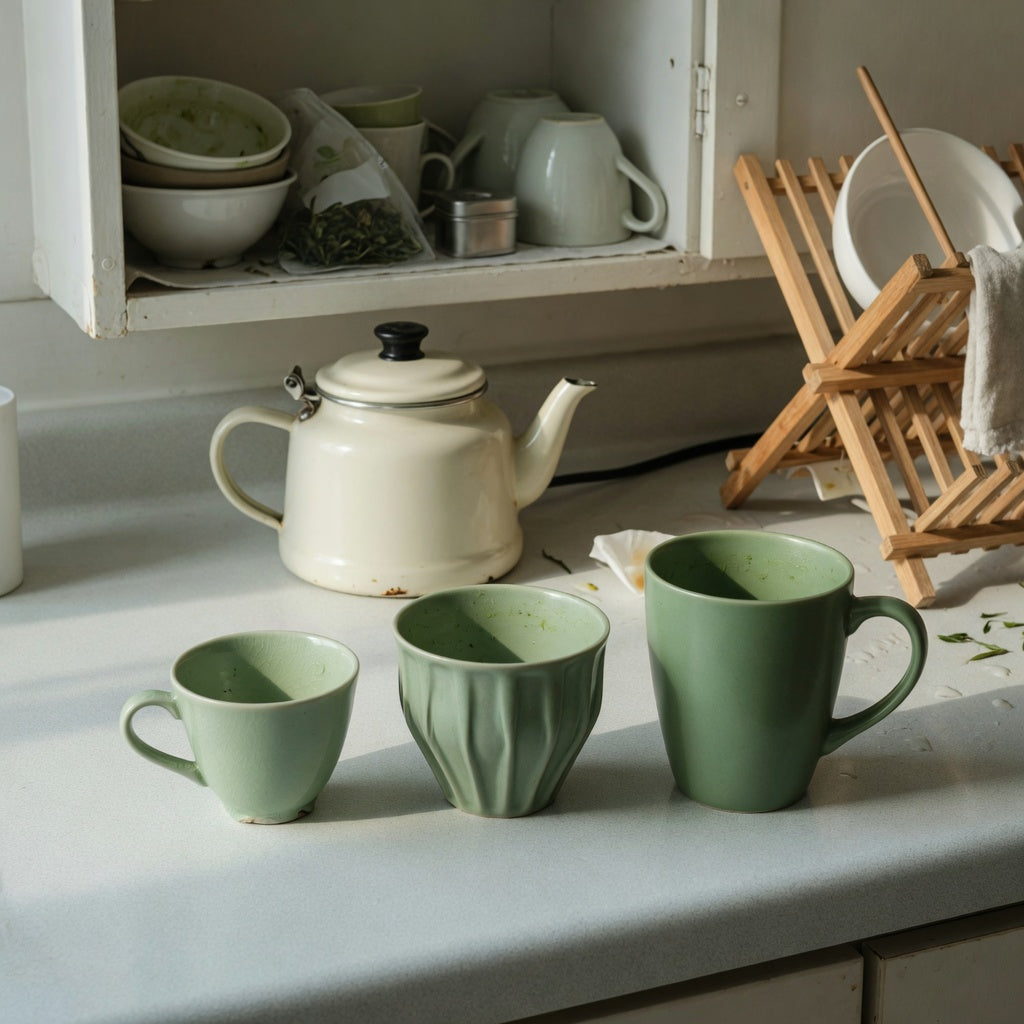
The capacity order is firm: 170 ml, 200 ml, then 270 ml. The exterior footprint is not. A 170 ml capacity does not prove that a cup is the shortest or narrowest, and 270 ml does not establish exact cabinet clearance. Capacity describes volume, not external dimensions.
Green tea mug everyday mug rotation product shortlist guide by daily scenario
Each option needs a defined job in the rotation. If you cannot name the job, it probably does not belong on the shortlist.
Short early pours: Retro 170 ml
Choose the Retro if you make a smaller serving, finish it, and are comfortable pouring again before moving into the next part of your morning. Its verified 170 ml capacity is the lowest of the three, making it the logical starting point for a frequent-refill routine. Review the visible profile on the Retro Coffee Tea Cup product page against the shelf or drying-rack position you plan to use. Skip it if another kettle trip during a meeting or breakfast would become irritating.
A middle-size kitchen-to-desk option: Pleated 200 ml
The Pleated is the practical middle candidate for someone who alternates between the kitchen counter and a desk but has no strong preference for the lowest or highest capacity. Its listed volume is 200 ml, and the pleated treatment is the clearest visible design distinction among these options. That texture is a style cue, not a verified promise of grip or handling performance. Choose the Pleated Coffee Tea Cup if you want a middle serving and like its visible shape; skip it if you prefer a smoother-looking profile or need one of the two capacity extremes.
Longer desk sessions: Emerald 270 ml
The Emerald has the largest listed capacity in this shortlist at 270 ml. Choose it when pouring more at once matches your routine and fewer refill decisions matter more than using the lowest-capacity option. That recommendation is about serving volume only; it is not a claim about heat retention or brewing performance. Skip the Emerald Coffee Tea Mug if you prefer finishing smaller portions or need external measurements that have not been verified here.
If all three choices force the wrong compromise, do not buy the closest one simply to complete a set. Shoppers who need a different visible silhouette, another capacity, or more room for a drink with ice should compare the broader unique coffee mug collection.
How should cabinet shelves and drying racks change the shortlist?
A capacity number is not a dimension. In a crowded kitchen, body width, total height, base shape, rim profile, and handle projection can matter as much as the amount a mug holds. Product photos help you compare visible shapes, but images may not be presented at identical scales.
- Put your current daily mug in the intended cabinet position. Check usable height and depth, including the shelf lip and cabinet door.
- Look for handle collisions with neighboring mugs and note how many stable positions remain on the drying rack.
- Compare the visible silhouette of each shortlisted product. If a small difference in clearance decides the purchase, confirm exact external measurements rather than estimating them from capacity or photography.
Do not assume that any of these mugs will nest or stack just because their capacities differ. No stackability claim is part of this comparison. The practical choice is the option whose visible shape appears compatible with your setup and whose fit can be confirmed when exact clearance is critical.
Should one capacity cover every day, or should two mugs split the job?
A stable routine may need only one model. A week that alternates between quick breakfast pours and long desk sessions can justify two capacities, provided both have a clear role and a realistic storage position.
- Mostly short sessions: Put the Retro 170 ml first and add another option only if refill frequency becomes inconvenient.
- Mixed daily use: Use the Pleated 200 ml as the middle candidate, then compare it with the smaller or larger option based on your busiest days.
- Mostly uninterrupted work blocks: Start with the Emerald 270 ml and skip smaller capacities unless you also have a distinct short-pour routine.
- Strongly different morning and afternoon habits: Compare the Retro and Emerald as a two-role rotation, accepting that two visibly different shapes require separate storage checks.
Buying all three before observing your routine can create the same crowded shelf you were trying to fix. In our experience, a stronger shortlist contains no more than two finalists, each with a specific time, place, and refill pattern attached to it.
What do the product details prove, and what still needs checking?
A useful commercial comparison separates listed facts from reasonable use-case guidance. Here is the boundary we use for these three products.
| Decision point | Supported in this shortlist | Not claimed |
|---|---|---|
| Capacity | Retro is 170 ml, Pleated is 200 ml, and Emerald is 270 ml. | Exact exterior dimensions cannot be inferred from those capacities. |
| Visible shape | The product imagery can be reviewed for body, rim, base, handle, and decorative profile. | Photos alone do not prove stackability, exact scale, balance, or grip. |
| Refill preference | A lower capacity suits shoppers who accept more frequent pours; a higher capacity suits those who prefer fewer refill trips. | Capacity does not prove better flavor, brewing performance, or heat retention. |
| Material and care | Current product information and packaging should be checked before use. | This article does not assign a material or promise dishwasher, microwave, or other care compatibility. |
A 270 ml mug provides more listed volume than a 170 ml cup. That fact alone does not establish better durability, easier care, or a better cup of green tea.
If material or cleaning method is a deciding factor, pause the purchase until that information is confirmed on the current listing or packaging. A daily rotation is not practical if its care requirements do not match your household routine.
Use this two-minute shortlist before you buy
Run this check during an ordinary weekday rather than a special tea session. Real interruptions produce a more useful answer.
- Count how many servings you finish and how many times you return to the kettle.
- Start with 170 ml for frequent smaller pours, 270 ml for fewer larger pours, or 200 ml for the middle position.
- Open the matching product pages and compare their visible body, base, rim, and handle profiles.
- Check the cabinet, counter, desk, and drying-rack position where the mug will spend time.
- Write one reason to choose and one reason to skip each finalist.
- Remove any mug that lacks a distinct job, even if you like its appearance.
Used this way, the green tea mug everyday mug rotation product shortlist guide leaves you with one or two defensible options rather than three vague possibilities. The winning mug should fit your actual serving preference, have a visible shape worth checking against your storage, and eliminate a specific annoyance in your routine.
Frequently asked questions
What does the green tea mug everyday mug rotation product shortlist guide compare?
It compares the verified 170 ml, 200 ml, and 270 ml capacities, the visible shapes shown on the product pages, and the number of refills you prefer. It does not rank the mugs by unverified material, durability, care compatibility, heat retention, or brewing performance.
Is a 170 ml green tea mug too small for daily use?
It is too small if frequent refills interrupt your routine. It can be a sensible everyday option if you prefer finishing a smaller serving before pouring again. The deciding factor is your refill tolerance, not a universal minimum mug size.
Should I choose 200 ml or 270 ml for an office desk?
Choose 200 ml if you want the middle capacity and can refill without disrupting your work. Choose 270 ml if fewer refill trips matter more and you normally finish the larger serving. Check the visible external shape separately because capacity does not confirm how much desk space either option occupies.
Are the Retro, Pleated, and Emerald mugs dishwasher-safe?
This shortlist does not make a dishwasher-safety claim or assign a specific material to the products. Check the current product information and packaging before using a dishwasher, microwave, or other cleaning and heating method.
What if I need more than 270 ml or room for ice?
None of these three should be the automatic choice if your normal serving requires substantially more than 270 ml or extra space for ice. Move to the wider mug collection and apply the same capacity, visible-shape, and storage checks to a more suitable option.
Next step: Put 170 ml, 200 ml, and 270 ml beside your usual refill count, cross out any option with no clear daily role, and open the surviving product page. If none survives, continue the comparison in the collection rather than settling for the wrong capacity.
More from our blog
Read more
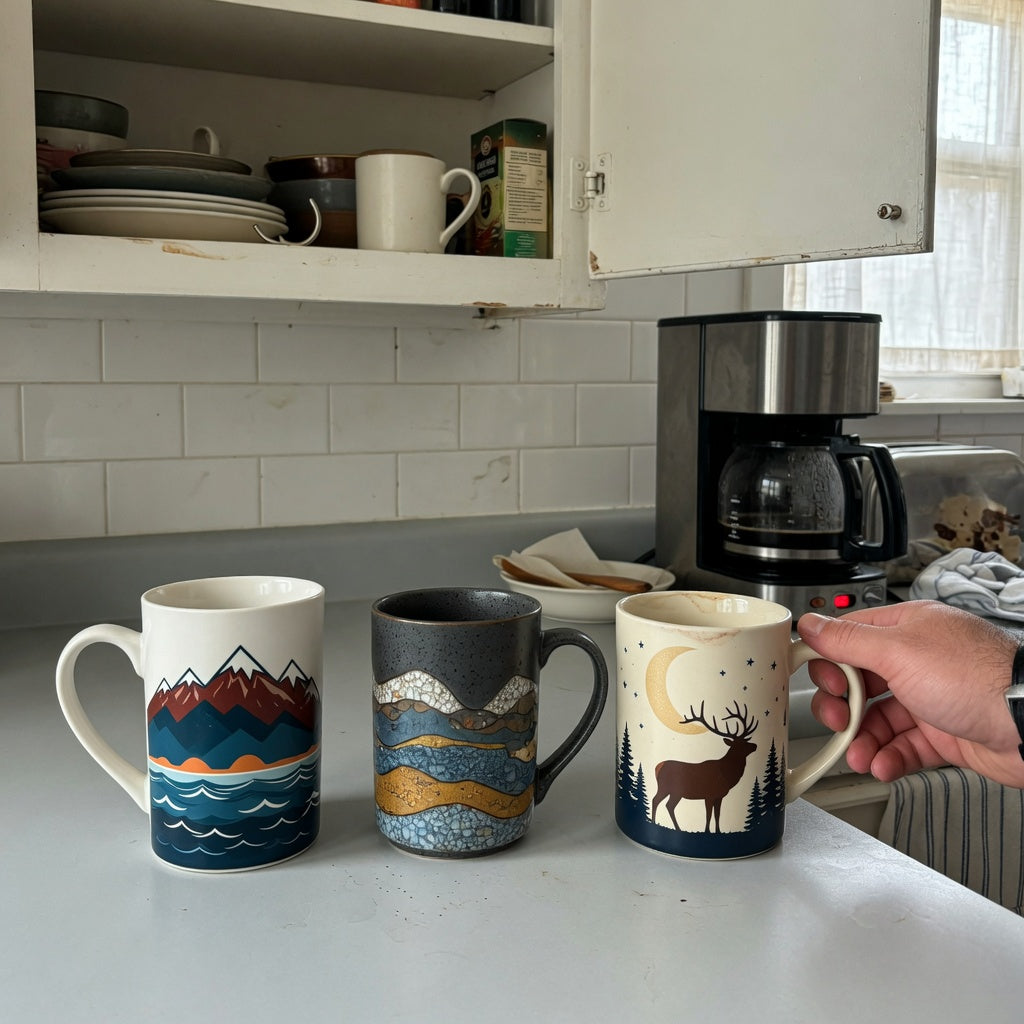
Coffee Mug Gift Ideas for Him: Everyday Mug Rotation Shortlist
Compare Mountain Sea, The Rock, and Elk and Moon by the role each could fill in his mug rotation. Use cabinet, handle, capacity, care, and theme checks to decide which design belongs on the shortli...
Read more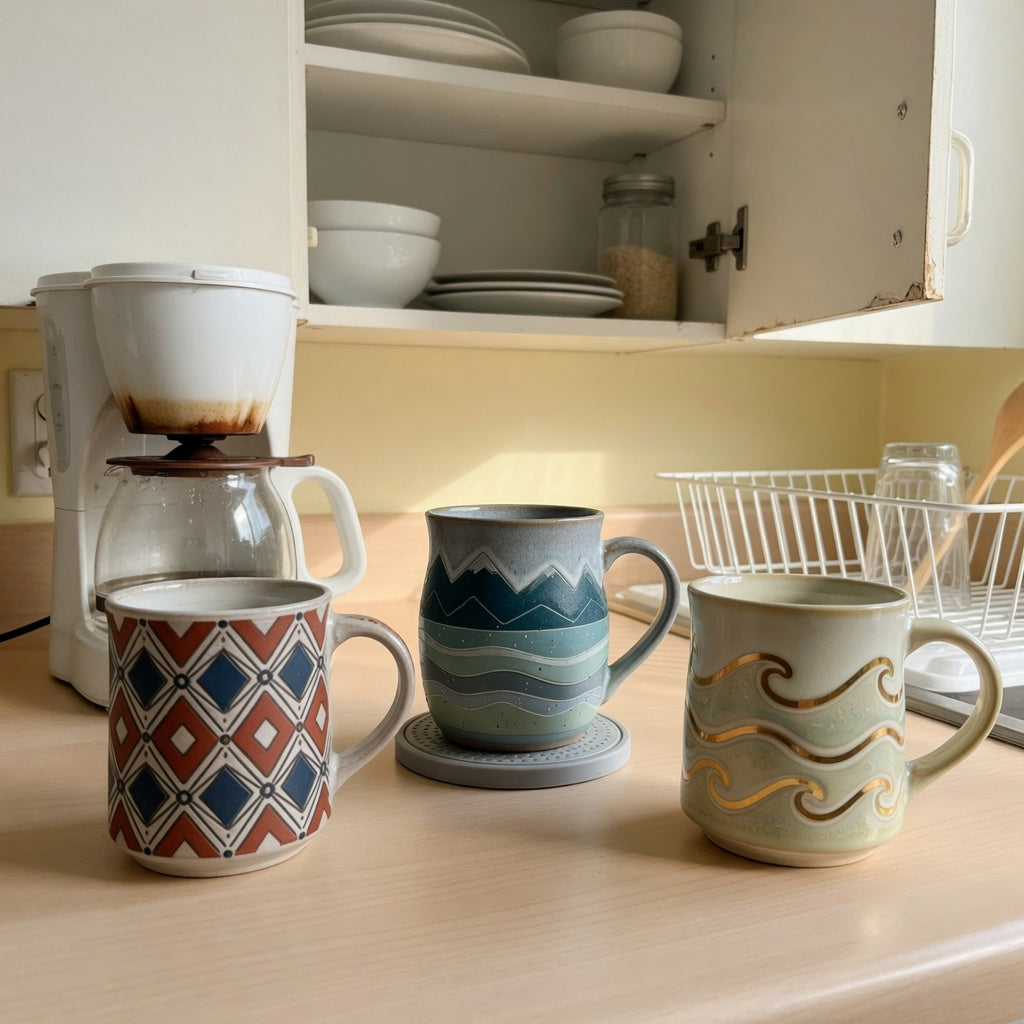
Unique Pottery Coffee Mugs: Everyday Mug Rotation Purchase Checklist
Audit a real week before adding another mug. This checklist compares cabinet fit, handle and rim comfort, care requirements, common ceramic inspection points, and three CoffeifyMug style directions...
Read more
Leave a comment
This site is protected by hCaptcha and the hCaptcha Privacy Policy and Terms of Service apply.