
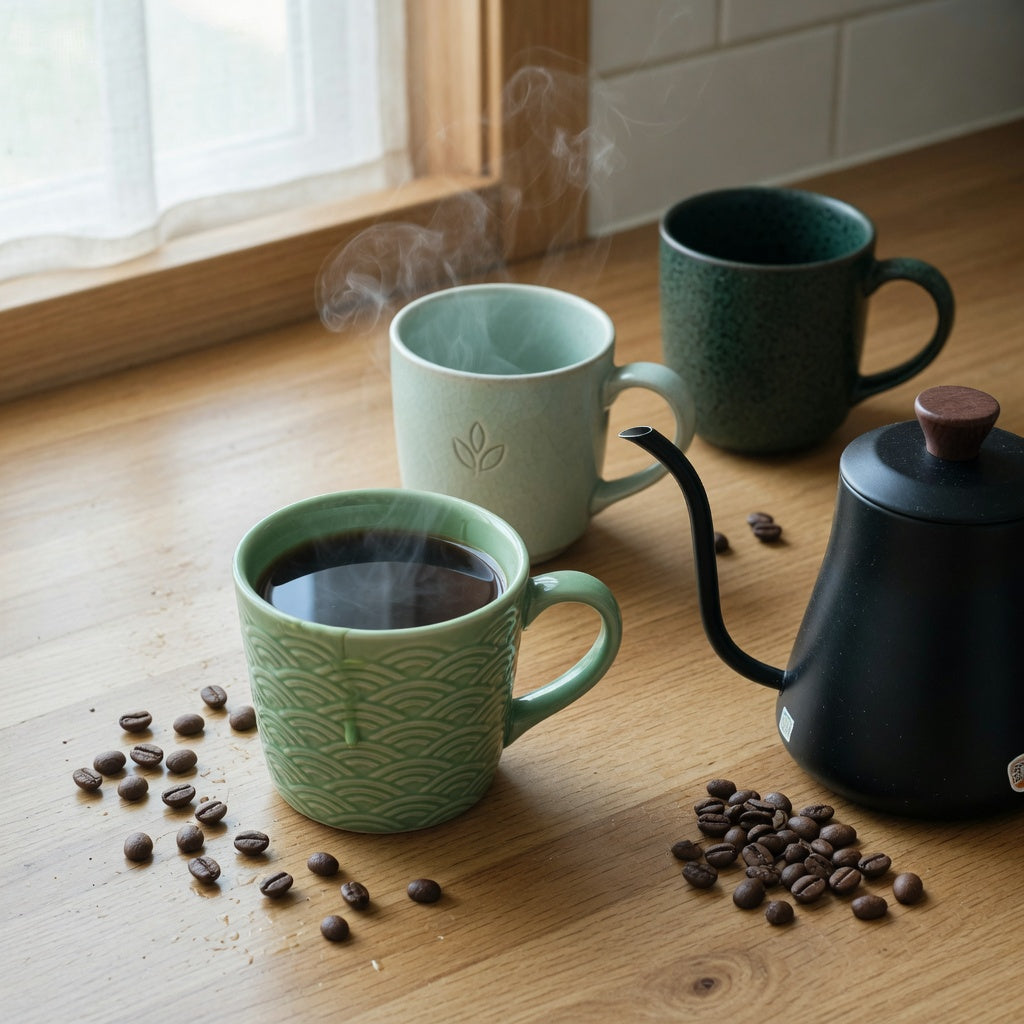
Green Ceramic Mug for Coffee Lovers: 6 Comparisons Before You Buy
Reading time: about 9 minutes
Two shoppers can describe the exact same green glaze in completely different words. One calls it sage. The other swears it's olive. We hear that split weekly in our store, and it captures what buying a green ceramic mug for coffee lovers actually involves: pinning down which green you're getting, then confirming the mug behind the color can survive daily coffee service.
Color earns the click. Capacity, glaze safety, heat retention, and handle fit decide whether the mug earns a permanent spot beside the coffee maker or gets demoted to the pencil cup. These are the six comparisons we run before any piece reaches our shelf — the same list we'd hand a friend before they ordered.
Which shade of green are you actually buying?
'Green' stretches from pale celadon — a jade-toned glaze with centuries of history in East Asian ceramics — through mint and sage to emerald and near-black hunter. Reactive glazes blend several of those tones in a single piece, with drips and speckling that make each mug its own small event.
Screens distort all of it. Warm indoor bulbs push green toward yellow; cool daylight nudges it toward blue. Reactive glazes also shift from piece to piece within one kiln load, so two photos of the 'same' mug can both be honest.
- Read the specific shade name, not just 'green.'
- Favor listings with natural-light photos from more than one angle.
- Buying handmade? Expect batch variation, and ask for a photo of the current batch if the exact tone matters.
- Matching existing dishes? Order one mug before committing to a set.
That variability is why we tell shoppers eyeing our Green Waves coffee tea mug to check the current listing photos rather than a saved screenshot — listings get refreshed as stock changes, and that page is also where the exact capacity and care details live. If the goal is a mug nobody else at the office owns, compare unique coffee mugs side by side in our collection before you decide.
What capacity matches your actual pour?
Capacity mismatch is the most common mug regret we hear about, and it usually starts with ordering on looks. A 12 oz mug photographs generously, then looks conspicuously small next to a 16 oz pour from a big drip machine. Match the mug to what you actually brew:
- 3–4 oz — espresso, doppio, cortado. Demitasse territory; look for a sturdy little handle.
- 8–12 oz — cappuccino, flat white, standard diner cup.
- 12–16 oz — the everyday sweet spot for most drip and pour-over drinkers.
- 18–28 oz — latte fans and big-morning-pour people. Also soup-at-the-desk people.
Weight is the hidden variable. Liquid runs roughly a pound per 16 fluid ounces, so a filled 16 oz mug carries a full pound before the ceramic adds its own heft. Thick stoneware bodies can add a lot more. A handle should clear two fingers comfortably; if you like wrapping your whole hand around it, look for a taller loop. And if your grip is small or arthritic, weigh the empty mug in your mental math before ordering oversized — the filled version only gets heavier.
| Your drink | Capacity to look for | Trade-off to weigh |
|---|---|---|
| Espresso or cortado | 3–4 oz | Drinks fast; tiny handles can feel fiddly |
| Drip or pour-over | 12–16 oz | Check clearance under single-serve brewers |
| Latte or large pour | 18–28 oz | Heavy when full; won't fit car cup holders |
Committed to the jumbo life? Our breakdown of a 480 ml big mug versus travel options covers what a 16-ounce-plus ceramic habit feels like day to day. Whichever size wins, scroll the listing for a stated capacity in ounces or milliliters — it's the fastest reality check there is.
Is a green ceramic mug for coffee lovers food-safe for hot, acidic pours?
Coffee is hot and mildly acidic, which makes it a mild solvent. Poorly formulated or vintage glazes can leach lead or cadmium into exactly the drink you sip all morning. Regulators take this seriously: the FDA sets an action level of 0.5 µg per milliliter of leaching solution for lead in ceramic cups and mugs, tested under ASTM C738 or equivalent methods.
Some research context worth knowing. In one pilot study of ceramic mugs already known to contain lead, lead leached into coffee at 0.2 to 8.6 µg per liter, and one of the five mugs produced an estimated daily dose above California's 0.5 µg/day Maximum Allowable Dose Level. That's a handful of worst-case mugs, not a verdict on retail ceramic — but it's a fair argument for buying from sellers who publish food-safety information instead of shrugging at it. One nuance: FDA action levels and California's Prop 65 safe-harbor levels are separate frameworks with different thresholds, so check which standard a listing actually cites.
Before checkout, confirm:
- The listing states the glaze is food-safe, lead-free, and cadmium-free.
- There's no metallic trim on the rim or handle if you microwave — metal trim can spark.
- The interior glaze is intact. Cracks and deep crazing on food-contact surfaces trap coffee oils and bacteria, and they're hard to sanitize.
- Unlabeled vintage or thrift finds get desk duty, not hot coffee.
- Run the microwave sanity test: heat a mug of water for 60 seconds beside a control cup. If the ceramic itself gets hot while the water stays warm, the body is absorbing energy — keep that mug out of the microwave.
Stoneware or porcelain: which body keeps coffee hot longer?
Body matters more than color here. Thick stoneware is thermal mass — preheated, it holds drinking temperature noticeably longer and feels substantial in the hand. The costs: it weighs more, and a chip exposes the tan clay underneath. Porcelain is thinner, lighter, denser, and more resistant to coffee staining, but pour into it cold and it gives its heat back to the room faster.
One habit beats both bodies: preheat. Swish hot tap water in the mug, dump it, pour. It buys minutes of drinking temperature either way. And if your stoneware has an unglazed foot ring — charming, and common on handmade pieces — keep a coaster under it, because that raw clay ring can mark wood tables.
Handmade glaze character or factory consistency?
Handmade green mugs carry glaze flow that varies piece to piece: drips, speckles, slight size tolerance, the occasional tiny pinhole near the foot. On the exterior, that's character. On the interior food surface, it's a different story — re-read the safety checklist above before celebrating the texture.
Verify three things before buying: a vitrified body, published care ratings, and a clear food-safe statement. A confident maker answers 'is it dishwasher and microwave safe?' without hedging. Factory-made mugs deliver an identical shade across a full set at a lower per-piece cost. Zero surprises — and, frankly, less soul. Our unique ceramic mug buying guide walks through the full inspection routine we run before anything reaches our shelf.
Green gifts well, too, because the shade spectrum maps to personality: mint for bright kitchens, deep forest for moody offices. Boxed pairs and mug-and-saucer sets land better than singles. One tip — warn the recipient that a handmade shade varies slightly from the photo. It heads off the awkward 'this looks different' moment. Our gifting checklist covers the rest.
Which daily habits keep a green glaze looking new?
- Dishwasher on the top rack with mild detergent — unless the maker says hand-wash, then believe them.
- Skip abrasive scrubbers and powder cleansers on reactive and matte glazes; months of cycles will dull the surface.
- Rinse soon after drinking. Coffee oils build up, and light celadon tones show staining first — a baking-soda paste lifts them without harsh chemicals.
- Avoid thermal shock. A fridge-cold mug meeting boiling liquid is how hairline cracks start.
- Retire the mug from coffee duty when a crack runs through the interior glaze, a chip appears on the rim, or crazing spreads across the food surface.
When a green ceramic mug is the wrong choice
Honest limits, because no mug suits everyone:
- Commuters, look away — there's no lid, and car cup holders rarely cooperate. A lidded tumbler will serve you better on the road.
- Iced-coffee desk sippers who want lids and straws will fight ceramic daily.
- Anyone who needs an exactly matching set delivered fast should skip handmade glazes entirely.
- A 22 oz stoneware mug is genuinely heavy filled. There's no shame in a lighter standard size — the right tool isn't always the prettiest one.
A 60-second checklist before you pay
- Shade name reviewed; natural-light photo checked.
- Capacity matches your actual pour, not your aspiration.
- Food-safe glaze statement present; no metal trim if microwaving.
- Dishwasher and microwave ratings confirmed on the current listing.
- Handle fit and filled weight pass the grip test.
- The seller's stance on glaze variation is clear.
Run any candidate through that list before paying. If the wave-motif green fits your counter, the Green Waves listing holds its exact current specs; if you'd rather weigh several greens and shapes at once, start in our unique coffee mugs collection.
Frequently asked questions
Are green ceramic mugs microwave and dishwasher safe?
Many are, but the rating belongs to the specific mug, not the color, so confirm both on the current listing. Pass on metallic rim trim if you microwave, since metal can spark. When in doubt, run the one-minute water test — if the ceramic itself gets hot while the water stays warm, hand-wash it and keep it out of the microwave.
What capacity should a green ceramic mug for coffee lovers have?
Match it to your pour: 3–4 oz for espresso, 12–16 oz for standard drip or pour-over, and 18–28 oz for lattes or oversized morning refills. Most daily drinkers settle in the 12–16 oz band because it matches a normal brew cycle without overflow.
Will the green shade match the product photos?
Sometimes closely, sometimes not. Reactive and handmade glazes shift with kiln position and lighting, so treat photos as a representative shade rather than a guarantee. If the exact tone matters for a shelf or a set, message the seller for a photo of the current batch before ordering.
How can I tell if a glaze is food-safe for hot coffee?
Look for an explicit food-safe or lead-free and cadmium-free statement from the maker, and check that the interior glaze is intact, with no crazing or exposed clay. The FDA maintains a 0.5 µg/ml lead action level specifically for ceramic cups and mugs, which is why reputable sellers publish compliance. Unlabeled vintage mugs make better pen cups than coffee vessels.
Does thick stoneware really keep coffee hotter than porcelain?
Thicker walls mean more thermal mass, so a preheated stoneware mug holds drinking temperature longer than a thin porcelain cup of the same size. Preheating with hot tap water makes a bigger difference than most upgrades — swish, dump, pour. For heat retention over hours, a vacuum-insulated travel tumbler still wins; ceramic wins on feel, microwave use, and how it looks on the desk.
Sixty seconds with the checklist above, then a slow scroll through our unique coffee mugs collection — that's the whole decision.
Read more

Best Gift Mug for Coffee Lovers Home Decor: 7 Checks Before You Buy
A gift mug gets judged twice: at the unwrap, then on the shelf every morning after. We sell these daily — here's the seven-check comparison covering capacity, handle fit, glaze safety, and wooden-h...
Read more
Christmas Mugs For Coffee Lovers: What Buyers Should Compare
A store-side comparison guide to christmas mugs for coffee lovers: usable capacity for lattes and cocoa, ceramic vs glass vs travel builds, handle fit, print durability in real dishwashers, and a p...
Read more
Leave a comment
This site is protected by hCaptcha and the hCaptcha Privacy Policy and Terms of Service apply.