
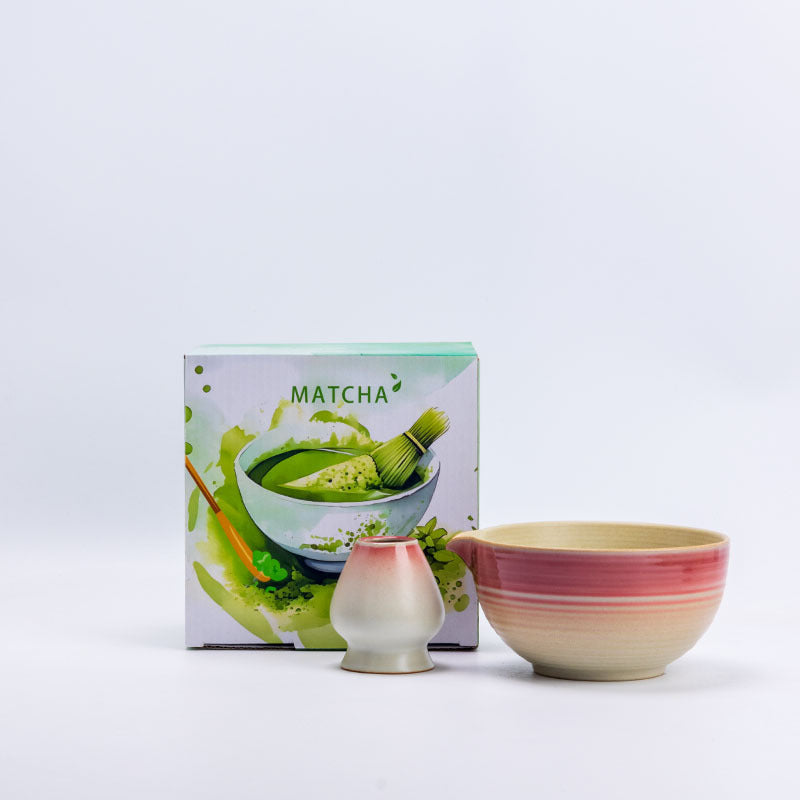
Gradient Glaze Matcha Bowl Set: Ribbed Rings vs Scalloped Bloom
Reading time: about 7 minutes
Two ceramic bowls, one purchase decision, and the difference is easy to miss in a thumbnail. In our catalog, a rounded bowl wrapped in fine horizontal rings sits one page away from a petal-scalloped bowl with an embossed flower hidden inside the base. Neither listing publishes a capacity figure or care instructions — what actually separates them is rim style, the direction each gradient fades, and how much decoration you want on the inside. We compare both sets below so your gradient glaze matcha bowl set decision comes down to rim, fade and box contents, with the fine print already in hand.
The short version: the Gradient Ribbed Matcha Bowl and Whisk Holder is the quiet one — fine horizontal rings, soft color gradients, a small pouring lip, and a choice of Burgundy, Pearl, Pale Pink or Sky Blue. The Scalloped Gradient Matcha Bowl and Whisk Holder Set is the decorative one — a softly scalloped rim, a shaped pouring spout, a flower motif inside the bowl, and a glaze that fades from pale cream into Pink, Green, Blue or Yellow Pink. Each is a two-piece ceramic set. Neither includes a whisk.
Which gradient glaze matcha bowl set fits your rim style?
Start with the edge, because it drives everything else. The ribbed bowl's listing leans into restraint: rings and gradients that, in its own words, "bring a quiet finish to this ceramic matcha pair." If your kitchen runs plain — unpatterned dinnerware, simple cabinets — that exterior texture reads as detail rather than decoration, and the small pouring lip keeps the rim line clean.
The scalloped bowl does the opposite. Its rim undulates, the listing calls the pair "a distinctive setting for your matcha ritual," and the embossed flower inside means the decoration follows you to the last sip. Choose this one when the bowl is meant to anchor the tray rather than support it. Both arrive in pictured presentation packaging — the ribbed set in a presentation carton, the scalloped set in an illustrated English-language matcha box — which matters if the set is a gift.
What's actually in the box — and what isn't
Both product pages are explicit about contents, and this is where careless gift purchases go wrong. Each set includes exactly two ceramic items:
- One ceramic matcha bowl — ribbed with a small pouring lip, or scalloped with a shaped pouring spout, depending on the set.
- One ceramic whisk holder — coordinating on the ribbed set, matching on the scalloped set. What the holder is sized to hold isn't specified in either description, so verify fit if you have a particular whisk in mind.
Not included: a bamboo whisk (chasen), a scoop, or any other preparation tool. The ribbed listing states that no bamboo whisk or other preparation tools are included; the scalloped listing says the whisk and other tools are sold separately. If you're building a first matcha kit, add the tools to the same order — our new catalog collection gathers the current lineup in one place. Boxed ceramics without tools, on the other hand, make a clean gift for someone who already owns a whisk.
Tone-on-tone fade or cream-to-color: how the gradients differ
The two color systems work differently. On the ribbed set, you pick one named colorway — Burgundy, Pearl, Pale Pink or Sky Blue — and the soft gradient shifts happen within it, layered over those horizontal rings. On the scalloped set, every colorway is two-tone by construction: the glaze fades from pale cream into Pink, Green, Blue or Yellow Pink. The cream section lightens the whole composition and makes the fade direction obvious at a glance; the ribbed body keeps its single colorway dominant across the rings. Neither is a flat, solid color, so if full saturation is your goal, neither set delivers it.
The full side-by-side:
| Feature | Gradient Ribbed set | Scalloped Gradient set |
|---|---|---|
| Exterior surface | Fine horizontal rings | Softly scalloped rim |
| Pouring feature | Small pouring lip | Shaped pouring spout |
| Interior detail | Not mentioned in the listing | Embossed floral detail inside the bowl |
| Gradient style | Soft color gradients within one colorway | Pale cream fading into the chosen color |
| Colorways | Burgundy, Pearl, Pale Pink, Sky Blue | Pink, Green, Blue, Yellow Pink |
| Set contents | One bowl + one ceramic whisk holder | One bowl + one ceramic whisk holder |
| Packaging | Pictured presentation carton | Illustrated English-language matcha box |
| Glaze variation | “Gradients vary naturally between pieces” | “Can vary slightly between pieces and under different lighting” |
Because glaze finishes behave differently depending on how decoration is applied, our guide to embossed vs reactive glaze matcha tea sets is useful background before you commit to a colorway.
Small pouring lip or shaped spout: what the listings actually say
The ribbed description spends three words on its feature: "small pouring lip." The scalloped listing calls its feature a pouring spout, and later a shaped pouring spout. That is the entire published detail. Neither page describes drip behavior, spout height, or how each rim handles a full bowl, and shared vocabulary about pouring does not mean the two rims perform the same. If controlled decanting matters to you, treat pour performance as an open question and review the listing photos or ask us before ordering. For how wall contours change a bowl's overall footprint, our breakdown of ceramic matcha bowl shapes — ringed, petal, fluted and ridged profiles covers the geometry basics.
Will your bowl match the photo? What each listing admits about variation
Both listings disclose variation, in slightly different words. The ribbed page: "Glaze gradients vary naturally between pieces." The scalloped page: "Color and glaze appearance can vary slightly between pieces and under different lighting." Practically, that means color depth and the point where a fade begins may sit near — not exactly on — what the product photos show, and the listings describe this as normal glaze behavior rather than a defect. The scalloped page even flags lighting itself as a variable, which is worth remembering if you're comparing colorways on a phone screen under warm kitchen bulbs.
Two honest boundaries. First, variation doesn't make your bowl a certified one-of-a-kind piece, nor does it guarantee dramatic differences; it means the finish simply isn't uniform by specification. Second, no listing promises a repeatable finish, so we can't assure you that a second order will match your first. If matched bowls for two people matter more than the gradient look itself, weigh that before checkout.
What these sets are not good for
- Complete starter kits. No whisk, scoop or frother comes in either box, so a beginner receives ceramics only and tools are a separate purchase.
- Spec-driven purchases. Capacity, bowl dimensions and dishwasher or microwave designations are absent from both descriptions. Don't assume them from category norms — confirm on the live listing.
- Matched pairs. The published variation wording means identical twin sets aren't something anyone can guarantee.
- Documented pour performance. Neither the lip nor the spout carries published pouring claims, so precision-pour buyers should verify before relying on either rim.
Frequently asked questions
Does a gradient glaze matcha bowl set include a bamboo whisk?
No. Both versions ship as two-piece sets: one ceramic matcha bowl and one ceramic whisk holder. The ribbed listing states that no bamboo whisk or other preparation tools are included, and the scalloped listing says the whisk and other tools are sold separately.
Which colors does the ribbed gradient glaze matcha bowl set come in?
Burgundy, Pearl, Pale Pink or Sky Blue, each listed as a gradient. The scalloped set instead fades from pale cream into Pink, Green, Blue or Yellow Pink. The colorways don't overlap, so palette preference alone can settle the choice.
Can I expect two sets to match exactly?
No exact match is promised. The ribbed listing says glaze gradients vary naturally between pieces, and the scalloped listing notes appearance can vary slightly between pieces and under different lighting. Treat a twin finish as unavailable rather than guaranteed.
Are capacity or care instructions published for either bowl?
Not in the descriptions we work from. Neither listing gives fluid measurements, dimensions, or dishwasher and microwave designations, so verify those details on the live product page before buying if they matter to your decision.
Which bowl pours better, the lip or the spout?
The listings don't compare pouring performance. The ribbed bowl has a small pouring lip; the scalloped bowl has a shaped pouring spout. Since neither page publishes drip or flow claims, choose based on rim style and check the photos or ask us for current detail.
Next step: pick the rim, then pick the fade
- Quiet, texture-led styling with single-colorway names: order the Gradient Ribbed Matcha Bowl and Whisk Holder in Burgundy, Pearl, Pale Pink or Sky Blue.
- Flower detail, cream-to-color fade and illustrated gift packaging: order the Scalloped Gradient Matcha Bowl and Whisk Holder Set in Pink, Green, Blue or Yellow Pink.
- Either way: add your whisk separately, expect gentle piece-to-piece glaze shifts, and browse the rest of the new catalog before deciding. Our guide to textured ceramic matcha bowl sets widens the field with hammered, fluted and banded forms if neither gradient suits you.
Read more
Ceramic vs Glass Tea Set: Charcoal Service for Two or Four
We compare two complete tea sets piece by piece: a textured charcoal ceramic service for two in a ribbon-closure presentation box, and a clear glass side-handle pot for four in Green or Ice Gray wi...
Read more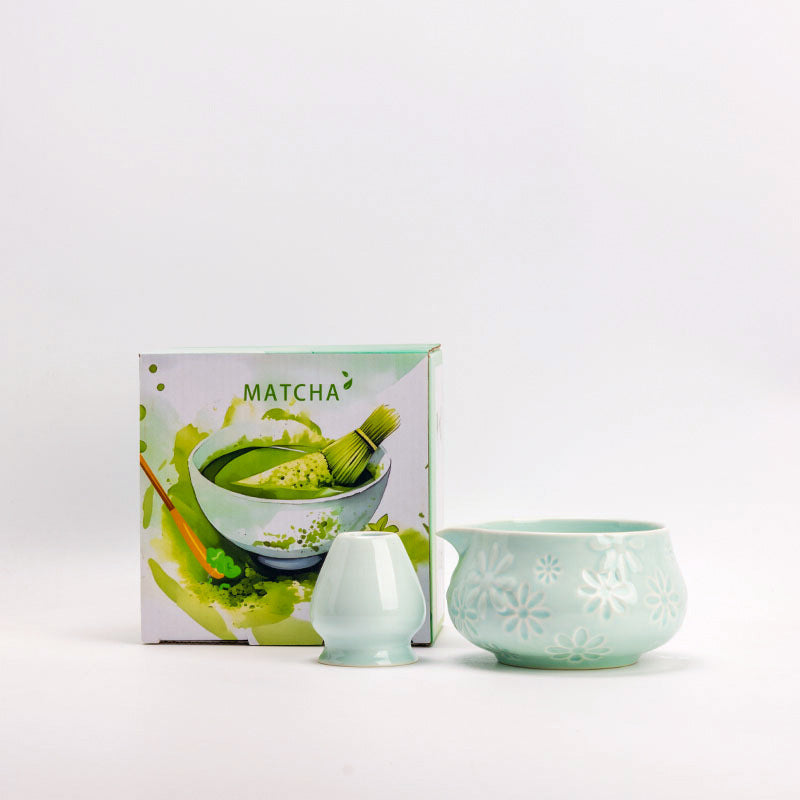
Textured Relief Matcha Bowl and Whisk Holder: Raised Design Guide
We compare four textured relief matcha bowl and whisk holder sets — embossed flower bands, curved relief rows, floral relief, and mountain motifs — by relief placement, finish families, box styles,...
Read more
Leave a comment
This site is protected by hCaptcha and the hCaptcha Privacy Policy and Terms of Service apply.