
Gift Coffee Mug Tray: Compare Fit, Materials, and Care
Reading time: about 10 minutes
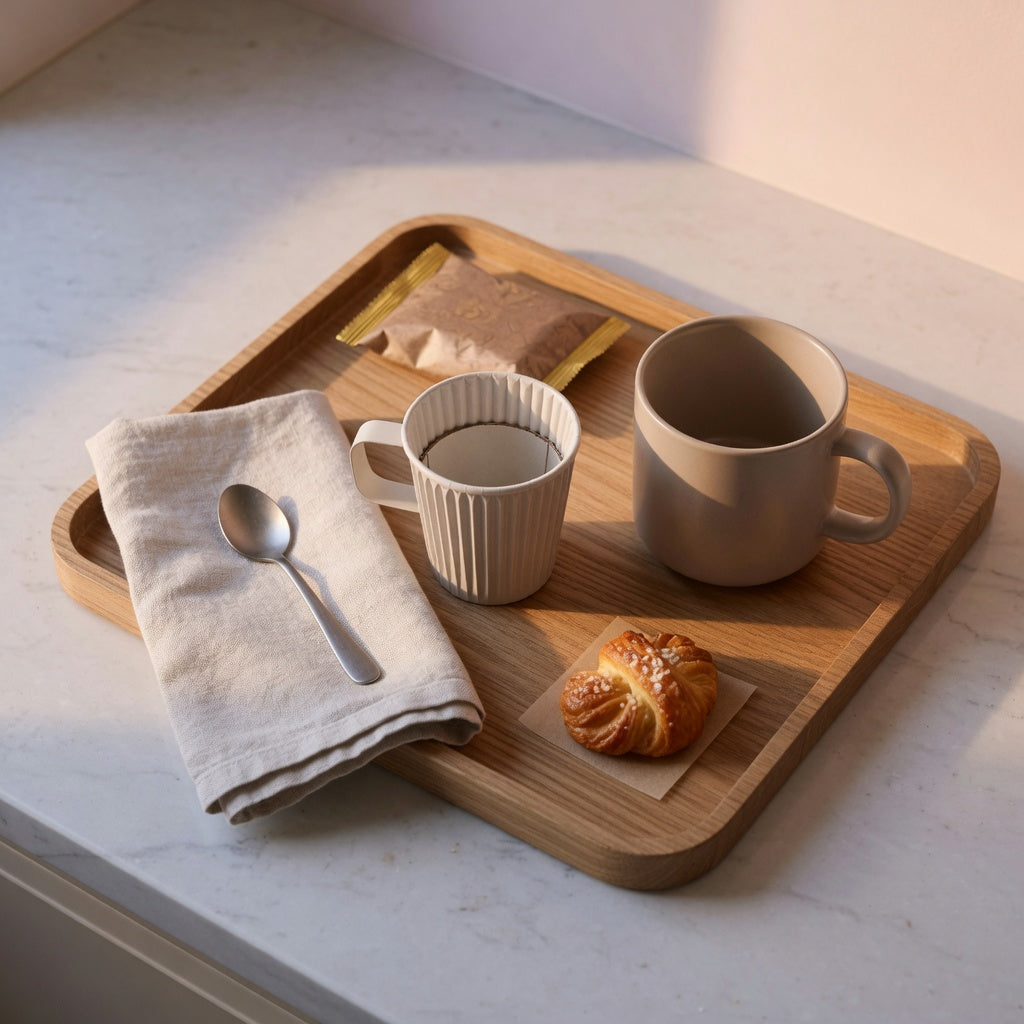
A mug can fit the tray in a styled photo and still fail on a real desk. Turn the handle outward and it hits the rim; add a teaspoon and the snack space disappears. We see this when our team stages gifts on kitchen counters and office desks. A gift coffee mug tray works only when the usable well, mug footprint, and cleaning routine agree. The decorative match matters, but it comes after fit, stability, and care.
In our store, we start with the vessel the recipient will actually drink from. If you are still comparing silhouettes, browse our coffee mugs for gifts, choose the mug, and then size the tray around the current listing details. This order helps prevent a handsome tray from becoming a display-only piece because the mug handle occupies all the snack space.
Which gift coffee mug tray layout fits the recipient's routine?
Picture the set in use the morning after it is opened. The right layout depends less on the occasion printed on the card and more on where the recipient drinks.
- Kitchen-counter coffee: One mug, a spoon, and a small biscuit need a compact usable well. An oversized board can make a one-mug gift look sparse and take up unnecessary counter space.
- Office desk: Prioritize a stable base, an easy-wipe surface, and a shallow rim that will not interfere with a mouse or keyboard. Check for feet or a non-slip underside rather than assuming the staged desk photo proves stability.
- Two-person service: Allow room for two mug bases and two handle arcs. Two mugs may technically fit side by side while remaining awkward to lift.
- Breakfast in bed: A raised rim and practical carry handles matter more than a delicate decorative edge. The trade-off is a larger tray that needs more storage.
- Coffee-station or entryway display: A smaller decorative tray can work as a catchall, but it is not a substitute for a full serving tray if the recipient plans to carry a filled mug and plate.
The best gift coffee mug tray is therefore not automatically the largest one. It is the smallest tray that comfortably accommodates the intended setup without forcing the handle, spoon, or food against the rim.
Which measurements prevent a cramped tray?
Mug capacity does not predict tray fit. Two cups holding similar amounts can have very different bases, body widths, and handles. Ask for usable inner dimensions rather than relying only on the tray's outside length.
- Measure the mug base: Record the diameter or the widest points if the foot is not circular. The base must sit fully on a flat surface rather than crossing a groove or raised edge.
- Measure to the handle tip: Check the full width from the opposite side of the mug to the outermost part of the handle. This is often the measurement that styled photos conceal.
- Check the usable tray well: Record the inner length and width inside the rim. Also check rim height so fingers can reach the handle without scraping the edge.
- Lay out the complete service: Include the spoon, coaster, packet, or pastry the recipient will actually use. A tray that fits an empty mug may still be too small for the intended gift.
If you have the mug in hand, make a quick paper template. Set it on paper, mark the base and handle tip, then place a real spoon and snack beside it. This exposes crowding more reliably than adding mug diameters on a calculator.
For someone who prefers clean, rounded forms and a simple one-mug counter setup, use the Round Coffee Tea Mug page as a starting point, then match the tray to any current measurements shown. For a more detailed housewarming or tea-service presentation, compare the Pleated Coffee Tea Cup; a restrained tray can keep a pleated silhouette from competing with extra accessories. Do not assume these products share capacity, material, or care instructions. Check each live listing when ordering, and ask if a measurement you need is not shown.
Ceramic, wood, glass, or melamine: which pairing fits?
Most mug-and-tray gifts combine materials, which means they also combine care rules. Match the pairing to the recipient's habits rather than choosing on appearance alone.
| Set type | Where it fits | Verify before buying | Main trade-off |
|---|---|---|---|
| Ceramic or porcelain mug with wood tray | Housewarmings and permanent coffee stations | Mug care label, wood species, finish, and inner tray size | The mug and tray usually need different cleaning routines; soaked wood may stain or warp |
| Ceramic or porcelain mug with matching tray | Coordinated tea or coffee service | Microwave and dishwasher status for each piece | Can be heavier, and hard pieces may chip if they knock together |
| Borosilicate glass mug with wood or glass tray | A visually light, modern presentation | That the listing actually specifies borosilicate glass, plus its heat and dishwasher guidance | Still breakable, and fingerprints remain visible |
| Mug with melamine tray | Busy desks, break rooms, or casual outdoor service | Food-contact use, heat limits, and microwave restrictions | Durable for carrying but less formal; the surface may show scratches |
A coordinated set is not necessarily a single care unit. If the recipient puts everything through the dishwasher, wood may be a poor fit. If they are careful with hand washing but prone to knocking dishes together, an all-ceramic set may be the less forgiving choice.
Which food-contact and heat claims should you verify?
Terms such as premium glaze, non-toxic, and food grade are not complete answers. We look for component-specific instructions and supporting documentation, especially when a set combines a drinking vessel with a painted, stained, or sealed tray.
The FDA action level for lead leaching from ceramic cups and mugs is 0.5 micrograms per milliliter of leaching solution. That is an action level for leaching, not a promise that a glaze contains zero lead and not a blanket certification for every item from a seller. Ask what current test documentation supports any ceramic safety claim, and do not use drinkware marked for decorative use only.
For wooden serving surfaces, Food Code provision 4-101.17 permits hard maple or an equivalently hard, close-grained wood in specified applications. This does not certify an individual tray or its finish. If unwrapped food will touch the surface, ask for the wood species, finish type, and confirmation that the finished face is intended for direct food contact.
- Microwave: Confirm the mug and tray separately. Metallic decoration, wood, and many tray materials require different treatment.
- Dishwasher: Check whether the claim covers the decoration as well as the mug body. Never extend a mug's care label to the tray by assumption.
- Food contact: Ask whether the tray is intended for unwrapped food or only for carrying cups and sealed packets.
- Testing: Request documentation rather than treating a hangtag as laboratory evidence.
Our handling checks can catch a wobbling base, rough glaze, poor packaging, or an unstable layout. They cannot prove chemical-leaching compliance. That requires reliable supplier or laboratory documentation.
How should mixed materials be cleaned after a spill?
A dishwasher-safe mug paired with a hand-wipe tray is still a hand-care gift. Before buying, decide whether the recipient will realistically separate the pieces after every use.
- Separate the components: Remove packets and utensils, then wipe coffee from the tray promptly. Leaving a wet mug on wood overnight can mark the finish.
- Clean the mug by its label: Start with mild dish soap and a non-abrasive sponge. If dishwasher use is approved, load it so the rim and handle cannot strike another hard item. Avoid steel wool on printed, glazed, or metallic decoration.
- Treat coffee rings cautiously: On plain glazed ceramic, a small baking-soda paste may help after normal washing, but test gently and follow the maker's instructions. Do not scrub a decorated surface as if it were bare ceramic.
- Hand-wipe wood unless told otherwise: Use a damp cloth, dry the top and underside, and avoid soaking. Do not automatically apply mineral oil to painted, lacquered, or veneered trays; use only the care product recommended for that finish.
Inspect the set before gifting. A sharp rim chip, hairline crack, rough mug foot, tray wobble, lifted veneer, or cloudy finish is not a charming handmade variation. It is a reason to request a replacement or choose another set.
Will the gift box protect the mug handle?
Gift-ready packaging should do more than look tidy. The mug body, handle, and tray need to remain separated during normal shipping and unboxing.
- The insert should support the mug body without making the handle carry the load.
- A soft divider should prevent the mug and hard tray edge from striking each other.
- Spoons, scoops, and coffee packets should be contained rather than left loose beside the mug.
- The closed box should not press directly on the mug rim or force the cup into a cavity that is too small.
After delivery, gently tilt the closed package. If pieces move, repack it before presenting or reshipping. Personalization works best when the spelling and recipient are certain; it is less suitable for a shared office gift or a present that may need to be exchanged. If you add coffee or sweets, keep them in sealed original packaging with dates and ingredient information visible, and leave enough room for the mug to sit flat.
Who is better off without a mug-and-tray set?
A mug-and-tray set is not good for every coffee drinker. A different format is usually more useful for:
- Commuters who need a lidded, cup-holder-friendly vessel rather than a serving surface
- People with very limited cupboard, dorm, or shared-office storage
- Dishwasher-only households if the chosen set includes hand-wipe wood
- Patios or family spaces where fragile glass or ceramic is likely to receive rough handling
- Recipients who already own a coffee-station tray and only need a replacement mug
In those situations, spend the budget on the mug they will use rather than adding a tray that becomes cupboard clutter.
A 60-second checkout check for home, desk, or housewarming use
Run through these points before placing the order:
- The recipient's use is clear: counter, desk, two-person service, breakfast, or display.
- The mug base and full width to the handle tip are known.
- The tray's usable inner length and width are confirmed, not estimated from outside dimensions.
- The complete layout leaves room for the intended spoon, coaster, or snack.
- Each component has separate microwave, dishwasher, and cleaning instructions.
- Food-contact and ceramic safety claims have documentation appropriate to the intended use.
- The packaging immobilizes the mug, protects the handle, and contains loose accessories.
If fit or care remains unclear, pause before checkout. A styled photograph can show color and presentation, but it cannot replace inner measurements or component-specific care labels.
Frequently asked questions
What size tray do I need for one mug and a snack?
There is no universal size because mug bases and handles vary. Measure the tray's usable inner length and width, then compare them with the mug's base, full width to the handle tip, and the space needed for a spoon or snack. A paper layout is the quickest way to test the arrangement before ordering.
Is a gift coffee mug tray dishwasher and microwave safe?
Only if each component is specifically labeled for that use. A mug may be dishwasher- or microwave-safe while its wood, melamine, metal-accented, or decorated tray is not. Do not heat or machine-wash the complete set based on a care claim that applies only to the cup.
Is a wooden coffee serving tray food-safe?
Ask whether the finished surface is intended for direct food contact, what wood species was used, and how it should be cleaned. Hard maple and equivalently hard, close-grained woods are permitted in specified Food Code applications, but that does not certify every wooden tray. Unless the maker says otherwise, hand-wipe the tray and dry it promptly.
How can I verify lead-safety claims for a ceramic gift mug?
Ask what test documentation supports the claim for the current product. The FDA action level for lead leaching from ceramic cups and mugs is 0.5 micrograms per milliliter of leaching solution; a simple lead-free label is not the same as test evidence. Skip drinkware labeled for decorative use only.
Should I choose the mug or the tray first?
Choose the mug first unless the recipient already owns one you can measure. Record the base size, full width to the handle tip, and care instructions, then find a tray with compatible inner dimensions and cleaning requirements. If the mug is still undecided, compare silhouettes in our gift-ready mug collection before committing to a tray.
More from our blog
Read more

Workday Ceramic Mug: Compare Size, Care, Handle, and Heat
This practical guide compares a workday ceramic mug by usable capacity, handle geometry, glaze, care labels, heat, lids, and desk fit. It also separates official Workday merch from artisan pottery ...
Read more
Filled Mug Gift Ideas for Coworkers: Compare Mug, Fillers & Fit
Compare mug dimensions, handle and rim comfort, care notes, office-safe artwork, dietary-aware DIY fillers, and wrapping. We also flag when a mug is likely to become clutter and a different gift is...
Read more
Leave a comment
This site is protected by hCaptcha and the hCaptcha Privacy Policy and Terms of Service apply.