
Geometric Coffee Mug Weekend Coffee Product Shortlist Guide: 3 Picks
Reading time: about 10 minutes
A 300 ml mug and a 350 ml mug can look almost interchangeable on a phone screen, then support very different Saturday routines. One may suit a measured single pour beside breakfast; the other provides more listed capacity for a larger drink or added milk. This geometric coffee mug weekend coffee product shortlist guide starts with those practical differences: capacity, ceramic material, visible shape, cupboard space, and the way the mug will move between kitchen counter, table, home desk, and sink.
In our store, we see geometric mugs chosen as much for their presence on the table as for the drink inside them. The useful question is not which one is the most eye-catching. It is which form earns its place during a slow breakfast, a refill while reading, or a gift unboxing where the recipient still needs a mug that fits an ordinary routine. We narrowed this shortlist to three current forms and made the reasons to choose or skip each one explicit.
How much capacity does a slow weekend serving really need?
Measure the finished drink you already make before comparing product photos. Pour your normal coffee into a measuring jug, add the milk or water you usually include, and note the total in milliliters. Listed capacity is useful for comparing mugs, but it is not the same as the comfortable level you will carry across the room. Most people need some open space below the rim.
- 300 ml: The listed capacity of the Rhombus Coffee Tea Mug, approximately 10.1 US fluid ounces.
- 320 ml: The listed capacity of The Gradient Coffee Tea Mug, approximately 10.8 US fluid ounces.
- 350 ml: The listed capacity of the Planet Coffee Tea Mug, approximately 11.8 US fluid ounces.
Those ounce conversions are rounded; use the milliliter figure on the product listing as the primary comparison. If your usual serving is 240 ml of coffee plus 30 ml of milk, the arithmetic total is 270 ml, making all three worth considering. If your recipe reaches 320 ml before milk, the 300 ml and 320 ml listings are likely too close for comfortable carrying, while the 350 ml option still needs to be checked against your preferred headroom.
Our geometric coffee mug weekend coffee product shortlist guide: which three fit?
| Product | Listed capacity | Material | Visible form | Best starting scenario |
|---|---|---|---|---|
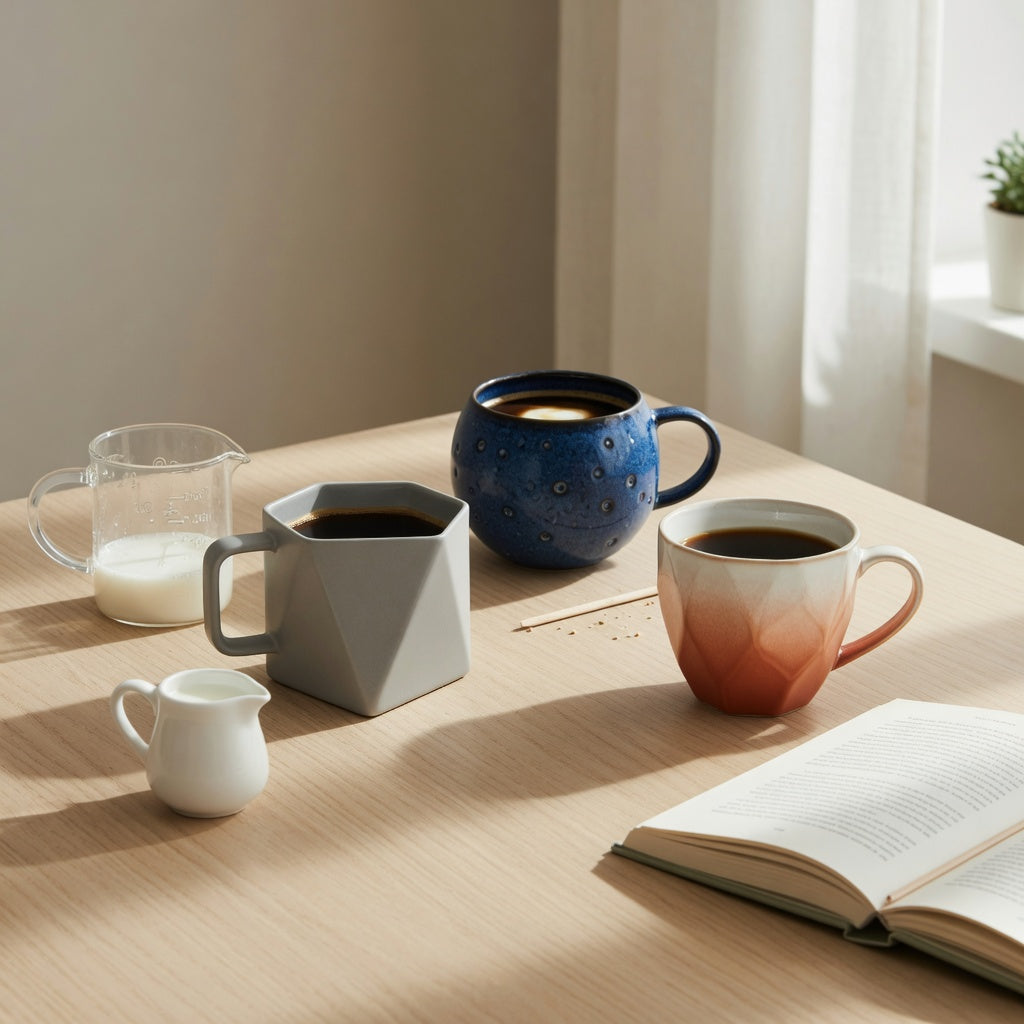
| Rhombus Coffee Tea Mug | 300 ml | Ceramic | Angular, rhombus-like planes | Smaller measured servings and a pronounced geometric look |
| Planet Coffee Tea Mug | 350 ml | Ceramic | Rounder, planet-like paneling | The largest listed capacity of the three |
| The Gradient Coffee Tea Mug | 320 ml | Ceramic | Faceted profile with a visible gradient | Middle capacity and a color-led table setting |
Choose Rhombus for a smaller serving and crisp visible planes
Reader situation: Your measured drink stays clearly below 300 ml, and the angular form is the main reason you are shopping for a geometric mug. The 300 ml Rhombus Coffee Tea Mug is the smallest option here, so it suits a deliberate single serving or a routine built around smaller refills.
Why it fits: Its rhombus-like planes provide the most explicitly angular profile in this shortlist without relying on an unverified story about design provenance or production method. Skip it if your drink approaches 300 ml before you account for carrying space, or if you prefer a visually smooth, rounded body. Your next step is to check the current product photos, dimensions if listed, and care information against a mug already in your cupboard.
Choose Planet when listed capacity is the deciding variable
Reader situation: You make the largest weekend serving among the three capacity ranges and would rather use one mug than return to the kitchen for an immediate refill. The 350 ml Planet Coffee Tea Mug lists 30 ml more than the Gradient and 50 ml more than the Rhombus.
Why it fits: It combines the largest listed volume in this group with a rounder, paneled geometric profile. Skip it if your cabinet has a narrow row for mugs or you specifically want straight visual sides. Capacity does not reveal width, height, weight, or base dimensions, so confirm any current measurements on the product page before treating the rounder form as a storage fit.
Choose Gradient for middle capacity and visible color
Reader situation: A 300 ml listing feels too close to your usual pour, 350 ml is more than you normally need, and a visible color transition is part of the appeal. The 320 ml Gradient Coffee Tea Mug sits between the other two capacities and pairs its faceted body with a gradient finish.
Why it fits: It is the most direct middle choice by volume, and the color change softens the visual effect of the facets. Skip it if you need a plain, single-color mug or exact color matching across a set. Screens display color differently, so use the current product images as a visual guide rather than a calibrated color sample.
If none of these situations describes your routine, browse our unique coffee mugs collection and begin with your measured serving volume. That is more reliable than choosing a shape first and discovering later that your normal recipe reaches the rim.
Does your routine favor one serving, a refill, or room for milk?
A smaller listed capacity is not automatically a disadvantage on a slow weekend. Some coffee drinkers prefer two measured refills because each trip to the kitchen is part of the routine. Others want one larger serving beside a book or at a home desk. Match the mug to the behavior you already enjoy.
- One smaller breakfast serving: Start with the 300 ml Rhombus if your finished drink leaves clear room below that figure and you want an angular form.
- One larger serving: Start with the 350 ml Planet when listed volume matters more than keeping the mug visually compact.
- Coffee one day and tea the next: The 320 ml Gradient offers a middle capacity without forcing you toward either extreme.
- A drink with added milk: Measure the complete recipe, not just the brewed coffee. Milk can turn a comfortable capacity into a rim-level pour.
We are not ranking these mugs for heat retention. Visible geometry and listed capacity do not provide enough evidence for that comparison, and none of the choices here should be treated as a substitute for a product with documented insulation if that is your priority.
How do ceramic form and cupboard space affect storage?
All three shortlisted mugs are listed as ceramic. That identifies the body material, but it does not tell you the exact weight, wall thickness, microwave compatibility, dishwasher status, or stackability. Those details must come from the current product page rather than assumptions about ceramic as a category.
Before ordering, measure the clear height, depth, and width of the shelf where the mug will live. Include any handle clearance shown in the product photos. Do not assume a faceted or rounded geometric body will nest inside another mug. If two ceramic pieces contact at their rims or raised exterior planes, store them side by side or place a soft separator between them instead of forcing a stack.
The same check applies to a crowded breakfast tray or small sofa-side table. Use listed product dimensions if available and compare them with the base of a mug you already own. Shape alone is not evidence that one mug will be more stable than another.
What should you inspect before the first wash or dishwasher cycle?
Our team recommends the same arrival check for any ceramic mug, geometric or plain. It takes a minute and catches visible damage before the mug enters daily use.
- Inspect the drinking rim and exterior under bright light for a chip, hairline crack, or unexpected rough patch.
- Check the base and any handle attachment points for visible cracking.
- Set the empty mug on a clean, dry, flat counter and check for unexpected rocking.
- Read the current product care instructions before using a microwave or dishwasher. Ceramic material alone does not confirm compatibility with either appliance.
- If dishwasher use is explicitly allowed, leave enough space that the mug cannot knock against another ceramic piece during the cycle.
If care instructions are not stated, hand washing is the cautious default: warm water, mild dish soap, and a soft non-scratch sponge. Rinse coffee residue rather than letting it dry repeatedly, avoid metal scourers on finished surfaces, and avoid abrupt temperature changes. If the mug arrives chipped or cracked, pause before using it and contact our store.
Who should skip these geometric ceramic mugs?
Skip this shortlist if your main need is a sealed travel lid, documented insulation, or a mug intended for a vehicle cup holder. Those features are not established by the material, shape, or capacity information compared here. A purpose-built travel mug would be the more practical choice.
A straight-sided mug with confirmed dimensions may also suit you better if cupboard density and easy stacking matter more than visible form. Shoppers who need a drink larger than 350 ml should start with a larger capacity category. If grip size, mug weight, or a specific ergonomic requirement is essential, do not infer comfort from photographs; choose a product that provides the relevant measurements.
A 60-second shortlist before checkout
Used properly, a geometric coffee mug weekend coffee product shortlist guide should remove unsuitable options instead of adding more tabs to your browser. Run through these checks once:
- Measure your complete weekend drink in milliliters, including milk or added water.
- Allow room below the rim for carrying the mug from counter to table.
- Compare that total with the listed 300 ml, 320 ml, and 350 ml capacities.
- Choose between angular rhombus planes, a rounder planet-like profile, or a faceted gradient body.
- Measure the cupboard shelf and the surface where the mug will normally sit.
- Verify current dimensions, care instructions, appliance compatibility, and product photos on the selected page.
The result should be simple: Rhombus for the smaller angular option, Planet for the largest listed volume, or Gradient for the middle capacity and visible color transition. If none survives all six checks, step back to the collection rather than compromising on a mug you will use every weekend.
Frequently asked questions
What should I compare in a geometric coffee mug weekend coffee product shortlist guide?
Compare your measured drink volume, the mug's listed capacity, ceramic material, visible exterior form, storage space, and current care instructions. Treat product photos as shape references, not substitutes for dimensions. A useful shortlist should also state why each option may be wrong for your routine.
Is a 300 ml geometric coffee mug big enough for weekend coffee?
It can be if your complete serving stays comfortably below 300 ml. Measure the coffee plus milk or added water, then allow space below the rim for carrying. If your recipe is close to 300 ml, start with the 320 ml or 350 ml listing and confirm the usable fit.
Can these ceramic mugs go through dishwasher cycles?
Check the current care instructions on each product page before using a dishwasher. Ceramic describes the material but does not automatically confirm dishwasher or microwave compatibility. If dishwasher use is not explicitly stated, hand wash with mild soap and a non-scratch sponge.
Does a faceted or rounded geometric shape retain heat better?
We are not making a heat-retention comparison from these shapes. A mug's visible geometry and listed capacity are not enough to support that claim because wall construction and other relevant specifications are not established here. Choose among these three based on serving volume, form, care, and storage fit.
Which geometric coffee mug is the most practical weekend gift?
Match the gift to a mug the recipient already uses: Rhombus for a smaller serving and angular look, Planet for the largest listed capacity and rounder form, or Gradient for middle capacity and visible color. If you do not know their usual volume or style, compare the recipient's current mug before ordering. Then use our collection of unique coffee mugs to make the final capacity and shape check.
More from our blog
Read more
Emerald Green Coffee Mug Weekend Coffee Product Shortlist Guide
Compare the current emerald and round mug options for porch pour-overs, brunch, and couch-side coffee. This shortlist explains the capacity, visible form, handle, and color trade-offs that should d...
Read more
Ocean Coffee Mug Weekend Coffee Product Shortlist Guide: 2 Picks
Compare two current ceramic ocean-style mugs by visible scene, handle form, listed capacity, care checks, and real Saturday use. Each pick includes a clear reason to choose it, skip it, or continue...
Read more
Leave a comment
This site is protected by hCaptcha and the hCaptcha Privacy Policy and Terms of Service apply.