
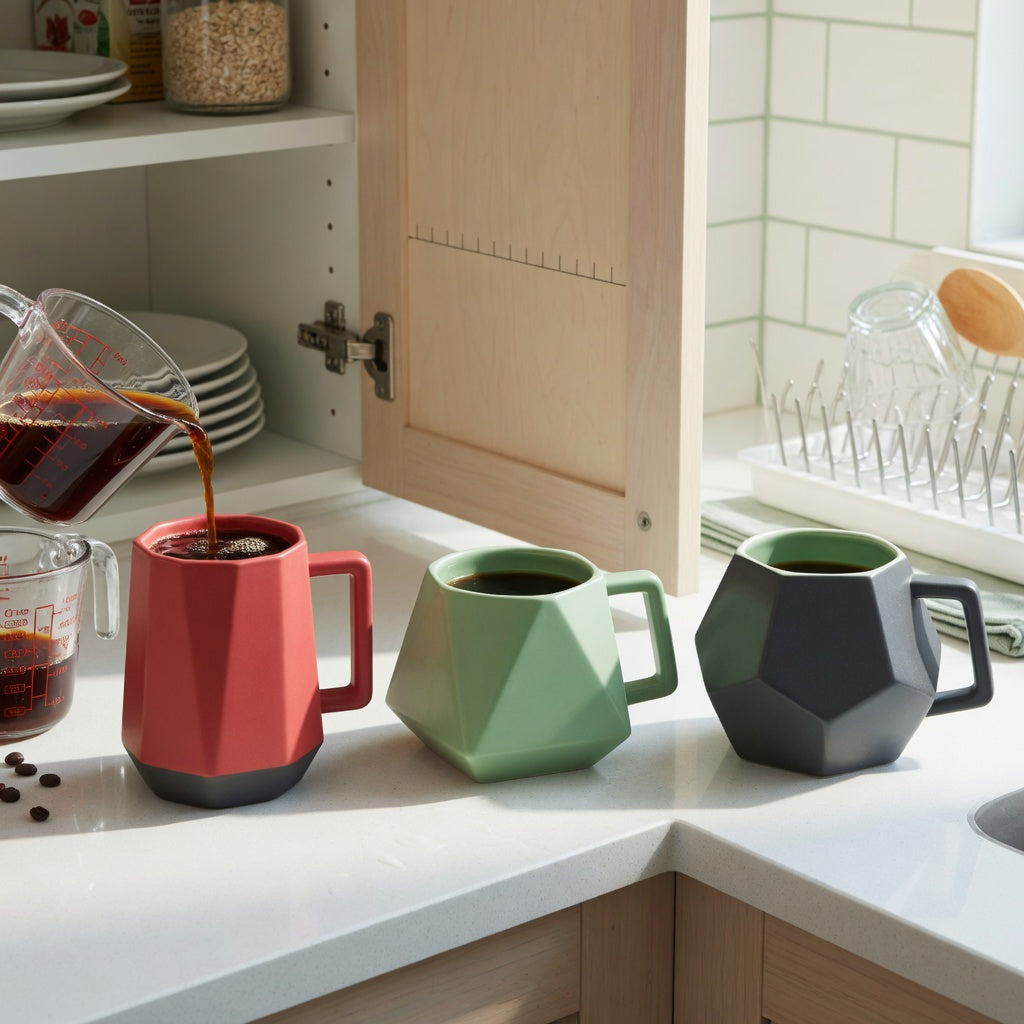
Geometric Coffee Mug Everyday Mug Rotation Practical Purchase Checklist
Reading time: about 10 minutes
A mug can look right in a product photo and still miss the weekday rotation because its handle crowds the mug beside it, its widest point wastes shelf space, or its listed capacity does not match your normal pour. This geometric coffee mug everyday mug rotation practical purchase checklist starts with those ordinary friction points, not a style label.
In our store, we handle mugs during merchandising and packing, and we know a visually distinctive form only earns everyday use if it is easy to reach, fill, carry, wash, and put back. We compare only details the current listing supports: stated capacity, stated material, visible shape, dimensions if provided, and explicit care instructions. If a detail is missing, we treat it as unknown rather than filling the gap with an assumption.
Will it fit the shelf you actually use every morning?
Measure the cabinet space before comparing colors or finishes. Use the interior shelf, not the cabinet's outside dimensions. Record the usable height from the shelf surface to the shelf above, the depth available with the door closed, and the narrowest side-to-side space where the mug will sit.
- Widest point: Include the handle, not just the body. Handle projection is often what prevents two mugs from sitting comfortably side by side.
- Base area: Compare the visible base with your shelf, coaster, and drying rack. Do not assume the widest body measurement is also the base measurement.
- Retrieval space: Leave enough room to get your fingers through or around the handle without moving the neighboring mug first.
- Storage method: Decide whether the mug must sit individually, hang from a hook, or stack. Do not assume a visibly geometric form is stackable unless the current listing says or shows that it is.
If dimensions are listed, mark the width and depth on a sheet of paper and place that footprint in the proposed cabinet spot. If dimensions are not listed, a product photo can help you compare form, but it cannot confirm fit. A missing measurement matters when your shelf has little spare room.
Frequency also belongs in this test. A mug intended for five weekday mornings deserves front-row access. A form you would use only for guests or relaxed weekend coffee may be worth owning, but it is not filling the same role in your rotation.
Capacity, material, and shape: which facts change the decision?
These variables should come directly from the current product page. Names and photographs can help you compare appearance, but they do not replace listed specifications.
| Buyer variable | What to verify | Practical rotation test |
|---|---|---|
| Capacity | The currently listed volume and whether further fill guidance is provided | Measure your normal water pour in a measuring cup and allow headroom below the rim for carrying |
| Material | The exact material wording on the listing | Do not infer weight, heat behavior, or care compatibility from appearance alone |
| Visible shape | Body width, base, rim, and handle position shown in current photos | Compare the widest points with your shelf, desk space, coaster, and neighboring mugs |
| Care | Explicit dishwasher and microwave instructions, if provided | Make sure the stated method matches how your household actually cleans and reheats mugs |
To measure your pour, fill your current favorite mug with water to the level you normally use, then transfer that water to a measuring cup. This is more useful than guessing from the mug's appearance. A listed capacity that is much smaller can mean repeated refills, while a much larger mug may hold more beverage than you normally finish before it cools.
Read material descriptions literally. For example, do not turn a broad ceramic description into an unsupported stoneware or porcelain claim. Those are more specific category terms. Material also does not establish exact weight, handle comfort, or heat retention without corresponding product information.
Care claims are separate as well. Dishwasher suitability does not automatically establish microwave suitability, and visible geometry establishes neither. If the cleaning method you need is not confirmed, keep it in the unknown column.
Which CoffeifyMug page should you compare first?
Start with the situation that most closely matches your routine, then verify the current listing before deciding. The product name can direct your first comparison, but the listed capacity, material, shape, and care details should make the final call.
- Situation: the visible rhombus form is the main appeal. It fits a shopper who wants an explicitly angular-looking mug and has enough room to evaluate that outline individually. Open the Rhombus Coffee Tea Mug product page, then record its currently listed capacity, material, dimensions if provided, and care instructions before assigning it a cabinet spot.
- Situation: you want a second geometric silhouette for a direct comparison. This helps prevent the assumption that every geometric mug occupies the same footprint. Review the current photos and specifications on the Planet Coffee Tea Mug listing, then compare its widest visible points with the Rhombus option and your existing mugs.
- Situation: the named gradient appearance is likely to make you reach for the mug more often. Visual preference matters in a rotation, but it should not override a capacity or care mismatch. Check The Gradient Coffee Tea Mug and confirm that its current product facts support your normal pour and cleaning routine.
- Situation: none of those three forms clearly fits, or you are buying a gift without exact cabinet measurements. The unique coffee mugs collection gives you more current forms to compare. Prioritize listings that answer the recipient's hard requirements, and avoid guessing about an unlisted dimension or care method.
These are comparison routes, not interchangeable recommendations. A shopper with a shallow shared cabinet has a different decision from someone displaying one mug on an open office shelf. The right next page is the one that helps you verify the constraint most likely to keep the mug out of use.
Will it work at an office desk, brewer, and dishwasher?
A mug can pass the cabinet test and still create friction elsewhere. Walk through the complete route it will take on a normal day.
- Office desk: Mark the listed footprint beside your keyboard, notebook, coaster, and charging cable. Check which direction the handle must face and whether that position works for your dominant hand.
- Coffee brewer: Compare the mug's listed height, if available, with the clearance under your brewer's outlet. A mug that cannot fit in the intended brewing position will not be an effortless weekday choice.
- Dishwasher: First confirm that the listing permits dishwasher cleaning. Then consider rack height, support spacing, neighboring glasses, and whether the mug can sit without being wedged into place.
- Drying rack: Plan a position where the rim and handle will not press against other dishes. An unusual outline may need a different slot from the round mugs already in the rack.
- Shared shelf: Test alternating handle directions with your current mugs. If one mug must be removed to reach another, the arrangement is likely to become annoying during a rushed morning.
Grip, loaded weight, and balance are harder to confirm online. If a current mug has similar listed dimensions and material, use it as a reference. Otherwise, treat one-handed carrying comfort as unverified rather than declaring the new form stable or comfortable from photos.
Use this geometric coffee mug everyday mug rotation practical purchase checklist
Apply the geometric coffee mug everyday mug rotation practical purchase checklist separately to every product page. Write down the displayed facts and keep unknowns visible.
- Measure your normal pour with water: ______.
- Record the product's currently listed capacity: ______. Does it leave practical carrying headroom?
- Copy the material description exactly as written: ______. Do not substitute a more specific material category.
- Record listed height, body width, base width, and handle projection if provided. Mark every missing dimension as unknown.
- Compare the full footprint with your front-row shelf space. Can the cabinet door close without the handle touching it?
- Check clearance under your brewer and space beside your keyboard, notebook, or coaster.
- Find explicit dishwasher and microwave instructions. Do they match the care methods you require?
- Decide how many days per week you would realistically use this mug: ______.
- If stacking is necessary, confirm that the listing supports it. A geometric appearance alone is not evidence that mugs will nest securely.
- Review the current return terms before ordering if fit, grip, or gift suitability cannot be confirmed online.
Treat hard requirements differently from preferences. Missing dishwasher confirmation is a hard stop if you will not hand-wash. Unknown dimensions are a hard stop in a tightly fitted cabinet. Color, facet arrangement, and which form looks best beside your coffee setup are preferences once the practical checks pass.
This is more useful than a points score. One failed hard requirement can keep a mug out of rotation even if every visual preference is satisfied.
What should you inspect at unboxing and after the first wash?
Open the package in good light and inspect the mug before discarding its protective materials. Our team recommends checking the same functional areas every time:
- Run a careful visual check around the rim for chips or rough damage.
- Inspect both handle attachment points for a visible hairline crack or separation.
- Place the empty mug on a flat, dry counter and check for unexpected rocking.
- Compare the received form, material description, and ordered option with the current listing and order confirmation.
Follow the stated washing instructions before first use. If dishwasher cleaning is explicitly allowed, position the mug according to those instructions and avoid forcing it against neighboring pieces. A successful first cycle does not prove long-term durability, so continue following the listed care guidance.
For a gift, perform this inspection before the giving date when the store's current terms allow it. A damaged rim, body crack, or unexpected base issue should be addressed before the mug is used.
When is a geometric mug the wrong purchase?
A geometric coffee mug is not the best fit for every rotation. Choose a simpler form with verified specifications if you need maximum stack density, confirmed compatibility with a specific appliance, or a travel lid and cup-holder fit. A travel mug is also the more appropriate category if spill resistance is essential.
Skip the purchase if your cabinet is already crowded and the new mug would have to live behind the pieces you use now. The same applies if dishwasher cleaning is non-negotiable but the product page does not confirm it. Shoppers sensitive to handle shape, loaded weight, or rim feel may also prefer a mug they can handle in person or return under clearly reviewed terms.
Geometry is a visual and spatial comparison point. It is not evidence of durability, provenance, production method, creator, limited availability, or association with a particular design movement.
Frequently asked questions
What should I check before buying a geometric mug for daily use?
A geometric coffee mug everyday mug rotation practical purchase checklist should cover your measured pour, the listed capacity and material, full shelf footprint, handle clearance, care instructions, and realistic days of use. Treat unlisted dimensions and care methods as unknown. Resolve any unknown that affects a hard requirement before ordering.
Are the Rhombus, Planet, and Gradient mugs the same capacity?
Do not assume that they are. Check the current capacity shown on each product page and compare it with your measured normal pour, since product details can differ and should be verified at the time of purchase.
Can I put a geometric coffee mug in the dishwasher?
The geometric shape does not determine dishwasher compatibility. Use the explicit care instructions on the current product page. If dishwasher use is not stated and it is essential to your routine, ask for confirmation or choose an option with clear care guidance.
Will a geometric mug stack with my round mugs?
Not necessarily. Differences in the body, rim, base, and handle position can prevent secure nesting even when the overall size looks similar. Plan for side-by-side storage unless stacking is specifically shown or stated.
Which geometric mug is best for a small cabinet?
There is no universal best form for a small cabinet. Choose the listing with dimensions that fit your measured shelf depth, height, and handle clearance while still matching your normal pour. If the necessary measurements are unavailable, do not use photos as proof of fit.
Open the Rhombus, Planet, and Gradient pages in separate tabs, record only the currently listed facts, and eliminate any option that misses a hard requirement. If all three leave a key fit or care question unresolved, compare the current unique mug collection rather than buying on shape alone.
More from our blog
Read more
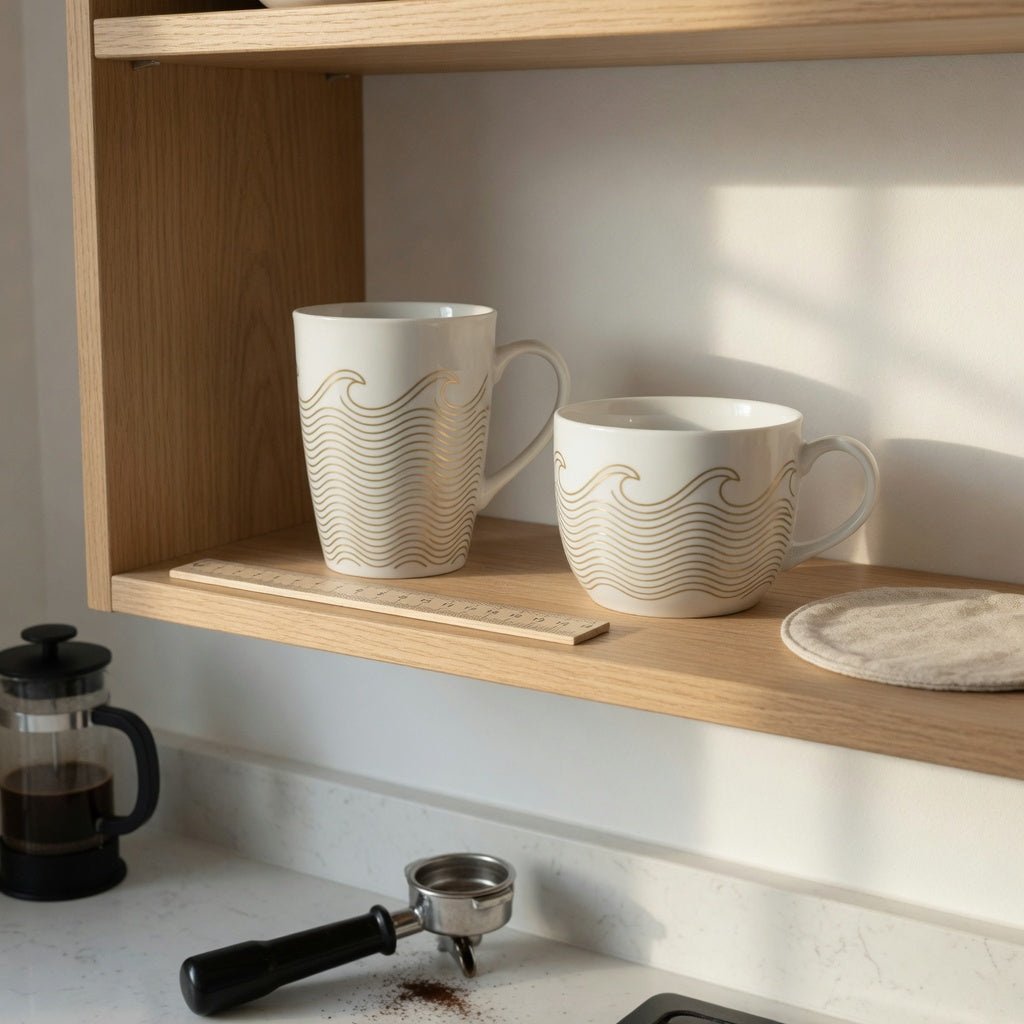
White and gold coffee mug everyday mug rotation product shortlist guide
Compare the White Golden Waves Tall and lower-profile Golden Waves Kio forms by listed capacity, shelf clearance, handle space, desk fit, and cleaning habits. Each option includes a clear reason to...
Read more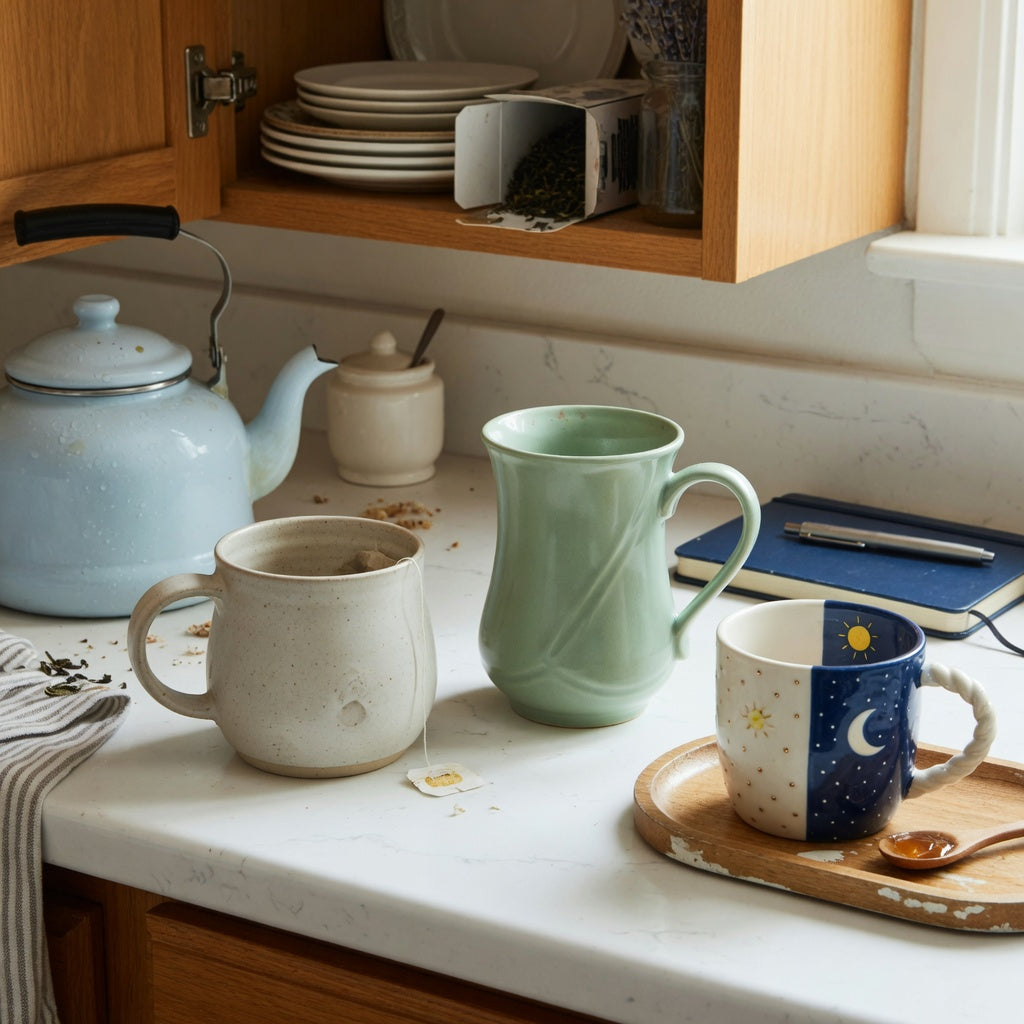
Ceramic Tea Mug Everyday Mug Rotation Product Shortlist Guide: 3 Picks
Compare three ceramic coffee and tea mugs by rotation job, listed capacity, visible form, handle shape, and cabinet fit. Each pick includes a clear reason to choose it, skip it, or keep browsing.
Read more
Leave a comment
This site is protected by hCaptcha and the hCaptcha Privacy Policy and Terms of Service apply.