
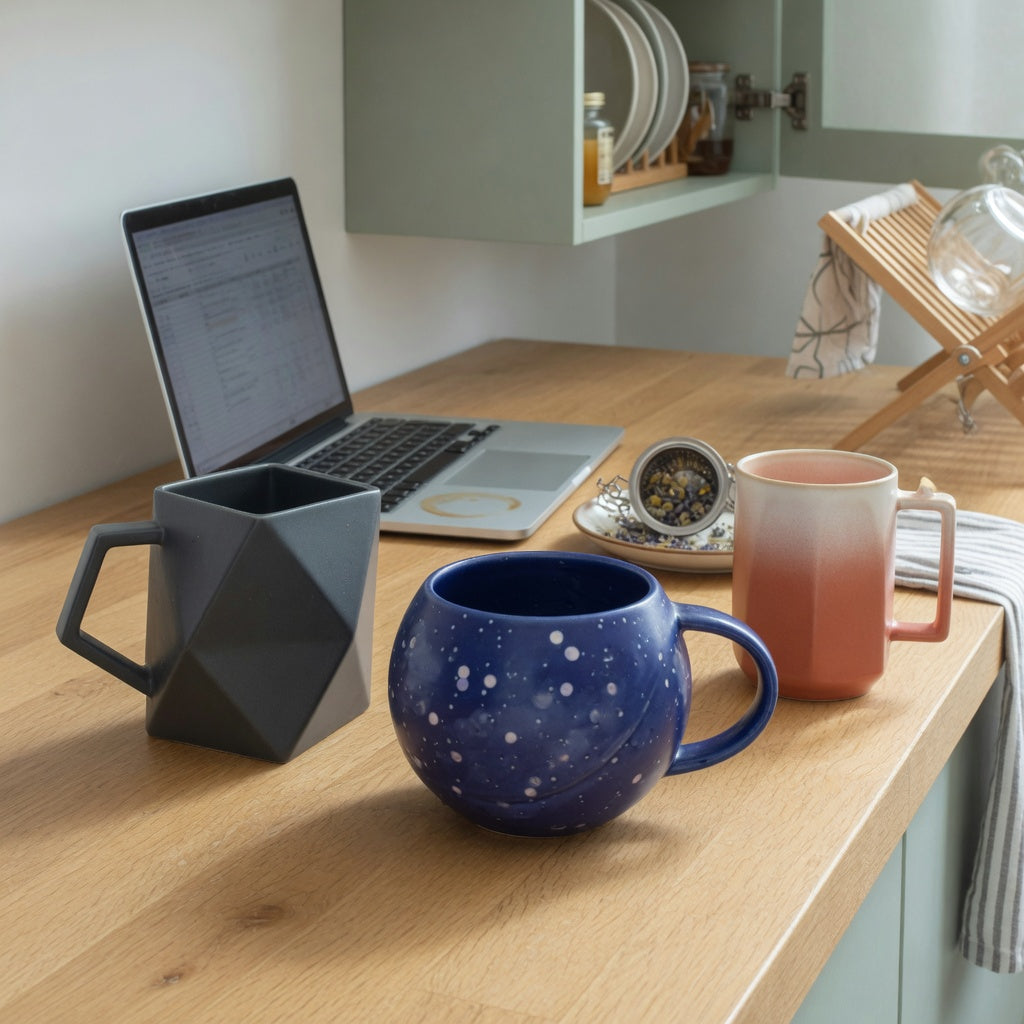
Geometric Coffee Mug Daily Use Guide: Desk and Kitchen Fit
Reading time: about 9 minutes
A geometric mug can look balanced in a product photo and still become awkward at 8:15 a.m. Its widest point crowds the laptop, the base sits badly on a padded coaster, or the body will not share a cupboard shelf with the mugs already there. This geometric coffee mug daily use guide focuses on those ordinary friction points. At CoffeifyMug, we handle and pack shaped ceramic mugs, so we pay close attention to the base, rim, handle join, exterior form, and listed capacity before appearance alone.
The three options below are compared using facts we can support: ceramic material, listed capacities of 320, 350, and 400 ml, and their visible current shapes. We are not assigning a design movement, creator, provenance, or unlisted production method to any of them. A geometric form can be visually distinctive and still be the wrong daily tool for a particular desk, drink, or cleaning routine.
Will the mug stay stable beside a keyboard or prep board?
A faceted body is not automatically unstable. Daily stability depends on the flatness of the mug base, the condition of the table, the coaster material, and how high you fill the mug. A padded coaster or flexible keyboard tray can make an angular mug feel less planted, while the same mug may sit normally on a clean stone or laminate counter.
The Rhombus Coffee Tea Mug is the most direct fit for someone who wants an angular ceramic form and a medium 350 ml serving on a clear, level surface. Its visible facets provide the geometric look, but buyers with a crowded desk, a soft coaster, or a standing desk that moves should check stability before making it their everyday mug. A simpler round form is usually more forgiving in those settings.
- Set the empty mug on the surface you actually use and press lightly near the rim in several directions.
- Repeat the check on your usual coaster; do not assume the counter result will be identical.
- Add cool water to your normal fill level and carry it from the counter to the desk to assess grip and clearance.
Geometric coffee mug daily use guide: which capacity fits your routine?
Listed capacity is a useful starting point, but it is not the same as comfortable carrying volume. Milk, foam, and ice need headspace. Filling a shaped mug to its maximum also increases spill risk as you move around a desk or kitchen.
| Mug | Material | Listed capacity | Visible form | Practical daily fit |
|---|---|---|---|---|
| Rhombus | Ceramic | 350 ml | Angular, faceted shape | Medium coffee on a level desk or counter |
| Planet | Ceramic | 400 ml | Rounded geometric shape | Larger servings and fewer refills |
| Gradient | Ceramic | 320 ml | Taller profile with a visible gradient | Tea, smaller coffee, or frequent fresh refills |
Choose the 350 ml Rhombus if your regular serving sits in the middle of this range and the angular appearance is a priority. It is less suitable for someone who routinely prepares a large milk drink or wants enough room for plenty of ice without reducing the coffee portion.
The Planet Coffee Tea Mug, listed at 400 ml, fits a long meeting, a slow kitchen breakfast, or a larger coffee that would require a second pour in the smaller options. The trade-off is simple: more liquid means more weight when full, and a rounded geometric body can require more shelf space than its capacity alone suggests.
The Gradient Coffee Tea Mug lists a 320 ml capacity. It makes more sense for tea, a smaller coffee, or a shopper who prefers to refill while the drink is still fresh. It is not the strongest fit for a one-fill morning routine or a large iced drink.
Before deciding, compare the listed capacity with the amount you actually pour, not the size printed on a mug you rarely fill completely. Leaving practical headspace is especially useful if the mug will travel from the kitchen to another room.
Will the shape fit your hand, cabinet, and drying rack?
Capacity does not reveal the full exterior footprint. A rounded 400 ml body may need more lateral shelf room, while a taller 320 ml profile can create a different vertical-clearance problem. Geometric mugs also should not be assumed to stack or nest unless the product information specifically says they do. Measure the open space between shelves and check the widest available gap against any dimensions provided on the current product page.
At our packing table, the areas that receive the closest visual check are the rim, exposed high points, base, and handle-to-body junction. Those are also the places most likely to contact another mug or a metal drying rack at home. If you keep mugs tightly grouped, leave separation around the geometric edges instead of forcing the shapes together.
Handle comfort remains personal. Test the mug with the same number of fingers and the same lifting motion you normally use. Someone who finds a full 400 ml ceramic mug cumbersome may be better served by the 320 or 350 ml option, even if the larger capacity initially looks more convenient.
Which capacity works for black coffee, milk drinks, iced coffee, or tea?
Match the mug to the finished drink rather than the coffee portion alone. Add-ins change both the required headspace and the weight you carry.
- Tea or a smaller hot coffee: The 320 ml Gradient keeps the serving moderate and suits people who would rather make a fresh refill than hold one large drink through a long session.
- Black coffee or an Americano: The 350 ml Rhombus offers a middle capacity for a standard desk session without moving to the largest ceramic body in this comparison.
- Milk drinks or iced coffee: The 400 ml Planet provides the most listed volume for milk, foam, or displaced space from ice. Check that your usual ice cubes fit through the opening, since capacity alone does not confirm opening width.
None of these should be treated as an insulated travel mug based only on being ceramic. Wall thickness, lid design, and opening size affect heat retention and portability, and those qualities cannot be inferred from capacity. For commuting, cup holders, or several hours of heat retention, a lidded insulated mug would be a more practical category.
Can geometric ceramic mugs match your cleaning routine?
Ceramic material alone does not confirm that every finish or decoration is dishwasher or microwave compatible. Follow the instructions on the current product page, packaging, or care insert for the specific mug. If compatibility is not explicitly stated, hand-washing and avoiding the microwave are the lower-risk choices.
Faceted forms deserve a little extra clearance during cleaning. In our experience, rough contact with other dishes causes more avoidable wear than the washing itself. We use side light during handling because small rim chips, glaze scuffs on exposed points, and marks around the handle join are easier to see from an angle.
- Rinse coffee or tea residue before it dries around the rim and handle junction.
- Use a nonabrasive sponge rather than a harsh pad on the visible finish.
- If dishwasher use is approved, leave space between the mug and metal utensils or other ceramics.
- Avoid abrupt temperature changes that can stress ceramic.
- Store the mug upright and do not force it inside another mug unless stacking is specified.
Also check the base before placing the mug on a glass table. A small piece of grit trapped underneath can scratch the surface even when the mug itself is stable. If the mug will face a crowded communal dishwasher or frequent knocks in a family sink, a plain round ceramic mug may tolerate that routine with less attention.
Will the shape still suit the recipient after gift unboxing?
Geometric mugs make an immediate visual impression in a gift box, but the recipient still has to store, wash, and carry the mug. Ask what they normally drink, where they keep mugs, and whether they use a dishwasher. Those answers are more useful than trying to choose by appearance alone.
The Rhombus is the logical gift for someone who likes an angular form and drinks a medium serving at a tidy desk. The Planet better fits a larger 400 ml routine in a kitchen or home office. The Gradient suits a recipient who favors tea, smaller coffee servings, or a visible color treatment. If their habits are unknown, a less angular or more conventional shape may be the safer gift.
Who should skip a geometric mug for daily use?
A geometric ceramic mug is not the most practical answer for every shopper. Consider another style if any of these needs takes priority:
- You must stack or tightly nest several mugs on one shelf.
- You need a travel mug that reliably fits a vehicle cup holder.
- Your main surface moves, flexes, or stays noticeably uneven.
- The mug will receive rough treatment in a shared sink or crowded dishwasher.
- You need confirmed dishwasher or microwave compatibility and cannot find it in the product instructions.
A round ceramic mug offers easier storage and more forgiving placement. A lidded insulated mug is better for travel. Choosing either is a practical decision, not a compromise, if geometric form would add friction to your normal routine.
Frequently asked questions
What does this geometric coffee mug daily use guide recommend for a home office?
Start with your desk surface and normal serving size. The 350 ml Rhombus fits a level, uncluttered desk and medium pour, while the 400 ml Planet suits longer sessions with fewer refills. Use a simpler round mug if the desk flexes or your coaster makes shaped bases feel unsteady.
Is 320 ml, 350 ml, or 400 ml better for everyday coffee?
Choose 320 ml for smaller drinks or frequent fresh refills, 350 ml for a middle-sized coffee, and 400 ml for larger servings or extra space for milk and ice. Leave enough headspace to carry the mug comfortably instead of treating the listed capacity as a required fill line.
Are geometric ceramic mugs dishwasher and microwave safe?
Do not assume compatibility from ceramic material alone. Check the instructions for the specific mug because the finish and decoration can affect approved care. Hand-wash and avoid microwave use if the product information does not give clear permission.
Which geometric coffee mug is the best gift?
The best fit depends on the recipient's drink volume and storage space. Choose the Rhombus for a medium serving and angular appearance, the Planet for a larger 400 ml routine, or the Gradient for tea and smaller coffee. A conventional shape is safer if you do not know how the recipient stores or cleans mugs.
Next step: Check three things before ordering: your usual finished drink volume, the surface where the mug will sit, and the available cabinet space. Then compare these products with the other shapes in our unique coffee mugs collection and choose the form whose daily trade-offs fit your routine.
More from our blog
Read more
Ceramic Tea Mug Comparison: 400 ml, 440 ml, or 480 ml?
Compare three current ceramic coffee and tea mugs by listed capacity, visible body form, and handle shape. See how the 400 ml Round, 440 ml Morning Night, and 480 ml Flow fit different desks, count...
Read more
Art Coffee Mugs Comparison: Mountain Sea, Koi, or Crane?
Compare three current ceramic art mugs by visible motif, handled form, listed capacity, care considerations, and fit for kitchen counters, office desks, tea breaks, and gifts.
Read more
Leave a comment
This site is protected by hCaptcha and the hCaptcha Privacy Policy and Terms of Service apply.