
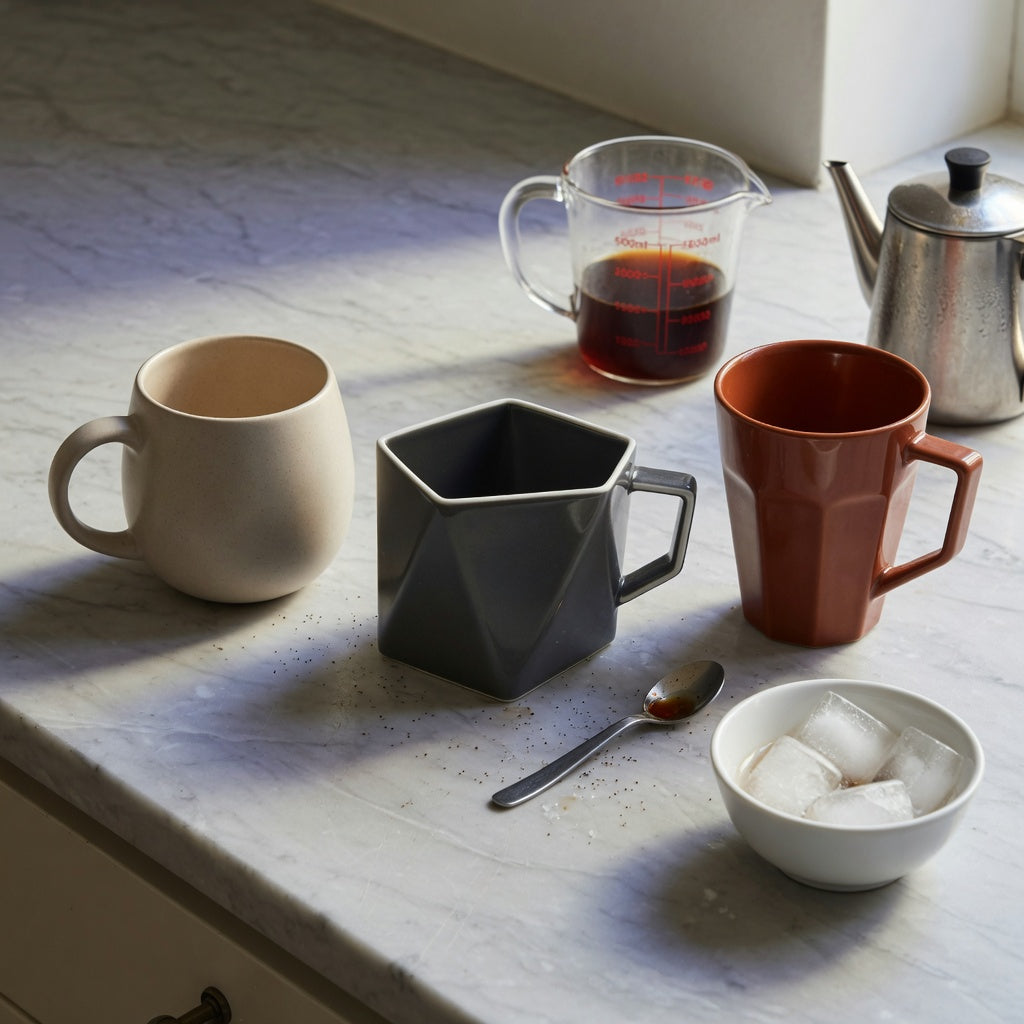
Geometric coffee mug capacity guide: 350, 400, or 450 ml?
Reading time: about 9 minutes
A 100 ml difference sounds minor until your usual coffee stops short of the rim or leaves you returning to the kitchen halfway through a meeting. A 350 ml mug, a 400 ml mug, and a 450 ml mug can look similarly substantial in product photos, but they suit different pour and refill habits. This geometric coffee mug capacity guide compares the three current ceramic options in our store using their listed volumes and visible forms.
We handle and sell this category, so we pay attention to the questions that appear after the first real pour: Is there room for milk? How much capacity does ice take away? Does the largest option become cumbersome when full? We stay within the details we can support here: listed capacity, ceramic material, visible shape, and practical serving scenarios. Dimensions, dishwasher compatibility, microwave use, and other care claims should always be confirmed on the current product page or packaging.
Geometric coffee mug capacity guide: what changes between 350, 400, and 450 ml?
The three mugs are separated by 50 ml steps. That gives shoppers a compact option, a middle option, and a larger single-pour option without requiring a broad comparison across unrelated mug styles.
| Mug | Listed capacity | Material | Visible form | Best initial match |
|---|---|---|---|---|
| Planet Coffee Tea Mug | 350 ml | Ceramic | Rounded geometric profile | Smaller drinks and intentional refills |
| Rhombus Coffee Tea Mug | 400 ml | Ceramic | Angular, diamond-like profile | Middle-capacity coffee or tea routines |
| The Gradient Coffee Tea Mug | 450 ml | Ceramic | Tapered, faceted-looking profile | Larger drinks and fewer top-ups |
A listed capacity should be used as a comparison figure, not as a target for filling a mug to the edge. Coffee needs spill headroom, while milk, foam, and ice all occupy part of the available space. If your finished recipe is already close to a mug's listed capacity, moving up one size is usually more practical than trying to carry a brim-full drink.
Capacity is only one part of the decision. If you have settled on a volume but want to compare other visible shapes, open our unique coffee mugs collection and check the current product details side by side.
How many refills suit each listed capacity?
Start with the drink you actually make, not the serving size printed on a coffee bag or cafe menu. The easiest home check is to fill your current mug with water to your normal drinking level, pour that water into a measuring jug, and record the result. Include the room you usually reserve for milk, foam, or carrying the mug safely.
- Choose 350 ml for smaller, repeated pours. The Planet is the current fit for someone who prefers a fresh refill rather than one large drink sitting on a desk. It also makes sense when your normal finished beverage is comfortably below 350 ml. It is not the strongest choice for a large iced coffee because ice reduces the room left for coffee.
- Choose 400 ml for a middle-capacity routine. The Rhombus gives 50 ml more listed space than the Planet without moving to the largest mug in this comparison. It suits shoppers who regularly find 350 ml restrictive but do not need the full 450 ml capacity.
- Choose 450 ml to reduce top-ups. The Gradient has the largest listed capacity of the three. It is the logical first product to check for a longer desk session, a larger tea serving, or a coffee that includes milk. The trade-off is more liquid weight and a larger volume to finish before the drink cools.
The point of this geometric coffee mug capacity guide is not to label one size as universally better. A smaller mug can keep refills deliberate. A larger mug can reduce interruptions. The correct choice depends on which inconvenience you would rather avoid.
Which capacity fits a desk, kitchen counter, or gift routine?
For a desk with the kitchen down the hall: The 450 ml Gradient can reduce refill trips if your usual drink uses the extra capacity. Remember that these are ceramic mugs rather than sealed travel vessels. If you carry coffee between floors, commute with it, or need protection beside electronics, a mug with a verified leak-resistant lid would be a better category.
For a counter near the kettle: The 350 ml Planet makes more sense when a refill takes only a few seconds and you prefer smaller servings. Its rounded form also presents a different hand feel from the angular Rhombus. Capacity does not establish the exact footprint, so check current dimensions before buying for a narrow shelf, crowded coffee station, or compact desk.
For a shared office kitchen: The 400 ml Rhombus is the balanced comparison point. It offers more listed room than the Planet while keeping the serving smaller than the Gradient. The angular visible form is also the main reason to choose it over a plain cylindrical mug; it should not be assumed to change heat retention or durability without supporting specifications.
For a gift: Do not assume the largest mug is the most generous choice. A recipient who drinks short tea pours may use the Planet more often, while someone who takes one coffee into a long morning meeting may appreciate the Gradient. If you can discreetly measure the mug already sitting beside their kettle, that number is more useful than guessing from photographs.
How do ceramic and geometric form affect full-mug handling?
All three current options in this comparison are ceramic, but the liquid itself creates a meaningful weight difference. A 450 ml water-based drink contains roughly 100 grams more liquid than a 350 ml drink before the weight of either mug is counted. Milk, sugar, ice, and the actual fill level can change the final total, but the basic trade-off remains: more capacity means more weight when full.
That matters for shoppers with limited grip strength, wrist fatigue, or a habit of carrying a mug while also holding a phone or notebook. In those situations, the smaller Planet may be more comfortable even if it requires an additional refill. Someone who keeps the mug on one surface for most of the morning may value the Gradient's extra 100 ml instead.
The visible form changes how each mug meets the hand, but grip is personal. The Rhombus has an angular, diamond-like body; the Planet is rounded; and the Gradient has a more tapered, faceted-looking profile. Product photos can show those differences, but they cannot tell you how a particular hand will respond to them. Check current dimensions and all available views on the linked product pages rather than treating shape as proof of stability, comfort, or thermal performance.
Our practical rule is simple: choose capacity for the drink, then confirm that the visible form and full-mug weight fit the person using it.
What should you verify before dishwasher or microwave use?
Ceramic describes the material; it does not automatically confirm a specific care method. We do not treat every ceramic mug as dishwasher safe, microwave safe, or suitable for abrupt temperature changes. The current product listing and any instructions supplied with the mug should take priority.
If you want a conservative care routine while checking those details, use these category-appropriate steps:
- Wash with a soft, non-abrasive sponge to avoid unnecessary surface marking.
- Keep the rim and body from striking a metal sink, tap, or another mug. Rim chips commonly begin with hard contact rather than ordinary pouring.
- Avoid moving ceramic directly between extreme hot and cold conditions unless the product instructions specifically allow it.
- Rinse away grit before stacking. Small particles trapped between glazed surfaces can leave marks.
- After delivery or gift unboxing, inspect the rim, body, and base before the first wash or pour.
These are general precautions for ceramic drinkware, not claims that any of the three mugs has a particular defect. Shoppers who require confirmed daily dishwasher or microwave use should verify that point before selecting by shape alone.
Which size leaves room for milk, ice, or tea?
Iced coffee: The Gradient provides the most listed space of the three, so it is the first option to compare if ice is part of the final drink. Ice displaces liquid. If your recipe already uses close to 450 ml of coffee before ice is added, none of these capacities is a suitable one-mug solution.
Coffee with milk or foam: Count the complete drink, not just the brewed coffee. A 350 ml coffee plus milk will exceed a 350 ml vessel, while a smaller coffee may fit the Planet comfortably. The Rhombus and Gradient provide progressively more listed room for additions, but headspace is still necessary.
Tea: The Planet suits smaller repeated steeps, the Rhombus sits in the middle, and the Gradient holds the largest single serving. Mug shape alone does not confirm faster cooling, better steeping, or compatibility with an infuser. Check the dimensions of any separate infuser you plan to use.
Espresso-sized servings: All three are 350 ml or larger. If you want a small, concentrated serving with minimal empty space, a dedicated espresso cup or smaller coffee cup would be a better fit than these current geometric mugs.
Which current geometric mug should you open first?
- Your normal drink is comfortably below 350 ml and you welcome fresh refills: Start with the 350 ml Planet Coffee Tea Mug. Its listed capacity avoids paying for volume you are unlikely to use.
- You want more room than 350 ml without selecting the largest option: Compare the 400 ml Rhombus Coffee Tea Mug. It maps directly to a middle-capacity routine and an angular visible form.
- You prioritize one larger pour, milk, or space for ice: Review The Gradient Coffee Tea Mug at 450 ml. Confirm that its filled weight and current dimensions work for your surface and grip.
Before ordering, check four things in this order: your measured normal pour, the volume taken by additions, your tolerance for refills, and any current product-specific care instructions. That short check is more reliable than choosing by appearance alone.
Frequently asked questions
What does the geometric coffee mug capacity guide recommend for fewer refills?
The 450 ml Gradient has the largest listed capacity of the three, so it is the first option to compare for fewer refills. Choose it only if you regularly use the extra volume and are comfortable with the additional liquid weight when full.
Is the 350 ml Planet mug large enough for daily coffee?
It can be if your finished coffee, including milk or other additions, stays comfortably below the listed 350 ml capacity. It is less suitable for a large iced drink or for someone who already finds a similarly sized mug empty too early.
Should I choose the 400 ml Rhombus or the 450 ml Gradient?
Choose the Rhombus if 400 ml covers your routine and you prefer its angular visible form. Choose the Gradient if you need the additional 50 ml for a larger pour, milk, or ice and do not mind the extra filled weight.
Are these geometric ceramic mugs dishwasher and microwave safe?
Ceramic material alone does not confirm either type of use. Check the current product page and the instructions supplied with the mug; this guide does not make an unlisted dishwasher or microwave compatibility claim.
How can I compare these mugs before buying one as a gift?
Measure the recipient's current everyday mug at its normal fill level, note whether they add milk or ice, and decide how often they are willing to refill. Then compare those needs with the 350, 400, and 450 ml options in our current unique coffee mug collection.
More from our blog
Read more
Emerald Green Coffee Mug Comparison: 12 fl oz vs 14 fl oz
Compare CoffeifyMug's current emerald options by listed capacity, visible form, and handle shape. See which 12 fl oz or 14 fl oz mug better fits smaller pours, longer desk sessions, and gift prefer...
Read more
Geometric Coffee Mug for Desk Use: Capacity, Footprint, and Fit
This practical comparison explains how to assess a geometric coffee mug for desk use by its full footprint, usable capacity, handle clearance, ceramic care needs, and fit beside everyday work equip...
Read more
Leave a comment
This site is protected by hCaptcha and the hCaptcha Privacy Policy and Terms of Service apply.