
Flat White Cup Storage Fit Guide: Compare 3 Current Shapes
Reading time: about 10 minutes
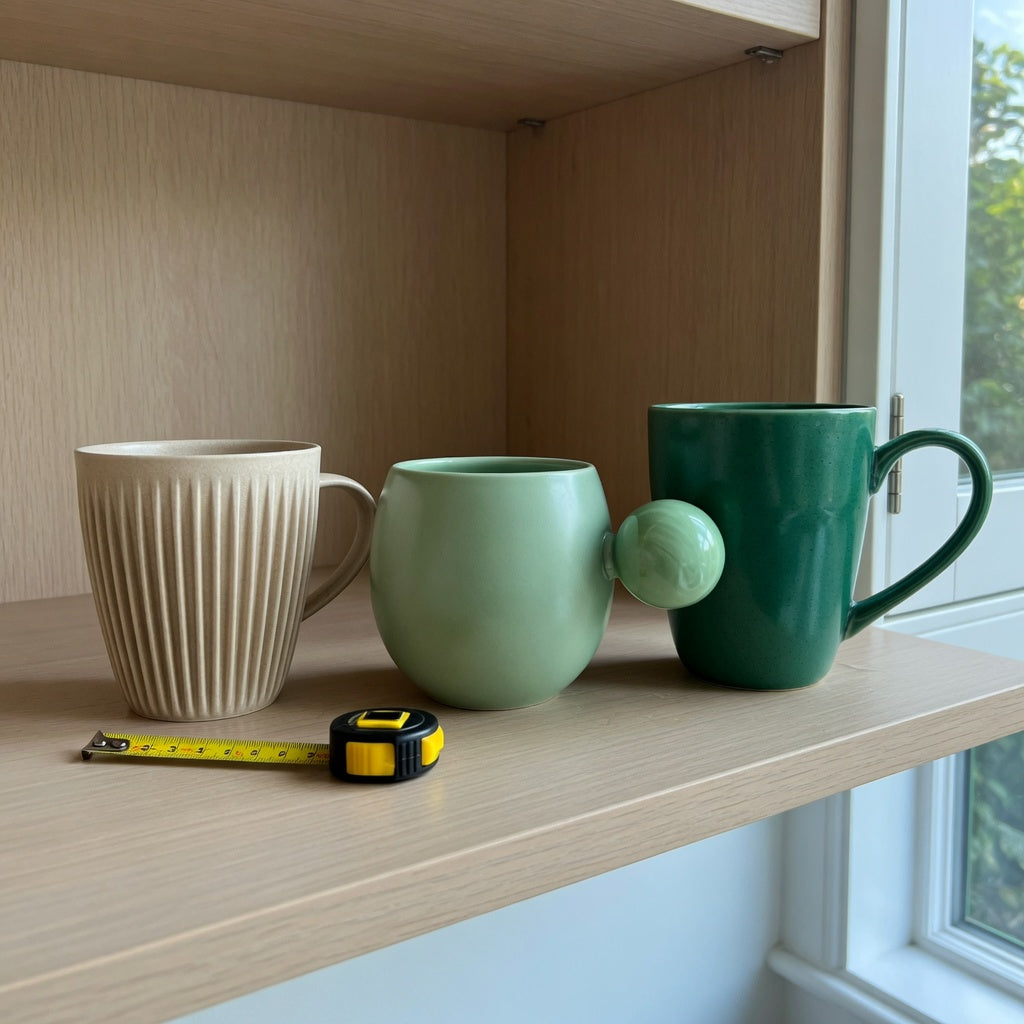
A cabinet door can clear a cup body and still tap the handle every time it closes. We see this storage mismatch when a shopper chooses by capacity alone: the cup technically fits, but the grip projects into the door path, the rim sits too close to the shelf above, or two cups cannot stand side by side. This flat white cup storage fit guide compares the three current CoffeifyMug forms using the verified catalog capacities: Pleated 200 ml, Ball Handle 250 ml, and Emerald 270 ml.
Our team sells and packs these shapes, so we look beyond the number of milliliters. We consider how the cup lifts out, where the handle sits, and which surfaces can touch during daily use. The source facts supplied for this comparison do not include verified exterior measurements, so we will not convert product photos into invented dimensions. Use any measurements shown on the current product pages, and ask our team before ordering several if a critical dimension is not listed.
Flat white cup storage fit guide: what should you measure?
Storage fit has four separate parts. A cup needs to stand on the shelf, clear the closed door, leave enough room for its neighbors, and follow a comfortable path into your hand. Measure all four rather than relying on capacity as a shortcut.
- Clear shelf height: Measure from the shelf surface to the lowest obstruction above it, including a shelf lip or cabinet frame. Then test how much extra room your hand needs to lift and tilt a cup out.
- Closed-door depth: Measure from the rear wall to the inside plane of the closed door. Hinges, rails, and door hardware can reduce usable depth near the sides.
- Total stored width: Include the cup body and the outermost point of the handle. A handle turned sideways consumes row width; a handle turned forward consumes depth.
- Retrieval space: Leave enough room to grip one cup without knocking its rim or handle against the next cup. Static clearance alone does not guarantee comfortable daily use.
Capacity describes liquid volume. It does not establish exterior height, base diameter, rim width, or handle projection.
Open the current unique coffee mugs collection while measuring. Comparing the listing photos side by side will show which visual form is closest to a cup that already fits your cabinet, but photographs should support measurements rather than replace them.
| Current cup | Verified capacity | Visible form cue | Main storage check |
|---|---|---|---|
| Pleated coffee tea cup | 200 ml | Pleated exterior with a side handle | Confirm total width at the handle and clearance around the textured body |
| Ball Handled coffee tea mug | 250 ml | Distinct ball-shaped grip | Check the grip against the cabinet door, shelf edge, and neighboring cups |
| Emerald coffee tea mug | 270 ml | Smoother body and loop-style handle visible in the product imagery | Verify exterior height, depth, and lifting room for the largest listed capacity |
How much do 200 ml, 250 ml, and 270 ml reveal about shelf fit?
The Pleated and Ball Handle differ by 50 ml. The Ball Handle and Emerald differ by 20 ml, while the full spread from Pleated to Emerald is 70 ml. Those differences matter for drink headroom, but they cannot be converted into a predictable increase in cup height or width. A designer can add capacity by changing height, body width, wall profile, or more than one variable at once.
If you pour the same amount into all three, the higher-capacity options provide more internal headroom. That may suit a larger regular pour or reduce the chance of carrying a cup filled near the rim. We do not prescribe a required flat white ratio or serving volume. The best cup for flat white in your kitchen is the one that supports your usual pour and fits the measured storage space.
Pleated 200 ml: does the smallest capacity suit a crowded shelf?
The Pleated 200 ml cup is the logical first product to inspect if your shelf is already crowded. It has the smallest verified capacity of the three and presents a visually compact form. That does not prove it has the smallest exterior footprint, so confirm any listed height, body width, and handle reach before treating it as the automatic space-saving choice.
This shape fits the shopper who normally makes a smaller drink, wants less unused cup volume, and stores cups in a close row. The exterior pleating adds visual and tactile detail, but it also creates channels that can take more attention during cleaning. After a splash or hand wash, wipe along the pleats and dry the base before returning the cup to a packed shelf. A smoother cup will suit you better if you want the fastest possible exterior wipe-down.
The Pleated is not a good solution for a shelf where every handled cup already projects past the front edge. In that situation, measure the full handle envelope or consider a handle-free form outside this three-product comparison.
Ball Handle 250 ml: will the grip cost an extra shelf place?
The Ball Handle 250 ml mug occupies the middle capacity position, but its defining storage variable is the grip rather than the extra 50 ml over the Pleated. The ball is visually prominent and may become the outermost point of the stored cup. Turn it forward and it can approach the cabinet door; turn it sideways and it can reduce the number of cups that fit across a shelf.
This is the relevant choice for a buyer with an open coffee shelf, a roomy cabinet, or an office desk where the distinctive grip has space around it. Before ordering, place an existing mug in both handle-forward and handle-sideways positions. If neither orientation leaves a comfortable retrieval path, the Ball Handle is unlikely to solve the problem.
Do not assume the ball grip will work with an under-shelf mug hook. Hook compatibility depends on the handle opening, attachment shape, and hook diameter. Buyers who rely on hanging storage should inspect the current product imagery closely and confirm compatibility rather than choosing from the product name alone.
Emerald 270 ml: is the extra headroom worth the space check?
The Emerald 270 ml mug has the largest verified capacity in this comparison: 20 ml more than the Ball Handle and 70 ml more than the Pleated. It is the natural next step for someone who regularly wants more liquid headroom and has a cabinet that is not already at its limit.
The capacity alone does not prove that the Emerald is the tallest or widest option. Check all available exterior dimensions and pay particular attention to the lifting path under a fixed shelf. A cup can stand comfortably in place yet scrape the shelf above when tilted toward you. The visible loop-style handle may also suit some hanging systems, but its opening still needs to match the hook.
The smoother-looking exterior has fewer visible channels than the Pleated form, which may appeal to buyers who prioritize quick wiping. The Emerald is not the cautious gift choice for a recipient with unknown cabinet space, and it is not the first option we would investigate for a very low shelf. Its strongest match is a buyer who values the 270 ml capacity and can verify generous storage clearance.
Which shape fits a closed cabinet, open shelf, office, or gift?
The room and storage method can change the recommendation even if your preferred drink size stays the same.
- Tightly packed upper cabinet: Start by checking the Pleated 200 ml because it has the smallest listed capacity and a compact-looking form. Confirm the handle reach before ordering a set.
- Open coffee station: Consider the Ball Handle 250 ml if the grip can sit fully over the shelf. Keep it away from an exposed edge where a sleeve, bag, or cleaning cloth could catch it.
- Roomy shelf and larger regular pour: Compare the Emerald 270 ml against your clear height and lift path. Its extra listed capacity is useful only if retrieving it remains comfortable.
- Office desk: Mark the cup's full footprint beside the keyboard, mouse, cables, and desk edge. The Ball Handle needs particular attention because its grip can enter an active work area.
- Under-shelf rail or hooks: Inspect the handle opening rather than capacity. The Ball Handle should not be selected without confirming that the specific hook can hold it.
- Gift with unknown storage: Share the current mug collection or ask the recipient which existing cup fits best. A visually distinctive mug is not useful if it has nowhere practical to live.
How do washing, unboxing, and daily handling affect spacing?
Storage planning should include the way cups move through the kitchen. During packing and inspection, we pay close attention to the rim, base, and handle attachment because those areas can take the impact if cups knock together. At gift unboxing, place the cup on a flat counter, check that it sits steadily, and inspect the drinking rim and handle junction under good light before use.
- Follow the current product care instructions; do not assume dishwasher compatibility from the cup's appearance.
- After washing, dry the base and any exterior texture before placing cups close together in a closed cabinet.
- Leave enough room to grasp the body or handle without dragging one cup against another.
- Do not plan on stacking unless the product information specifically identifies the cup as stackable. Rim-to-base contact and an offset handle can make an improvised stack unstable.
- Retire a cup from drinking use if an impact leaves a chipped drinking rim or a visible crack at the handle attachment.
A single-layer row uses more shelf width than stacking, but it reduces contact between rims, bases, and handles. For a cup used every morning, reliable retrieval is usually more valuable than squeezing one extra item into the cabinet.
How should you measure before ordering several cups?
- Empty the intended shelf so you can see the rear wall, hinges, frame, and front lip.
- Measure the lowest clear height and the usable depth to the inside of the closed door. Record the figures in millimeters for easier comparison.
- Decide whether handles will face forward, sideways, or alternate. Measure the width available for each orientation.
- Lift an existing flat white coffee cup from the same location. Watch the rim path and where your fingers pass under the shelf above.
- Trace that existing cup and its handle on paper if it fits well. The outline gives you a practical storage envelope to compare with current product dimensions.
- Open each product page and compare any listed exterior measurements with your shelf figures. If the dimension you need is absent, ask our team instead of estimating it from the photograph.
Measure for the number of cups you intend to own, not just one display piece. Two handles can alternate into open spaces, but that arrangement needs to remain easy to repeat after a dishwasher cycle or hurried hand wash.
Frequently asked questions
Which current flat white cup takes up the least cabinet space?
The Pleated has the smallest verified capacity at 200 ml, so it is the first option to investigate for a tight cabinet. Capacity does not establish exterior dimensions, however. Compare its current listed height, body width, and handle projection with the Ball Handle 250 ml and Emerald 270 ml before deciding.
How do I use the flat white cup storage fit guide if dimensions are missing?
Measure your cabinet's clear height, closed-door depth, and available width per cup, then identify which number is most restrictive. Do not estimate product measurements from an angled photograph. Ask our team for the missing external dimension before placing a multi-cup order.
Can the Ball Handle 250 ml hang from a standard mug hook?
Do not assume that it can. Mug hooks vary in diameter and shape, and the ball grip may not provide the same opening as a conventional loop handle. Check the handle form against your actual hook or choose shelf storage.
Can I stack these cups to save space?
The verified product facts used for this guide do not identify any of the three as stackable. Plan for single-layer storage unless the current product instructions explicitly support stacking. This avoids building your cabinet layout around an unstable rim-to-base fit.
Is the Emerald 270 ml too large for a normal kitchen cabinet?
There is no single normal cabinet clearance, and capacity does not reveal the Emerald's exterior height. Measure the intended shelf and allow room to lift the cup, not merely stand it upright. Choose it when you want the largest listed capacity and can confirm the full storage envelope.
Take three numbers to the CoffeifyMug unique coffee mugs collection: clear height, closed-door depth, and width available per cup. Open the Pleated, Ball Handle, and Emerald listings side by side, confirm the current external dimensions, and choose the shape whose handle and lift path fit those measurements. If a needed dimension is missing, ask before ordering several.
More from our blog
Read more
Mocha Mug Size Decision Guide: 400, 440, or 480 ml?
Compare CoffeifyMug's verified 400 ml, 440 ml, and 480 ml options by your measured pour, preferred headroom, refill habits, storage, and care constraints. The guide also explains when none of the t...
Read more
Macchiato Cup Size Decision Guide: 170, 200 or 250 ml?
This macchiato cup size decision guide compares the Retro 170 ml, Pleated 200 ml and Ball Handle 250 ml by finished pour volume, foam headroom, ice, visible form and care checks. It also explains w...
Read more
Leave a comment
This site is protected by hCaptcha and the hCaptcha Privacy Policy and Terms of Service apply.