

Flat White Cup Size Decision Guide: 200, 250 or 270 ml?
Reading time: about 9 minutes
A cup can look comfortably sized beside the espresso machine, then feel precariously full on the walk to an office desk after the milk goes in. This flat white cup size decision guide addresses that exact buying problem: choosing enough listed capacity for your usual finished drink and preferred headroom, without treating one volume as a required flat-white standard.
Our store currently has three verified options in this compact group: the Pleated at 200 ml, the Ball Handle at 250 ml and the Emerald at 270 ml. When we help shoppers compare them, we separate confirmed catalog facts from assumptions. Capacity is confirmed. A required drink ratio, cafe standard, heat-retention result, external dimensions, material and appliance compatibility should not be inferred from capacity alone.
How does the flat white cup size decision guide compare 200, 250 and 270 ml?
Start with the listed capacity, then subtract the space you personally want to leave below the rim. That unfilled space is headroom. It gives milk and foam somewhere to sit and makes a filled cup easier to move, but there is no single headroom measurement that every home drinker must follow.
| Current option | Listed capacity | Capacity difference | Practical fit signal | Main trade-off |
|---|---|---|---|---|
| Pleated | 200 ml | Starting point | Your measured pour is repeatable and still leaves your preferred rim gap | Least spare capacity for changes in milk or foam |
| Ball Handle | 250 ml | 50 ml more than Pleated | Your pour varies or more than one person will use the cup | May provide unused volume for consistently smaller drinks |
| Emerald | 270 ml | 70 ml more than Pleated and 20 ml more than Ball Handle | You want the largest current capacity margin | Can feel larger than necessary for a fixed, low-volume routine |
The 50 ml step from Pleated to Ball Handle is larger than the 20 ml step from Ball Handle to Emerald. That distinction matters. A shopper deciding between 250 ml and 270 ml may find that design, handle style, storage measurements or care requirements settle the choice, while someone moving from 200 ml to 250 ml is making a more substantial capacity change.
Is the 200 ml Pleated cup enough for a fixed, compact pour?
The Pleated 200 ml coffee and tea cup makes the most sense for a shopper who already knows that a smaller finished drink fits without reaching the rim. It is the lowest-capacity option in this comparison, so it suits a deliberate routine better than an unpredictable one.
- Your usual drink can be reproduced below 200 ml while preserving the headroom you want.
- You prepare roughly the same espresso and milk amount each day.
- You want the lowest-capacity option for a desk, kitchen setup or gift recipient who prefers shorter drinks.
- You do not need the cup to cover larger tea servings or drinks with ice.
The limitation is straightforward: 200 ml gives you the least room to absorb an unexpectedly generous milk pour. It is not the practical choice for someone who regularly changes recipes, wants a brim-level foam presentation or needs one vessel for substantially larger drinks. Do not select it only because flat whites are often photographed in small cups; a photograph is not a serving standard.
Does 250 ml provide useful flexibility without jumping to the largest option?
The Ball Handle 250 ml mug sits between the two alternatives. Its listed capacity is 50 ml greater than the Pleated and only 20 ml below the Emerald. We point shoppers toward it when their main problem is inconsistency rather than a consistently large drink.
- Two people share the cup but do not use exactly the same milk amount.
- Your weekday pour is modest, while weekend drinks tend to be fuller.
- You want more margin than 200 ml but have no clear need for the largest current option.
- The Ball Handle design itself is part of your preference.
Capacity does not confirm how the handle will fit a particular hand or how much shelf clearance the mug needs. Check the current product images and any listed external measurements if grip or cabinet fit is a deciding factor. If your measured drink already fits comfortably within a 200 ml cup, moving to 250 ml may add volume without solving a real daily problem.
Who benefits from the 270 ml Emerald mug's extra capacity?
The Emerald 270 ml coffee and tea mug has the largest verified capacity in this three-product comparison. It is the sensible shortlist option when your normal pour sits too close to the limit of a smaller cup or when one cup must handle more than one drink size.
- Your measured finished level leaves too little personal headroom in a 250 ml vessel.
- You alternate between a flat white and a somewhat larger coffee or tea pour.
- You want the greatest nominal capacity margin among these current options.
The Emerald is not a replacement for a travel mug or a high-volume iced-drink cup. Ice takes up part of the listed capacity, and 270 ml remains the upper end of this compact comparison rather than an unlimited serving size. It may also look underfilled if your routine consistently occupies far less than 200 ml. As with the other two options, confirm external dimensions instead of assuming that capacity reveals its exact footprint.
How can you measure headroom without inventing a drink standard?
For most home shoppers, the best cup for flat white routines is the one that accommodates the drink they actually make. Measuring that routine is more reliable than copying a recipe photo or choosing by product name alone. You can estimate occupied volume with cool water and a marked measuring jug.
- Prepare your usual drink in your current cup and note where the highest point of the finished foam sits.
- After the cup is empty and clean, add measured cool water until it reaches the same level.
- Record the amount of water used. This is an estimate of the space your finished drink occupies, including the level normally taken by foam.
- Compare that result with 200 ml, 250 ml and 270 ml while preserving the rim gap you prefer for carrying and drinking.
Foam volume changes with preparation and settles over time, so do not plan around an exact brim-level result. Listed capacities may also be rounded or measured according to the seller's product specifications. Treat the number as a comparison tool, leave a margin for normal variation and avoid filling a hot drink to the rim simply to make a smaller cup work.
Do desk space, cabinet storage and care change the size choice?
Yes. Capacity is only one part of daily fit. In our experience, buyers are more satisfied when they check the cup's route through the kitchen, office and cleaning routine before ordering.
- Office desk: Think about how far you carry the finished drink and how crowded the desk is. More headroom may matter more than choosing the lowest possible capacity.
- Cabinet storage: Measure shelf height, depth and available handle clearance. A 200 ml label does not prove that one cup has a smaller external footprint than another.
- Dishwasher routine: If the cup must go through frequent dishwasher cycles, verify the current care statement on its product page before checkout. Do not infer dishwasher or microwave suitability from appearance.
- Hand care: If the listed instructions call for hand washing, use a soft, non-abrasive sponge and dry the cup before returning it to the cabinet.
- Gift unboxing: Check the rim, handle connection and base before first use. A chip, visible crack or base that rocks on a flat counter is a reason to stop and contact the store.
Material and finish can affect care, but those details should come from the current product listing rather than a general article. We apply the same rule to handle clearance, wall thickness and exact dimensions: verify them on the linked page when they affect your decision.
Which current cup belongs on your shortlist?
Use your measured drink, not a supposed universal serving size, to narrow the three options.
- Choose Pleated 200 ml when your stable pour leaves comfortable headroom and lower capacity is a deliberate priority.
- Choose Ball Handle 250 ml when your milk amount varies, two people share the cup or you prefer the middle capacity and handle design.
- Choose Emerald 270 ml when the largest current capacity margin matters more than keeping the drink visually close to the rim.
- Choose a different style if you need a travel vessel, a much larger tea serving or substantial room for ice. Do not force one of these compact choices to cover a use it was not selected for.
A useful flat white coffee cup should remove friction from your routine. If you still need to pour cautiously to avoid the rim, or the cup regularly sits mostly empty, revisit the measured volume before choosing by appearance.
Frequently asked questions
How can I use the flat white cup size decision guide if I do not know my pour volume?
Reproduce your normal finished fill level with cool water and measure how much water the cup holds at that point. Compare the result with the listed 200 ml, 250 ml and 270 ml capacities, allowing room for day-to-day variation. This is more useful than assuming your recipe matches someone else's serving size.
Is a 200 ml cup too small for a flat white?
Not automatically. The Pleated 200 ml option can be practical when your usual drink fits below its listed capacity with the headroom you prefer. It becomes a poor fit when your milk and foam routinely bring the drink close to the rim.
Is there a meaningful difference between 250 ml and 270 ml?
The listed difference is 20 ml, which is smaller than the 50 ml step between 200 ml and 250 ml. If both capacities accommodate your measured pour, design, handle preference, external dimensions and care instructions may be more useful deciding factors than volume alone.
Which size makes sense for a gift if I do not know the recipient's exact routine?
The 250 ml Ball Handle is the middle capacity, but that does not make it universally correct. Try to confirm whether the recipient prefers lower-volume coffee, larger milk pours or a cup that can also serve tea. Style, handle comfort, storage and care habits still matter for a gift.
What should I check immediately before ordering a flat white coffee cup?
Confirm your measured occupied volume, preferred headroom, the cup's current external dimensions and its current care instructions. Then compare the linked 200 ml, 250 ml and 270 ml product pages in our unique coffee mugs collection and choose the option whose verified details match your actual routine.
More from our blog
Read more

Hot toddy mug buying priorities: Capacity, shape, and space
Compare The Gradient and The Flow at a listed 400 ml with The Rock at 480 ml, then use handle shape and real desk, nightstand, and cabinet space to find the better fit.
Read more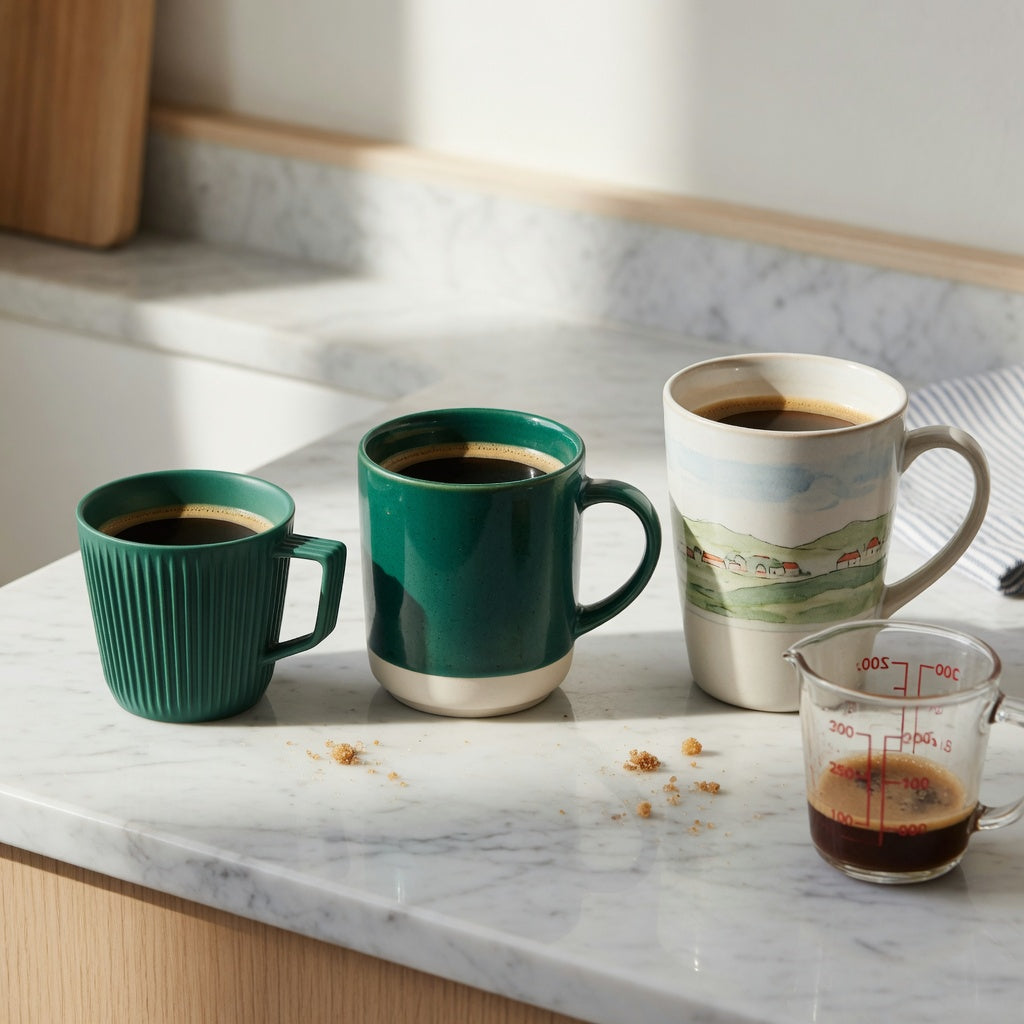
Americano Coffee Cup Size Decision Guide: 200, 270 or 350 ml
Use your actual pour volume to compare the 200 ml Pleated, 270 ml Emerald and 350 ml Landscape Tall. See how each capacity changes headroom for desk use, kitchen routines and gifts without assuming...
Read more
Leave a comment
This site is protected by hCaptcha and the hCaptcha Privacy Policy and Terms of Service apply.