
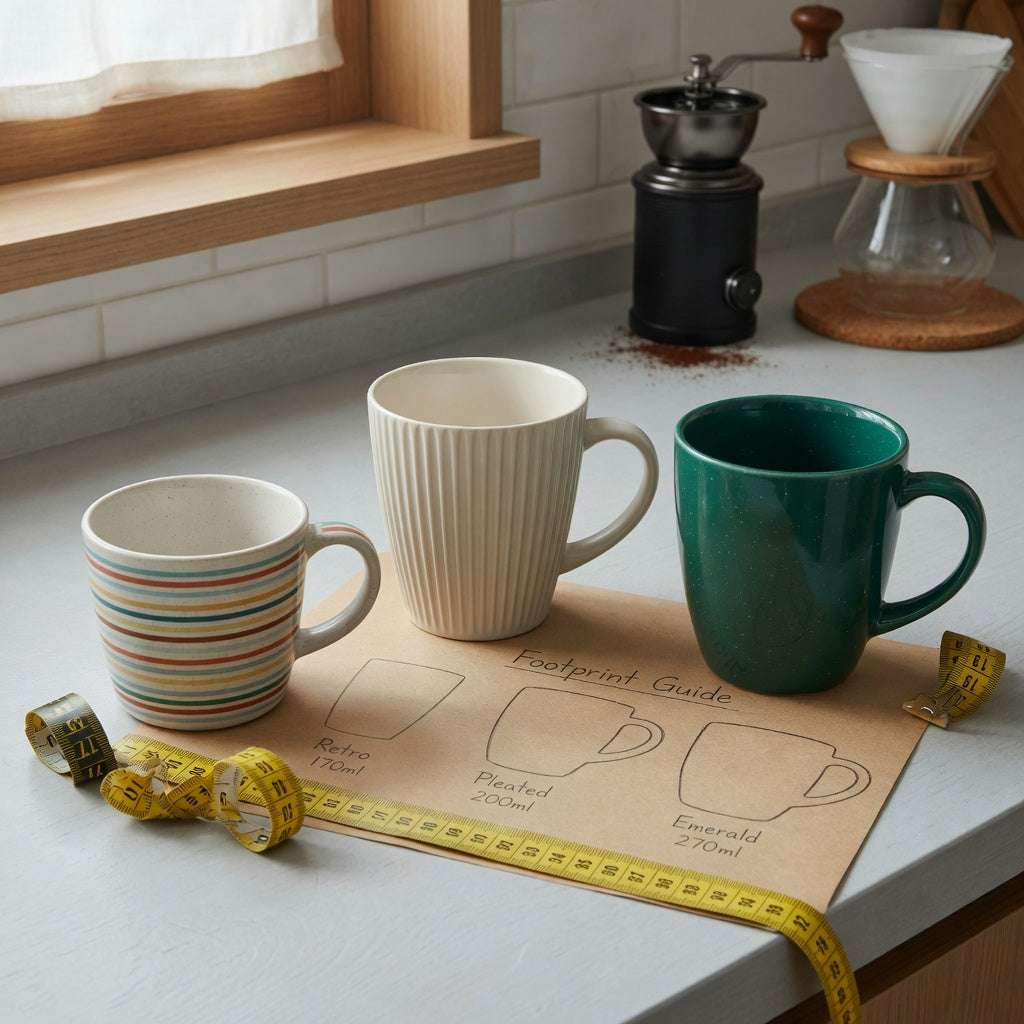
Eggnog Mug Home Coffee Station Practical Purchase Checklist
Reading time: about 9 minutes
A compact mug can look tidy beside a brewer in a product photo and still be awkward on the counter you use every morning. In our store, the useful questions are concrete: how much do you actually pour, where will the mug sit, and which details still need confirmation before checkout? This eggnog mug home coffee station practical purchase checklist compares the catalog facts we can verify for three compact options.
We handle these comparisons by separating confirmed information from assumptions. The confirmed choices are the Retro 170 ml cup, Pleated 200 ml cup, and Emerald 270 ml mug. We are comparing their listed capacities and visible shapes only. We are not inferring exterior dimensions, material, dishwasher or microwave compatibility, temperature performance, stackability, licensed design status, included food or drink, or bundled accessories.
Which listed capacity matches the serving you make at home?
Start with the drink, not the product image. Measure one normal eggnog or coffee serving in a kitchen measuring cup, then decide how much empty space you prefer below the rim. A holiday pour that looks generous in a wide serving glass may not translate neatly to a compact coffee-station mug.
- For an intentionally short serving: The Retro has the lowest listed capacity at 170 ml. It suits a shopper whose measured serving fits that limit and who does not want unused volume. The trade-off is straightforward: it will require a refill or a different mug if your regular pour is larger.
- For a middle-capacity choice: The Pleated holds 200 ml, which is 30 ml more than the Retro and 70 ml less than the Emerald. It fits someone whose measured serving falls between the other two options and who prefers the visible pleated surface.
- For the fullest serving among these three: The Emerald has a listed capacity of 270 ml. It provides 100 ml more capacity than the Retro, but it is still a compact serving option rather than a large travel or oversized coffee mug.
Capacity does not establish external footprint. A 170 ml cup is the smallest by liquid volume in this comparison, but that alone does not prove it has the narrowest base, shortest height, or least handle projection. Those measurements need to be checked separately.
Measure counter depth, shelf height, and handle clearance
A practical coffee-station check uses the same terms we use when reviewing mug fit: overall height, rim diameter, base diameter, total width including the handle, and handle projection. If one of those dimensions is missing from the live product information, do not substitute a guess based on capacity or photography.
- Mark the parking area. Measure the width and depth of the exact spot where the mug will rest between uses.
- Check vertical clearance. Measure from the counter or drip tray to the lowest cabinet, shelf, spout, or stand above it.
- Allow room for your hand. A handle can technically fit beside a grinder while leaving too little space for comfortable finger access.
- Watch the counter edge. The base should sit fully on the tray or counter, with the handle turned away from a busy walkway.
- Compare with a mug that already works. Record its height, base width, and overall width, then use those figures as a practical reference when checking the product details.
We do not make appliance-compatibility claims from a mug photo. Clearance under an espresso outlet, pod machine, or pour-over stand can only be confirmed by comparing the mug's exact exterior height with the space available in your setup.
Retro 170 ml, Pleated 200 ml, and Emerald 270 ml side by side
The useful distinction is not which option is universally best. It is which verified capacity and visible profile align with your measured serving and the look you want on the counter.
| Mug | Verified capacity | Visible shape cue | Reader situation | Decision boundary |
|---|---|---|---|---|
| Retro | 170 ml | Rounded, retro-style profile shown in the listing images | You make a short measured serving and want the lowest capacity here | Least liquid volume; exterior footprint must still be verified |
| Pleated | 200 ml | Visible vertical pleating around the exterior | You want a capacity between the Retro and Emerald plus a textured visual profile | Pleating does not by itself prove better wet-hand grip or easier stacking |
| Emerald | 270 ml | Smoother-sided, taller-looking silhouette in the listing images | Your measured serving needs the highest listed capacity of the three | Largest capacity here; exact height and counter footprint still need checking |
Visible shape helps with style selection, but photos are not measuring tools. We also avoid treating pleating as evidence of special grip performance or assuming that smooth-sided mugs nest or stack. Those conclusions require specifications or direct testing that are outside the verified facts used here.
How should the mug share space with a brewer, grinder, and tray?
A home coffee station usually has more than one active zone. There is a pouring area near the brewer, a parking area for the mug, and a route to the sink. A cup that works in only one of those places can still create daily friction.
- Beside a grinder: Check that the handle does not block a grounds bin, switch, or removable part you use regularly.
- On a drip tray: Compare the mug's base and height with the usable tray surface and available vertical clearance. Do not rely on listed capacity for this check.
- On a narrow shelf: Confirm overall height and handle projection, then leave enough open space to lift the mug without scraping nearby items.
- On a serving tray: Make sure the full base can rest on a flat section rather than crossing a raised rim or decorative groove.
One useful test is to place your current mug in the proposed parking spot and note what works or gets in the way. Record that mug's measurements. You then have a real reference for judging the Retro, Pleated, or Emerald once the required exterior dimensions are available, without inventing compatibility with your equipment.
Material, care, and first-use checks before station setup
The verified facts for this comparison do not include material or care compatibility. Screen color and surface appearance are not reliable substitutes for an exact material description. Before ordering, check the live listing for the material name, finish details, and explicit dishwasher or microwave instructions.
- Read the care wording literally. Do not treat missing dishwasher or microwave guidance as approval for either appliance.
- Consider the visible surface. If you choose the Pleated design, decide whether you are comfortable cleaning around its exterior texture after splashes.
- Confirm the included quantity. A styled product image can contain props. Only the written listing should determine what is included in the order.
- Inspect the rim and handle junctions. During unboxing, look for unexpected chips, sharp points, or visible hairline cracks before use.
- Test the base on a flat counter. Check for noticeable rocking before placing the mug near a brewer or counter edge.
These are standard inspection points for mugs, not a claim that any of these models has a recurring defect. For gift orders, perform the check before wrapping and keep the original packaging until the item, capacity, and condition are confirmed.
If care instructions are unavailable, a conservative routine is to hand wash with mild dish soap and a non-abrasive sponge, rinse eggnog residue promptly, and dry the mug before returning it to a wood shelf or tray. This is a cautious default, not a claim of special care requirements or performance.
Eggnog mug home coffee station practical purchase checklist
Run this sequence before selecting a design. Each step removes an assumption that commonly leads to a mug being stored elsewhere instead of staying on the coffee station.
- Measure one serving you actually make and record the volume in milliliters.
- Eliminate any listed capacity that cannot hold that serving with your preferred amount of headroom.
- Compare the visible profiles: rounded Retro, pleated exterior, or the smoother-sided Emerald silhouette.
- Measure the free counter area, vertical clearance, and space available for a handle and your fingers.
- Obtain the mug's exact exterior measurements from the live listing or the store if those measurements are essential to fit.
- Mark the proposed footprint on the counter with a piece of paper before ordering.
- Confirm material, finish, care guidance, and included quantity in writing rather than inferring them from photos.
- After delivery, inspect the rim, handle junctions, surface, and base before washing or gifting the mug.
Use the eggnog mug home coffee station practical purchase checklist as a stop-or-go filter. If capacity works but a required dimension or care detail remains unknown, pause and confirm it. A product should not earn permanent counter space through guesswork.
When should you choose a different mug style?
These three compact capacities will not suit every routine. A different category is more practical if:
- Your measured serving regularly exceeds 270 ml.
- You need a travel lid, sealed design, or verified insulation.
- You require a specific material or appliance-safe care method that has not been confirmed.
- You need proven stackability, an exact multi-piece set, or included accessories.
- Your station has strict machine clearance and the necessary exterior dimensions are unavailable.
If one of those limits applies, browse our unique coffee mugs collection for a different capacity or visible silhouette, then repeat the same measurement process. The collection is the better next step for shoppers whose drink volume, storage arrangement, or feature requirements fall outside this three-mug comparison.
Frequently asked questions
What does the eggnog mug home coffee station practical purchase checklist verify?
It compares three confirmed capacities: Retro 170 ml, Pleated 200 ml, and Emerald 270 ml. It also uses visible shape to help narrow the style. Exterior dimensions, material, care compatibility, special temperature performance, and included items must be confirmed separately.
Does the Retro 170 ml automatically have the smallest counter footprint?
No. The Retro has the lowest listed liquid capacity of the three, but capacity does not prove base diameter, total width, or exterior height. Use exact product dimensions before treating it as the smallest physical option.
Does the Pleated 200 ml exterior guarantee a better grip?
No. The pleating is a visible design feature, but we are not claiming tested grip performance. If wet-hand security matters to you, treat it as a separate requirement rather than assuming texture settles the question.
Can I assume these mugs are dishwasher or microwave safe?
No. Only explicit care language on the current product listing or packaging should answer that question. Do not infer appliance compatibility from the mug's appearance, color, or capacity.
Which option fits a fuller single serving of eggnog?
The Emerald provides the highest verified capacity at 270 ml, compared with 200 ml for the Pleated and 170 ml for the Retro. It is the logical first product to check if your measured serving exceeds the smaller capacities. You still need to verify its exterior dimensions against your station.
Measure one real serving and the free counter rectangle now. Then choose the capacity row that survives both checks and open its linked product page for the final shape, specification, care, and included-quantity review. If none of the three meets every required condition, use the collection above to compare another mug rather than forcing a compact option into the wrong routine.
More from our blog
Read more
Oversized Ceramic Coffee Mugs: Home Coffee Station Shortlist
Compare three oversized ceramic mugs by the way your station is actually used: brewing clearance, shelf space, drink style, handling, and care. Each option includes a clear reason to choose it, a r...
Read more
Dandelion Coffee Mug Home Coffee Station Product Shortlist Guide
Compare the Gradient and The Flow at 400 ml with The Rock at 480 ml using measured serving size, handle-fit checks, station clearance, and care verification. Each option includes a clear reason to ...
Read more
Leave a comment
This site is protected by hCaptcha and the hCaptcha Privacy Policy and Terms of Service apply.