



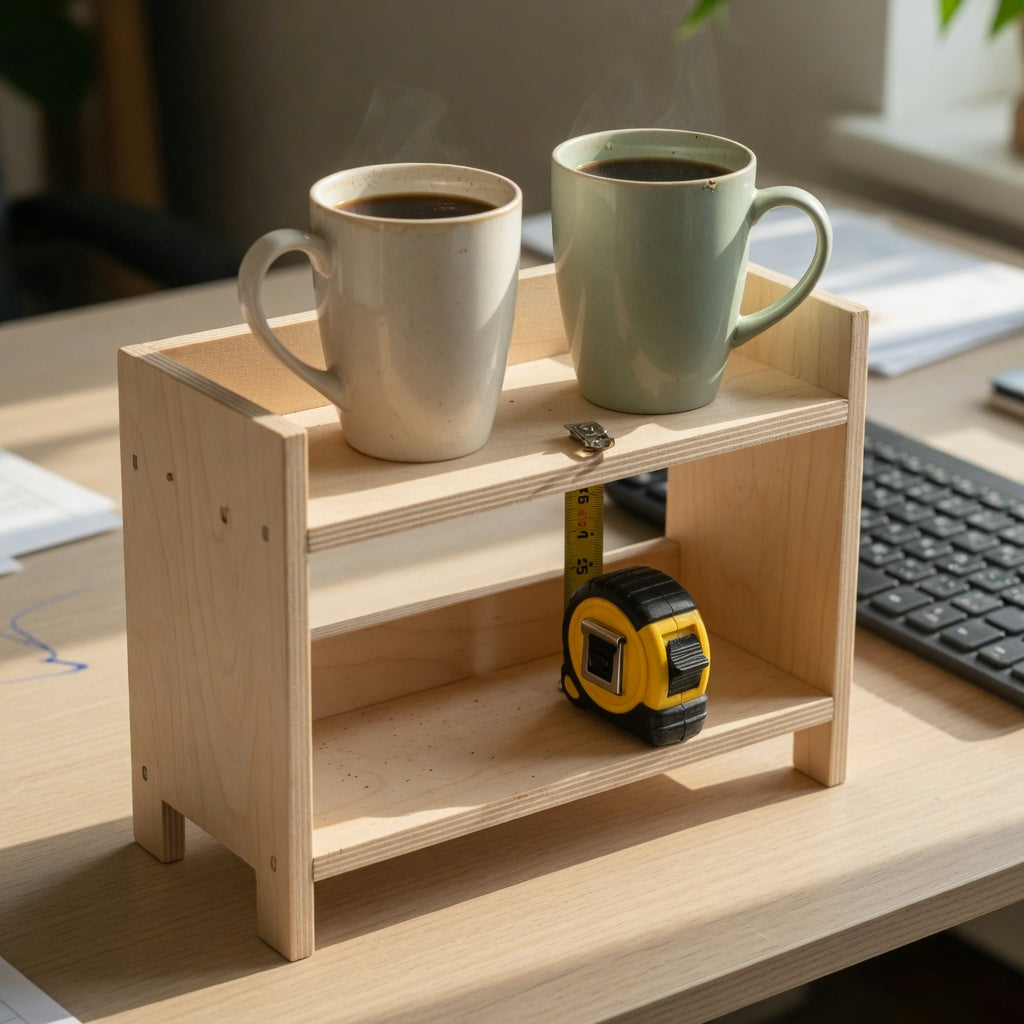
Desk Shelf for Tall Coffee Mugs: What Buyers Should Compare
Reading time: about 12 minutes
The photo made the rack look generous. On the desk, the rim stopped short of the board above it, and the handle would not enter the next cubby. That is the complaint we hear from people shopping for a desk shelf for tall coffee mugs. The finish is fine. The opening was cut for a small diner cup. The mug they actually drink from does not fit. Fit decides whether that cup stays beside the keyboard or goes back in a cupboard.
In our store the sequence repeats. Someone wants a mug that holds a full morning pour and can sit out through a workday. They set it on a two-tier organizer bought from a lifestyle photo. The base rocks, because the board is shallower than the footprint once the handle sticks out. Compare finishes later. Measure first.
If the cup is still undecided, start there. We send desk shoppers to our unique coffee mugs collection when they want one mug in daily reach instead of a stack they never use. The landscape tall coffee tea mug and the round coffee tea mug can demand different cubby widths, but only the current pages can say how. Copy the height, width, and handle notes printed on those listings today. If a figure is missing, leave it blank. We will not guess a size, and a shelf ordered to a guess is how rims get chipped.
Three situations show up when customers ask us where the mug should live:
- One everyday mug beside the keyboard. A short freestanding shelf with a published gap is the match, and the mug belongs on the lower tier.
- A row of mugs on display. A cubby rack or hook rail works only if the opening or the hook spacing is printed, handles included.
- The cup is not chosen yet. Pick from the collection, write down the live listing numbers, then buy the shelf that clears those numbers.
Why does a desk shelf for tall coffee mugs fail on the gap, not the photo?
Retail pages lead with overall height. That figure includes the top cap, the feet, and sometimes a lip. Your mug only cares about the open air between the surface it sits on and the underside of the next board. In our experience, a unit shot as a coffee station is often a spice rack with a new name.
A home-storage bulletin archived by The Ohio State University treats one or two inches above a stored article as enough clearance when you are not stacking, unstacking, or lifting from the back. Pairing a shallow cup with a tall one on the same shelf wastes the vertical room the tall piece needed. On a desk, that wasted inch also comes out of the typing zone.
Hunt for four interior numbers, not the glamour height:
- Open height between tiers, from the top of the lower surface to the underside of the board above.
- Cubby opening, width and depth, with the handle counted if the mug sits handle-out.
- Hook spacing, center to center, if the rack hangs cups instead of standing them.
- Footprint on the desk, including any rear lip that pushes the shelf toward the keyboard.
If the listing only says how many mugs it holds and never prints the gap, assume the count was staged with small cups. Ask for the interior measurement or skip it. A shorter rack that is honest beats a tall frame that clips the rim.
What should you record on the mug before the shelf goes in the cart?
There is no shared retail height for a tall coffee mug. A travel tumbler that must clear a brewer is a different object from a latte mug you lift by the handle. A hand in the air is not a measurement.
Set the mug on a flat counter and record four things with a tape:
- Rim height. Table to the top of the rim. If a lid stays on in storage, measure with the lid. The lid is stored height.
- Base diameter. The footprint that has to sit fully on the board. A narrow base under a wide rim can feel steady in the hand and still overhang a thin slat.
- Handle reach. From the outer wall to the outside of the handle. Cubbies and neighboring mugs hit this first.
- Widest point of the body. Some cups belly out below the rim. A lip-only measurement lets that belly strike the cubby wall.
Add the one-to-two-inch buffer only if you can lift straight up. A monitor arm or an overhead cabinet that forces a tilt needs more room than that. Do not plan a layout that tips a full mug over a keyboard.
Handle reach also tests capacity claims. On hook rails, only small cups often sit side by side, and a larger mug has to skip a hook. A photo of tiny cups touching is not proof your desk mug will do the same. If the product page for the mug you plan to store omits a dimension, that dimension is unknown. Do not borrow it from a different mug, a photo, or an older article.
Which rack clears an oversized mug without eating the keyboard?
Not every holder is a shelf, and not every shelf belongs next to a laptop. Match the type to the mug you measured.
| Organizer | Works when | Fails a tall mug when |
|---|---|---|
| Two-tier standing shelf | The published gap beats rim height plus your lift buffer, and the board is deeper than the base | Only overall height is listed, or the upper tier is a short spice gap |
| Cubby rack | The opening is wider than body plus handle, and taller than the rim | Cubbies were cut for diner cups and the handle will not enter |
| Under-shelf hook rail | Hooks are spaced for your handle and the rail is fixed to something solid | Hooks are so close that only small cups fit without knocking neighbors |
| Countertop mug tree | Open air above the desk still clears the cabinets once mugs are on it | Loaded height hits the cabinet, or one heavy side makes it wobble |
| Cabinet shelf riser | You are storing mugs inside a cupboard, not beside a keyboard | You expected it to free desk space; it does not |
| Monitor or desktop riser | The open area under the platform is taller than your mug, and the keyboard still has a home | It is a keyboard hutch with only a couple of inches of clearance |
A standing shelf suits a heavy mug you set down several times a morning. Hooks belong under a real cabinet or on a wall, not on a tray that shifts when you type. A mug tree looks small until the mug's own height hits the cabinets above. Measure loaded height, not the bare metal.
The shelf does not fix brewer clearance. A mug that fits the rack can still be too tall for a single-serve machine. Read the machine's cup limit in its own guide and set it beside the shelf gap. Both numbers have to work, or you own two incompatible objects.
Renters are usually better with a freestanding rack: wide feet, non-slip pads, no holes in the wall. Adhesive strips are a weak sole support for a rack you will load with full mugs, because a bump becomes a fall. A wall rail is reasonable in a stud or a solid wall with a proper anchor. It is a bad plan on a cubicle panel or a hollow door. A cabinet riser tidies a cupboard. It does not free the strip of desk beside the keyboard.
Will the shelf crowd the monitor, the keyboard, or your knees?
A mug you cannot reach without leaning ends up on a pile of paper. OSHA's computer-workstation guidance is concrete. The desk should let the monitor sit at least 20 inches away. Frequently used items belong in the primary work zone. Leg clearance under the desktop is generally 20 to 28 inches high, and storage under the work surface should not take space from legs and feet.
- Keep the shelf beside the keyboard, in the near zone, not behind the monitor where you reach through cables.
- Do not shove a deep shelf forward so the monitor has to break that 20-inch distance.
- Do not hide the rack under the desk. That space is for legs and feet. A mug falling toward your shoes is a mess we hear about more often than people expect.
- If the upper tier sits near shoulder height while you are seated, you will abandon it. The everyday mug goes on the lower tier.
Length is the quiet problem. A long row of cubbies can overrun the free strip beside a laptop. Measure from the keyboard edge to the wall or monitor arm, then compare that with the shelf's stated length. If you only have one cubby width, add the end frames before you trust the math.
A full mug over a keyboard, a laptop fan, or a power strip is a bad neighbor. Shift the shelf to your non-dominant side and use a coaster or a lipped tray for any mug that is waiting. An open board will not catch a chair bump. A low front lip, or hooks that turn upward, matters when the desk gets jostled.
What keeps a heavy load from tipping the rack or steaming the wood?
One heavy side can make a light aluminum or bamboo rack feel fine when empty and unsteady when full. Shoppers describe the same pivot: mugs on the left, nothing on the right. A line about how many mugs it holds is not a tip test, and a real weight rating is seldom printed. You have to judge the stance.
- Wide feet. The stance should be wider than the loaded mugs, so the center of gravity stays low. A skinny pedestal is the wrong shape.
- Non-slip pads. They need to grip a smooth desktop. Hard plastic dots skate when you bump the desk.
- Heavier pieces on the lower tier. The U.S. Consumer Product Safety Commission advises anchoring bookcases and dressers and keeping heavier items on lower shelves. Its STURDY tip-over rule covers clothing storage units such as dressers and armoires, not a small mug shelf. Copy the lower-shelf habit anyway. Anchor a tall bookcase-style display someone could pull over. A short desktop stand does not need drywall screws. It does need to stay put.
- Balanced loading. Two mugs go on opposite ends or both on the bottom, not as a photo row on one hook bar.
Steam is the other failure we get asked about. A hot mug tight under wood or a composite tier wets the underside every morning. We have no lab number for how fast that marks a finish, and specs almost never mention it. Leave the lift gap. Metal handles condensation better than raw or thinly sealed wood. Wood looks right next to furniture, and it is the worse choice for wet travel mugs or a once-a-month wipe. Skip a rack that reads like a bathroom caddy with mug wording added.
Do not use the rack to stack three tall mugs, hang glass carafes, or double as a laptop stand unless under-clearance and a weight note are both published and both check out. It is a poor gift when you do not know the other person's mug height. Give the mug. Add the shelf after the measurements exist.
Wipe coffee film the same day. Dried sugar under a base makes the next mug stick, then tip. Keep wood out of the dishwasher. Metal wire can take a sink wash. Check the feet every few weeks. A missing pad is how a steady rack starts to walk.
What belongs on the buying sheet before you pay?
Fill this with the listing open and a tape on the mug. A blank cell is a reason to wait, not a reason to hope.
| Check | Write this down | It passes when |
|---|---|---|
| Rim height | Table to rim, lid on if you store it that way | The open gap adds 1 to 2 inches for a straight lift |
| Base and handle | Base diameter, handle reach, widest body point | The board and the cubby or hooks clear all three, not just the rim |
| Interior gap | Underside of the upper tier to the shelf surface | You are not using overall product height as a stand-in |
| Desk footprint | Shelf length and depth versus free desktop | Keyboard, the 20-inch monitor distance, and legroom all stay put |
| Mount | Freestanding or wall | No-drill if you cannot anchor; a stud or solid wall if you can |
| One-sided load | Your real set of mugs, not the catalog photo | The rack sits flat with the heavy side loaded |
| Brewer, if you brew at the desk | The machine's own cup clearance | The same mug also clears the machine |
| Capacity line | Whether handles are included in the count | Large mugs do not have to skip every other hook |
If two of those cells are blank on the product page, keep looking. When the mug is the missing piece, compare shapes in the mugs we stock for a desk setup and confirm the live dimensions on the landscape and round listings. Then buy the shelf that clears those numbers with room to lift.
Frequently asked questions
Will a desk shelf for tall coffee mugs fit oversized cups, or only smaller ones?
Only the interior gap and the cubby or hook spacing can answer that. Overall height and a phrase about how many mugs it holds usually describe a mix of small cups. Measure rim height, base, and handle reach, then compare them with the open space between tiers. If the seller will not give the interior gap, treat the shelf as unproven for a tall mug.
How much open height should I leave above the rim?
When you can lift the mug straight up, without tipping it or digging it out from the back, one or two inches above the rim matches the clearance storage guidance treats as enough. A lid counts toward the mug's height. If a monitor shelf or cabinet forces a tilt, leave more room, or pick a different spot.
Do I need the handle measurement, or is height enough?
Height alone misses the collisions. Record handle reach and the widest part of the body, because cubbies and neighboring mugs hit those before they hit the rim. On a tight hook rail, a larger mug often has to skip a hook. If the mug's own page omits a dimension, that number is unknown.
Will the rack tip if I load heavy mugs on only one side?
It can, especially on a light frame with a narrow foot. Put heavier mugs on the lower tier, balance the load left to right, and look for non-slip feet. Wall-anchor advice is for taller furniture such as bookcases, not for a small desk rack, and the STURDY rule is about clothing storage units. A desktop shelf should still refuse to skate when you bump the desk.
Can I keep a steaming mug tight under a wood shelf?
We would not. Moisture from a hot drink against the underside of wood or a thin composite is a real worry, and shelf listings rarely test it. Leave the same lift gap you need for your fingers, and prefer metal if the mugs go up wet. Shift the shelf off to the side of the keyboard so a spill stays a coaster problem, not an electronics problem.
Once the sheet is filled, order the shelf only if the interior gap clears your mug with room to lift straight up. If the mug is still the open decision, start with the collection and use only the measurements on the current listings.
More from our blog
Ready to pick your mug? Two ways to save on today's order:
Ordering 1–3 mugs? Get an extra 10% off your 1st order with code 10_OFF Apply 10% Off & Shop Wooden-Handle Mugs →
Gifting 4+ mugs? Buy 3, Get the 4th Free applies automatically at checkout (no code needed; offers do not stack) · Free standard shipping (Nov pre-Christmas delivery: 15–20 calendar days US) · Free replacement if chipped in transit.
Popular mug buying guides: 8 oz & 9 oz Mugs · Cute & Aesthetic Mugs · Ceramic Tea Cups & Infuser Mugs · Ceramic Mugs with Lids Compared · Wooden-Handle Tea Infuser Mugs Compared · Christmas & Secret Santa Mugs 2026 · Espresso & Cortado Cups Guide · Cup & Saucer Gift Sets · All 25 Mugs Spec Table · Mug Size Guide · Shipping & Promo FAQ
FIRST ORDER 10% OFF (CODE: 10_OFF) · OR BUY 3, GET THE 4TH FREE


Read more
Best coffee mugs for brunch gift pair: what to compare
A brunch gift pair fails when only one person uses the mug again. Compare capacity, handle comfort, dishwasher and microwave labels, and glaze safety before you buy two cups for a shared table.
Read more
Open Shelf Coffee Corner Mugs: What Buyers Should Compare
Open shelf coffee corner mugs are weekday cups that also sit in the open. Compare footprint, hooks versus stacks, dust near the range, and food-use labels before you pick a daily mug.
Read more
Leave a comment
This site is protected by hCaptcha and the hCaptcha Privacy Policy and Terms of Service apply.