
Decaf Coffee Cup Size Decision Guide: 170, 200, or 270 ml?
Reading time: about 9 minutes
Set a 170 ml cup beside a 270 ml mug on an office desk and the choice stops being a vague small-versus-large question. The smaller vessel may suit the amount you actually serve, while the larger one may save a return trip to the kitchen. This decaf coffee cup size decision guide compares the three verified capacities we currently sell: Retro 170 ml, Pleated 200 ml, and Emerald 270 ml. In our store, we handle these options and focus on serving amount, handle preference, and where the cup will be used.
The capacity labels are confirmed catalog facts. They do not establish exterior dimensions, empty weight, material, usable fill below the rim, heat retention, or dishwasher suitability. We do not use capacity as a shortcut for those details. A 200 ml label answers how much the cup is listed to hold, but it cannot tell you how the handle will fit your fingers or how much clearance you prefer while carrying it.
Using the decaf coffee cup size decision guide: what changes at each capacity?
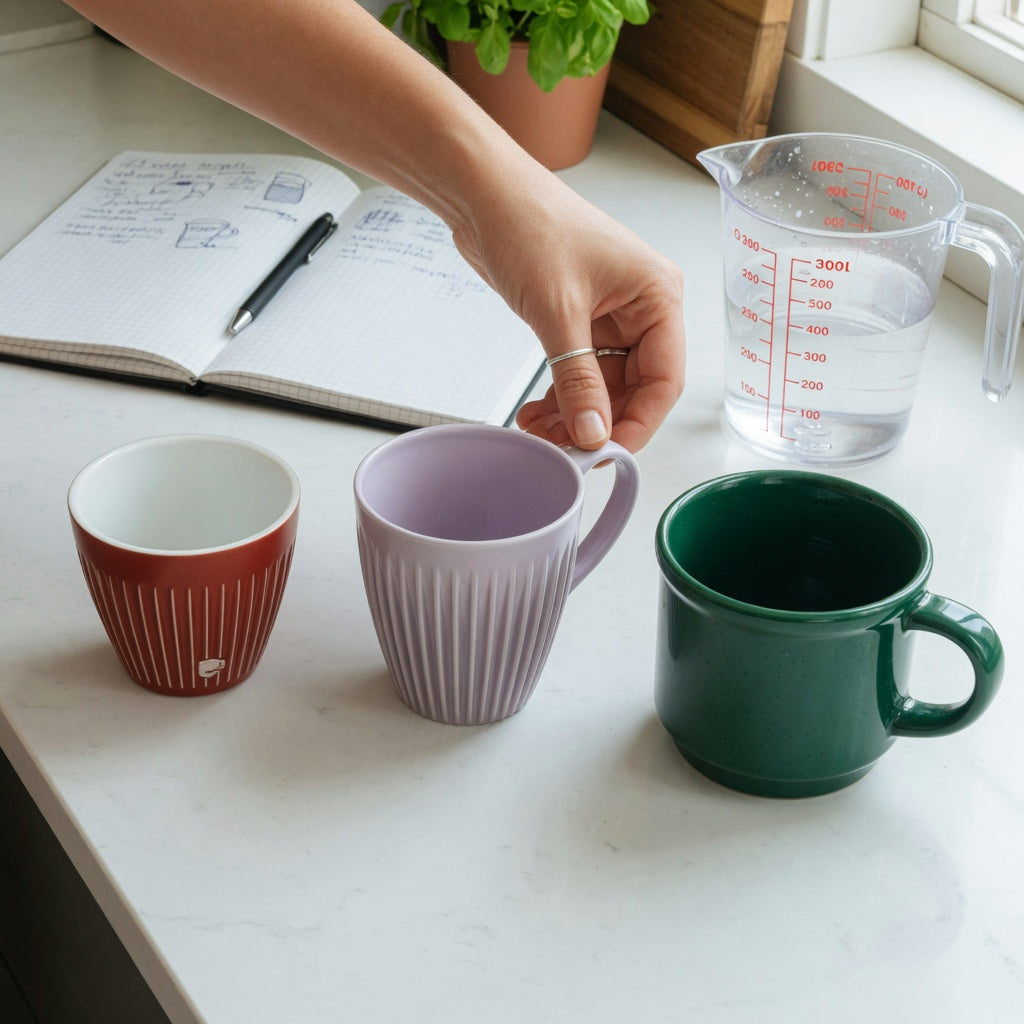
Start on your own kitchen counter rather than with an assumed serving standard. Fill your current cup to the level you normally use, transfer that amount into a marked measuring jug, and record the result. Repeat the check on two or three typical occasions if your serving changes between a workday and a slower morning.
- Measure your usual serving in milliliters.
- Decide how much open space you prefer between the liquid and the rim.
- Add those two amounts to create a personal capacity target.
- Shortlist the smallest current option that can accommodate that target, then verify its handle and exterior dimensions.
| Example measured serving | Retro 170 ml | Pleated 200 ml | Emerald 270 ml |
|---|---|---|---|
| 150 ml | 20 ml nominal difference | 50 ml nominal difference | 120 ml nominal difference |
| 190 ml | Exceeds capacity by 20 ml | 10 ml nominal difference | 80 ml nominal difference |
| 240 ml | Exceeds capacity by 70 ml | Exceeds capacity by 40 ml | 30 ml nominal difference |
These are arithmetic examples, not drink standards. A nominal difference is not guaranteed rim clearance because product listings may measure total capacity close to the brim. Your practical fill level may be lower, so avoid choosing a cup whose listed capacity merely equals your usual pour.
Who should start with the Retro 170 ml cup?
If your normal serving plus your preferred carrying margin fits comfortably below 170 ml, the Retro 170 ml coffee and tea cup is the logical first option to inspect. It suits shoppers who deliberately serve a smaller amount and would rather prepare another fresh serving later than keep one larger volume on the desk.
The honest limitation is that 170 ml leaves little flexibility for anyone whose measured serving is already close to that figure. It is not a practical choice if your routine amount exceeds its listed capacity or if you want substantial open space below the rim. A smaller capacity also does not prove that the cup has the smallest exterior footprint or lowest empty weight. If desk clearance is the deciding factor, check the live dimensions rather than relying on the capacity label.
Does the Pleated 200 ml cup make sense between the two sizes?
The Pleated 200 ml coffee and tea cup adds 30 ml over the Retro while remaining 70 ml below the Emerald. That relatively small step is useful when the 170 ml option falls just short of your measured target but moving directly to 270 ml would leave far more unused capacity than you want.
This is not automatically the safest size for every shopper or gift recipient. For example, a 190 ml serving leaves only a 10 ml nominal difference, which may be too close to the rim for comfortable carrying. For a gift, 200 ml makes sense when you know the recipient prefers a middle-sized serving. If you do not know their habits, visual style alone cannot resolve the capacity question, and a gift receipt or direct size check is more useful than guessing.
When is the Emerald 270 ml mug the practical larger option?
A shopper whose capacity target exceeds 200 ml should start with the Emerald 270 ml coffee and tea mug. Its listed capacity is 70 ml greater than the Pleated and 100 ml greater than the Retro. A measured 240 ml serving, for example, exceeds both smaller options but leaves a 30 ml nominal difference in the Emerald.
The larger option also makes sense for someone who prefers one fuller serving and wants to reduce top-ups. That benefit only applies if the extra capacity is actually used. A 150 ml serving would leave 120 ml of nominal capacity unused, so the larger mug may be unnecessary for a deliberately modest pour. Filling it with more liquid also means carrying more liquid, while its empty weight and handle dimensions remain separate specifications to verify. It is not the best choice for a tightly arranged desk until you confirm the outside measurements.
What should handle comfort decide when two capacities both fit?
At our packing table, we can compare handle shapes and overall form, but fit remains personal. Milliliters are not an ergonomics score. A larger-capacity cup does not automatically have a roomier handle, and a smaller cup is not automatically lighter when empty.
Use your current favorite cup as a reference and check four concrete points:
- Handle opening: Measure the interior height and width if finger clearance is critical, then compare those figures with any dimensions stated on the product page.
- Knuckle clearance: Notice whether your fingers touch the cup body when you lift your current cup.
- Grip style: Decide whether you normally use a one-finger pinch grip or place multiple fingers through the handle.
- Filled balance: Test your current cup with your normal measured serving, since an empty cup cannot show how the grip feels during use.
Online product photos help with shape and proportion, but they cannot provide an exact fit unless a scale or handle measurement is included. If handle opening is a purchase-breaking detail and the measurement is not shown, ask our store before ordering. Choose capacity to create the shortlist, then use handle fit to settle the decision.
What should you verify about material, dimensions, and dishwasher care?
The verified facts used in this comparison are the three listed capacities. Material, microwave compatibility, dishwasher care, height, rim diameter, base diameter, and handle-opening dimensions should be confirmed on each live product page. Product photography is not reliable proof of material or care compatibility, so we do not fill in missing specifications based on appearance.
Use this pre-order and unboxing check:
- Read the exact material description rather than assuming every cup with a similar finish uses the same construction.
- Confirm dishwasher and microwave instructions separately; one does not imply the other.
- Check exterior height and base width if the cup must fit a shelf, machine, tray, or crowded office setup.
- During gift unboxing, inspect the rim, base, and handle attachment points for chips or hairline cracks before first use.
- Set the empty cup on a flat counter and check for unexpected rocking. Contact the store before use if it arrives damaged.
If dishwasher use is explicitly approved on the product page, load the cup with enough separation to keep the rim and handle from knocking against nearby drinkware during the cycle. If care instructions are not clear, do not assume dishwasher suitability; hand washing with a soft, non-abrasive sponge is the cautious option until the care method is confirmed.
Capacity alone also cannot qualify any of these options for a travel lid, verified insulation, exact machine clearance, or specialized stacking. If one of those features is central to the purchase, a different drinkware style with the required specification will suit you better.
Which current cup should you compare first?
Use your measured serving plus your preferred rim margin as the working target:
- If the full target sits comfortably below 170 ml, inspect the Retro first.
- If it does not fit the Retro but sits comfortably below 200 ml, compare the Pleated next.
- If it exceeds 200 ml but stays below 270 ml with room to carry, start with the Emerald.
- If your target exceeds 270 ml, or you need a lid or other specialized feature, browse our collection of unique coffee mugs and compare a different format rather than forcing one of these capacities to fit.
Once the capacity shortlist is clear, compare the live product information for handle shape, dimensions, material, and care. That order prevents an appealing finish from distracting you from a size mismatch you will notice every time the cup reaches your desk.
Frequently asked questions
How do I use the decaf coffee cup size decision guide if my serving changes each day?
Measure the two amounts you use most often rather than relying on a single average. Choose the smallest cup that fits the larger routine serving plus your preferred rim margin, or choose the smaller option if you are comfortable making a second pour. A rare oversized serving does not have to dictate every daily cup purchase.
Is a 170 ml cup too small for an office desk?
Not if your measured serving and carrying margin fit below its listed capacity. The Retro may suit someone who prefers a smaller serving, but capacity does not confirm how much desk space its base occupies. Check exterior dimensions if the cup must sit beside a laptop, keyboard, or notebook.
What is the practical difference between 200 ml and 270 ml?
The listed capacity difference is 70 ml. That extra space matters when your usual serving approaches or exceeds 200 ml, but it may go unused if you normally pour much less. Handle size, empty weight, and exterior footprint must still be compared separately.
Does the larger Emerald mug automatically have the most comfortable handle?
No. Capacity and handle comfort are separate variables, and comfort depends on handle opening, finger placement, knuckle clearance, and filled balance. Review the live product photos and dimensions, or ask our store for clarification if handle fit is decisive.
Are all three cup sizes dishwasher safe?
Do not infer dishwasher suitability from capacity or appearance. Check the current care instructions on the individual product page before placing any cup in a dishwasher. If the instruction is absent or unclear, hand wash with a soft sponge until the approved care method is confirmed.
Make the next step concrete: place a measuring jug beside your current cup, record one normal serving, add the open rim space you prefer, and shortlist the smallest listed capacity that accommodates both. Then verify the handle dimensions, exterior size, material, and care details before adding the cup to your cart.
More from our blog
Read more

Herbal Tea Mug Size Decision Guide: 400, 440 or 480 ml
Compare The Flow 400 ml, Morning and Night 440 ml, and The Rock 480 ml using your usual pour, refill pattern, carrying load, and handle grip. This guide explains the practical trade-offs without tr...
Read more
Green Tea Mug Size Decision Guide: 170, 200, or 270 ml
Compare the Retro 170 ml, Pleated 200 ml, and Emerald 270 ml by refill preference and visible shape. See where each current size makes practical sense and where it does not.
Read more
Leave a comment
This site is protected by hCaptcha and the hCaptcha Privacy Policy and Terms of Service apply.