
Decaf Coffee Cup First Time Buyer Product Shortlist Guide: 3 Sizes
Reading time: about 9 minutes
A cup can look right on a product page and still feel wrong five minutes after it reaches an office desk. The usual pour sits too close to the rim, two fingers do not clear the handle, or the cup occupies more counter space than expected. Our decaf coffee cup first time buyer product shortlist guide starts with those ordinary fit problems because they are what shoppers ask us about before placing a first order.
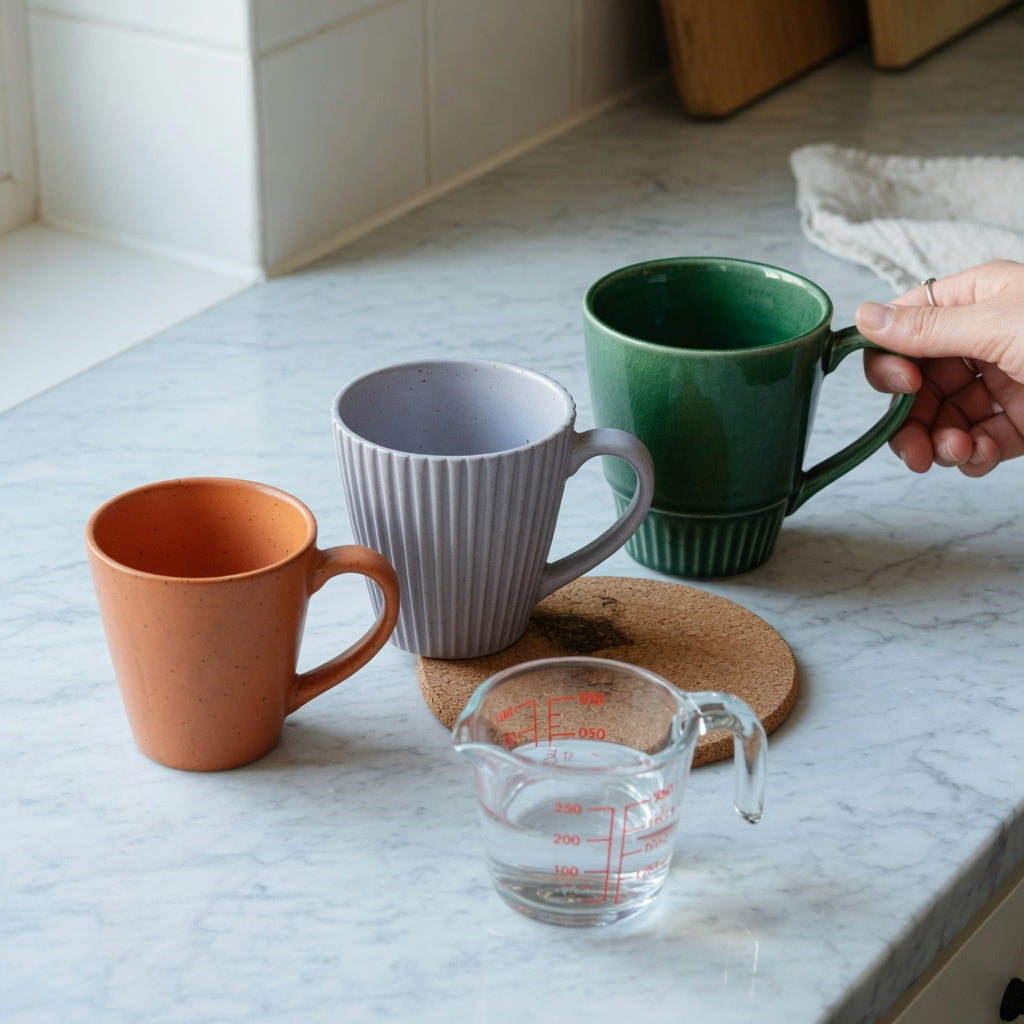
We handle and pack these ceramic styles in our store, but we will keep the comparison inside the facts a buyer can verify. The Retro is listed at 170 ml, the Pleated at 200 ml, and the Emerald at 270 ml. Those capacities help build a useful shortlist. Handle comfort, external dimensions, and care compatibility still need to be checked on the current product pages rather than guessed from a name or a single photograph.
Which of 170 ml, 200 ml, or 270 ml matches your real pour?
Start with the cup you already use, even if you dislike its style. Fill it to your normal stopping point, including the headspace you leave when carrying it from the kitchen to a desk or sofa. Pour that amount into a marked measuring jug. This gives you a better comparison than estimating from a product image.
- Measure the serving you actually finish, not the cup's brim-full volume.
- Keep your normal carrying headspace in the measurement.
- Compare the result with 170 ml, 200 ml, and 270 ml.
- Move up a size if your measured amount would leave little practical room below the rim.
| Option | Listed capacity | Best starting situation | Reason to skip |
|---|---|---|---|
| Retro | 170 ml | A short, measured serving that you normally finish | Your usual pour needs most of the listed volume before leaving headspace |
| Pleated | 200 ml | A compact everyday serving with slightly more room than 170 ml | You already know that a 200 ml cup feels restrictive |
| Emerald | 270 ml | A fuller serving or fewer trips back to the kitchen | You usually pour much less and prefer the smallest practical cup |
The difference between the Retro and Pleated is 30 ml. The jump from Pleated to Emerald is 70 ml, while the full spread from Retro to Emerald is 100 ml. These are listed capacities, not promises that carrying each cup filled to the brim will be comfortable. Your measured serving should fit with the amount of headspace you prefer.
Decaf coffee cup first time buyer product shortlist guide by scenario
A shortlist becomes useful only after it connects a real situation to a reason for choosing or rejecting a product. We would reduce these three options as follows.
- Short serving at a small desk or side table: Start with the Retro Coffee Tea Cup at 170 ml. Its listed capacity is the smallest here, so it fits a buyer whose measured serving is comfortably below 170 ml and who does not want unused volume. Skip it if your normal pour already approaches that figure or you often return for an immediate refill.
- One flexible cup for kitchen-to-desk use: Consider the Pleated Coffee Tea Cup at 200 ml. It is the middle capacity in this group and gives 30 ml more listed volume than the Retro without moving to 270 ml. Choose it if your measurement rules out 170 ml but does not justify the larger Emerald. Skip it if you want either the shortest possible serving or substantially more room.
- Fuller serving during a longer desk or sofa session: Open the Emerald Coffee Tea Mug at 270 ml. It provides the most listed capacity of the three and suits a measured pour that exceeds what the 200 ml option can hold comfortably. Skip it if you routinely leave larger cups half full or if shelf and desk dimensions are tight.
- Gift purchase with no reliable serving information: Do not assume the 200 ml option is universally safer just because it sits between the other two. Ask what size the recipient already uses, then compare the current shapes in our unique coffee mugs collection. Skip a surprise order based only on color if handle fit, capacity, or storage space could be decisive.
Can the handle work with your actual grip?
Capacity is measurable from the listing. Handle comfort is more personal, and the verified facts for this shortlist do not include handle-opening dimensions. The names Retro, Pleated, and Emerald describe the styles; they do not establish finger clearance.
We check three handle variables while handling cups: the inner opening, the gap between the handle and cup body, and the two points where the handle joins the body. A loop may accept one finger comfortably but press against the knuckles in a two-finger grip. A larger opening can be easier for bigger hands, yet it may feel less controlled to someone who carries a cup with a single hooked finger.
- Look for a straight side view: It reveals the opening and body-to-handle gap more clearly than an angled lifestyle image.
- Compare several image angles: A close camera angle can make a handle look larger than it is.
- Check the attachment points: The upper and lower joints should appear even, with no visible crack line.
- Do not treat exterior texture as proof of comfort: Pleated or decorative surfaces may affect how the body feels, but they do not tell you how the handle fits.
In our experience, a dry grip test after unboxing tells you more than prolonged inspection of a screen. Before use, place your fingers in the handle exactly as you would at your desk. If your knuckles are already crowded while the cup is empty, filling it will not improve the fit.
Which product-page details must be confirmed, and which are unknown?
A reliable first-purchase decision separates published details from assumptions. The three capacities are clear comparison points. Other details can vary by product or listing revision, so verify them directly before ordering.
- External height and base width: Capacity does not reveal the exact footprint. These measurements matter for shallow shelves, crowded desks, and small coasters.
- Handle-opening dimensions: If the listing does not provide them, finger clearance remains unknown. Product photos can help, but they are not measurements.
- Capacity convention: Confirm whether the stated number describes nominal capacity or a specific fill method if that distinction appears on the page.
- Material and finish description: These are ceramic styles, but do not assume every ceramic cup has the same surface finish or care requirements.
- Dishwasher and microwave guidance: We will not label a cup compatible with either appliance unless the current product information says so. Check again before the first dishwasher cycle or microwave use.
- Pieces included: Confirm whether the purchase includes only the cup or any accessory pictured beside it. A styled photograph is not a substitute for the included-items description.
If a needed dimension or care instruction is absent, call it unknown and ask our team before ordering. That is especially important for buyers with large hands, limited grip, fixed shelf clearance, or a strict appliance-care requirement.
What should you inspect at gift unboxing and before the first wash?
Ceramic needs a quick arrival check before packaging is discarded. During packing and handling, we pay particular attention to rims and handle joints because a chip or hairline crack in those locations affects use, not just appearance.
- Inspect the rim under direct light. Look for a chip, sharp spot, or crack rather than judging only the color and finish.
- Check both handle joints. Run a fingertip gently around the upper and lower attachment areas. Stop if you find sharp roughness or a visible crack.
- Set the empty cup on a dry, flat counter. A pronounced rock deserves attention before the cup is filled.
- Read the current care line. Do this before placing the cup in a dishwasher or microwave. Do not use an appliance cycle as an experiment when compatibility is unspecified.
- Use conservative care if instructions remain unclear. Hand-wash with a soft, non-abrasive sponge and avoid knocking the rim against a metal faucet or another ceramic piece.
For a gift, leave enough time for this inspection before the presentation date. The recipient should not have to discover a handle problem after the packaging and order details have been discarded. If cabinet storage involves stacking, confirm that the shape is intended to stack; otherwise, store the cup without pressing another rim or base against it.
When should you skip all three ceramic cups?
These three options are open ceramic cups, not lidded travel vessels. They are poor matches if your first requirement is a car cup-holder shape, a sealed lid, known insulation performance, or a serving larger than 270 ml. They also should not be chosen on capacity alone if you need a precisely measured oversized handle or verified stackability.
A different style is also more sensible if your usual serving needs substantial room beyond the measured liquid volume. Browse other shapes in the CoffeifyMug unique coffee mug collection, then apply the same capacity, handle, care, and footprint checks. The right decision may be to leave this three-cup shortlist rather than force one of the options to fit.
Frequently asked questions
Is a 170 ml cup too small for a first decaf coffee cup?
It is too small if your measured serving needs most of that capacity before allowing for headspace. It can be practical for a short serving that you consistently finish. Measure your current pour instead of using the word small as the deciding factor.
Is the Pleated 200 ml cup the safest default size?
It is the middle listed capacity, but that does not make it a universal default. It offers only 30 ml more than the Retro and 70 ml less than the Emerald. Choose it when your measured serving and available space support 200 ml, then verify the handle photos.
Does this decaf coffee cup first time buyer product shortlist guide name one best option?
No. The Retro fits shorter servings, the Pleated covers the middle capacity, and the Emerald provides the most listed volume. The best first purchase is the one that matches your measured pour and grip while leaving the fewest important details unknown.
How can I judge coffee cup handle comfort online?
Use side and three-quarter product images to estimate the inner opening and gap from the cup body. Look for a hand or familiar object that provides scale, but treat photographs as supporting evidence rather than exact measurements. Ask for dimensions if finger clearance is critical.
Can I put the Retro, Pleated, or Emerald cup in a dishwasher or microwave?
Use the current care instructions on the relevant product page as the authority. Ceramic material alone does not confirm dishwasher or microwave compatibility. If the listing does not answer the question, contact our store or use conservative hand-washing until it is clarified.
Use this five-point checkout test
- Measure your normal serving with the headspace you actually use.
- Match it against 170 ml, 200 ml, and 270 ml.
- Review multiple handle angles for finger and knuckle clearance.
- Confirm dimensions, included pieces, and appliance-care instructions.
- Write down any unknown that could stop you from using the cup comfortably.
Open the matching product page if one size clears all five checks. If none does, return to the unique coffee mugs collection and compare another shape using the same list before you buy.
More from our blog
Read more
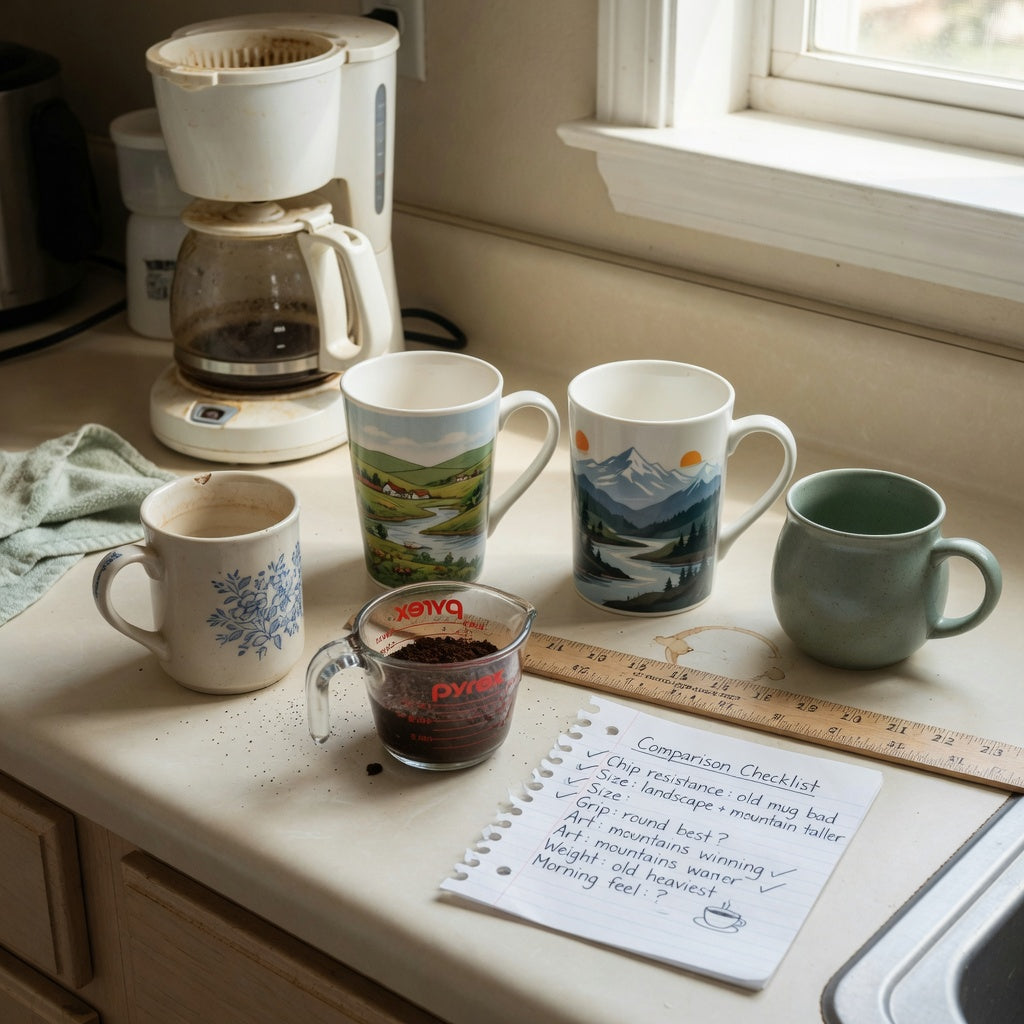
12 Oz Ceramic Coffee Mugs: Practical Replacement Purchase Checklist
Replace a damaged or awkward 12 oz mug by comparing actual fill, brewer clearance, handle fit, shelf space, and care needs. This checklist maps those constraints to relevant CoffeifyMug options wit...
Read more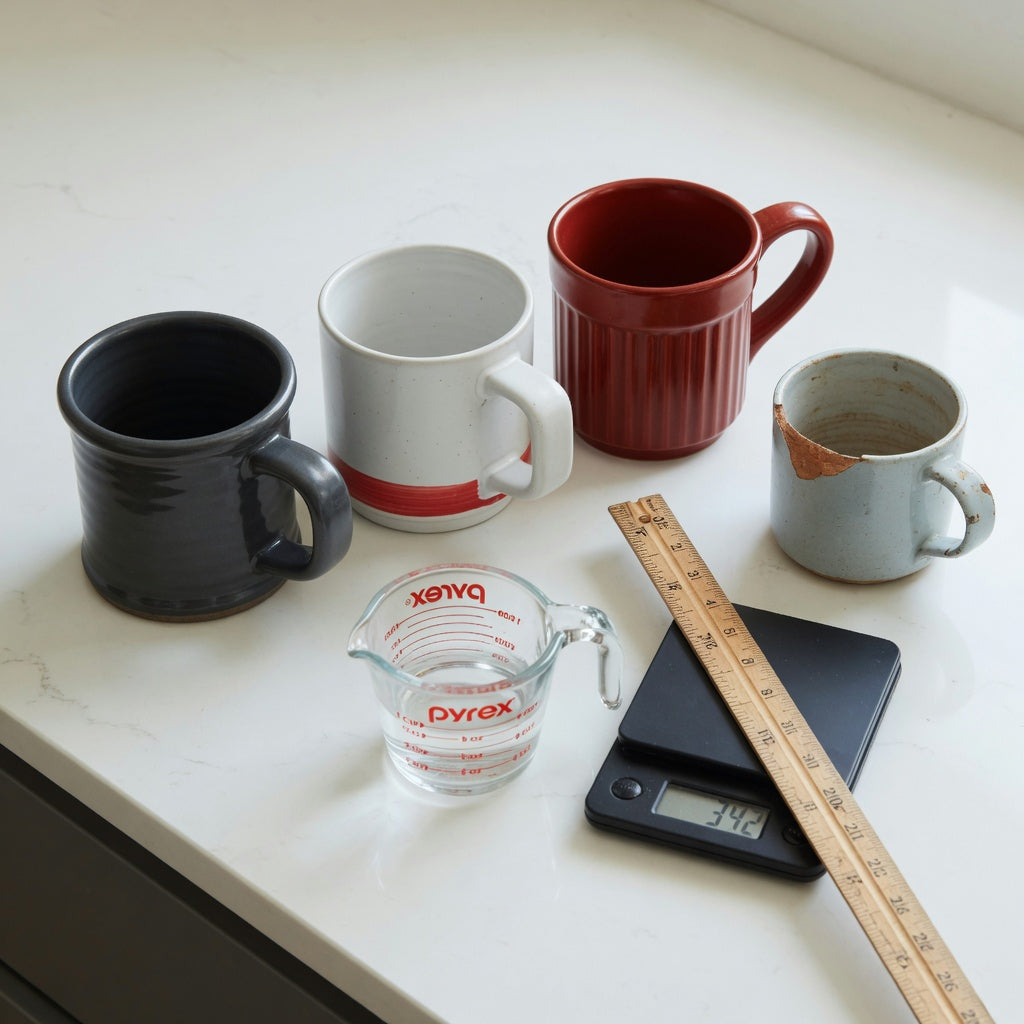
Thick Ceramic Coffee Mugs: A Practical Replacement Purchase Checklist
Start with the exact reason the old mug failed. This checklist helps you compare usable capacity, handle clearance, storage fit, care instructions, and three current CoffeifyMug designs without gue...
Read more
Leave a comment
This site is protected by hCaptcha and the hCaptcha Privacy Policy and Terms of Service apply.