




Daily Use Mug for Home Enthusiasts: What Buyers Should Compare
Reading time: about 9 minutes
Most mugs don't fail dramatically. They get quietly demoted — pushed to the back of the cabinet because the handle pinches, the rim feels thick against your lip, or the glaze goes dull after a winter of dishwasher cycles. That slow demotion is the real exam for a daily use mug for home enthusiasts: it has to look right on an open shelf and feel right at 6:40 a.m., half-asleep, with the kettle still steaming.
We handle this category in our store, and the mugs that stay in rotation are rarely the most photogenic. They are the ones where five or six physical details were chosen well. Color gets you to the product page. These are the things that decide whether you still reach for the mug by spring.
What makes a daily use mug for home enthusiasts survive the rotation?
The difference is repetition. A display mug gets lifted twice a week. A daily mug gets poured into, sipped from, rinsed, stacked, knocked against a tap, and run through the dishwasher again and again. That changes the priority list.
- Rim thickness. A rim under about 4 mm feels clean against your lip. Heavy rolled rims look sturdy in photos but feel clumsy when you drink, especially with tea you sip slowly.
- Handle clearance. Two fingers or three? If the gap between handle and body is under roughly an inch, larger hands will notice immediately.
- Foot ring finish. A glazed foot can slide on a countertop. An unglazed foot grips, but coarse grit can scuff a painted shelf.
- Wall thickness. Thicker walls hold heat longer and add weight. That is a trade-off, not a free upgrade.
- Taper. Straight-walled mugs stack. Tapered mugs nest but can wobble in a tall stack.
When new stock arrives, those are the first checks we make before anything goes on the shelf or into a photo.
Does a thick wall or a lid keep coffee hotter on a kitchen counter?
Both help, but they solve different problems. Wall thickness gives the mug thermal mass: a heavy stoneware or porcelain body absorbs heat, so your second sip can be warmer than it would be in a thin-walled cup. A lid stops heat escaping from the top, where a lot of it goes.
For a mug that lives on a desk, a lid does more work than a thick wall. For a mug you carry from kitchen to couch and finish in ten minutes, mass is often enough. The practical trick is the same either way: preheat the mug with hot tap water for about thirty seconds, empty it, then pour. A preheated thick-walled mug holds drinking temperature longer than a cold one.
If heat retention past twenty minutes is your real requirement, ceramic is the wrong material. Double-walled stainless steel wins that comparison outright — but it changes the drinking experience, the weight, and usually the look on the shelf. Most home enthusiasts we talk to would rather have the ceramic body and a shorter window of perfect temperature.
How much coffee do you actually pour before choosing a capacity?
Buyers routinely overestimate this. If your pour-over yields 10 ounces, a 16-ounce mug leaves a lot of empty ceramic and a thinner band of coffee cooling against a wide surface. Match capacity to your actual brew, not to your appetite for coffee.
| Capacity | Suits | Watch out for |
|---|---|---|
| 8–9 oz | Tea, cortados, small pour-over doses | Fills fast; needs refilling mid-morning |
| 11–12 oz | The most common drip and pour-over pour | Leave half an inch of headspace or it sloshes |
| 14–16 oz | Large morning brew, iced coffee, tea drinkers who sip slowly | Heavier in hand; check your shelf clearance first |
Listed capacity and usable capacity are not the same number. A mug filled to the brim is a mug you cannot walk across a room with. If you pour 12 ounces, buy 14.
Which handle and rim details still feel right after a month?
Ergonomics are hard to judge from a product photo, so judge them from the side profile instead. Look at where the handle attaches and how much of the body it clears.
- Top attachment point. A handle that joins high on the body balances a full mug better than one attached mid-wall, which can tip forward as you raise it.
- Grip shape. Squared handles look architectural, but rounded handles distribute pressure across the fingers better over a long morning.
- Rim lip. A slight inward curve catches drips. A flat rim with an abrupt edge tends to send liquid down the outside of the mug.
- Weight loaded. A large ceramic mug plus coffee can feel heavy by the last sip. If you have wrist or grip issues, that is a real reason to size down.
This is why we tell shoppers to hold a mug with their non-dominant hand when they can. The awkwardness shows up instantly there and not at all in a photo.
Where does the Elk and Moon coffee and tea mug fit in a daily rotation?
Some households want one mug that handles both brews rather than a cupboard of single-purpose cups. That is the slot our Elk and Moon coffee and tea mug is positioned for: a piece that can sit out as decor and still get used every morning. We point shoppers to it when they want one good mug instead of five mediocre ones.
Two honest caveats. First, we will not quote a capacity, material, or care routine we have not verified. The current product listing is the only place to confirm exact dimensions, material, dishwasher and microwave safety, and handle clearance. Check those details before you commit, because they are the ones most likely to disappoint after delivery. Second, if your priority is keeping coffee hot for half an hour or more, or you need a locking travel lid, this is not the right category; an insulated vessel will serve you better.
Where it does earn its place: a coffee-and-tea household, an open shelf, and a shopper who wants the mug to look intentional between uses. If you are still weighing silhouettes and finishes, browse the unique coffee mugs collection to compare shapes side by side.
Will the glaze and foot ring survive dishwasher cycles?
Care is where cheap mugs expose themselves. Three things to look for:
- Food-safe glaze labeling. Any food-contact glaze should be sold with a food-safe statement on the listing or the base. If it is not stated, ask before buying. That is a normal question, not a paranoid one.
- Crazing. Fine hairline cracks in the glaze are a common long-term defect on daily-use ceramics. They are usually cosmetic, but they make a mug harder to keep clean, which is a fair reason to retire it.
- Metallic trim. Any luster, gold, or metallic band means the mug is not microwave safe, regardless of what the body is made of.
Dishwasher guidance that holds across most ceramic: top rack, low heat, and do not nest mugs so tightly that they knock together during the cycle. Hand-washing extends glaze life. If a listing does not specify dishwasher safety, assume hand-wash and treat that as a deal-breaker if it does not suit you.
Open shelf or closed cabinet: which storage changes the mug you should buy?
If your mugs live on an open shelf, the back of the mug matters as much as the front. That is the side everyone in the room sees. A clean, fully glazed exterior and a neat foot ring look intentional; a rough unglazed base with kiln grit looks unfinished next to a stack of plates.
Measure before you buy. Shelf clearance is the number people forget: mug height plus an inch of lift room, or you will be sliding mugs out sideways forever. If your shelves are tight, a shorter, wider mug beats a tall one. Closed-cabinet households have the opposite freedom: stackability and rim durability matter more than finish, because nobody sees the mug until it is in use.
If open storage is the plan and you want to compare shorter profiles, start with the collection of unique coffee mugs and check height first.
One mug or a household rotation?
Four people, four different grips. The tea drinker wants a smaller bowl and a thinner rim. The iced-coffee person wants height and a wider mouth. The person who takes coffee to a desk wants something with a lid. Buying four identical mugs because they look tidy on the shelf is the most common regret we hear about.
Our advice: buy one mug you genuinely like first, live with it for a week, then buy the second. You will learn your own preferences — handle size, rim feel, how much you actually pour — far faster than you will from comparing product pages. A household rotation can grow from one good daily use mug for home enthusiasts rather than a matching set that looks good and feels wrong.
Frequently asked questions
Is a 12 oz mug big enough as a daily use mug for home enthusiasts?
For most drip and pour-over pours, yes — 11 to 12 ounces covers a standard mug of coffee with a little headspace. Go to 14 or 16 ounces if you drink large servings or take your time with tea, and size down to 8 or 9 ounces for espresso-adjacent drinks and small tea servings.
Can I put a ceramic mug in the dishwasher every day?
Most well-fired stoneware and porcelain handles it, especially on the top rack at low heat. Check the listing for an explicit dishwasher statement first, and hand-wash anything with metallic trim, gold accents, or an unglazed decorative surface.
How do I stop coffee going cold in a ceramic mug?
Preheat the mug with hot tap water for about thirty seconds, empty it, then pour. Thicker walls help, and a lid helps more. If you need coffee hot for more than half an hour, an insulated mug is a better fit than any ceramic option.
What should I check on the product page before ordering?
Four things: exact capacity, material, dishwasher and microwave safety, and overall height including the handle. If any of those are not stated on the current listing, ask before ordering — especially height, because shelf clearance is the detail buyers most often get wrong.
Why do my mugs chip at the rim?
Usually stacking and sink knocks, not the dishwasher. Stacking mugs rim-to-rim puts stress on the thinnest part of the ceramic. Store them side by side, or use a rack, and you will get more years out of a daily-use set.
Ready to pick your mug? Two ways to save on today's order:
Ordering 1–3 mugs? Get an extra 10% off your 1st order with code 10_OFF Apply 10% Off & Shop Wooden-Handle Mugs →
Gifting 4+ mugs? Buy 3, Get the 4th Free applies automatically at checkout (no code needed; offers do not stack) · Free standard shipping (Nov pre-Christmas delivery: 15–20 calendar days US) · Free replacement if chipped in transit.
Popular mug buying guides: Ceramic Tea Cups & Infuser Mugs · Ceramic Mugs with Lids Compared · Wooden-Handle Tea Infuser Mugs Compared · Christmas & Secret Santa Mugs 2026 · Espresso & Cortado Cups Guide · Cup & Saucer Gift Sets · All 25 Mugs Spec Table · Mug Size Guide · Shipping & Promo FAQ
FIRST ORDER 10% OFF (CODE: 10_OFF) · OR BUY 3, GET THE 4TH FREE


Read more

Round Coffee Mug Gift for Decor Enthusiasts: 7 Checks Before You Buy
A round mug has to look deliberate on an open shelf and still feel balanced when it's full. We walk through silhouette, glaze flaws, handle clearance, care lines, and how to box one so the unboxing...
Read more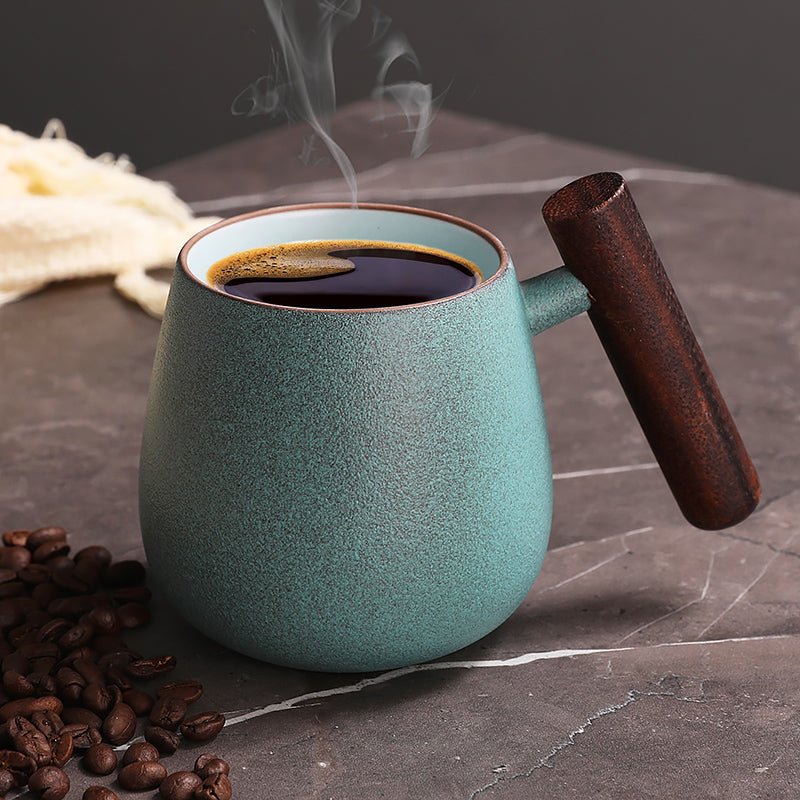
Best Round Mug for Coffee Lovers Home: 6 Details Buyers Compare
A round mug is a shape, not a spec sheet. We compare the details that actually decide whether a mug stays in rotation — rim profile, handle clearance, base diameter, wall thickness, and drink match...
Read more
Leave a comment
This site is protected by hCaptcha and the hCaptcha Privacy Policy and Terms of Service apply.