



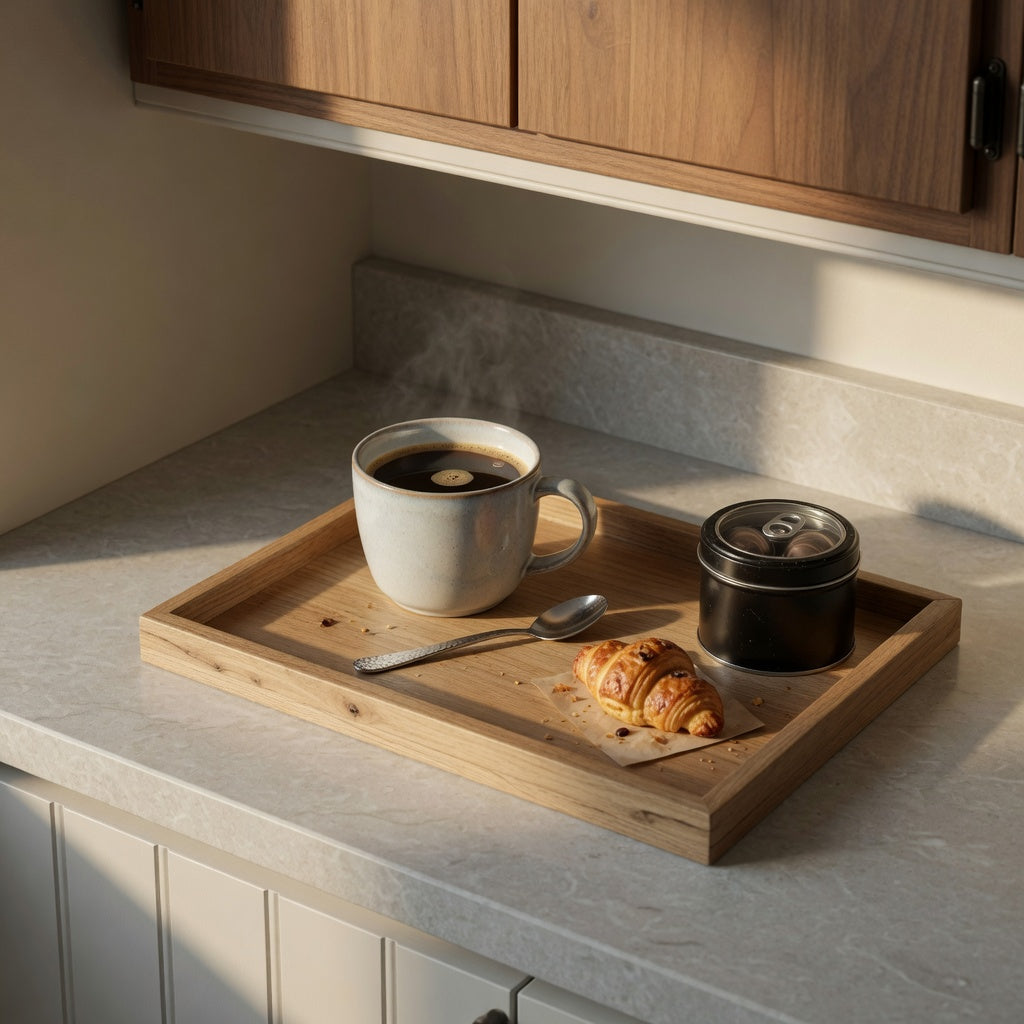
Coffee Nook Tray With Ceramic Mug: Size, Care, and Fit
Reading time: about 13 minutes
A shopper cleared a corner of the counter, slid a short tray under the cabinet, and tried to park a full mug, a pod tin, and a spoon cup on it. The handle hung off the edge. The tray looked finished in the photo. The nook was not usable. That miss shows up whenever someone shops a coffee nook tray with ceramic mug without splitting the tray's job from the cup's job.
In our store we sell the ceramic side of that pair. We handle the mugs, hear the returns that are really size complaints, and watch people try to force one listing into a whole coffee station. The tray may be wood, melamine, metal, MDF, or a molded organizer bought somewhere else. The mug has its own capacity, glaze, and wash rules. When those pieces disagree, you hand-wash a set that was sold as easy care, or you microwave a board that was only meant to carry the drink.
Is a coffee nook tray with ceramic mug a station, a rack, or a serving set?
The same search pulls three products. They do not stand in for each other.
| What you think you are buying | What it usually holds | Where it fails |
|---|---|---|
| Counter coffee-nook tray | A brewer footprint, pods or beans, spoons, and one or two mugs | Too tall under a cabinet, or so wide it eats the prep space |
| Mug rack with a drip tray | Mugs stored upside down over a shallow catch | Not a serving surface, and no room for a pastry |
| Two-mug serving set | Two cups plus a biscuit on wood, melamine, or a coated board | Cups often drink smaller than a daily brew, and tray care may not match the mug |
We ask which job you actually need before we point at a cup. If the tray is already on the counter and you want one everyday ceramic that lives on it, open the round coffee tea mug and read the current listing for stated capacity, handle shape, and any dishwasher or microwave line. We will not guess those from a styled photo. If you are still matching a shape to the board, the unique coffee mugs collection is a faster pass than a lifestyle image.
A drip-tray rack stores cups. It will not hold a pastry. A two-cup gift set can sit beside a biscuit, but it is a poor home for a machine, a bean jar, and a milk pitcher.
How many ounces will the ceramic actually drink?
This is the complaint we hear most after a patterned set arrives. The title showed a mug. The hand felt a small cup.
FDA's lead policy for ceramicware treats cups and mugs as small hollowware commonly used for coffee or tea above room temperature. They normally, though not exclusively, hold about 240 ml (8 fl oz), and they are usually made with a handle. That is a testing definition. It is not a promise that a biscuit-tray set holds 8 ounces, and it is not the daily size many people expect at the counter.
Brim capacity is not a comfortable pour. Leave headspace or the tray sloshes between counter and table. If the listing never says whether the number is filled to the lip, treat capacity as unconfirmed.
Silhouette and usable ounces often disagree. For a breakfast tray or a guest pour, open the pleated coffee tea cup and confirm capacity and care on the current listing before you treat it as a large daily driver. If you want more coffee in the hand, run the same check on the round coffee tea mug. A bigger cup changes handle reach, any cup-well diameter, and whether two full mugs can sit without knocking.
A short cup is a poor fit for iced coffee loaded with ice, a travel-mug habit, or one pour meant to last a long desk session. Bare ceramic cools. The tray does not fix that. Many patterned serving sets suit espresso, a short tea, or coffee next to a biscuit, not an all-morning mug. Name the drink before you buy.
Will the tray clear the cabinet and still hold a snack?
Footprint listings are often the length and width of the board alone. That number ignores the handle, the lip, and the cabinet.
- Measure the counter run, then add the swing of the mug handle past the cup body. A handle that clears the tray can still hit the backsplash or the machine.
- Measure from the counter to the underside of the cabinet. Subtract mug height and any knob, rack, or raised lip. If the cup must tip to come out, the nook is too short.
- List what else has to live there: machine, pods, beans, sugar, spoons, a small pitcher. A brewer on the tray means you are buying an organizer, not a biscuit board.
- Check lip height. A low lip looks sleek and lets a cup slide when you carry it. A high lip corrals crumbs and can make a wide mug awkward to lift.
- Look for flat snack space. Two cup wells and nothing else will not hold a pastry. Breakfast on the tray needs open board beside the cup.
A tray short enough for a cabinet is often a bad breakfast-in-bed tray. Two heavy cups on a thin board feel tippy. Two light cups on a long board slide. Carrying full ceramics across a room spills even when the tabletop photo looks calm.
Skip this setup for a grinder, kettle, and carafe. That gear needs a deeper counter, not one decorative rectangle. In our experience the tray earns its place as a boundary for mugs, pods or beans, spoons, sweetener, and maybe the brewer. It fails when it has to store every tool you own.
Can the mug and the tray share one wash and one microwave?
Care lines split inside one box more often than the title admits. The ceramic may be sold as dishwasher safe while the wood, MDF, melamine, or resin-coated board is hand-wash only. Read the mug line and the tray line. One badge for the whole set is how people ruin the board.
Microwaves pass through glass, paper, ceramic, and similar plastics, and they reflect off metal. The cup is not heated by the waves themselves, but it can get hot from the drink. That still does not make every ceramic mug microwave safe. A metal rim, a cork foot, a crack, or a maker's warning rules a mug out. Heat only a mug labeled microwave-safe. On any cup from our store, that line has to be on the current listing. A photo of the set is not a care instruction.
Do not heat food or drink on melamine. Heat in ceramic or other cookware labeled microwave-safe, then serve on the melamine. Migration from melamine can increase when highly acidic foods are heated to extreme temperatures, about 160°F or higher. A melamine tray is for after the reheat, not during it.
Keep metal trays and foil out of the microwave. Reflection can cook unevenly and may damage the oven. If the board is metal, the mug might be fine alone. The tray is not. Do not put the whole set in.
FDA has received reports of burns when water heated alone in a very clean cup goes past boiling without looking like it is boiling, then erupts if the cup is moved or if instant coffee is added afterward. Putting the coffee or sugar in before heating cuts that risk a lot. Stay inside the oven maker's times. A board waiting on the counter does not make a superheated cup safer to lift.
What ruins a wooden tray under a daily ceramic mug?
Wood used for serving swells when it takes up water and shrinks as it dries. Dry it too fast and the surface can crack. That is the failure we expect after a wooden tray spends a night in the dishwasher or a soaking sink, even when the mugs beside it come out fine.
A water-repellent finish reduces the effect of a brief wash and makes the surface easier to clean. Any finish that touches food should be safe, nontoxic, and recommended for food use or described as food grade. A wipe-clean line is not a finish spec. If the listing does not name the finish, ask before you oil the board yourself.
- Wipe spills soon. Do not leave the board wet until later.
- If the maker says hand-wash only, that rule beats a set-level dishwasher claim printed for the mugs.
- Edible vegetable oils are sometimes used on wood utensils. They can go rancid and leave an odor or a flavor.
- Mineral oil, also called paraffin oil, has been used as a penetrating finish. Confirm the bottle is meant for food-contact wood.
- Do not use baby oil. It contains ingredients that should not contact food.
Choose the wood look only if a wipe-and-dry habit is realistic in your kitchen. If every mug goes through the dishwasher at night, the wooden tray becomes the piece you resent. Melamine, or another non-wood board, can be the simpler mate for dishwasher mugs, as long as that board stays out of the microwave.
How do you read a lead-free line on the glaze?
Lead-free and food-safe often show up as one line, with no test, no lot, and no split between a food-contact surface and a decorative one. That line is not a lab report.
FDA's compliance policy for ceramic cups and mugs sets an action level of 0.5 micrograms of lead per milliliter of leaching solution in any one of six units tested. Cadmium has separate action levels: 0.5 micrograms per milliliter for small hollowware in any one of six units, and the same 0.5 figure as an average of six units for flatware. Large hollowware is 0.25 micrograms per milliliter in any one of six units. Small hollowware is under 1.1 liters. Those are enforcement benchmarks for leaching, not a sticker you can assume is printed on a handmade cup. FDA also monitors glazed ceramicware because toxic elements can leach from containers that contact food.
Lead may sit in the glaze or the decoration. If the piece was not fired properly, it can leach into a drink. Washing, boiling, or any other home process does not remove it. If a cup is labeled decorative only, or not for food use, do not cook, serve, or store drinks in it.
Give extra attention when a cup looks handmade and irregular, is antique, is chipped or worn, was bought where you cannot name the maker, or is brightly decorated in orange, red, or yellow. Those pigments have a longer history with lead. Everyday commercial pottery is much less likely to be the problem. We still want a clear food-use claim and a maker you can name, not a decorative import with a slogan and no care card.
Color shifts and small bubbles are common in small-batch ceramics and are not automatically defects. A crack through the glaze, a gritty lip, or crazing that holds a coffee stain is a different issue. A chipped foot will also scratch a wooden tray every time you set the cup down. Stoneware and porcelain both chip. Once the foot is rough, that cup is a bad daily partner for a soft wood board.
Is the set a couple's gift or a counter tool you will resent?
Gift pages sell the pattern and the box. They rarely mention ceramic weight, shipping cracks, or whether two people can carry full mugs without a slosh.
A two-cup serving set can be a sound housewarming or breakfast gift when both people drink a short cup and someone will hand-wash the tray. It is a weak gift if the recipient already lives on a large office mug, needs pod storage beside a machine, or runs everything through the dishwasher. Handmade glaze can differ from the photo. That shift is often normal. A hairline crack from the carrier is not.
A plain mailer is not gift-ready. Keep the care card in the rewrap so the wood-versus-mug rules survive the unboxing. Pair the pieces only after the cup size is known. A small cup on a large board looks unfinished. A heavy mug on a thin melamine rectangle feels unsteady in the hand. We would not send this combo as the only coffee setup for a household that brews a full pot, or for a wet outdoor counter where an unfinished wood board sits in spills. The pretty set and the working nook are allowed to be two purchases.
A counter check before the mug goes on the tray
Write this down beside the listing. It takes less time than returning a set that cannot be washed as one piece. Run it before a coffee nook tray with ceramic mug lands on the counter.
- Name the job: organizer, rack, or serving set.
- Record usable fill, not only the biggest number in the title. Confirm it on the current mug listing.
- Measure tray length, width, lip, and cabinet clearance, including handle swing.
- Split the care label: one line for the mug, the next for the tray.
- Microwave only the piece labeled for it. Melamine and metal stay out.
- If the mug says lead free, look for who made it and whether it is sold for food, not decor.
- For wood, plan a wipe-and-dry habit and a food-contact finish. Skip baby oil and the dishwasher.
If the tray is already chosen, open the round coffee tea mug or the pleated coffee tea cup and read capacity and care on the current listing before you commit. If you are still choosing the cup, start in the unique coffee mugs collection and match the shape to the board you measured, not to the styled photo.
Frequently asked questions
How many ounces should a coffee nook tray with ceramic mug actually hold?
Hold the size that matches the drink, not the photo. FDA's cup-and-mug definition for lead testing centers on about 8 fl oz (240 ml), but many serving sets are shorter cups for espresso, tea, or coffee with a biscuit. Confirm the listing's capacity and whether that figure is brim-full. Leave headspace so a carried tray does not slosh.
Can the wooden tray and the ceramic mugs go in one dishwasher cycle?
Often no. The mug and the tray can have opposite rules in the same box. Wood swells when it absorbs water and can crack if it dries too fast, which is why a hot wash or a long soak is a bad default. Follow the tray maker's hand-wash line even when the ceramic is marked dishwasher safe.
Can I microwave the mug if the set includes melamine, wood, or metal?
Only if that mug is labeled microwave-safe, and only the mug. Do not heat food or drink on melamine. Heat in labeled microwave-safe ceramic, then move the drink to the melamine to serve. Keep wood and all metal trays out of the oven. Metal reflects microwaves and can damage the oven.
Is a lead-free claim enough on a brightly glazed or handmade cup?
Not by itself. Ask who made it, whether the surface is sold for food rather than decoration, and what care card came with it. Washing does not remove lead from a poorly fired glaze. Be more cautious with irregular handmade pieces, worn antiques, unknown makers, and bright orange, red, or yellow decoration. Do not drink from anything labeled decorative or not for food use.
Will a two-mug serving tray work under a cabinet as a coffee station?
Usually it will not. A serving set is sized for cups and a snack, not for a machine, pods, spoons, and a pitcher. Measure cabinet clearance and handle swing before you buy. If the brewer has to live there, shop an organizer tray and choose the ceramic mug as a separate piece that fits the height you measured.
More from our blog
Ready to pick your mug? Two ways to save on today's order:
Ordering 1–3 mugs? Get an extra 10% off your 1st order with code 10_OFF Apply 10% Off & Shop Wooden-Handle Mugs →
Gifting 4+ mugs? Buy 3, Get the 4th Free applies automatically at checkout (no code needed; offers do not stack) · Free standard shipping (Nov pre-Christmas delivery: 15–20 calendar days US) · Free replacement if chipped in transit.
Popular mug buying guides: Wooden-Handle Tea Infuser Mugs Compared · Christmas & Secret Santa Mugs 2026 · Espresso & Cortado Cups Guide · Cup & Saucer Gift Sets · All 25 Mugs Spec Table · Mug Size Guide · Shipping & Promo FAQ
FIRST ORDER 10% OFF (CODE: 10_OFF) · OR BUY 3, GET THE 4TH FREE


Read more
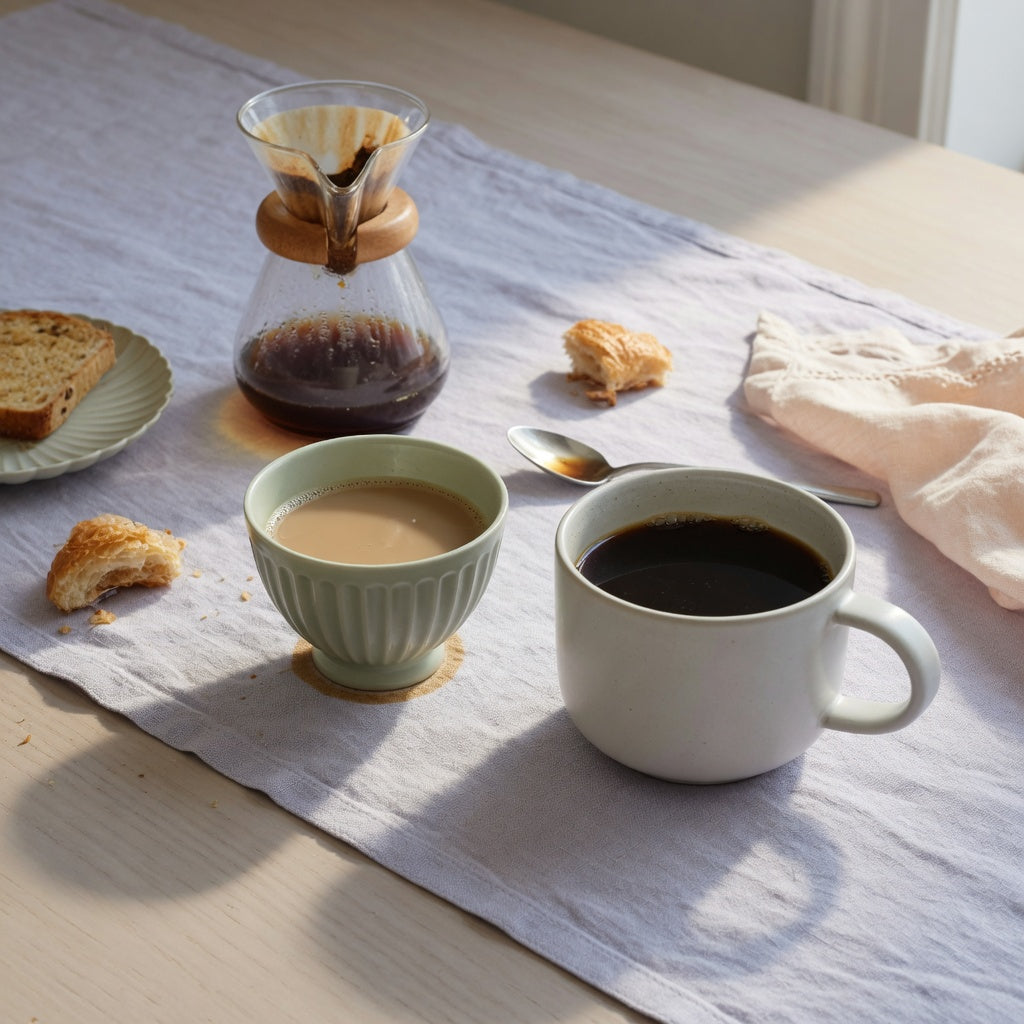
Pleated Ceramic Cup vs Round Mug: Capacity and Care
A pleated ceramic cup and a round mug are built for different pours. We compare usable capacity, grip, heat loss, cleaning, stacking, and food-contact glaze so you can match the shape to the drink ...
Read more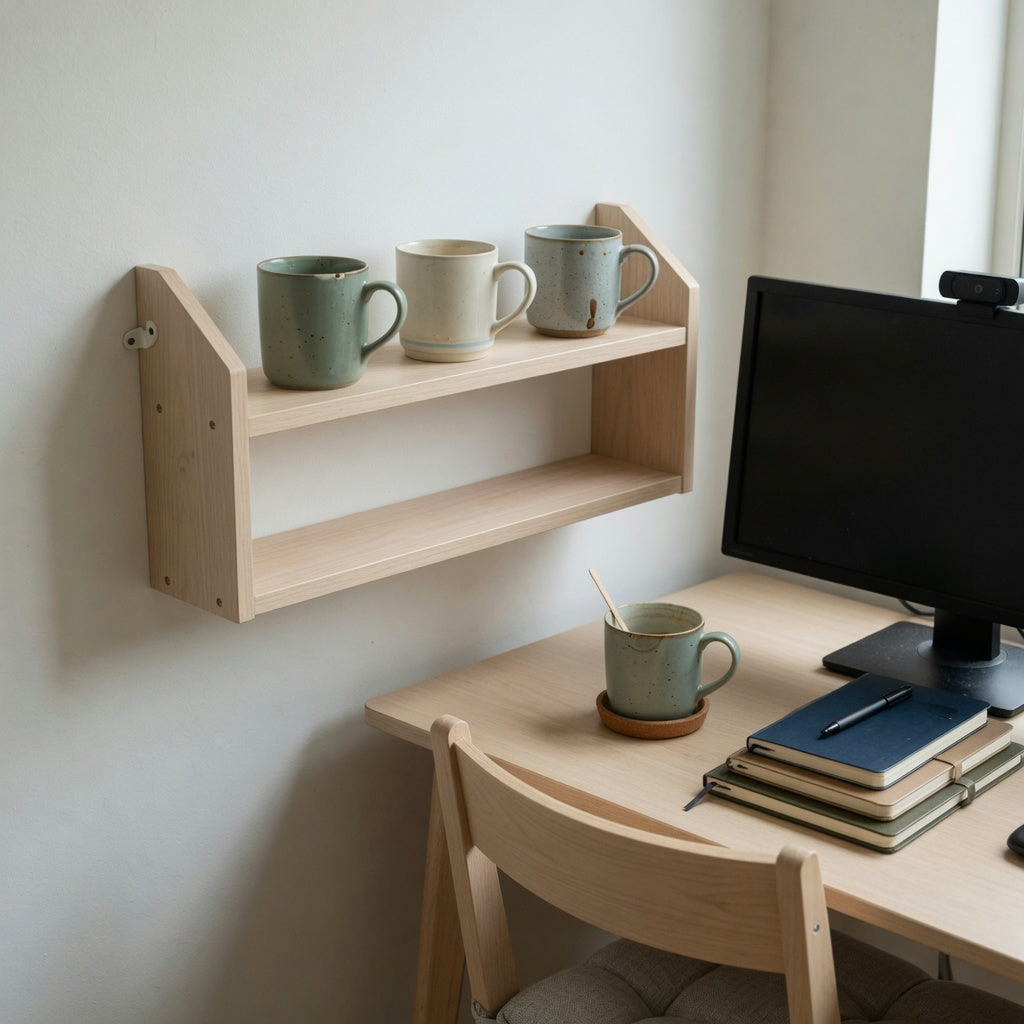
Tidy Home Office Coffee Mug Shelf: What to Compare
A tidy home office coffee mug shelf works only when format, handles, and daily cup count match the desk you actually use. We compare cubbies, hooks, stackers, and risers, then cover mounts, materia...
Read more
Leave a comment
This site is protected by hCaptcha and the hCaptcha Privacy Policy and Terms of Service apply.