



Coffee Mugs With Big Handles: Home Office Product Shortlist Guide
Reading time: about 11 minutes
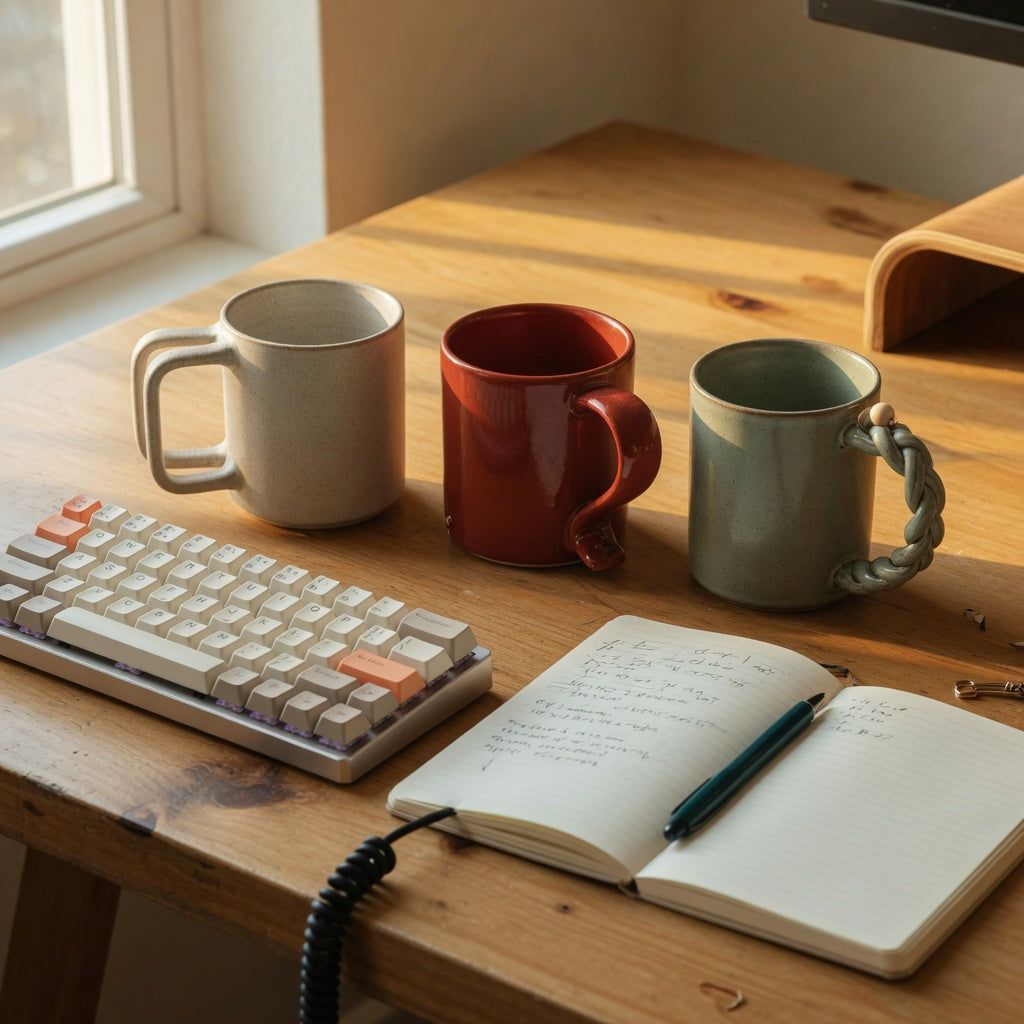
The mug sits just left of the keyboard. You reach for it mid-sentence without looking, the loop catches: two fingers slide in, the third wedges against the outside, and your knuckles graze the warm wall of the cup. You take the sip, set it down harder than you meant to, and lose the sentence you were typing. Customers describe this exact moment to us in support emails, which is why this coffee mugs with big handles home office product shortlist guide is built around hand size and desk routine rather than around the word “oversized” in a product title.
A mug can have a genuinely large handle and still be tiring to use all day. Big is not the same as usable. What actually removes the pinch is interior clearance that matches your fingers, a loop that holds your hand off the hot wall, and a capacity your wrist is happy to lift forty times before lunch. Those three rarely arrive together by accident, so we shortlist by them.
What should you measure before you trust the phrase “big handle”?
Retail copy is vague on purpose. “Comfort grip,” “generous handle” and “extra large” are photo captions, not dimensions. The number that decides whether a mug feels good at a desk is the open area inside the loop, plus how far your hand sits from the vessel body.
A 2023 study of drinking cups for care-home residents with reduced strength and dexterity treated cup mass, cup diameter, handle length and handle orifice area as the four dimensions that determine usability. The researchers reported that an opening needs roughly 650 mm² of mean cross-sectional area to pass two adult fingers and roughly 950 mm² to pass three. Their best-performing designs were light, allowed at least two fingers through the loop, still let the thumb and ring finger brace the body, and kept wrist moment low. That last point is the one shoppers skip: a huge loop on a heavy mug is not automatically easier to hold.
Handle thickness is a separate variable. In a biomechanics study of people with rheumatoid arthritis gripping spoons, thicker handles were associated with less finger-joint flexion than a slender standard handle, and most participants picked a 1.50-inch built-up handle over a 1.00-inch version. A thin wire loop forces the fingers to curl tighter; a thicker loop lets the hand stay more open.
- Finger count. Slide your hand into the loop before you sip anything. Two fingers with room to spare is the minimum for a desk mug; three is comfortable; four is generous.
- Knuckle standoff. The backs of your fingers should not rest flat against the cup wall. If they do, a hot drink turns every sip into a small flinch.
- Wrist angle. Lift the mug with your elbow near your side. If your wrist has to cock outward to keep the cup level, the handle sits too far from the body or the load is too heavy.
- Filled mass. Liquid weighs roughly a gram per millilitre, so a full 480 ml mug carries close to half a kilogram of drink before the ceramic counts. That is the real load on a one-handed lift, not the handle’s outline.
Which home office routine are you actually buying for?
Most mug regret comes from buying for the drink instead of the day. Three routines cover nearly every desk we hear about, and each points at a different capacity.
- The deliberate break (200–300 ml). A flat white, a cortado, an espresso with milk. You get up between meetings anyway, so a light, low-volume cup is a feature: it gives you a reason to leave the screen.
- The focus block (350–420 ml). One full pour-over, an Americano, or a pot of tea that has to survive ninety minutes of writing or code review. This is the capacity sweet spot for most remote workers.
- The long session (450–500 ml). Deep work, back-to-back calls, or a tea habit that would otherwise mean three kitchen trips. You gain fewer refills and pay for it in lift weight.
One honest gap: capacity is easy to publish, empty weight often is not. If wrist load is your deciding factor, ask us before you order instead of guessing from photos, because two 400 ml mugs can differ meaningfully on the scale depending on wall thickness.
Coffee mugs with big handles home office product shortlist guide: three mugs, three desk jobs
Our catalog has three handled mugs with visibly different approaches to the grip. Below are the stated capacities and how each handle reads on the current product photos. Interior clearance in millimetres is rarely published in this category, so measure your own hand and ask us for a figure before you commit to a specific finger count.
| Mug | Listed capacity | Visible handle shape | Fits this desk routine | Skip it if… |
|---|---|---|---|---|
| Ball Handle Coffee & Tea Mug | 250 ml | Ball-shaped handle detail rather than a long open loop, per current photos | Deliberate breaks, espresso drinks, short calls | You want three or four fingers through a loop |
| The Flow Coffee & Tea Mug | 400 ml | Broad, swept loop with visible vertical room | Workday filter coffee, ninety-minute focus blocks | Your brewer sits low and the mug stands tall |
| The Rock Coffee & Tea Mug | 480 ml | Wide-stance handle scaled to a larger body | Long sessions, big pour-overs, all-morning tea | You need the lightest possible lift |
Ball Handle Coffee & Tea Mug, 250 ml: the deliberate-break mug
The Ball Handle Coffee & Tea Mug is the one to look at if your ritual is a short, good cup rather than a long, large one. At a stated 250 ml the filled load stays small, and the ball-form grip gives the fingers something to close around instead of a long loop to thread. Check the listing photos to confirm the shape matches how you naturally grip.
- Choose it if: you drink espresso-based drinks, take frequent short breaks, or find open loops awkward because your fingers curl rather than pass through.
- Skip it if: you specifically want an open handle with room for three or four fingers, or you need a mug that holds a full 12 oz drip coffee in one pour. It will not do either job.
The Flow Coffee & Tea Mug, 400 ml: the everyday desk mug
The The Flow Coffee & Tea Mug sits in the middle at a stated 400 ml, and for most home offices that is the capacity that matches a normal morning pot without forcing a refill at 10:30. The handle reads as a broad swept loop in the photos, which is the shape most people mean when they search for coffee mugs with big handles.
- Choose it if: you want one mug for filter coffee, Americanos and loose-leaf tea, and you want your fingers spread across the handle rather than pinched together.
- Skip it if: your single-serve brewer sits close to the drip tray or you like a mug that slides under a low spout. Measure the mug height against your machine, and ask us if the listing you are viewing does not state it.
The Rock Coffee & Tea Mug, 480 ml: the long-session mug
The The Rock Coffee & Tea Mug tops the shortlist at a stated 480 ml. The handle reads wider and more architectural than the other two, scaled to the body rather than added as an afterthought.
- Choose it if: you settle in for a two-hour block, drink tea by the pot, or simply hate returning to the kitchen mid-call.
- Skip it if: you have an active arthritis flare, carpal tunnel symptoms, or you already know a heavier mug tires your wrist by afternoon. At 480 ml it carries the most liquid of the three, and that is the trade-off you are accepting.
If none of these handle profiles suits your hand, the wider unique coffee mugs collection shows the rest of the silhouettes we stock, including shapes that solve a grip problem by changing the whole vessel rather than the loop.
One oversized loop, two handles, or a T-handle: which grip shape wins?
A bigger loop is not the only answer, and it is not always the best one. Match the handle to the problem you actually have.
- One large C or D loop. The default, and the right call for most desk users with normal grip strength. It lets the hand stay relaxed and keeps the other hand on the keyboard.
- Two handles. Worth considering if a one-handed lift feels unstable or you carry a full mug with both hands anyway. The cost is shelf space, dishwasher space, and the fact that neither loop is usually large.
- T-handle or a rotating swivel handle. These help when the limit is wrist rotation rather than finger clearance, because you can hold with a straighter wrist. We do not stock these shapes, and we would rather say so than stretch a description to fit.
With tremor or significant hand weakness, the deciding factor is usually total weight before loop size. A lighter mug with a moderate handle beats a heavy mug with a cavernous one, and that runs against how most of this category is marketed.
What should you confirm on the product page before you pay?
- Interior clearance, in millimetres. If it is not stated, ask. Compare it to your three-finger span measured across the knuckles; if your span exceeds the opening, it will pinch.
- Empty weight. Rarely published, and the single most useful number for anyone with wrist pain.
- Height against your brewer. Measure from the drip tray to the spout, then add a centimetre of clearance.
- Base diameter for a mug warmer. A deeply recessed foot ring can leave the mug barely touching the plate, so the drink stays lukewarm no matter how long it sits.
- Handle joint construction. A handle formed out of the body and fired with it resists dishwasher cycles and thermal shock better than a thin applied trim. Glued-on novelty handles are a known failure point.
- Stated care instructions. If the page does not say microwave or dishwasher safe, treat the mug as hand-wash only and keep it out of the microwave until the seller confirms.
Heat, glaze and the microwave: what we can and cannot promise
Coffee sits on a home office desk longer than anyone plans. If you reheat in the cup, the coating matters as much as the handle.
Never microwave ceramic with a metallic rim, an iridescent lustre or a reflective foil glaze. The U.S. Consumer Product Safety Commission recalled about 440,500 Starbucks-branded holiday gift-set mugs with a metallic coating on 21 March 2024 after the mugs overheated or broke when microwaved or filled with very hot liquid; the agency recorded 12 incidents and 10 injuries, including burns, blisters and one cut.
Glaze formulation is the other half of the question. The FDA notes that lead in glazes and decorations on some traditional pottery can leach into food or drink if a piece is not made and fired properly, and that washing or boiling will not remove it. Everyday commercial factory ware is described as far less likely to have the problem than glazed, antique, damaged or uncertain-source pieces, and brightly orange, red or yellow decorated ware. Ceramicware with extractable lead above FDA action levels should not be labelled lead free.
We are a small store, not a testing lab. We cannot hand you an independent lead or cadmium report for every mug, and we will not repeat a supplier’s safety word as if it were a test result. What we can do is tell you what the specific product page states about microwave and dishwasher use, and answer a direct question about a specific mug rather than let you assume.
Frequently asked questions
Will a big handle mug actually fit my hand, or is it just a wide photo?
Judge it by the opening, not the outline. Research on cup design puts the threshold at roughly 650 mm² of interior area for two adult fingers and about 950 mm² for three, so ask the seller for a clearance measurement and compare it to your own finger span before buying.
How did you choose the mugs in this coffee mugs with big handles home office product shortlist guide?
We started from capacity and handle shape, because those are the two things we can state accurately for the Ball Handle (250 ml), The Flow (400 ml) and The Rock (480 ml). Then we matched each to a realistic desk routine and wrote down the reason to skip it, since a shortlist without trade-offs is just an advertisement.
Is a 480 ml mug too heavy to use all day at a desk?
It depends on how you lift it. A filled 480 ml mug holds close to half a kilogram of liquid before the ceramic is counted, so it is the heaviest option in our lineup and the one most likely to tire a sore wrist. If you lift one-handed dozens of times a morning, a 400 ml mug is the safer default.
Do large-handle ceramic mugs stay cool enough to hold?
That depends on the gap between the loop and the hot wall, which most listings do not measure. A handle set close to the body warms up; one set further out stays cooler. Test with your knuckles on the first cup rather than your palm.
Can these mugs go in the dishwasher?
Check the current product page for the specific mug rather than assuming across the range. If no care statement is listed, hand-wash it and keep it out of the microwave until the seller confirms, because a care claim for one mug should not be extended to another.
Start with your routine, then your hand: pick the capacity you will genuinely drink in one sitting, confirm the handle clears your fingers, and worry about colour last. If you want the middle option that suits most desk setups, The Flow at 400 ml is where we point most people; if you drink short and often, the Ball Handle at 250 ml is the better match.
Ready to pick your mug? Two ways to save on today's order:
Ordering 1–3 mugs? Get an extra 10% off your 1st order with code 10_OFF Apply 10% Off & Shop Wooden-Handle Mugs →
Gifting 4+ mugs? Buy 3, Get the 4th Free applies automatically at checkout (no code needed; offers do not stack) · Free standard shipping (Nov pre-Christmas delivery: 15–20 calendar days US) · Free replacement if chipped in transit.
Popular mug buying guides: Ceramic Tea Cups & Infuser Mugs · Ceramic Mugs with Lids Compared · Wooden-Handle Tea Infuser Mugs Compared · Christmas & Secret Santa Mugs 2026 · Espresso & Cortado Cups Guide · Cup & Saucer Gift Sets · All 25 Mugs Spec Table · Mug Size Guide · Shipping & Promo FAQ
FIRST ORDER 10% OFF (CODE: 10_OFF) · OR BUY 3, GET THE 4TH FREE


Read more

Coffee Mug Gifts Ideas Home Office Product Shortlist Guide
A scenario-based shortlist for home-office mug gifts: match 200 ml, 400 ml, or 440 ml ceramic mugs to desk, meeting, and tea-break routines, with explicit reasons to choose or skip each one. Includ...
Read more
Wide Based Coffee Mugs Home Office Practical Purchase Checklist
A practical checklist from our store for choosing wide based coffee mugs for a home-office desk: compare the visible foot, listed capacity, handle clearance, brewer fit, and care details before you...
Read more
Leave a comment
This site is protected by hCaptcha and the hCaptcha Privacy Policy and Terms of Service apply.