



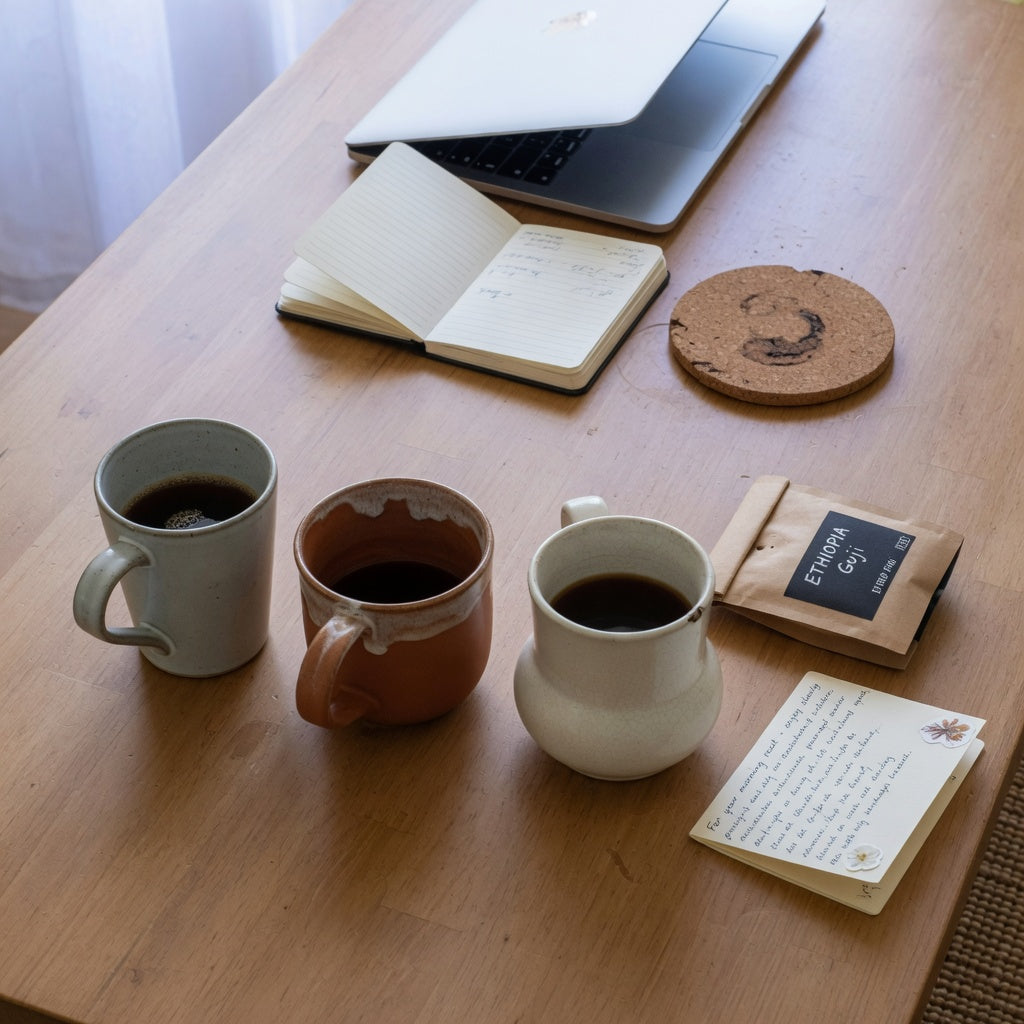
Coffee Mug Gifts Ideas for Home Offices: A Practical Purchase Checklist
Reading time: about 10 minutes
A gifted mug usually lands in one of two places: within reach of the keyboard, or the back shelf behind the travel tumblers. The design rarely decides which. Fit does — the pour size, the handle, and the spot the mug occupies during a 9 a.m. call. That is the premise behind this coffee mug gifts ideas home office practical purchase checklist, and it is the same order we use when we help a customer reconsider a mug they were about to buy.
We sell three ceramic cups at CoffeifyMug, and the honest differences between them are listed capacity, visible finish, and how much desk they take up. Everything else is a question worth asking before checkout, not an assumption worth making in an article.
Does the recipient actually want another mug on the desk?
Plenty of people quietly own too many mugs, and a gift that ignores that becomes cupboard filler. The mug earns its place when it replaces a bad one: a chipped rim, a handle that pinches two fingers, a cup that holds half a coffee.
Three signals say yes:
- A daily desk drink: coffee or tea is part of the workday, not a weekend ritual.
- A fixed landing spot: a coaster, a tray, or a clear corner of the desk.
- A current gripe: the mug they use goes cold, holds too little, or feels awkward in the hand.
The no-signals matter just as much. If they commute with coffee, a lidded travel mug is the right gift; a ceramic cup has no lid and no insulation, and no pattern makes up for that. If they drink iced coffee from a tall tumbler all day, a 200 ml cup may never leave the shelf. And if the cabinet is already crowded, a consumable or one very specific replacement mug beats a generic one.
Start with shape and capacity rather than pattern. Our current ceramic mug lineup shows the available sizes side by side, which makes the next decision faster.
Which capacity — 200 ml, 400 ml, or 440 ml — matches the actual pour?
Listed capacity is where mug gifts quietly go wrong. A 400 ml mug is not a 400 ml drink. Practical pours leave a centimeter or two of headroom for milk, a spoon, and the walk from kitchen to desk.
- 200 ml — the smallest of the three, the Pleated Coffee & Tea Cup: a short coffee, a proper tea, or a desk that gets refilled often. A poor fit for someone who takes a large drip coffee in one go.
- 400 ml — the mid-size Flow mug: the safest choice when you do not know the recipient's habit. It holds a normal desk coffee with room for milk without turning into a bucket.
- 440 ml — the largest listed size, Morning and Night: one fill for a long call. Expect a bigger footprint; confirm the desk has the space before you commit.
Capacity also says nothing about height or base width, and those decide whether a mug clears a single-serve brewer spout or fits on a shelf above the monitor. Treat dimensions as a listing question and measure the gap if the mug has to slot into a specific spot.
A 200 ml cup with a splash of milk is a small drink. If the recipient takes milk, sweetener, or a long steep, lean up a size rather than down.
Where will the mug sit: keyboard tray, shelf, or shared meeting table?
Three physical details decide daily use, and none of them appear in a capacity number.
- Handle opening: two fingers plus a thumb should pass without scraping. A handle that pinches turns a dishwasher mug into a hand-wash mug.
- Base diameter: a wide base can overhang a small coaster or crowd a narrow keyboard tray.
- Overall height: check clearance under a brewer, a cabinet shelf, or a monitor riser.
Meeting tables add one more test. The mug should be easy to spot in a shared kitchen or a room full of identical white cups. A distinct finish helps, and so does a shape the recipient can identify from across the table.
Left-handed users and anyone with grip issues should study handle placement in the listing photos rather than the pattern. A handle set at an unusual angle is a daily annoyance for some people and unnoticeable to others, and only the recipient knows which they are.
What do "dishwasher safe" and "microwave safe" actually cover?
They are separate claims, and neither implies the other. A mug can survive a dishwasher and still have a metallic rim that should stay out of a microwave. A second mug can be microwave-friendly while its decoration fades after a year of hot detergent.
Decoration type is the detail most shoppers miss. Glaze-fired decoration sits under a glassy layer and behaves differently from a decal or a metallic luster applied on top. Gold rims, luster bands, and metallic accents are the first things to question for microwave use. Surface decals and printed designs are the first things to question for repeated dishwasher cycles.
For the three cups we list, treat care as an open question until you read the exact product page. We publish capacity and show the finish; a blanket dishwasher or microwave promise is not something we would put in a gift guide on your behalf. Check the page or ask before the mug joins a shared office dishwasher.
- Does the dishwasher claim cover the decoration, not just the body?
- Is microwave use confirmed separately?
- Is the design underglaze, a decal, or metallic trim?
- Will a printed design survive repeated hot washes?
- Does the handle or base make the mug awkward to load and unload?
One habit worth passing to the recipient: warm a cold ceramic mug before pouring boiling water into it. It takes ten seconds and avoids a needless stress on the glaze.
Which glaze and lead questions matter for handmade, vintage, or bright-glazed mugs?
Gift roundups skip this, and it is the one question worth slowing down for with handmade, imported, vintage, or brightly decorated pieces.
The FDA sets an action level of 0.5 µg/ml of leaching solution for lead in ceramicware cups and mugs under Compliance Policy Guide 545.450, and it warns that lead in glazes or decorations can leach into drinks when a piece is not made or fired properly. Washing or boiling does not remove lead.
The higher-concern list is specific: handmade pottery with crude or uncertain glazes, antique or damaged pieces, pottery of unknown origin, and pieces with bright orange, red, or yellow decoration. Commercially made everyday pottery is described by the FDA as much less likely to have lead problems, which is the practical reason a straightforward commercial mug is the lower-risk gift for daily office use.
"Lead free" is a label, not a lab result. FDA guidance on lead-glazed pottery says ceramicware that shows extractable lead under the CPG 545.450 test method should not carry a "Lead Free" claim. And under 21 CFR 109.16, decorative ceramicware that looks like drinkware is treated as foodware unless it carries a conspicuous "Not for Food Use" warning or has a hole bored through the food-contact surface. A mug marked not for food use stays a shelf object, however good it looks beside a laptop.
None of this rules out handmade mugs. It means asking the maker for current food-contact confirmation before the mug becomes a daily coffee cup — the same caution we apply in our comparison of ceramic mug gifts for coffee lovers.
What turns a mug into a gift instead of a cup with a bow?
A mug alone can read as a default purchase. A mug plus one consumable and a two-line note reads as a choice someone made on purpose.
- Coffee or tea: a small bag of beans or a few tea sachets lets the recipient test the mug with their actual drink.
- A care card: the listed capacity in ml plus the care instructions. Handwritten is fine. It saves the mug from a first-week dishwasher mistake.
- A coaster or small tray: useful on a wooden desk, but only if they do not already own one. Extra desk objects are clutter.
- A specific note: reference the routine, not a slogan. "For the 2 p.m. tea break" beats a printed joke.
The relationship changes the design, not the checklist. For a coworker, keep the design neutral and the note short. For a teacher or a new hire, practical beats novelty. For a partner, choose the mug that matches how they actually drink — including the size of the pour, which is the part most gift buyers skip.
What belongs on the coffee mug gifts ideas home office practical purchase checklist?
Run these seven checks before you add anything to the cart:
- Name the routine: desk coffee, tea break, or meeting table.
- Match listed capacity with headroom: 200 ml for small pours, 400 ml for an unknown habit, 440 ml for long calls.
- Look at what it replaces: if nothing is worn out and the cabinet is full, consider skipping the mug.
- Verify care claims: dishwasher, microwave, and decoration durability on the exact listing.
- Check the physical fit: handle opening, base diameter, height clearance.
- Confirm food-contact safety: especially for handmade, vintage, imported, or brightly glazed pieces.
- Keep the extras small: one consumable, a care card, and a note.
| Mug | Listed capacity | Best fit | Verify before buying |
|---|---|---|---|
| Pleated Coffee & Tea Cup | 200 ml | Short tea, small coffee, frequent refills, meeting tables | Care claims, handle opening, whether 200 ml is enough for the usual drink |
| The Flow Coffee & Tea Mug | 400 ml | Everyday desk coffee or a generous tea when the habit is unknown | Care claims, microwave confirmation, handle comfort |
| Morning and Night Coffee & Tea Mug | 440 ml | One fill for long calls and big-mug drinkers | Desk footprint, care claims, whether the larger capacity is wanted |
If none of the three matches the routine, browse the full ceramic selection by capacity and finish before choosing a design. The design is the last decision, not the first.
Frequently asked questions
Which capacity is the safest bet when I do not know their coffee habit?
400 ml. The Flow Coffee & Tea Mug sits between the 200 ml Pleated cup and the 440 ml Morning and Night mug, so it covers a normal desk coffee or a generous tea without assuming a giant pour. Step up to 440 ml only when you know they fill one mug and stay at the desk.
Can a ceramic mug with a metallic rim go in the microwave?
Do not assume it can. Metallic trim is the detail to question first, and a dishwasher-safe claim says nothing about microwave use. Check the exact listing or ask the seller before the mug goes into a workplace microwave.
How much drink actually fits in a 200 ml cup?
Less than 200 ml once you leave room for milk and a spoon. It suits tea, a short coffee, or a desk with frequent refills, and it is a poor fit for someone who drinks a large drip coffee in one sitting. In that case, look at the 400 ml or 440 ml option instead.
Is a handmade mug marked "lead free" safe for daily coffee?
Not automatically. The label is not a lab test, and FDA guidance says ceramicware with extractable lead should not carry a "Lead Free" claim in the first place. Ask the maker for current food-contact confirmation, and treat any piece marked "Not for Food Use" as decorative only.
What if they already own too many mugs?
Then use the coffee mug gifts ideas home office practical purchase checklist as a skip test rather than a shopping list. Choose one specific mug that replaces a chipped or uncomfortable one, or pair a small consumable with a note and leave the mugs out. If you want to compare what we stock, start with the three listed capacities in our shop and work back to the design last.
More from our blog
Ready to pick your mug? Two ways to save on today's order:
Ordering 1–3 mugs? Get an extra 10% off your 1st order with code 10_OFF Apply 10% Off & Shop Wooden-Handle Mugs →
Gifting 4+ mugs? Buy 3, Get the 4th Free applies automatically at checkout (no code needed; offers do not stack) · Free standard shipping (Nov pre-Christmas delivery: 15–20 calendar days US) · Free replacement if chipped in transit.
Popular mug buying guides: Ceramic Mugs with Lids Compared · Wooden-Handle Tea Infuser Mugs Compared · Christmas & Secret Santa Mugs 2026 · Espresso & Cortado Cups Guide · Cup & Saucer Gift Sets · All 25 Mugs Spec Table · Mug Size Guide · Shipping & Promo FAQ
FIRST ORDER 10% OFF (CODE: 10_OFF) · OR BUY 3, GET THE 4TH FREE


Read more

Pottery Tea Cups Home Office Practical Purchase Checklist for Desks
A desk-first buying checklist for pottery tea cups: what to verify about glaze and food contact, how 170, 200, and 250 ml capacities change your tea routine, and which trade-offs should decide the ...
Read more
Coffee Mugs With Big Handles Home Office Practical Purchase Checklist
This coffee mugs with big handles home office practical purchase checklist compares handle clearance, listed capacity, desk fit, materials, and care so you can choose a CoffeifyMug shape without gu...
Read more
Leave a comment
This site is protected by hCaptcha and the hCaptcha Privacy Policy and Terms of Service apply.