
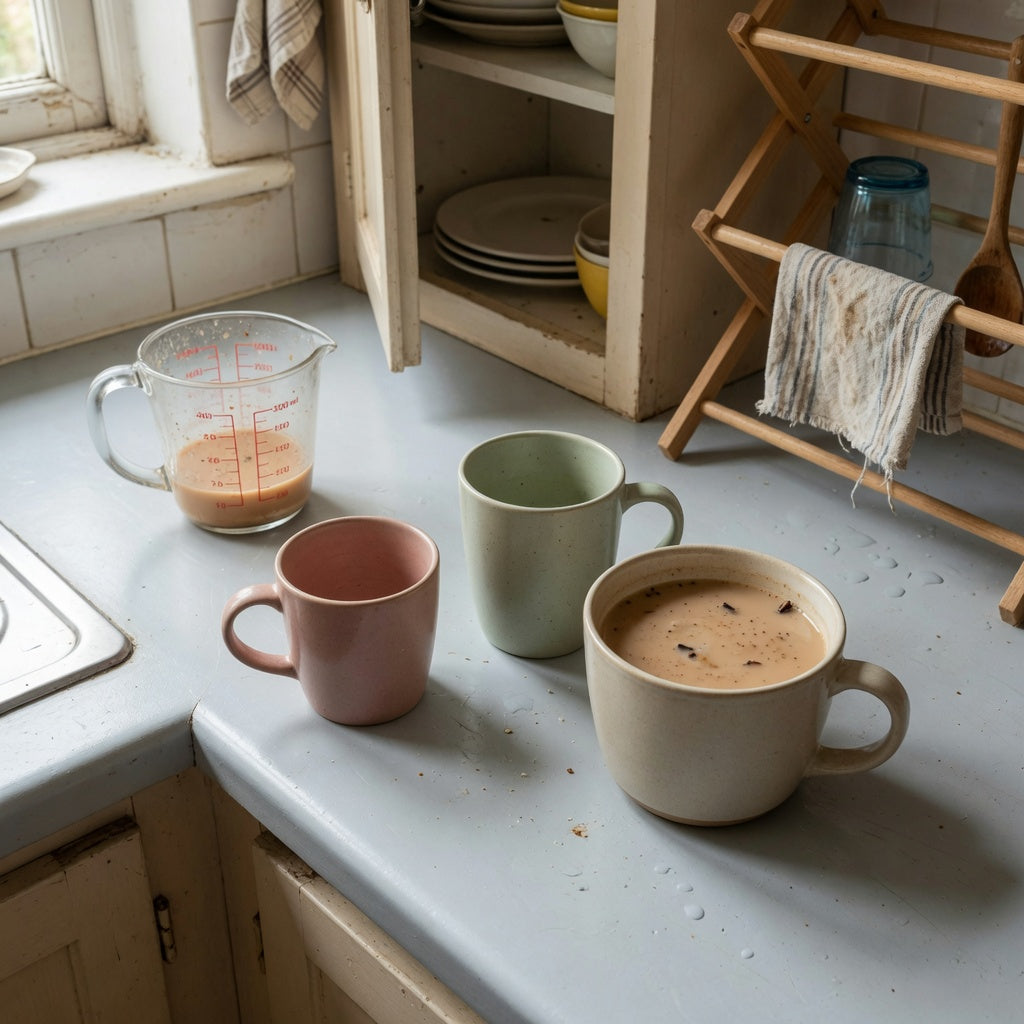
Chai Tea Mug Everyday Mug Rotation Practical Purchase Checklist
Reading time: about 10 minutes
Open the cupboard after the second chai of the day and the weak point in a mug rotation becomes obvious. One mug is beside the sink, another is waiting to be unloaded from the dishwasher, and the largest option barely clears the shelf. This chai tea mug everyday mug rotation practical purchase checklist starts with that ordinary bottleneck, then compares three verified capacities by pour volume, handling, washing routine, and storage space.
In our store, we see shoppers focus on artwork before checking how a mug will function at 7 a.m., beside a keyboard, or in a crowded drying rack. We approach the decision in the opposite order. Capacity comes first, followed by full-mug comfort, external fit, and care requirements. The verified catalog facts are straightforward: The Flow is 400 ml, Morning and Night is 440 ml, and The Rock is 480 ml. Their catalog descriptions support tea use, but capacity alone does not establish dimensions, empty weight, dishwasher compatibility, insulation, or included brewing accessories.
How many clean mugs must your daily chai rotation cover?
Start by counting pours between reliable washing sessions, not by deciding how many matching mugs would look good on a shelf. A person who drinks one chai and washes the mug that evening has a different rotation problem from a household where two people make drinks before the dishwasher is unloaded.
- One regular pour per day: One mug may cover the routine, while a second keeps the schedule moving when the first is still dirty or drying.
- Two or three pours before washing: Record whether you reuse the same mug. If you prefer a clean mug for each drink, the rotation must cover that gap.
- Shared kitchen or office: Count simultaneous use. Two people reaching for mugs at the same time can exhaust a two-mug rotation even if each drinks only once.
- Irregular dishwasher cycles: Base the count on the longest normal delay, but verify that the selected mug is approved for machine washing before treating the dishwasher as part of the plan.
Also note where mugs tend to pause. A cup left on an office desk all afternoon is unavailable to the kitchen rotation even if it is technically reusable. In our experience, location is easy to overlook until every usable mug is in a different room.
400 ml, 440 ml, or 480 ml: which capacity fits your pour?
Measure your normal prepared serving before comparing products. Nominal mug capacity is not the same as a comfortable working fill because many drinkers want headspace for stirring, milk, foam, or carrying the mug without spilling. The useful number is the volume you actually pour, not the largest number on the product page.
| Option | Verified capacity | Situation it fits | Trade-off to check |
|---|---|---|---|
| The Flow coffee tea mug | 400 ml | Your regular serving fits comfortably below 400 ml and you want the lowest listed capacity of these three options. | A full recipe close to 400 ml may leave less stirring or carrying headspace than you prefer. |
| Morning and Night coffee tea mug | 440 ml | Your current pour crowds a 400 ml mug, but you do not consistently need the largest available volume. | The extra 40 ml does not prove a particular handle size, shelf fit, or empty mug weight. |
| The Rock coffee tea mug | 480 ml | You make a larger chai or deliberately want more room between the drink and the rim. | It holds 80 ml more than The Flow at stated capacity, so a full serving carries more liquid weight. |
The 40 ml steps are useful because they allow a close match without pretending that bigger is automatically better. A shopper who usually pours 350 ml may gain little from moving to 480 ml. Someone whose prepared drink already approaches 400 ml has a clearer reason to consider 440 ml or 480 ml.
Capacity does not reveal the mug's outer height, base diameter, handle opening, rim profile, or stackability. Check current product details for those measurements where provided. We do not infer them from volume, and we do not convert a tea-use description into a claim about special temperature performance or professional testing.
How do handle feel, rim clearance, and liquid weight affect comfort?
An empty mug can feel manageable and still become awkward after it is filled. The mug contributes its own weight, then the drink adds more. The 480 ml option can carry 80 ml more liquid than the 400 ml option at their stated capacities, but that comparison does not tell us how much either empty mug weighs.
For a useful home check, measure your usual chai with a kitchen measuring jug. Put the same amount of water into a safe mug or vessel you already own, carry it from the preparation area to your usual seat, and notice where pressure builds. Pay attention to the number of fingers that fit through the handle, whether your knuckles touch the body, how much your thumb has to brace, and whether the rim leaves enough headspace while walking.
This is a practical handling proxy, not a laboratory test. It is especially helpful for shoppers with smaller hands, reduced grip comfort, or a long walk between the kitchen and an office desk. If carrying weight is already a concern, a smaller serving or lighter vessel style may be a better purchase than choosing the largest capacity.
Will the mug fit your cupboard, dishwasher cycle, and drying rack?
A rotation only works if each piece has a reliable place to be stored, washed, and dried. Before ordering multiples, measure the usable shelf height, shelf depth, and width available around neighboring handles. Do not plan on stacking unless the current listing or product shape clearly supports it. Mugs with the same capacity can have very different external proportions.
Care instructions need the same attention. A catalog description supporting tea use does not by itself confirm dishwasher or microwave compatibility. Check the current product page, packaging, or care information before relying on either appliance. If a dishwasher is permitted, inspect rack spacing and spray-arm clearance, and leave enough room to prevent the rim or handle from knocking against other items during a cycle.
For hand washing, make sure your usual sponge or brush can reach the interior and that the drying rack supports the mug without forcing the handle against another dish. If your chai contains milk, a prompt rinse helps keep residue from drying while the mug waits to be washed. Follow the product's current care directions for the full cleaning process and for any temperature-related precautions.
Chai tea mug everyday mug rotation practical purchase checklist
Use these steps in order. They separate the verified product facts from the personal fit questions that no capacity label can answer for you.
- Measure the volume of your normal prepared chai, including any milk you add, instead of estimating from the mug's appearance.
- Decide how much empty space you want above the drink for stirring and carrying.
- Count the clean mugs required between your normal hand-wash or dishwasher sessions.
- Compare that working fill with the verified 400 ml, 440 ml, and 480 ml options.
- Simulate the filled weight with a measured amount of water and note hand, thumb, and wrist comfort.
- Measure shelf height, shelf depth, drying space, and any dishwasher clearance your routine depends on.
- Verify current care instructions instead of assuming dishwasher, microwave, or temperature suitability.
- If several people will use the mug, account for their serving sizes and grip preferences as well as your own.
- Buy one capacity first when you are uncertain, then add another only after it earns a regular place in the rotation.
Treat this chai tea mug everyday mug rotation practical purchase checklist as a filter. A product should pass your serving-volume test, handling test, and storage test before color or artwork makes the final decision.
Which CoffeifyMug option fits each everyday scenario?
Your measured pour stays comfortably below 400 ml
The 400 ml The Flow mug for coffee and tea is the relevant starting point because it has the lowest verified capacity in this comparison. It suits a shopper who does not need the additional 40 ml or 80 ml offered by the other options. Check the current listing for exterior measurements and care details before assuming it will fit a tight shelf or dishwasher rack.
Your drink needs more room than 400 ml without moving to 480 ml
The 440 ml Morning and Night coffee tea mug occupies the exact middle position. It provides 40 ml more stated capacity than The Flow and remains 40 ml below The Rock. This is the logical comparison for a shopper whose usual serving nearly fills a 400 ml mug but who does not want unused volume as the default.
Your regular serving is large or needs generous headspace
The 480 ml The Rock coffee tea mug is the largest verified option here. Choose it only after confirming that the additional liquid weight, external dimensions, and storage requirements work for your routine. It is a capacity-led recommendation, not a claim that the mug retains heat longer or has been professionally performance-tested.
You want a mixed rotation or are choosing a gift
A mixed set can make sense if morning and evening servings differ, but matching capacities simplify filling and storage decisions. For a gift, use the recipient's current favorite mug as the capacity reference rather than guessing from appearance. The unique coffee mugs collection is the practical next step for comparing available designs after you have established the right volume range.
When is a larger chai tea mug the wrong purchase?
A larger mug is a poor fit if you make small tasting portions, dislike carrying a heavier full vessel, or lack verified cupboard clearance. It is also the wrong category for a commute that requires a sealed lid or spill resistance. A purpose-built travel tumbler would suit that job better.
These recommendations do not establish that a lid, infuser, strainer, chai ingredients, or other brewing accessories are included. They also do not imply insulation, unusual heat retention, cultural certification, or professional testing. If any of those features is essential, confirm it on the current product listing or choose a vessel specifically designed around that requirement.
Frequently asked questions
How should I use a chai tea mug everyday mug rotation practical purchase checklist?
Measure your actual serving, count how many mugs are unavailable between washes, and check the filled weight and storage space. Then compare those results with the verified 400 ml, 440 ml, and 480 ml capacities. Leave style until the practical filters are settled.
Is 400 ml enough for a milky chai?
It can be, but the answer depends on the total prepared volume and the headspace you prefer. Measure the finished drink after adding milk rather than relying on the recipe name. If the result approaches 400 ml, compare the 440 ml and 480 ml options so you have room to stir and carry it comfortably.
What is the practical difference between 400 ml, 440 ml, and 480 ml?
Each step adds 40 ml of stated capacity, while the difference between the smallest and largest options is 80 ml. That can change headspace and liquid weight, but it does not reveal exterior dimensions, empty mug weight, handle size, or care compatibility.
Should every mug in an everyday rotation have the same capacity?
No. Matching capacities make serving and storage more predictable, while mixed capacities let you choose a smaller or larger mug for different times of day. A mixed rotation works best when every mug still fits the same washing, drying, and cupboard routine.
Are these mugs dishwasher-safe or supplied with chai accessories?
The verified facts used here are their 400 ml, 440 ml, and 480 ml capacities and catalog support for tea use. Those facts do not confirm dishwasher compatibility or included ingredients, infusers, strainers, or lids. Review the current product page and care information before buying around any of those requirements.
Measure one normal pour, count the mugs needed between washes, and record your available shelf space. With those three answers, compare the linked products or browse the CoffeifyMug unique coffee mugs collection for the capacity and design that can earn a regular place in your rotation.
More from our blog
Read more
Peppermint Tea Mug Everyday Mug Rotation Practical Purchase Checklist
Compare The Flow 400 ml, Morning and Night 440 ml, and The Rock 480 ml using a measured-pour test, a handle-comfort screen, and honest storage limits. This checklist helps you add one mug with a cl...
Read more
Matcha Latte Mug Home Coffee Station Product Shortlist Guide
Compare the Ball Handle 250 ml, Round 390 ml, and Spittoon 400 ml using listed capacity, the Ball Handle's 11.2 cm diameter, and visible opening shape. Each option includes a clear reason to choose...
Read more
Leave a comment
This site is protected by hCaptcha and the hCaptcha Privacy Policy and Terms of Service apply.