
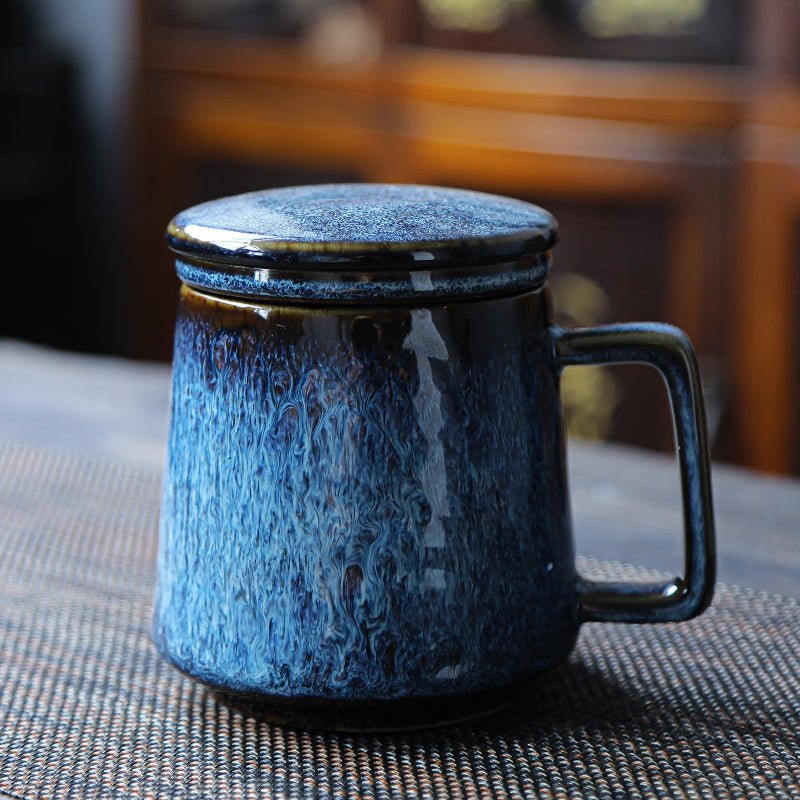
Chai Tea Mug Compact Kitchen Practical Purchase Checklist: 400–480 ml
Reading time: about 10 minutes
A prepared chai is waiting beside the sink, the toaster owns the only dry corner, and your current mug will not slide back into the cabinet unless its handle faces exactly right. This chai tea mug compact kitchen practical purchase checklist is built for that squeeze. We compare the three verified capacities in our catalog—The Flow at 400 ml, Morning and Night at 440 ml, and The Rock at 480 ml—without pretending capacity alone proves a mug will fit.
In our store, the useful questions are rarely just about which mug is biggest. Shoppers also need to know how much chai they pour, where the mug dries, whether the cabinet opening is tighter than the shelf, and whether documented care instructions suit their routine. We can verify the listed capacities and that each catalog description supports tea use. We cannot verify external dimensions, material, dishwasher or microwave compatibility, included accessories, or special temperature performance from the information used for this comparison, so we treat those as pre-purchase checks rather than claims.
Why capacity cannot answer the cabinet-fit question
The listed capacities are separated by 40 ml: 400 to 440, then 440 to 480. The full spread is 80 ml. Those differences help with serving volume, but they do not reveal height, body diameter, base diameter, or handle-inclusive width. A low, wide mug can use more shelf area than a taller mug with greater capacity, and a cabinet frame can reduce clearance even when the shelf itself looks roomy.
We will not call The Flow the smallest physical option simply because it has the lowest listed capacity. Before ordering, measure the actual places the mug must occupy:
- Cabinet opening: Include the frame, shelf lip, and any hinge that intrudes into the opening.
- Usable shelf depth: Measure with the cabinet door fully closed, not just to the edge of the shelf board.
- Counter landing zone: Leave the kettle, toaster, saucepan, and other daily items in their usual positions while measuring.
- Handle clearance: Account for the space beside a wall or appliance and the route from the preparation area to your table or desk.
- Drying space: Check the rack or dishwasher position, but only after the current care instructions confirm that machine washing is suitable.
We would rather flag an unknown dimension than let a capacity number stand in for it. If the current product page does not show a measurement you need, ask our store before checkout instead of estimating from a photograph.
Chai tea mug compact kitchen practical purchase checklist
Work through these checks in order. Each one removes a different source of buying regret.
- Measure your normal finished serving. Prepare chai using your own ingredients and equipment, transfer it to a measuring jug, and record the amount you actually drink. Do not choose a mug based on the full capacity of your kettle or saucepan.
- Allow your preferred headspace. If you stir, add milk at the mug, or carry the drink to another room, choose a listed capacity that lets you stop below the rim. We do not assign a universal headspace amount because mug geometry and drinking habits differ.
- Define the maximum external envelope. Record the greatest height, body width, handle-inclusive width, and base diameter your storage and counter spaces can accept. These are your limits, not assumed product dimensions.
- Compare those limits with current product details. Product photographs are not reliable measuring tools. Confirm every dimension shown on the current listing, and contact us if a measurement needed for your kitchen is absent.
- Consider filled comfort. The listed difference between The Rock and The Flow is 80 ml. More beverage adds carry weight even though the empty mug weights are not verified here, so the lower capacity may be more comfortable if you carry chai one-handed or take it up stairs.
- Confirm material and care. Material can affect empty weight and cleaning routine. Do not assume dishwasher or microwave compatibility from the word mug; follow the current product page and packaging instructions.
- Rule out missing format features. This comparison does not verify a lid, seal, infuser, strainer, or insulation. If one is essential to your routine, choose a product that documents it clearly.
400 ml, 440 ml, or 480 ml: which serving pattern matches?
The three options are close enough to compare directly, but each serves a different measured-pour situation.
| Product | Verified catalog fact | Reader situation and fit logic | Still confirm |
|---|---|---|---|
| The Flow | 400 ml; catalog description supports tea use. | Your measured serving fits with comfortable headspace. Shortlist it because 400 ml is the lowest listed capacity of the three. | External dimensions, handle clearance, material, empty weight, and care instructions. |
| Morning and Night | 440 ml; catalog description supports tea use. | A 400 ml option would put your drink too close to the rim, while 480 ml is more capacity than you plan to use. It sits 40 ml from each alternative. | External dimensions, storage fit, grip comfort, material, and care instructions. |
| The Rock | 480 ml; catalog description supports tea use. | Your usual serving needs the greatest listed capacity and you are comfortable carrying more liquid. It provides 80 ml more listed capacity than The Flow. | External dimensions, filled carrying comfort, handle clearance, material, and care instructions. |
Choose the lowest listed capacity that holds your normal serving with comfortable headspace. Then verify the mug's external fit separately.
All three product descriptions support tea use. That does not establish included chai ingredients, brewing accessories, lids, or temperature-retention features. Treat each option as a mug purchase unless the current product page explicitly states more.
Which option suits a studio counter, shared kitchenette, or desk?
One daily mug in a studio kitchen
Your situation is one measured serving, one available cabinet slot, and little tolerance for unused drink volume. If that serving fits comfortably within a 400 ml listed capacity and the current external measurements clear your storage space, the 400 ml The Flow coffee tea mug is the logical first check. It offers the lowest beverage capacity here, but it is not guaranteed to have the smallest physical footprint.
Two mugs drying in a shared kitchenette
Your situation is a crowded drying area where handles can collide and dishes accumulate quickly. If 400 ml is too close to the rim but you do not expect to use 480 ml, Morning and Night at 440 ml provides the middle capacity. Confirm the handle-inclusive dimensions before assuming two mugs can sit side by side on the rack or shelf.
A larger chai kept on a stable desk
Your situation is a measured serving that needs more capacity and a secure desk where the mug will remain after pouring. The Rock at 480 ml is the relevant next step because it has the highest listed capacity of the three. Check filled carrying comfort first, and choose a documented lidded style instead if the drink must survive a commute.
Capacity is settled, but shape or care is not
Your situation is different: you know the volume you need, but handle shape, material, external size, or documented care will decide the purchase. Browse our unique coffee mugs collection, compare the current details for each option, and apply the same cabinet and counter checks. This keeps your capacity decision intact without forcing a shape that does not suit the space.
What should you inspect before the first chai?
When we help with mug purchases, we recommend an empty, dry inspection before the first wash or hot fill. It catches visible damage and storage problems while the mug is easy to handle.
- Rim condition: Inspect the rim under clear side lighting for chips or sharp rough spots. Do not drink from the mug if the rim is damaged.
- Handle attachment: Look closely at both points where the handle joins the body for cracks, separation, or impact marks. Do not pull on the handle as a stress test.
- Body and base: Check for hairline cracks, then place the empty mug on a flat, dry counter to confirm that it sits as expected.
- Cabinet trial: Put the empty mug in its intended orientation and close the door slowly. Make sure the rim or handle does not contact the frame, hinge, or neighboring drinkware.
- Care confirmation: Read the current product and packaging instructions before the first wash. If dishwasher use is permitted, leave enough space that the rim and handle cannot knock against another item during the cycle.
For a gift, make this inspection soon after delivery rather than leaving the package sealed until the occasion. Confirming the rim, handle, base, and care information early gives you time to ask questions before the mug is wrapped or used.
Where a 480 ml drinking mug is the wrong tool
The Rock's 480 ml capacity can be useful, but larger is not automatically better. More beverage means more carrying weight, and capacity cannot replace a feature your routine requires.
- You need a sealed commuter cup: Choose documented travel drinkware rather than assuming a lid or leak resistance.
- You want to brew loose tea inside the mug: Look for a product that explicitly includes or supports an infuser. Tea use alone does not prove that an infuser is supplied.
- You require prolonged heat retention: Select a product with clearly documented construction and performance information. We make no special temperature claim for these three mugs.
- You drink a small serving or dislike a heavier fill: A smaller-capacity mug may be more comfortable even if your cabinet can hold 480 ml drinkware.
- You depend on dishwasher or microwave use: Do not order until the current instructions confirm the care feature you need.
These mugs should not be treated as stovetop vessels or professional brewing equipment based on tea-use wording alone. If that is the job you need the product to perform, a different, clearly documented category will suit you better.
A no-guesswork checkout test
Keep this chai tea mug compact kitchen practical purchase checklist beside the product page and answer five yes-or-no questions:
- Does my measured serving fit without requiring a brim-level pour?
- Have I confirmed the external dimensions needed for my cabinet, shelf, and counter?
- Will the handle, base, and body clear neighboring items in normal use?
- Do the documented material and care instructions match my cleaning routine?
- Am I buying a drinking mug rather than assuming an unlisted lid, infuser, seal, or insulation feature?
A single no is a reason to pause, not to rationalize. Capacity is the easy fact; comfort and fit come from matching current product details to your own kitchen.
Frequently asked questions
What should I measure before buying a chai mug for a small kitchen?
Our chai tea mug compact kitchen practical purchase checklist starts with your normal finished serving, cabinet-opening clearance, usable shelf depth, body-width limit, handle-inclusive width, and acceptable base diameter. Compare those limits with current product information because capacity alone cannot confirm physical fit.
Is 400 ml enough for a chai tea mug?
It can be if your actual serving fits with the headspace you prefer for stirring and carrying. The Flow has a verified 400 ml capacity, so measure the prepared drink rather than guessing from your kettle or recipe. If you regularly fill a 400 ml mug close to the rim, the 440 ml or 480 ml option may be more comfortable.
Does The Rock's 480 ml capacity mean it is physically the largest?
No. Capacity describes beverage volume, not external height, width, base diameter, or handle projection. This comparison does not have verified external dimensions for The Rock, so check the current listing or ask our store before assuming it will take the most cabinet space.
Are these mugs dishwasher-safe, microwave-safe, or sold with an infuser?
The verified facts used here do not establish dishwasher or microwave compatibility, nor the inclusion of an infuser, lid, chai ingredients, or another accessory. Check the current product page and packaging, and contact us if an essential feature is not explicitly stated.
What should I do before placing the order?
Measure one real serving and one real storage slot, then open the product whose listed capacity gives you comfortable headspace. If its current dimensions, material, or care details do not clear the rest of the checklist, compare another shape in our unique coffee mugs collection; buy only after capacity, external fit, care routine, and intended use all receive a clear yes.
More from our blog
Read more
Cappuccino Coffee Mug Weekend Coffee Product Shortlist Guide: 3 Sizes
Compare the verified 170 ml, 200 ml, and 270 ml capacities by real weekend routines. Each option includes a reason to choose it, a reason to skip it, and facts to verify before first use.
Read moreClay Pottery Coffee Mugs Shared Household Practical Purchase Checklist
Use this shared-kitchen checklist to compare drink volume, filled weight, handle fit, cabinet clearance, care instructions, and distinct designs. It also identifies the details to verify on each Co...
Read more
Leave a comment
This site is protected by hCaptcha and the hCaptcha Privacy Policy and Terms of Service apply.