
Ceramic Wide Bottom Coffee Mugs Storage Fit Guide: Shelf Fit
Reading time: about 9 minutes
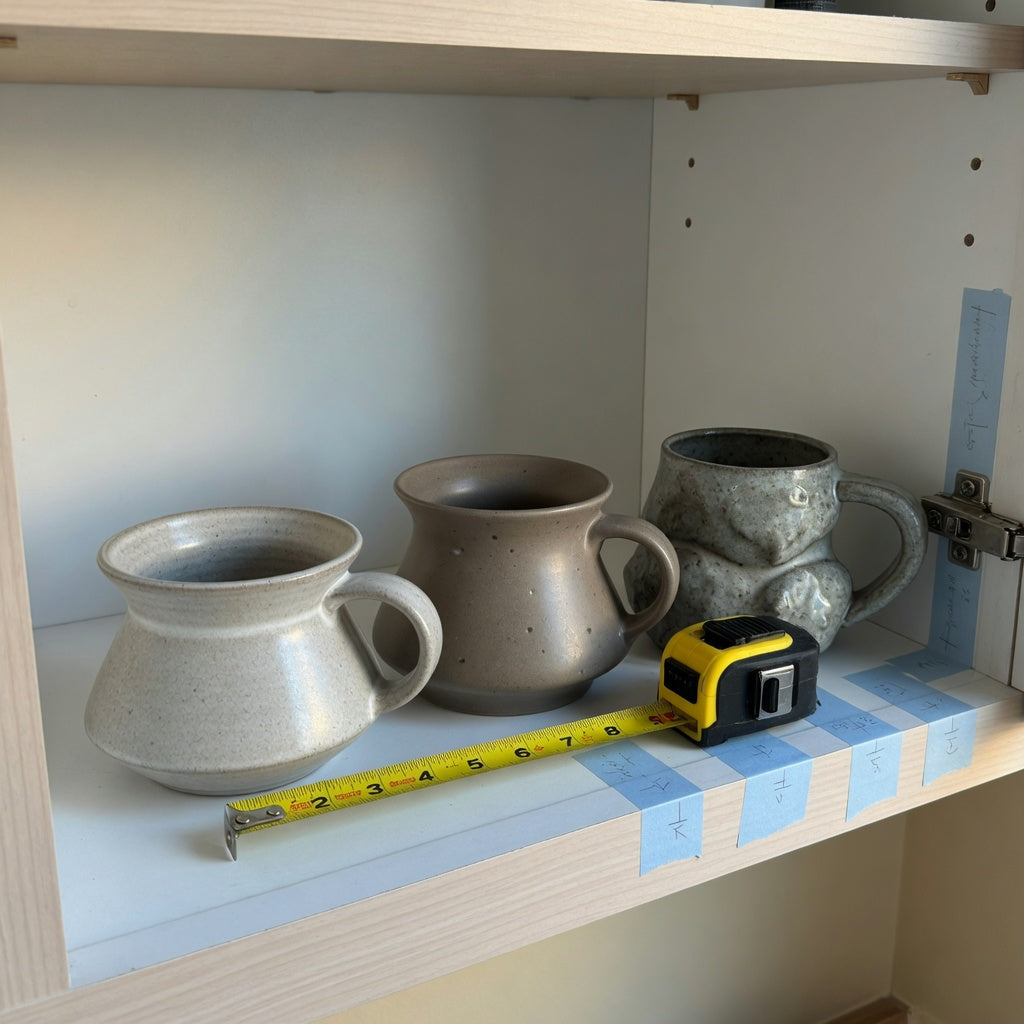
A cabinet door can clear a mug's body and still strike its handle during the last inch of travel. On an open shelf, that same mug may fit front to back but take enough side space that the cup beside it cannot be lifted without ceramic edges touching. This ceramic wide bottom coffee mugs storage fit guide addresses those everyday fit problems by comparing the visible Round, Spittoon, and The Rock forms without assigning measurements that their product pages do not state.
In our store, we assess these mugs as objects that must be packed, displayed, lifted around other dishes, and given a permanent place in a kitchen or office. A wide bottom provides a broad contact area, but the silhouette alone does not guarantee tip resistance, stackability, hook compatibility, or dishwasher fit. The useful storage measurement is the full outer envelope: the widest ceramic point, the outer handle edge, the mug's height, and the space your hand needs to remove it. Exact dimensions and care claims should always come from the current product listing.
What does the ceramic wide bottom coffee mugs storage fit guide measure?
Start by separating product-specific facts from general cabinet planning. The linked product pages show the current forms and any specifications provided by CoffeifyMug. The following measurements describe your storage space, not the dimensions of a particular mug.
- Usable shelf depth: Measure from the back panel to the inside face of the closed door. A cabinet face frame, hinge, door bumper, or front shelf lip can reduce the usable depth.
- Storage width: Allow for the mug's widest body section and the handle in its planned position. Turning a handle sideways reduces front projection but consumes more width along the shelf.
- Vertical opening: Measure from the shelf surface to the lowest obstruction above it, including the underside of the next shelf and any hanging rack.
- Door sweep: Check the path the door follows as it closes. A mug can sit behind the shelf edge and still be struck by a hinge-side door.
- Removal clearance: Leave room for fingers around the handle or body. A technically fitting mug is still a poor fit if every removal causes it to knock against its neighbor.
Record the maximum depth, width, and height your cabinet can accept in one consistent unit. If a product page supplies matching dimensions, you can make a paper or cardboard footprint before ordering. If it does not, avoid estimating scale from photography and verify the missing measurement before relying on a close fit.
How do Round, Spittoon, and The Rock use shelf space?
The three product pages provide different visible silhouettes. Product photography is useful for identifying where a body widens and how a handle sits, but image cropping and perspective make it unsuitable for comparing absolute size across separate pages.
| Current shape | Visible form to inspect | Storage question to answer |
|---|---|---|
| Round Coffee Tea Mug | A rounded, regular-looking body outline with a clearly visible handle. | Does the total width, including the handle, fit your planned row and door clearance? |
| Spittoon Coffee Tea Mug | A distinctive spittoon-inspired profile with more than one body width to consider. | Which section is widest, and is there enough side clearance around that point? |
| The Rock Coffee Tea Mug | A more sculptural, rock-themed outline that should be judged by its outermost contours. | Can it keep a dedicated footprint without crowding nearby mugs, a monitor stand, or other counter items? |
Do not compare the number of pixels each mug occupies in its product image. One page may use a tighter crop or a different camera angle. Use the images to compare form, then use listed dimensions or a direct measurement to confirm fit.
Which current shape fits your cabinet, shelf, or desk routine?
Cabinet storage in straight rows
If mugs must sit in a regular row behind a closing door, start by examining the Round mug's product details. Its visually regular outline is easier to map into a rectangular shelf plan. That does not mean it is confirmed to be the smallest option; the full body and handle dimensions still decide whether the door will close.
Open shelving with display space
If the mug will remain visible and has room around it, review the Spittoon Coffee Tea Mug. Its distinctive profile makes more sense where the widest section does not have to squeeze between matching cups. It is a weaker choice for a tightly packed row if you have not confirmed that outer width.
A dedicated desk or coffee-station spot
If you plan to leave one mug in the same place each day, inspect The Rock Coffee Tea Mug. A dedicated position lets you plan around its sculptural outline instead of maximizing mugs per shelf. Check that the handle and body will not interfere with a keyboard, mouse path, monitor base, coffee machine, or nearby canisters.
Storage density before distinctive shape
Wide-bottom forms are not the best match for every cabinet. If you need secure nesting, maximum cup count per shelf, or easy storage in a shallow office cupboard, compare other visible silhouettes in the unique coffee mugs collection. Choose only after the body and handle fit the space you actually have.
How do you account for handle projection without a listed measurement?
Handle projection and overall width are related but different. Handle projection is the distance from the nearest outside wall of the mug body to the handle's outermost edge. Overall width spans from the opposite side of the body all the way to that outer handle edge. For cabinet planning, overall width is usually the more useful figure.
- Read the dimension labels carefully. If a listing says diameter, check whether it refers to the rim, body, or base. Do not assume that a listed width includes the handle unless the page makes that clear.
- Find the outermost point in the images. Use the photos to identify the shape, not to calculate an unstated measurement.
- Measure your limit. Record the maximum overall width that allows the door to close and your hand to remove the mug.
- Test handle orientation. Handles facing forward use more cabinet depth. Handles turned sideways use more shelf width. Alternating left and right may improve spacing, but it can make individual mugs less convenient to lift.
- Use a comparable mug as a reference. Measure a mug that already fits, including its handle, and compare that known requirement with any dimensions stated on the product page.
This process is more dependable than assuming a wide base is the only part that matters. In the cabinets we assess, handles, face frames, and finger clearance are often the constraints that determine whether a mug works day after day.
Where do ceramic chips and fit problems appear in daily use?
Ceramic is rigid. It will not flex past a cabinet frame or compress between neighboring cups. General ceramic handling also calls for attention to hard contact points, especially the rim, outer handle, and base edge. These are storage and care checks, not model-specific durability claims.
- Cabinet doors: Repeated contact between a handle and door can mark the door and damage the mug. Close the door slowly during any fit test.
- Side-by-side storage: Leave enough room to lift one mug without dragging its rim or handle across another ceramic surface.
- Stacking: Do not assume a wide-bottom mug is stackable. If the product page does not describe stacking, store it individually so the base does not load the rim or handle below.
- Mug hooks: Confirm the handle opening, handle thickness, balance, and hook capacity. A visible handle does not guarantee compatibility with an under-shelf rack or mug tree.
- Dishwasher racks: First verify that the product's current care instructions permit dishwasher use. Rack fit is a separate issue: the mug must sit securely between tines without blocking the spray arm or striking another item during the cycle.
If dishwasher care is not stated, hand washing is the conservative choice. Avoid sudden temperature changes unless the product instructions specifically support them, and use a cleaning tool that reaches the interior without forcing the mug against the sink or faucet.
Buying two or more mugs: a shelf-fit checkout
A fit issue becomes more noticeable when repeated across a row. Before ordering multiple mugs, run this short check:
Use product images to compare shape. Use listed dimensions or direct measurements to decide fit.
- Measure usable shelf depth to the closed door, not only to the shelf edge.
- Measure the uninterrupted shelf width between frames, hinges, and other dishes.
- Choose one handle orientation and include it in the planned footprint.
- Reserve enough space to grip and lift each mug without ceramic contact.
- Plan for side-by-side storage unless stackability is explicitly stated.
- Confirm care instructions and dishwasher-rack space separately from cabinet fit.
For a gift, storage uncertainty is a real limitation. One distinctive mug intended for an open desk or coffee station is easier to place than several wide-bottom mugs that require a full cabinet row. If the recipient relies on a narrow locker, crowded shared kitchen, or hanging rack, a different silhouette may be the more useful gift.
Frequently asked questions
Does this ceramic wide bottom coffee mugs storage fit guide provide exact dimensions?
It uses exact dimensions only when they are stated on the current product page. Where a base diameter, overall width, height, or handle projection is not listed, we do not estimate it from photography. Recheck the selected listing at the time of purchase because product details can change.
Which mug should I inspect first for a shallow cabinet?
The Round Coffee Tea Mug is a practical first page to inspect because its visible outline is more regular and easier to map into a cabinet row. It is not guaranteed to have the smallest overall depth. Confirm the listed body and handle measurements against the inside face of your closed cabinet door.
Can ceramic wide bottom coffee mugs be stacked?
A wide bottom does not make a mug stackable. Unless the individual product page specifically describes secure stacking, plan to store these mugs side by side. Improvised stacking can place hard ceramic contact on a rim, handle, or uneven body contour.
How can I tell whether the handle will clear my cabinet door or mug hook?
For a cabinet, compare the mug's overall width and handle projection with the usable depth behind the closed door. For a hook, you also need the handle opening, handle thickness, balance, and the hook's load limit. Product photos can show the handle's form, but they cannot supply an unstated measurement.
Are the Round, Spittoon, and The Rock mugs dishwasher safe?
Storage shape alone cannot answer that question. Follow the care statement on each current product page, and use hand washing if dishwasher compatibility is not confirmed. A mug that is approved for dishwasher cleaning must still fit securely between your particular rack tines.
Your next step is to measure usable depth, shelf width, vertical opening, and door sweep, then open the product page that best matches your setting. Start with Round for a regular cabinet-row outline, Spittoon for an open shelf with room around its distinctive profile, or The Rock for a dedicated desk or coffee-station position. If none fits your recorded limits, return to the unique mug collection and compare other shapes instead of forcing a wide-bottom mug into crowded storage.
More from our blog
Read more

Macchiato Cup Current Product Facts: 170-250 ml Compared
Compare the verified listing details for CoffeifyMug's 170 ml Retro, 200 ml Pleated, and 250 ml Ball Handle ceramic cups. See how capacity changes nominal headroom, how visible form affects the sho...
Read more
Hot Toddy Mug Current Product Facts: 400 ml vs. 480 ml
Compare the verified capacities of The Gradient, The Flow, and The Rock. This current-facts review also explains how to assess handle shape, care information, and purchase fit without treating unli...
Read more
Leave a comment
This site is protected by hCaptcha and the hCaptcha Privacy Policy and Terms of Service apply.