
Ceramic vs Porcelain Coffee Mugs Storage Fit Guide: Shelf Check
Reading time: about 8 minutes
A mug can look compact in a product photo and still catch the cabinet frame every morning because the handle, not the cup body, is the widest point. Our ceramic vs porcelain coffee mugs storage fit guide starts with that everyday failure and compares visible shape, handle projection, and shelf clearance without guessing at measurements that are not shown.
When we handle mugs for order checks and packing, we look at the full storage envelope: body, rim, base, and handle. A product image can show form, but it is not a reliable scale. We keep those visible product details separate from general material guidance, and we recommend treating any dimension not stated on the current product page as unconfirmed.
Ceramic vs porcelain coffee mugs storage fit guide: does material set the footprint?
Porcelain is a type of ceramic. In retail comparisons, ceramic often serves as shorthand for other ceramic bodies, including stoneware and earthenware. Porcelain can be formed with relatively thin walls, while many non-porcelain mugs have a more substantial wall and rim. That difference may affect weight and external diameter, but it does not guarantee that a porcelain mug will be shorter, narrower, or easier to store.
For cabinet planning, the finished form matters more than the material label. Three details deserve attention:
- Wall and rim profile: A thinner wall can provide more internal room within a compact body, but only listed exterior dimensions confirm the actual shelf footprint.
- Base and foot ring: The base controls shelf stability. It also determines where one mug contacts another if you attempt to stack them.
- Handle arc: The outer edge of the handle may extend well beyond the body, making total width more useful than body diameter alone.
Material still affects the ownership trade-off. A heavier-feeling mug adds more load across a full shelf and may be less convenient on a high cabinet level. A finer rim can feel refined for coffee or tea, but exposed rims remain vulnerable when mugs knock together. Porcelain is not automatically compact or fragile, and a mug labeled ceramic is not automatically bulky or impact resistant. Section thickness, glaze, handle geometry, and firing all contribute.
Which shelf and handle measurements prevent cabinet snags?
Measure the space before comparing capacities or decorative finishes. Use a rigid ruler or tape, and check the cabinet opening as well as the interior. A mug that fits behind the door can still be awkward to insert through a narrow frame.
- Clear height: Measure from the shelf surface to the shelf or cabinet top above it. Include enough room to lift the mug without scraping its rim.
- Usable depth: Measure from the back panel to the inner face of the closed door, accounting for a raised shelf lip or door hardware.
- Total mug width: Measure from the body wall opposite the handle to the handle's outermost edge. Product diameter may describe only the body.
- Removal path: Check the room needed to tilt, turn, and lift the mug past neighboring handles.
- Row requirement: Record how many mugs must occupy the shelf. A comfortable fit for one mug may become crowded across a full set.
A useful home test is to measure a mug that already fits well, then record its height, body diameter, and total body-to-handle width. That gives you a physical reference for reading current product-page details. Do not estimate a new mug's measurements by scaling it against props in a photograph.
Handle direction changes the result. Turning every handle sideways consumes cabinet width. Pointing handles forward saves side-to-side room but uses depth and may interfere with the door. Angling handles can work on an open office shelf, though it makes a tightly packed row harder to remove without contact.
How do the round, pleated, and landscape forms compare?
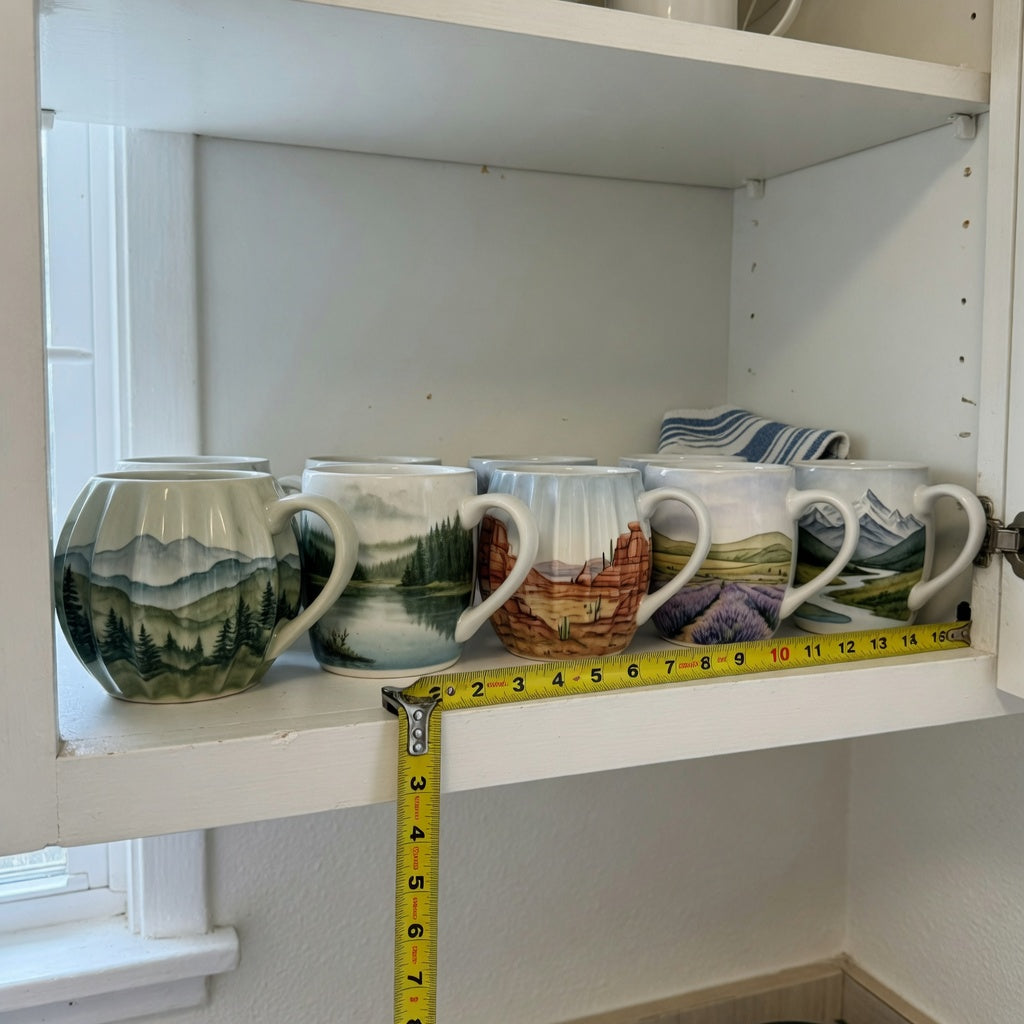
The current CoffeifyMug pages show three different design directions. We can compare those visible forms, but the images should not be treated as a calibrated size chart. Check each page for the latest listed dimensions and option details before ordering.
The Round Coffee Tea Mug has the most straightforward visible profile of the three. A simple round body gives you fewer contour changes to account for when planning a repeated row. It is a sensible first product to inspect for a fixed upper cabinet, but its name and shape do not prove that it has the lowest height or smallest handle envelope.
The Pleated Coffee Tea Cup adds a visibly contoured exterior. That texture gives the cup more surface detail, but raised contours can become the first contact points when cups sit closely side by side. This form is better suited to a shelf with individual spacing, a cup rail, or counter storage than a cabinet where every cup must press against its neighbor. Do not assume the pleated form nests or stacks unless the current listing specifically confirms it.
The Landscape Coffee Tea Mug makes decorative presentation part of the decision. That visual emphasis suits an open shelf, office desk, or gift more naturally than a hidden, densely packed cabinet. The landscape name does not establish physical width, so compare the current height, base, and handle details instead of interpreting the artwork as a dimensional cue.
| Current form | Visible storage cue | Detail to verify | Practical use case |
|---|---|---|---|
| Round | Simple, consistent body profile | Total width including handle and listed height | Repeated cabinet row after measurement |
| Pleated | Contoured exterior rather than a plain wall | Widest body point and any stacking claim | Spaced shelf, rail, or individual display |
| Landscape | Decorative presentation is a buying priority | Current dimensions and handle envelope | Open shelf, desk, or gift setting |
There is no responsible overall winner without comparable exterior measurements. The round form is easier to assess visually, the pleated cup needs more attention at its widest contour, and the landscape design earns its space mainly when the mug will remain visible.
Can you stack these mugs after a dishwasher cycle?
Stacking is a separate question from side-by-side fit. A mug is stack-friendly only if its base and inner wall create stable contact without forcing weight onto a delicate rim. The product names alone do not establish that any of these forms are designed for stacking.
- A base resting directly on another mug's rim concentrates pressure and can contribute to rim chips.
- An unglazed foot ring can leave abrasion marks if it rotates against a glazed interior.
- Projecting handles can strike each other as a stack is lifted or returned to the shelf.
- A recessed base can retain water after washing, so stacking too quickly may trap moisture between pieces.
Follow the care wording on the current product page or packaging. If dishwasher use is allowed, let the mug cool, empty any water from the base, and dry the foot ring before storage. Place mugs into a stack by hand rather than dropping them into one another. If the base rocks, wedges into the opening, or bears on the rim, store that mug separately.
These decorative consumer mugs should not be assumed to replace purpose-designed commercial stackable ware. A cafe, shared office kitchen, or household that needs tall, dense stacks would be better served by mugs explicitly made and listed for that use.
Which current shape fits your kitchen, office, or gift plan?
Start with the storage situation, then choose the form whose visible design and current listing address it.
- Fixed upper cabinet and repeated daily grabs: Inspect the round mug first because its uncomplicated visible body is easier to compare with a mug you already own. Confirm height and total handle width before treating it as the compact choice.
- Open shelf, cup rail, or counter with individual spacing: Consider the pleated cup when texture matters and neighboring pieces will not rub. It is not the strongest choice for an unverified stack or a tightly compressed row.
- Office desk, visible shelf, or gift unboxing: Consider the landscape mug when decorative impact has value after the box is opened. For a recipient with unknown cabinet dimensions, accept that storage fit remains less certain until they measure.
- Mixed coffee and tea needs: Browse our unique coffee mugs collection to compare current forms and listing details. If a larger tea serving or iced coffee is non-negotiable, prioritize the required capacity, then confirm that the resulting height and width still fit.
Before placing an order, use this pass-or-fail checklist:
- Record the cabinet's clear height, usable depth, and opening width.
- Measure a mug that already fits the same shelf.
- Check whether the listed product width includes its handle.
- Plan the direction each handle will face.
- Reject stacking as a requirement unless the listing confirms it.
- Choose display detail only after the storage limits are satisfied.
Our store can show the current shapes and the details provided with them, but your shelf measurements decide the fit. A quick check now is more useful than rearranging an entire cabinet after delivery.
Frequently asked questions
Does porcelain always use less cabinet space than ceramic?
No. A ceramic vs porcelain coffee mugs storage fit guide should compare exterior body size and the complete handle envelope, not rely on the material name alone. Porcelain can have relatively thin walls, but capacity, body shape, and handle design may remove any space advantage.
How do I measure a coffee mug's handle projection?
Place the mug on a level surface with its handle pointing to the side. Measure from the body wall opposite the handle to the handle's outermost edge; that total span is the width your shelf row must accommodate.
Can I stack the Pleated Coffee Tea Cup?
The pleated name and visible exterior do not confirm stackability. Stack it only if the base seats securely without pressing on the lower cup's rim, and stop if the pieces rock, wedge, or scrape each other.
Which current mug should I inspect first for a narrow cabinet?
Start with the Round Coffee Tea Mug because its simple visible profile is easier to compare against an existing straight-sided mug. It is not guaranteed to be the smallest option, so verify the current listed height and total width before buying.
What is the quickest shelf-fit check before I order?
Measure a mug that already fits, record its height and total width including the handle, then compare those limits with the current product details. Review the shapes in our unique coffee mugs collection and choose only an option whose listed dimensions fit your recorded space.
More from our blog
Read more
Large Decorative Coffee Mugs Size Decision Guide: 400-480 ml
Compare current 400-480 ml decorative ceramic mugs by desk footprint, cabinet clearance, filled handling, care, and gift fit. We map practical situations to Golden Waves Kio, The Flow, White Golden...
Read more
Unique Coffee Mugs for Gifts Buying Priorities: Capacity, Shape & Space
Match a gift mug to the recipient's normal pour, preferred silhouette, and available desk or cabinet space. Compare the Handbag, Rhombus, and Crane designs without assuming unlisted dimensions or c...
Read more
Leave a comment
This site is protected by hCaptcha and the hCaptcha Privacy Policy and Terms of Service apply.