
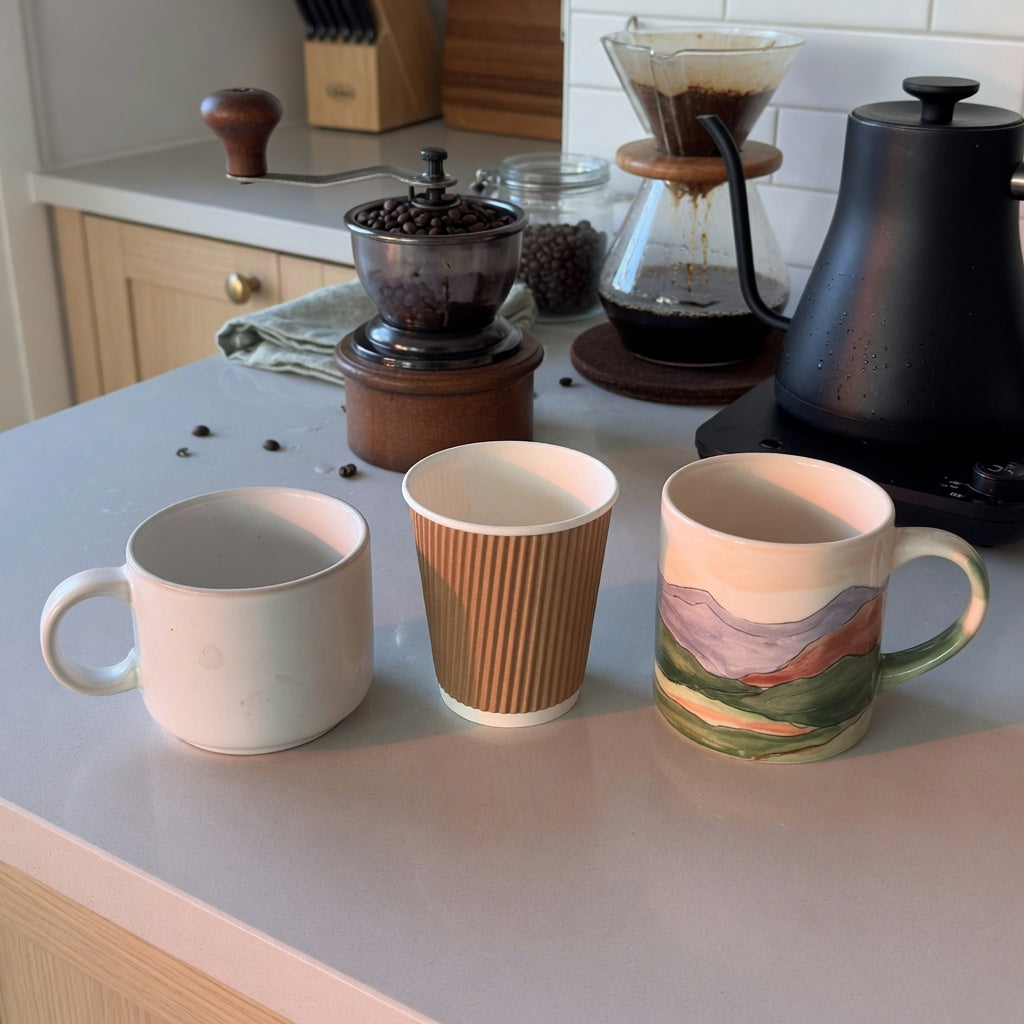
Ceramic vs Porcelain Coffee Mugs: Home Coffee Station Shortlist
Reading time: about 10 minutes
The mug space beside a grinder can look generous until the kettle, scale, filters, and coffee bag return to the counter. Then handle clearance, base stability, and the way a mug feels during a quick rinse matter more than an abstract material debate. This ceramic vs porcelain coffee mugs home coffee station product shortlist guide starts with that real setup: limited space, repeated use, and a mug that may travel from the brewer to an office desk several times a day.
At CoffeifyMug, we handle mugs while evaluating listings, merchandising designs, and preparing orders. Three details often reveal more than the material label alone: rim construction, the condition of the foot ring, and how far the handle projects from the body. We also keep general material guidance separate from product-specific facts. A product name or photograph does not prove capacity, appliance clearance, dishwasher safety, or microwave suitability, so the current instructions and specifications on each linked product page should control the buying decision.
Ceramic vs porcelain coffee mugs home coffee station product shortlist guide: what belongs on the counter?
Porcelain is technically a type of ceramic. In retail comparisons, ceramic is often used as shorthand for non-porcelain bodies such as stoneware or earthenware. Porcelain is generally made from a more refined clay body and fired to a high level of vitrification, which usually produces lower porosity and allows thinner walls. A stoneware-style mug often feels thicker and more substantial, but the word ceramic alone does not guarantee extra weight or durability.
That distinction matters because shoppers sometimes expect porcelain to be delicate and ceramic to be nearly unbreakable. Neither assumption is reliable. Wall thickness, handle attachment, rim shape, glaze quality, and the way the mug is stored all affect daily performance. Both materials can chip at the rim, crack after a hard sink impact, or suffer from sudden temperature changes.
- For a shared, high-traffic counter: Start by comparing mugs with a substantial-feeling wall, a stable foot, and a handle that does not crowd nearby equipment. A stoneware-style ceramic body may suit this preference, but confirm the individual product construction rather than relying on the category name.
- For a quiet station or open shelf: Porcelain can suit shoppers who prefer a visually lighter body and a finer lip. Skip very delicate-feeling forms if mugs are regularly knocked together in the sink or drying rack.
- For a mug that moves to a desk: Consider the filled weight and handle comfort. A mug that feels balanced while empty may feel different once filled, and a narrow handle can become tiring during the walk from kitchen to workspace.
- For both coffee and tea: Capacity, opening diameter, and lip shape may matter more than the clay body. Do not select a material first and assume every mug made from it will provide the same drinking experience.
Heat retention also depends on more than ceramic versus porcelain. Wall thickness, beverage volume, starting mug temperature, room temperature, and the time between pouring and drinking all contribute. We would not choose between two mugs based on a blanket heat-retention claim unless their actual construction was also known.
Busy counter, quiet shelf, or office desk: which style fits?
A useful shortlist begins with the busiest moment at the station. For one household, that is a rushed first pour with a kettle moving across a wet counter. For another, it is an afternoon refill carried past a laptop. A third shopper may care most about how the mug looks on an open shelf between uses.
Use the following questions to identify the dominant scenario:
- Does the mug stay beside the brewer, or does it travel to another room?
- Will several people reach for it, or will one person use and rinse it?
- Is the mug stored alone, side by side, or stacked?
- Do you want a quiet shape that blends in or a design that remains visible?
- Will the mug be used for coffee, tea, or drinks that require different capacities?
The answers narrow the field faster than choosing porcelain because it sounds refined or ceramic because it sounds durable. In our experience, the best home coffee station mug is the one whose shape and care requirements fit the routine without creating a new annoyance.
Round, pleated, or landscape: which CoffeifyMug design should you shortlist?
The recommendations below are based on the visible design direction and information presented on the linked product pages. Check each page for its current material, measurements, capacity, and care instructions before ordering. We do not infer those details from the product name.
| Reader situation | Shortlist option | Reason to choose | Reason to skip |
|---|---|---|---|
| Your station is still evolving, and you want a visually straightforward everyday shape. | Round Coffee Tea Mug | The rounded design is a practical starting point for shoppers who prefer a familiar silhouette that does not dominate the counter. | Skip it if pronounced exterior texture or decorative artwork is the main reason you are replacing your current mug. |
| Several similar mugs share the station, and you want one that is easy to recognize by sight and touch. | Pleated Coffee Tea Cup | The pleated exterior gives the cup a distinct surface and a more architectural appearance than a smooth-sided design. | Skip it if mugs sit tightly side by side or if you strongly prefer an uninterrupted exterior for quick wiping. |
| The station is on display, or the mug is intended as a gift for someone who likes scenic designs. | Landscape Coffee Tea Mug | The landscape-led design gives the mug a decorative role when it remains visible between drinks. | Skip it for a strictly neutral kitchen, a matching plain set, or a gift recipient whose design preferences are unknown. |
This is a scenario shortlist, not a ranking. The Round mug is not automatically the smallest, the Pleated cup is not automatically more secure in a wet hand, and the Landscape mug is not automatically suitable for a particular appliance. Those decisions require the specifications and care information shown on the individual page.
If none of the three design directions matches your counter, browse our unique coffee mug collection after writing down your required measurements. Starting with constraints keeps the larger selection manageable.
Will the mug clear your brewer, scale, and cabinet shelf?
Material cannot solve a geometry problem. A porcelain mug that is too tall for the available space is still the wrong mug, and a ceramic mug with a wide handle may interfere with a neighboring canister even if its body fits. We never assume compatibility with an espresso machine, pod brewer, drip machine, or pour-over device from a product photograph.
Measure these points before ordering:
- Maximum vertical clearance: Measure from the drip tray, scale, or counter surface to the lowest part of the brewer outlet. Leave room to place and remove the mug without tilting it into the machine.
- Overall mug height: Compare the product's listed height with the available clearance. If a measurement is not published, do not estimate it from the photograph.
- Body width and handle projection: The handle can be the widest point. Check whether it will touch the kettle, grinder, wall, or another mug.
- Base footprint: If you brew on a scale or narrow tray, confirm that the mug's foot can sit fully on the platform.
- Cabinet and shelf space: Measure shelf height and depth, then decide whether the mug will stand alone or beside other pieces. Do not assume a textured or decorated mug is designed for stacking.
Pour-over users should also compare the mug opening with the dripper manufacturer's support requirements. A wide-looking rim does not establish a secure fit. The same restraint applies to cup warmers and vehicle cup holders: use actual measurements instead of relying on the terms ceramic, porcelain, round, or coffee cup.
What wear appears after sink and dishwasher cycles?
A gift unboxing reveals the decoration, but the sink routine reveals the ownership experience. Before first use, inspect the rim for chips, the handle attachment for visible cracks, and the base for rough points that could scratch a counter. A small chip at the drinking edge is not merely cosmetic because it can leave a sharp surface.
During regular use, watch for three common issues:
- Rim and handle impacts: Mugs often contact a faucet, sink divider, or neighboring piece during washing. Porcelain and non-porcelain ceramic can both chip from these impacts.
- Glaze crazing: This is a network of fine lines within the glaze. It is different from an intentional printed or painted pattern. If unexpected lines appear, follow the seller's care guidance rather than assuming they are harmless decoration.
- Foot-ring abrasion: Grit caught beneath a mug or between stacked pieces can mark the glaze and the shelf. Wipe and dry the base before stacking or returning the mug to a polished counter.
Do not infer dishwasher or microwave safety from the material name. Glaze, decoration, metallic details, and product construction can change the care requirements. If the product page permits dishwasher use, load the mug where it will not strike plates or another mug during the cycle. If it calls for hand washing, that direction takes priority.
Both porcelain and other ceramic bodies can also be damaged by thermal shock. Avoid abrupt temperature changes, such as moving a very hot mug directly onto a cold, wet surface or rapidly chilling it. A material label does not remove that risk.
How should you test one mug before buying a set?
A matching set is tempting, especially when the mugs will stay on display. We recommend testing one first when size, weight, or care routine is uncertain. Seven days of normal use will expose practical issues that are easy to miss on a product page.
- Read the current material, capacity, dimensions, and care details on the product page.
- Compare the measurements with your brewer clearance, scale, cabinet, and drying area.
- Choose the design that matches your main scenario, not every possible drink or guest.
- Use it for a complete morning routine, including filling, carrying, sipping, rinsing, and storing.
- Carry it to your usual desk or seating area and judge the handle with the mug filled.
- If dishwasher use is permitted, confirm that the mug sits securely without contacting nearby dishes.
- Check the rim, handle, exterior texture, and foot after several uses before buying additional pieces.
This ceramic vs porcelain coffee mugs home coffee station product shortlist guide is meant to reduce overbuying. One week is not a laboratory durability test, but it is usually enough to expose poor shelf clearance, awkward handle placement, unexpected weight, or a finish that does not suit your cleaning routine.
Frequently asked questions
What should a ceramic vs porcelain coffee mugs home coffee station product shortlist guide compare first?
Compare the station's physical clearance and daily traffic first. Material matters, but mug height, handle projection, base footprint, filled weight, and care instructions often determine whether the mug works in the actual space.
Does porcelain keep coffee hot longer than ceramic?
Not automatically. Heat retention depends on wall thickness, beverage volume, mug temperature, and surrounding conditions as well as the clay body. Compare the construction of the specific mugs instead of treating porcelain or ceramic as a universal heat-retention rating.
Are ceramic and porcelain coffee mugs always dishwasher safe?
No. Dishwasher suitability depends on the complete product, including its glaze, decoration, and construction. Follow the care directions on the individual product page and avoid letting mugs strike other dishes during a permitted wash cycle.
Which CoffeifyMug option should I consider for a small coffee station?
The Round Coffee Tea Mug is a sensible visual starting point if you want a straightforward shape, but its name does not guarantee that it fits a small space. Compare the page's current measurements with your brewer clearance, handle space, and cabinet before buying.
Can I mix ceramic and porcelain mugs on the same shelf?
Yes, provided each mug fits the shelf and its care needs suit your routine. Mixing materials can be practical if one mug stays at the station and another travels to a desk, but avoid unstable stacking and keep delicate rims from contacting neighboring pieces.
Before checkout, confirm six items: material, capacity, overall height, widest point including the handle, care instructions, and your reason to skip the design. Then compare the Round, Pleated, and Landscape options with the full CoffeifyMug collection, and start with the one mug that best fits your busiest daily pour.
More from our blog
Read more

Vintage Pottery Coffee Mugs Replacement Purchase Product Shortlist Guide
Replace a chipped, cracked, or awkward old mug by measuring its working fill, handle clearance, footprint, and care needs first. Then compare three current CoffeifyMug styles, with clear reasons to...
Read more
Coffee Mug Birthday Gift Ideas: Replacement Purchase Shortlist Guide
Start with the old mug's rim, handle, size, cupboard fit, and care limitations. This shortlist maps three CoffeifyMug designs to clear birthday-gift scenarios, with reasons to choose or skip each.
Read more
Leave a comment
This site is protected by hCaptcha and the hCaptcha Privacy Policy and Terms of Service apply.