
Ceramic Tea Mug First Time Buyer Practical Purchase Checklist
Reading time: about 9 minutes
A front-facing mug photo can make a handle look roomy and a body look compact. The mismatch appears later, when your normal tea pour does not fit as expected, your fingers sit awkwardly against the cup, or the mug occupies more of the office desk than you pictured. Our ceramic tea mug first time buyer practical purchase checklist is designed to catch those issues while the product pages are still open.
We sell and handle this category in our store, and the most useful comparisons are rarely based on a product name alone. We check four pieces of evidence: an explicit ceramic material statement, any listed capacity, the body form visible in the photos, and the shape and position of the handle. Those are the claim boundaries here. We are not adding assumptions about care, temperature performance, brewing accessories, or included items.
How to use the ceramic tea mug first time buyer practical purchase checklist
Give each mug a simple four-column scorecard before deciding which design you prefer. A blank field is not permission to estimate. It is an unknown that you need to accept, resolve, or use as a reason to choose another listing.
- Confirm the material: Look for the word ceramic in the written product details. Do not identify material from gloss, color, or photography alone.
- Copy the capacity exactly: Record the number and its unit, such as ounces or milliliters. If no capacity appears, write unknown.
- Read the body profile: Use side and three-quarter images to identify whether the vessel looks straight, curved, rounded, tall, or low.
- Inspect the handle geometry: Look at the opening, its distance from the body, and the upper and lower attachment points.
- Match the evidence to one setting: Decide whether this mug is primarily for a kitchen counter, office desk, or gift. Each situation gives different weight to capacity, form, and grip.
This method prevents a common first-purchase mistake: treating an appealing photo as proof of size or fit. Product styling can show the design clearly, but it cannot supply a missing capacity figure or an exact handle measurement.
Does the product page explicitly confirm ceramic material?
A ceramic-looking surface is not enough. The written material field or description should identify the vessel as ceramic before you count that detail as verified. This matters because a product title, finish, or styled photograph does not establish the material on its own.
The word ceramic confirms the category, but it does not automatically confirm exact weight, wall thickness, care instructions, or other properties that the listing does not state. Keep those questions separate. For example, if you are considering The Flow Coffee Tea Mug, start with its current written material information, then move to capacity and photos. The current page at the time you order is the source of truth.
In our experience, this disciplined reading takes less time than trying to reverse-engineer a product from lifestyle images. It also makes comparisons fair: every option is judged by the same published evidence rather than by how large or substantial it happens to look on screen.
Will the listed capacity match your normal tea pour?
Capacity should be compared with a real serving, not with a vague idea of small, medium, or large. Fill the mug you already use to your normal level, transfer that water to a marked measuring cup, and record the result in milliliters or fluid ounces. You now have a personal target to compare with any capacity stated on a product page.
- For a consistent morning serving: Give priority to a listing that publishes a capacity close to the amount you actually pour.
- For repeated desk refills: Decide on your minimum acceptable capacity before body shape or artwork influences the choice.
- For a gift: Check the recipient's current mug if possible. A familiar serving size is more useful than guessing from a product photo.
A listed capacity does not tell you everything about the shape. A rounded body and a straighter body may present the same volume differently, and the handle can still change how the filled mug feels in the hand. Capacity is one decision column, not a substitute for the other checks.
If a page does not publish a capacity, mark it as unknown. A hand, book, or countertop in a photograph may provide visual context, but it is not a reliable volume measurement. First-time buyers who require a specific serving size should choose a listing with that number clearly stated rather than converting photo proportions into a guess.
What do body profile and handle photos reveal?
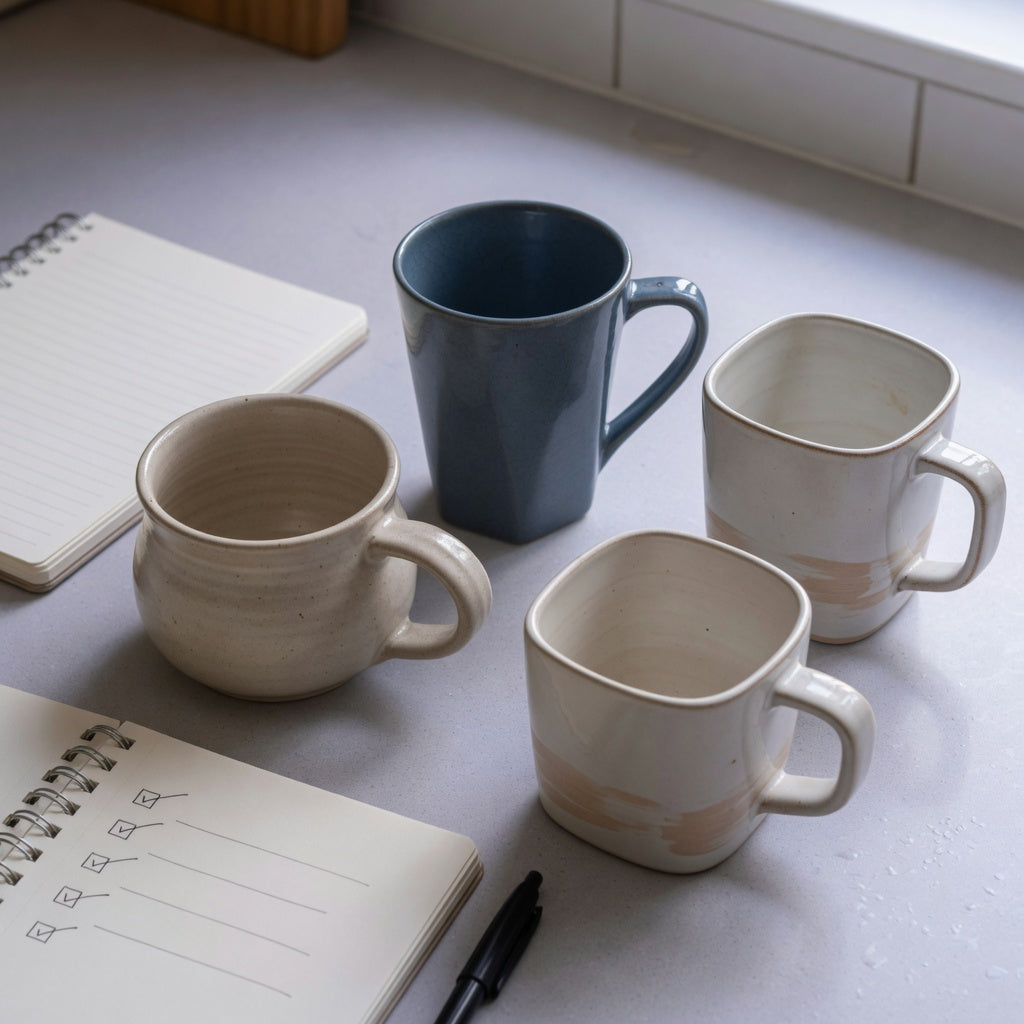
Product images are useful for evaluating visible geometry. We look for a direct side view and a three-quarter view because they answer different questions. The side view shows the height-to-width relationship and overall outline. The three-quarter view is usually more helpful for seeing handle projection and how close the opening sits to the body.
- Body profile: Compare a straight-sided, flowing, or rounded outline with the mug you already find comfortable.
- Handle aperture: Look at the open space inside the handle, but do not treat it as an exact finger-clearance measurement unless scale or dimensions are supplied.
- Attachment points: Note where the handle meets the upper and lower body. This helps you picture your usual one-finger, two-finger, or fuller grip.
- Handle projection: Consider how far the handle appears to extend beyond the body, especially on a crowded desk or narrow counter.
At our packing table, the difference between a compact-looking front image and the depth visible from an angle is easy to see. Online, the three-quarter photo has to do that work for you. It can reveal relative form, but it still cannot guarantee exact dimensions that the listing does not provide.
Handle fit deserves extra caution for shoppers with larger hands, limited finger movement, or a very specific grip. If exact clearance is a must-have and the page provides no measurement or dependable scale reference, the fit remains unknown. A different listing with clearer evidence is the lower-risk choice.
Which CoffeifyMug listing fits your counter, desk, or gift?
The three linked products are presented as coffee and tea mugs. The table below is not a ranking. It maps a shopper's situation to the visible feature worth examining and then points to the relevant current listing for verification.
| Reader situation | Why this is the useful starting point | Relevant next step |
|---|---|---|
| You prefer a flowing outline for ordinary counter service | Start with the design whose visible profile attracted you, then confirm that its material, listed capacity, and handle geometry also suit your routine. | Review The Flow Coffee Tea Mug listing. |
| You want to evaluate a visibly rounded body against your grip and available surface | A rounded form gives you a distinct profile to compare with your current mug. Do not infer its exact capacity or footprint from the name. | Inspect the Round Coffee Tea Mug. |
| You are choosing a gift because the Morning Night presentation suits the recipient | Visual identity can guide the shortlist, but gift fit still depends on confirmed material, capacity, and a handle the recipient is likely to use comfortably. | Check the current Morning Night Coffee Tea Mug page. |
| None of the three pages resolves your must-have detail | A broader comparison is better than accepting an unknown that matters to your daily serving. | Apply the same scorecard while browsing the unique coffee mugs collection. |
We use the ceramic tea mug first time buyer practical purchase checklist as a filter, not as a reason to force a winner. If The Flow has the profile you prefer but another page gives you clearer evidence for a must-have capacity or handle shape, the clearer fit should carry more weight. Style begins the comparison; verified details finish it.
Which unknowns should stop a first purchase?
An unknown is not evidence that a mug is poor quality. It means the listing does not let you confirm a detail that may affect your decision. Pause before ordering in these situations:
- The page does not explicitly confirm ceramic, and material is a non-negotiable requirement.
- You use one specific serving volume, but no capacity is listed.
- Your grip requires exact finger clearance, but the handle is shown from only one angle and has no usable scale reference.
- Your desk or shelf has strict space limits, but the visible form does not provide enough information to judge fit.
- You need a sealed travel vessel, a brewing accessory, or a product selected primarily by care requirements. This checklist covers an ordinary coffee and tea mug for counter or desk serving, not those separate categories.
A style-led ceramic mug is not a good blind purchase when an exact volume or handle fit is essential. It may still be the right mug once the missing detail is confirmed, but the attractive image should not be used to fill an evidence gap.
Your five-minute comparison before checkout
- Measure the amount you normally drink from your current mug.
- Open the Flow, Morning Night, and Round product pages in separate tabs.
- Write down the ceramic material statement and listed capacity from each page.
- Label every missing item as unknown instead of estimating it.
- Compare the visible body profile with your actual counter, desk, or gift scenario.
- Compare the handle opening, projection, and attachment position with your normal grip.
- Remove any option with an unresolved must-have, then choose between the remaining designs.
The result may be one clear choice, two reasonable finalists, or no suitable option yet. All three outcomes are useful. The point is to know why you are buying, and which detail remains uncertain, before the mug reaches your kitchen or office.
Frequently asked questions
What belongs in a ceramic tea mug first time buyer practical purchase checklist?
Confirm four things: written ceramic material information, any listed capacity, the visible body form, and the handle shape. Record a missing detail as unknown rather than inferring it from a styled image. Then match those four findings to your normal serving, grip, and surface.
What should I do if a ceramic tea mug listing does not show capacity?
Do not calculate an exact volume from the product photo. Mark capacity as unknown and decide whether serving size is a must-have. If it is, choose a listing that publishes the figure or wait until the information can be confirmed.
Can product photos confirm whether a mug handle will fit my hand?
Photos can show the handle's general shape, projection, and attachment points. They cannot guarantee exact finger clearance without dimensions or a dependable scale reference. Buyers with specific grip requirements should treat that missing measurement as a meaningful unknown.
Which CoffeifyMug option should a first-time gift buyer compare first?
Start with the visible design that best matches the recipient, such as the flowing, rounded, or Morning Night presentation. Then select only from listings whose stated capacity and handle photos make sense for the recipient's usual mug habits. For a blind gift, clearer listing evidence is more valuable than assuming one shape fits everyone.
Are the linked mugs presented for tea only?
No. The current linked listings are presented as coffee and tea mugs. This checklist evaluates them as ordinary serving vessels and does not make additional claims about brewing equipment, care methods, temperature performance, or included contents.
Next step: Put your usual serving volume and grip at the top of a note, compare the three current product pages, and reject unresolved must-haves. If you still need another visible form, continue the same evidence-first comparison in the CoffeifyMug collection.
More from our blog
Read more

Ceramic Mug With Wooden Handle First Time Buyer Product Shortlist Guide
Compare two wooden-handle ceramic mugs using supported listing details: 12 oz versus 14 oz capacity, visible vessel form, and handle shape. We explain who should choose or skip each option and whic...
Read more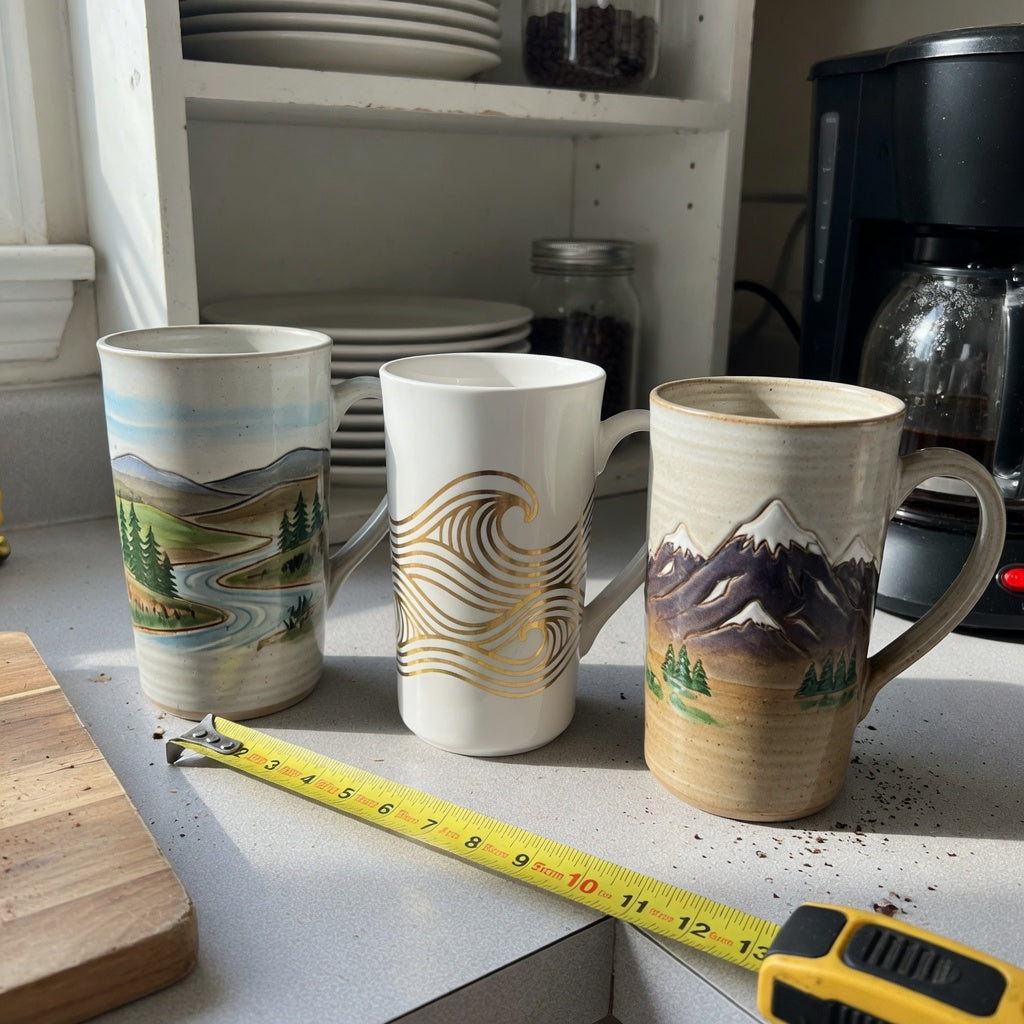
Tall Ceramic Coffee Mugs First Time Buyer Product Shortlist Guide
Build a practical first-purchase shortlist by checking stated capacity, measurable height, visible shape, handle form, shelf fit, and care wording. We map three CoffeifyMug designs to desk, gift, a...
Read more
Leave a comment
This site is protected by hCaptcha and the hCaptcha Privacy Policy and Terms of Service apply.