
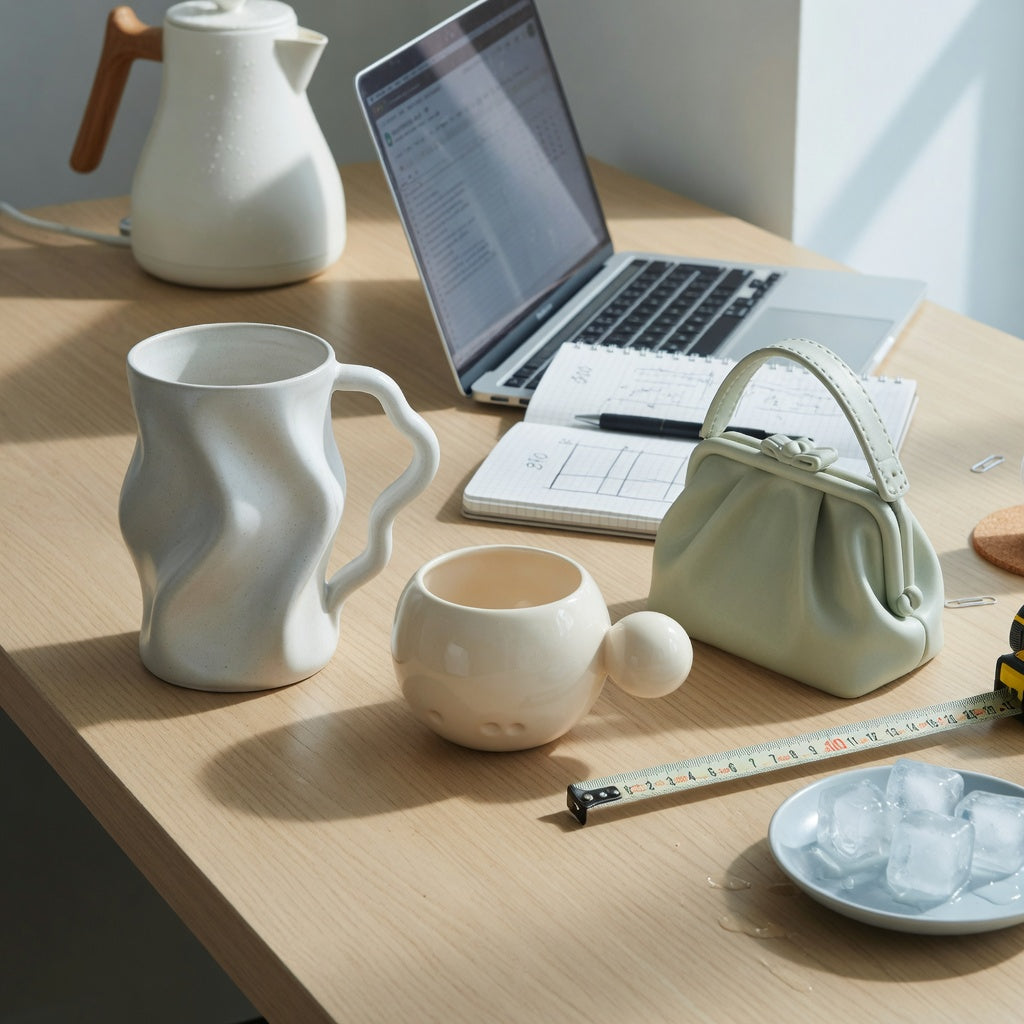
Ceramic sculptural mug buying priorities: Capacity, shape, space
Reading time: about 10 minutes
A mug can look compact in a product photo and still feel awkward once it sits between a laptop, notebook, and desk lamp. The opposite problem is just as common: a striking cup arrives, but its listed capacity is smaller than the drink poured every morning. That is why our ceramic sculptural mug buying priorities start with the routine around the mug, not the decorative impression it makes on a screen.
We handle and pack sculptural ceramic pieces in our store, and the practical questions are consistent: How much do you normally pour? Where will the mug rest? How do you hold it? Will it need to share a cabinet with tightly stacked cups? For the current comparison, the confirmed facts are clear: The Flow has a listed 400 ml capacity and sculptural curves, the Ball Handle mug holds 250 ml and has a rounded sculptural handle, and the Handbag mug holds 310 ml with a purse-shaped silhouette. These are three-dimensional forms rather than mugs distinguished mainly by surface artwork.
Which listed capacity matches the drink you actually pour?
Start by measuring your usual serving instead of relying on labels such as small, medium, or large. Fill your current mug to the level you normally use, including milk or creamer, then pour that drink into a marked measuring jug. For iced coffee, add your usual ice first because the cubes displace part of the listed volume.
- 250 ml, approximately 8.5 US fl oz: The Ball Handle suits shorter coffee servings, a modest tea pour, or an espresso-based drink with limited milk. It is not a good match for someone who dislikes refilling during a meeting.
- 310 ml, approximately 10.5 US fl oz: The Handbag provides 60 ml more than the Ball Handle and occupies the middle of this range. It is a practical starting point for a moderate drip coffee or tea routine.
- 400 ml, approximately 13.5 US fl oz: The Flow provides 90 ml more than the Handbag and 150 ml more than the Ball Handle. It is the clearest option of the three for a longer pour or a drink that needs room for milk or ice.
Listed capacity is a comparison figure, not an instruction to fill a mug to its rim. A normal serving needs headspace to reduce spills while carrying it from the kitchen to a desk. If your measured drink falls close to a mug's maximum listed capacity, moving up to the next size is usually more practical than planning to carry a brim-full cup.
Ceramic sculptural mug buying priorities for grip and form
Capacity tells you what fits inside. Shape determines how you approach the mug with your hand and how much clearance the form may need around it. We do not treat a visible sculptural feature as proof of universal comfort because hand size, finger position, and preferred grip vary too much.
The Flow's defining feature is its field of sculptural curves. It is the option to examine if you like holding the body of a mug as well as using its grip area, but review the current product images from several angles before ordering. Curves can also create wider high points than a plain cylinder, which matters in a crowded cupboard.
The Ball Handle concentrates its identity in a rounded sculptural handle. That makes sense for a shopper who wants the handle itself to be the visual and tactile feature. A ball is different from a conventional open loop, however, so buyers who habitually place several fingers through a handle should study the grip area carefully rather than assuming it will feel the same.
The Handbag is shaped around a recognizable purse-like silhouette. It fits a shopper who wants the complete side profile to carry the design, especially for open shelving or gifting. That silhouette is not intended to behave like a plain, tightly nesting cylinder, so it is a weaker choice for anyone building a stackable matching set.
How do The Flow, Ball Handle, and Handbag fit different routines?
The useful comparison is not simply biggest to smallest. Each recommendation should connect the listed capacity and visible form to a real use case.
| Mug | Confirmed details | Routine it can fit | Trade-off to check |
|---|---|---|---|
| The Flow | 400 ml; sculptural curves | A larger morning coffee, tea with room for additions, or iced coffee with headspace | Highest filled weight of these three and potentially more clearance needed around curved high points |
| Ball Handle | 250 ml; rounded sculptural handle | Shorter pours, planned refills, or a buyer who prioritizes an unconventional handle | Lowest capacity and a grip that differs from a traditional loop |
| Handbag | 310 ml; purse-shaped silhouette | Moderate servings, display on an open shelf, or a form-led gift | Not designed for tight stacking with plain cylindrical mugs |
A shopper who makes one large drink before a long work block has a clear reason to start with The Flow. Someone who drinks smaller servings before they cool can reasonably favor the Ball Handle. For a gift recipient whose serving size is uncertain, the Handbag's middle capacity can be a sensible compromise, but it is not automatically right for every kitchen. The recipient may care more about a conventional grip or compact storage than the purse silhouette.
Shoppers still deciding which type of three-dimensional form they prefer can compare the wider unique coffee mug collection. Use the collection to compare current images and product details, then return to your measured drink volume before making the final selection.
How much desk, counter, and cabinet space should you reserve?
Do not estimate exterior size from capacity alone. A 250 ml mug can have a visually prominent handle, while a 400 ml form can distribute its volume vertically or through wider curves. The verified catalog facts used here include capacities and visible forms, but not a complete set of exterior measurements, so we will not invent numeric footprints.
Use a quick placement check before ordering:
- Place your current mug where the sculptural mug will normally sit.
- Mark the available width and depth with removable tape, including clearance for the handle and your fingers.
- Measure the cabinet opening, shelf depth, and shelf height rather than measuring only the empty space between other cups.
- Check the current product page for exterior dimensions when provided. If a critical measurement is not shown, ask for it instead of scaling from a photograph.
- Leave a buffer between the mug and hard neighbors such as a monitor base, faucet, cabinet door, or another ceramic handle.
For a busy office desk, spill distance matters as much as footprint. The mug should not occupy the path between your hand and the keyboard. A smaller listed capacity does not guarantee a smaller exterior footprint, so the Ball Handle should be selected for its 250 ml serving and rounded handle, not on an unsupported assumption that it will fit every narrow desk.
Which shape works for coffee, tea, iced drinks, and gifting?
For a long coffee or generous tea, The Flow's 400 ml capacity offers the most room of this group. That advantage comes with more liquid weight: 400 ml of beverage adds roughly 400 grams before accounting for the ceramic mug itself. Someone with limited grip strength may prefer a smaller serving even if fewer refills sound convenient.
For short coffee, a modest tea serving, or a routine built around fresh refills, the Ball Handle's 250 ml capacity is a deliberate choice. It is not the product we would direct toward a shopper asking for the largest possible desk drink. The rounded handle should be the reason to choose it, not an afterthought.
For iced coffee, the 400 ml Flow gives you the most listed capacity for both liquid and ice. Leave extra headspace because adding cubes after pouring can raise the drink quickly. None of these open ceramic mugs should be treated as a replacement for a sealed travel mug; commuters who need leak resistance should buy a purpose-built lidded vessel.
For gift unboxings, shape often carries more weight than maximum volume. The Handbag's 310 ml capacity and purse-shaped silhouette suit a recipient who enjoys recognizable object-inspired forms. The Ball Handle fits someone drawn to unusual grip details, while The Flow suits a person who prefers abstract curves and larger drinks. If you do not know the recipient's storage space, include a gift receipt or confirm dimensions before ordering rather than assuming any sculptural form will fit.
What care checks protect a sculptural ceramic mug?
Three-dimensional features deserve more clearance during washing and storage than a plain cylinder. In our handling routine, we pay particular attention to the rim, the handle junction, and the outermost points of the sculptural form. Those are the areas most likely to contact a sink, faucet, neighboring dish, or cabinet wall.
- Inspect the rim, handle area, and raised contours after unboxing. Stop using a ceramic mug if you find a chip or hairline crack that affects its structure.
- Use a soft, nonabrasive sponge for hand washing, especially around curves and narrow transitions where residue can remain.
- Avoid forcing a sculptural mug into a stack. Contact between handles and raised forms can create pressure points or chips.
- Check the individual product page for dishwasher and microwave guidance. Ceramic material alone does not establish that every finish or form has the same appliance-care instructions.
- Avoid dramatic temperature changes unless the product's care guidance explicitly permits them. Moving a very cold ceramic mug directly into intense heat is an unnecessary risk.
If effortless stacking, identical footprints, and unrestricted dishwasher loading are your main priorities, a straightforward cylindrical mug set is a better purchase. Sculptural mugs earn their place through form and visual presence, but they ask for more deliberate storage and handling.
A five-minute shortlist before you order
Use these ceramic sculptural mug buying priorities as a final check:
- Measure your normal drink, including milk or ice.
- Choose 250 ml for shorter servings, 310 ml for a middle capacity, or 400 ml for the largest pour among these three.
- Decide which form you genuinely want to handle: flowing curves, a rounded ball handle, or a purse-shaped silhouette.
- Measure the desk, counter, and cabinet where the mug will spend most of its time.
- Confirm current care details and any exterior measurement that could decide the fit.
With those answers in hand, open the matching product page or compare the forms in our unique mug collection. The best next step is the one tied to your measured pour and available space, not simply the most dramatic product photograph.
Frequently asked questions
Which ceramic sculptural mug buying priorities matter most for a small desk?
Measure the available footprint, handle clearance, and distance from your keyboard before comparing capacity. Do not assume the 250 ml Ball Handle has the smallest exterior dimensions solely because it holds less. Check current measurements when listed, then decide how often you are willing to refill.
Is 250 ml, 310 ml, or 400 ml best for everyday coffee?
Choose 250 ml for shorter servings, 310 ml for a moderate pour, and 400 ml for the largest drink among these options. Measure the amount you already make and leave headspace rather than matching your drink to a brim-full listed capacity. The right size is the one that avoids both unwanted refills and unnecessary filled weight.
Which sculptural mug is the most practical gift?
The 310 ml Handbag is a reasonable middle-capacity option for someone who likes purse-inspired objects, but no design is universally safest. Choose The Flow for a recipient who drinks larger servings and likes abstract curves, or the Ball Handle for someone specifically drawn to an unconventional rounded handle. Confirm storage space if the recipient has a small kitchen.
Can a ceramic sculptural mug go in the dishwasher or microwave?
Check the care guidance on the individual product page before using either appliance. Ceramic material by itself is not enough to confirm that every finish and sculptural form shares the same dishwasher or microwave instructions. If explicit appliance compatibility is essential and is not stated, choose a mug with clearly published care directions.
Are these sculptural mugs suitable for commuting?
They suit coffee or tea served at a stable desk, table, or counter. An open ceramic mug is not a substitute for a leak-resistant travel mug in a moving vehicle or bag. Choose a purpose-built lidded vessel if spill protection is the primary requirement.
More from our blog
Read more
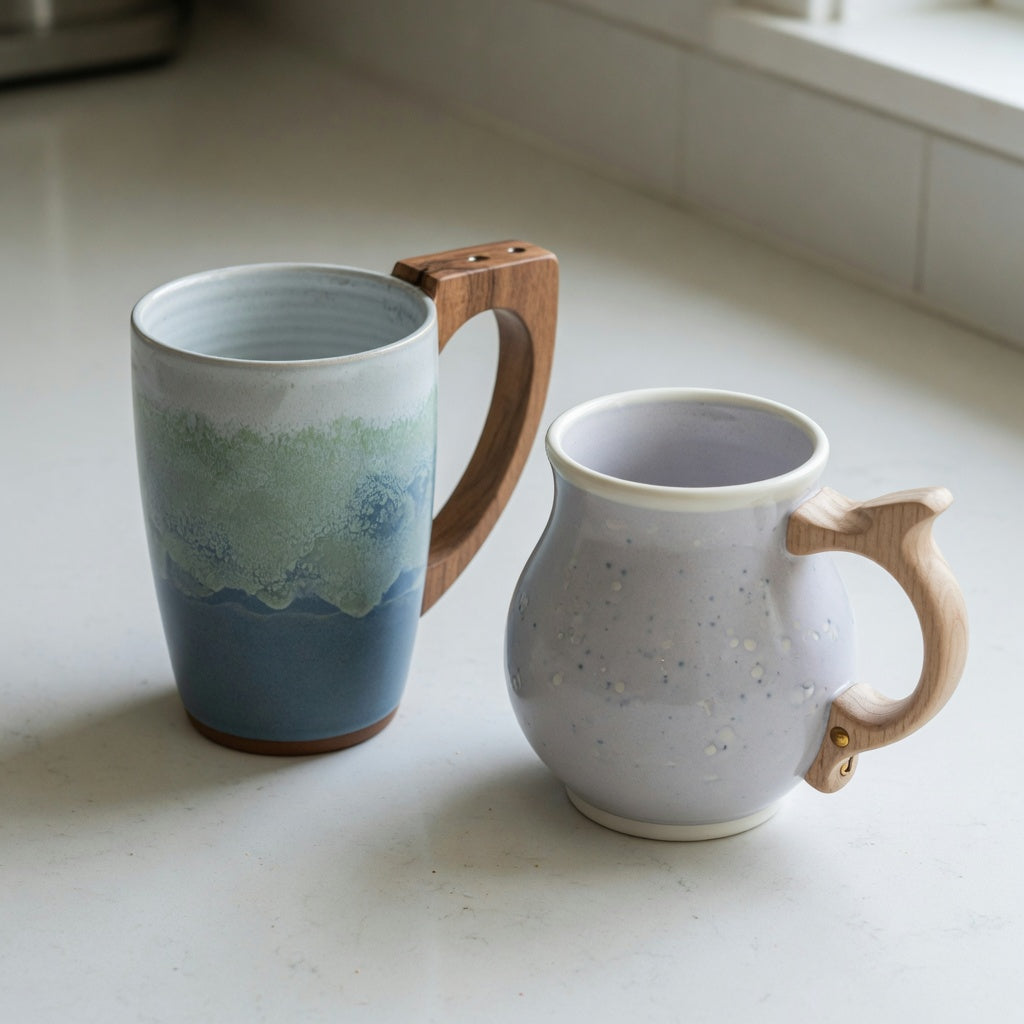
Ceramic mug with wooden handle current product facts: compare 2 options
Compare Mountain Sea II and The Cloud using only confirmed listing evidence: ceramic bodies, wooden handles, visible vessel form, and the absence of a verified capacity figure. See which unknowns m...
Read more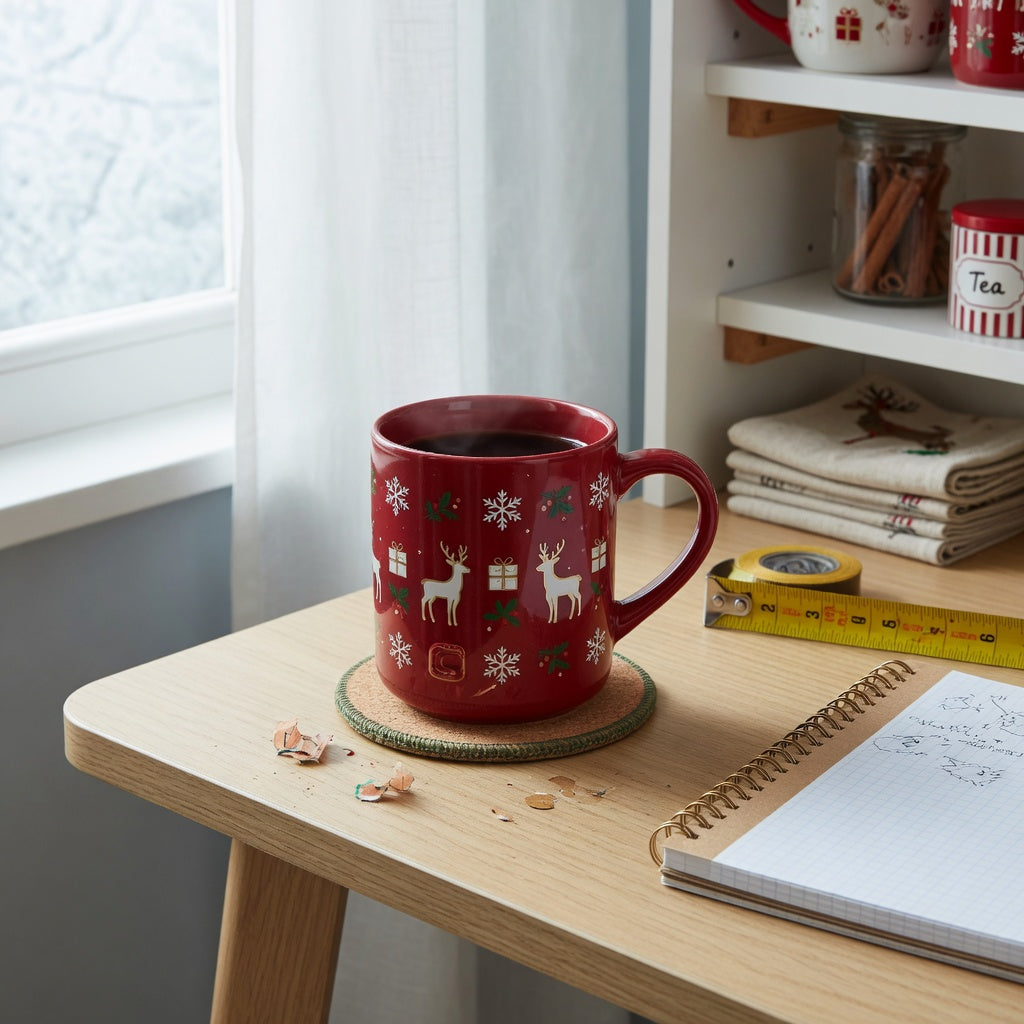
Red Ceramic Coffee Mug Buying Priorities: Capacity, Shape, Space
Use your normal pour, desk and shelf measurements, and color plans to judge CoffeifyMug's listed 460 ml Red ceramic mug. This guide separates confirmed facts from photo-based estimates and explains...
Read more
Leave a comment
This site is protected by hCaptcha and the hCaptcha Privacy Policy and Terms of Service apply.