

Ceramic Mugs for Coffee and Tea Lovers: A Buyer's Comparison Guide
Reading time: about 9 minutes
Every shipment that reaches our shelves gets the same welcome. A team member pulls a mug from the box, runs a thumb around the rim, hooks two fingers through the handle, and half-fills it with hot water to feel how the wall behaves in a real grip. The keepers migrate to our own desks. The rest — pinched handles, gritty foot rings, glazes that dull after a few dishwasher cycles — are the reason this guide exists. When shoppers compare ceramic mugs for coffee and tea lovers, the differences that matter almost never show up in product photos.
They show up on day three, when a pour-over has gone lukewarm in a wide bowl, or on day thirty, when a web of hairline cracks spreads across the glaze. Below is the same evaluation we run in-house: clay body, glaze safety, capacity against your actual drink, structure, and care. We'll also be straight about where ceramic loses to stainless steel and glass, because it does.
Ceramic vs. stainless steel vs. glass: where each material wins
No mug material does everything. Ceramic's strengths are specific: it belongs at the table, not in a backpack.
| Material | Flavor at the rim | Heat on a long sit | Real weak spot |
|---|---|---|---|
| Ceramic (stoneware or porcelain) | Inert glaze adds nothing of its own | Thick walls hold serving temperature well | Chips when dropped; hates sudden temperature swings |
| Double-wall stainless steel | Some drinkers notice faint metallic notes in acidic coffee | Best in class — insulated walls hold heat for hours | Sipping through a lid muffles aroma; poor for slow savoring |
| Single-wall glass | Neutral, and you can watch the brew | Poor — thin walls shed heat fast | Fragile, and it punishes slow drinkers with a cold cup |
Peer-reviewed research published in the journal Flavour has reported that the vessel around a drink — its material, even its color — can shift how people perceive taste. Our take after years of handling both ceramic and steel: flavor happens at the rim, and a smooth ceramic rim is the most neutral delivery there is. Choose stainless for the commute, glass for watching oolong leaves unfurl, ceramic for the twenty unhurried minutes you actually spend with the cup.
Ceramic mugs for coffee and tea lovers: how stoneware, porcelain, and earthenware differ
"Ceramic" is an umbrella, not a material. The clay body and firing decide how a mug behaves for the next five years:
- Stoneware is fired hot, until the clay partially vitrifies into a dense, stone-like body. Thick walls, steady heat, and honest chip resistance make it what we hand to people who are hard on dishware. The trade-off is weight — a full stoneware mug is a two-hand pour for some wrists.
- Porcelain, made from refined kaolin and fired even hotter, is hard, non-porous, and can be thrown thin. Tea purists love the delicate rim because you feel the temperature of every sip. The trade-off: thin edges are the first thing to chip against a faucet or a crowded sink.
- Earthenware is fired at lower temperatures and stays porous under its glaze. It's often the prettiest shelf piece and the cheapest, but for daily boiling drinks it's the weakest — more prone to chipping, and any glaze crack lets liquid seep into the clay. We'd steer you toward earthenware for pens and plants, not morning coffee.
If a listing doesn't name its clay body, that's worth asking about before you buy. High-fired stoneware or porcelain is what survives dishwashers, desk knocks, and the cabinet door someone left open.
What size fits your actual drink? Capacity, mapped to the cup
The most common mismatch we see: a two-ounce espresso poured into a jumbo mug. All that surface area cools the shot in minutes, and it looks lost in there. Match capacity to the drink, not the shelf aesthetic:
- 3–4 oz: straight espresso or a small, strong serving.
- 8–10 oz: cappuccinos, flat whites, cortados, and gongfu-style tea sessions.
- 12–14 oz: standard drip, pour-over, and a generous tea bag mug — the everyday default we point most shoppers toward.
- 16 oz and up: large lattes, americanos, and teas padded with milk. Bigger also means faster cooling, so this size suits quick drinkers or heavy adders.
Shape matters as much as volume. A wide bowl brings scalding tea down to sippable fast and gives loose leaves room to open; a tall, narrow cylinder with a thick base is the better pick if you nurse one mug across a whole morning. And if your day runs coffee at 7 a.m. and chamomile at 9 p.m., you don't need two vessels — you need one that serves both. That two-drink routine is exactly what our Morning Night Coffee Tea Mug is named around. Confirm its exact capacity and care details on the current listing rather than taking our word for it; that's the standard we hold ourselves to.
Steeping loose leaf? What tea drinkers need beyond a coffee cup
Most mug content online is written for coffee, so tea drinkers end up comparing cups built for the wrong job. For loose-leaf tea, look for:
- Room for leaves to expand — a wide bowl or a removable infuser basket, since cramped leaves over-steep and turn bitter.
- A fitted lid to hold heat while green and oolong teas steep, which doubles as a rest for the infuser once you pull it.
- An easy-clean interior — wide mouths rinse out; narrow teacups hold tannin residue in the curve of the base.
Honest trade-offs: an infuser mug gives up some capacity to the basket, and lidded mugs are one more part to wash. If you regularly make two cups at once, a small teapot still beats any mug design. Shapes that split the difference between the two drinks appear throughout our unique coffee mugs collection, worth browsing if your cabinet serves both habits.
Glaze safety: lead, crazing, and what to check before the first sip
A glaze isn't decoration — it's a glass barrier between your drink and the clay. Three things deserve attention:
- Food-safe disclosure. Buy from sellers who state the glaze is food-safe and formulated without lead or cadmium. Health authorities, including the WHO, are clear that lead exposure is harmful, so this is the one spec we never treat as negotiable. Vintage mugs and uncertified imported pottery sit in the risk zone; if a piece's glaze can't be verified, retire it to dry goods or display.
- Crazing. A fine web of hairline cracks across the glaze can be an intentional crackle finish — or a sign the glaze doesn't fit the clay body. On a food surface, crazing traps tannins and coffee oils, staining the mug and aging it fast. A new mug with an interior crackle is one we'd pass on.
- The foot ring. That unglazed ring on the bottom is normal — mugs rest on it in the kiln — but it should be sanded smooth. A rough, raw foot scratches wooden tables and trays every time you set the cup down.
Quick test in hand: run a finger around the interior. You should feel nothing — no rough patches, no pinholes, no crackle texture. The inside of a drinking mug should be the most finished surface on the whole piece.
Microwave, dishwasher, and a rolling boil: will it survive your routine?
Mugs die from care mistakes more often than from defects. The patterns we see most:
- Microwaves: fully glazed ceramic without metal trim is generally microwave-safe, but any metallic rim, luster, or decal can spark — check the listing and the mug itself. One caution that applies to any smooth vessel: water can superheat and erupt violently when disturbed, so let a full mug sit a moment before adding instant coffee or stirring.
- Dishwashers: continuous-glaze stoneware and porcelain tolerate racks well. Hand-wash anything earthenware, hand-painted, or metallic-finished, and seat heavy mugs securely — an unclipped stoneware mug in a crowded rack finds the kitchen floor on the first bump.
- Thermal shock: never pour boiling water into a mug that's ice-cold from a windowsill, and never move ceramic from freezer to oven. A few seconds of warm tap water first prevents the sudden expansion that cracks clay.
- Stains: a baking-soda paste and a soft cloth lifts tea tannin lines without scratching. Skip steel wool — scratched glaze becomes tomorrow's stain trap.
The three details you notice on day 30
These are the specs shoppers skip and owners stop noticing — in both directions:
- Handle clearance. You want three fingers through the loop, or two comfortable ones on a small cup, with knuckles clear of the hot wall. Handles that force a fingertip grip end up at the back of the cabinet.
- Base stability. A wider pedestal resists the nudge from a charging cable or a notebook, which matters when the mug lives next to a keyboard. Top-heavy flared shapes look sculptural and tip the easiest.
- Weight, full. Sixteen ounces of liquid plus a thick-walled body is real heft. If wrists or grip are a concern, choose a smaller stoneware or a thinner porcelain instead of the biggest mug on the shelf.
Frequently asked questions
Are ceramic mugs for coffee and tea lovers dishwasher safe?
Most fully glazed stoneware and porcelain mugs tolerate the dishwasher, but confirm on the product page itself — for example, on the Morning Night Coffee Tea Mug listing — rather than assuming. Hand-wash earthenware, metallic finishes, and anything marked hand-wash only. Even tough glazes dull gradually after years of harsh cycles.
Do ceramic mugs contain lead?
Modern food-safe glazes from transparent sellers are formulated without lead; the risk sits with vintage pieces and pottery sold with no glaze disclosure. Buy from makers who state food-safe, lead-free glazes in writing. Any older mug you can't verify should hold pens, not coffee.
What size ceramic mug is best for everyday coffee?
Twelve to fourteen ounces covers a standard drip or pour-over with room for milk. Drop to 8–10 ounces for cappuccino-sized drinks, and go 16 ounces or larger only if you genuinely drink that volume — extra surface area cools coffee faster.
Why does coffee taste different in a ceramic mug?
A fired glaze is inert: it adds no metallic or plastic notes and, when intact, doesn't hold onto yesterday's coffee oils. Rim shape plays a role too — a thin porcelain lip and a rolled stoneware edge deliver liquid differently, which regular drinkers notice as much as the material itself.
How do you remove tea stains from a ceramic mug?
Make a paste of baking soda and a few drops of water, rub gently with a soft cloth, and rinse warm. Let the paste sit ten minutes on stubborn tannin lines. Avoid abrasive pads, which scratch the glaze and create new places for stains to settle.
The checklist we run before any mug earns shelf space
Run your own shortlist through the same seven questions:
- Capacity: does it match your real drink — 12–14 oz for drip, 8–10 oz for milk-forward espresso drinks?
- Clay body: high-fired stoneware or porcelain for daily hot drinks, not porous earthenware?
- Glaze: smooth, continuous interior with a stated food-safe, lead-free finish?
- Handle: three-finger clearance without knuckles against the wall?
- Foot ring: sanded smooth so it won't scratch wooden surfaces?
- Care: microwave and dishwasher guidance you can actually live with?
- Home: desk mug, kitchen staple, or gift box — does the weight and shape fit that life?
If you'd rather compare finished designs than raw specs, start with our unique coffee mugs collection. And when a spec isn't spelled out on a listing, ask before you order — we answer those questions every day, and it's the fastest way to a mug you'll still reach for in month twelve.
More from our blog
Read more
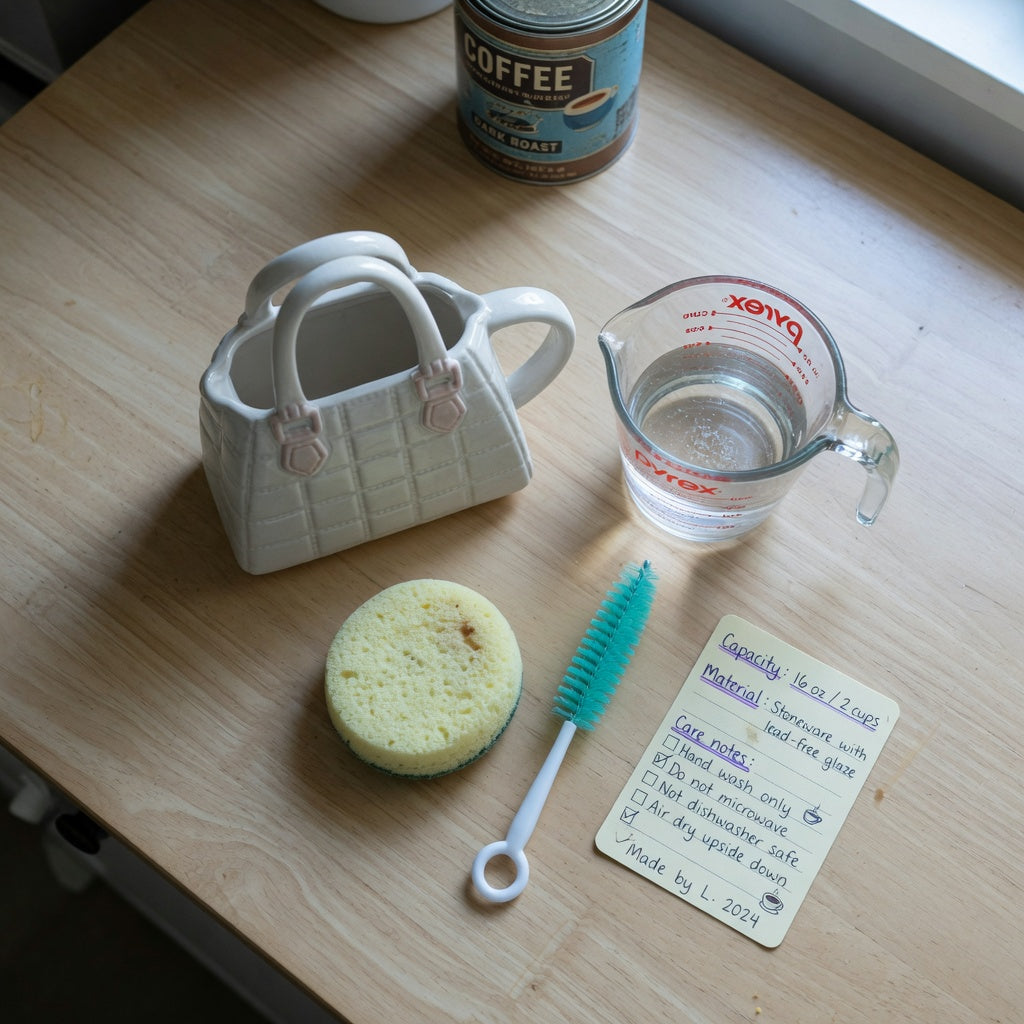
Handbag Mug Comparison: 7 Checks Before You Buy or Gift One
A practical handbag mug comparison covering true capacity, ceramic versus resin materials, food-safe labeling, microwave and dishwasher limits, and the gift occasions a purse-shaped mug actually su...
Read more
Crane Mug Comparison: 6 Checks Before You Buy
We pack and ship crane mugs every week, and most buying mistakes come from skipping the same few checks. Here's the comparison our team runs on any bird-design ceramic — decoration method, true cap...
Read more
Leave a comment
This site is protected by hCaptcha and the hCaptcha Privacy Policy and Terms of Service apply.