
Ceramic Mug With Wooden Handle Storage Fit Guide: Shelf Needs
Reading time: about 10 minutes
A mug can sit completely inside a cabinet and still stop the door from closing because the wooden handle extends beyond the ceramic body. In our experience handling and selling this category, that is the storage detail shoppers are most likely to miss. This ceramic mug with wooden handle storage fit guide focuses on the outer silhouette, the direction of the handle, and the space needed to remove the mug without shifting everything around it.
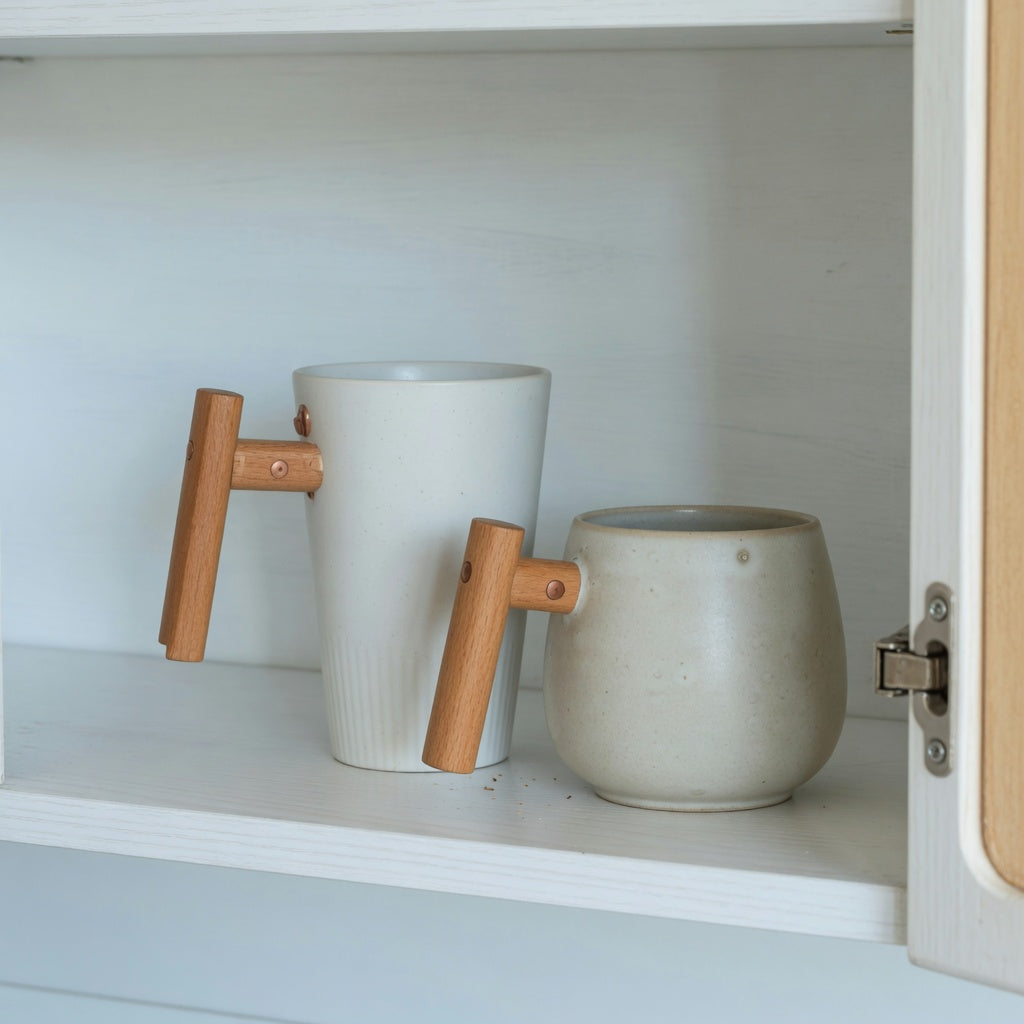
We are comparing the current Mountain Sea II and Cloud designs using the details we can support: each product is identified as a ceramic coffee and tea mug with a wooden handle, and its visible form can be compared in the product imagery. We do not add unlisted measurements, estimate capacity from photographs, identify the wood species, or assume that a handle folds or detaches. The purpose is narrower and more useful: deciding which shape is the better starting point for your cabinet, floating shelf, office cubby, or countertop coffee station.
Ceramic mug with wooden handle storage fit guide: usable shelf space
Start with usable space, not the outside dimensions of the cabinet. A shelf board may look deep enough until the closed door, front frame, hinge, or raised shelf lip takes away part of that depth. Height also needs to include enough room to lift the mug before pulling it forward.
- Usable depth: Measure from the cabinet back to the inside face of the closed door. Do not stop at the front edge of the shelf board if the door closes inside that line.
- Clear row width: Measure the open span between the side wall, hinge hardware, and neighboring drinkware. A handle turned sideways uses this space.
- Vertical clearance: Measure from the shelf surface to the shelf above, then allow room for your fingers and the upward part of the lift-out motion.
- Handle orientation: Decide whether the handle will face the door, point toward a side wall, or sit at the end of a row. Each position changes the footprint.
- Quantity: One wooden-handle mug may fit easily. A row of four repeats the handle-clearance problem several times.
If a current product page lists dimensions, check whether the stated width covers only the ceramic vessel or the entire mug including the handle. For storage planning, the most useful figures are overall height, body width, and total width to the farthest edge of the handle. Capacity is helpful for choosing a drink size, but it cannot replace those exterior measurements.
Current shape comparison: Mountain Sea II or the Cloud?
The two mugs share the same broad construction described in their titles, but their visible vessel forms are different. The Mountain Sea II presents a more upright, gently tapered profile. The Cloud looks softer, rounder, and fuller through the body. Those distinctions affect how each mug occupies a row even before handle clearance is considered.
| Storage variable | Mountain Sea II | The Cloud |
|---|---|---|
| Visible vessel form | Upright and gently tapered | Rounded and visually fuller |
| Visible handle relationship | More linear beside the body | Follows the softer, rounded silhouette |
| Best starting location | A single cabinet row or structured open-shelf lineup | An open shelf, desk, or coffee station with breathing room |
| Main fit check | Handle clearance in the chosen direction | Combined space used by the rounded body and handle |
| Less suitable situation | A shallow shelf if the handle must face forward | A narrow, tightly filled cabinet compartment |
This is a visual storage comparison, not a dimension chart. Cabinet construction varies, and a photograph cannot establish exact scale. Use the table to identify the better candidate, then confirm the available measurements on the live product page before ordering several pieces.
Mountain Sea II: an upright form for an orderly cabinet row
The visible profile of the Mountain Sea II coffee and tea mug with wooden handle makes it the stronger first candidate of these two for shoppers trying to maintain a straight cabinet row. Its body reads as more vertical and gently tapered rather than broadly rounded. That can make the vessel easier to place beside conventional cups, provided the wooden handle has a clear direction to occupy.
A deeper cabinet gives you the option to point the handle toward the door while keeping neighboring mugs closer to the ceramic body. The trade-off is door clearance. In a shallower cabinet, turning the handle parallel to the back wall may reduce front-to-back use, but it claims more row width. Neither orientation is automatically better; the right one depends on which dimension your cabinet has available.
This shape also makes sense for a structured floating-shelf display where several mugs need to appear aligned. It is less convincing for a very shallow shelf with a front rail or for a narrow cubby where the handle has no open side. For a gift recipient with unknown cabinet dimensions, ordering one is a lower-risk decision than assuming a full set will fit.
The Cloud: a rounded profile that prefers open space
The Cloud coffee and tea mug with wooden handle has a visibly softer, rounder body. That fuller silhouette gives it presence on an open shelf, coffee bar, or office desk, where the outline can be seen and the handle does not need to fit between tightly packed items.
Inside a closed cabinet, the same rounded form deserves a more careful width check. The body begins using horizontal space before you reach the outer edge of the handle. If you place it at the end of a row, the handle may be able to point into the open side area. Placing it in the middle of a dense row is less efficient because neighboring mugs cannot sit as close to the rounded vessel.
The Cloud is the more natural choice for a shopper who values its organic outline and has room to leave visible spacing around it. It is not our first recommendation for a cabinet already filled from wall to wall, a narrow office locker, or a shelf where every mug must share an identical rectangular footprint.
Handle direction changes cabinet depth and row width
Handle projection is the distance between the outer edge of the ceramic body and the farthest point of the handle. It matters because changing the mug's direction transfers that projection from one cabinet dimension to another. This is the central fit test in any ceramic mug with wooden handle storage fit guide.
- Handle facing forward: This preserves more side-to-side room between mug bodies, but it requires enough depth for the handle and the closed door. It also keeps the handle easy to reach.
- Handle facing sideways: This can help on a shallow shelf, but the handle now occupies part of the row width. Leave enough room to lift the mug without catching the next piece.
- Handle placed diagonally: This may get one mug past an obstruction, but it often uses both depth and width. It is a workaround for a single piece, not an efficient plan for a matching set.
Door hinges and cabinet frames are easy to overlook. A mug may fit in the middle of a shelf but not at the outer end where the hinge enters the compartment. In a row of several mugs, keep the handles in a consistent direction or alternate them only after confirming that the visible shapes can sit without forced contact. Do not assume the handles will interlock neatly from product photos alone.
Capacity is not a reliable shelf measurement
Two mugs can hold a similar amount while using very different exterior footprints. A taller, tapered vessel may concentrate its volume vertically. A lower, rounded vessel may distribute more of its form across the shelf. The handle then adds another exterior dimension that capacity does not describe.
Check the live listing for any currently stated capacity, but use that figure to decide how much coffee or tea the mug suits, not whether it fits a cabinet. We do not quote an estimated capacity here because no verified figure was supplied for this comparison. Guessing from the product image would create a false level of precision.
The same restraint applies to exterior size. If a listing does not specify whether its width includes the handle, do not treat that number as the complete shelf footprint. For a large order, the practical choices are to confirm the overall dimensions first, test one mug in the intended location, or select a shape with more forgiving storage geometry.
Storage situations where another mug style makes more sense
A ceramic mug with a wooden handle is a visual and functional object, but it is not the most space-efficient answer for every kitchen. A different style is likely to suit you better in these situations:
- You need mugs that are explicitly designed to stack or nest vertically.
- Your cabinet is shallow enough that every existing handle already sits close to the door.
- Your drinkware is packed tightly with no free space at either end of the row.
- You use an under-shelf rack or hanging system that requires a verified handle shape or load rating.
- The mug will live in a shared office cabinet where other users regularly move and crowd the contents.
We do not advise planning around a removable handle unless the current listing explicitly confirms one. The product titles establish a wooden handle, but they do not establish detachability or a folding mechanism. If compact storage matters more than this particular material pairing, compare closer-set handles and straighter vessel profiles in our unique coffee mugs collection.
A five-minute cabinet check before checkout
- Measure the usable shelf depth to the inside of the closed door, including any front frame or lip.
- Measure the clear width where the mug will sit, accounting for hinges and neighboring drinkware.
- Check shelf height and leave room to lift the mug before pulling it outward.
- Choose the planned handle direction and identify which dimension will absorb its projection.
- Review the current product photos and any listed dimensions. Confirm that width includes the handle before treating it as an overall measurement.
- If ordering multiples without verified overall dimensions, test one first or choose a less storage-sensitive silhouette.
Choose Mountain Sea II as the first comparison for a structured cabinet row and a more upright visible profile. Choose the Cloud for an open shelf, desk, or coffee station where its rounded form can have space around it. If neither matches the storage you measured, use the broader collection to compare a different vessel and handle shape instead of forcing a poor fit.
Frequently asked questions
What does a ceramic mug with wooden handle storage fit guide compare?
It compares the exterior variables that determine real cabinet fit: vessel shape, total handle projection, usable shelf depth, row width, and lift-out clearance. It should not use capacity as a substitute for exterior measurements or add dimensions that are not verified on the current product listing.
Which current CoffeifyMug shape is better for a crowded cabinet?
The Mountain Sea II is the better starting candidate because its visible body is more upright and gently tapered. That is not a guarantee of fit, since its wooden handle still needs either depth or side clearance. The rounded Cloud is generally easier to place where open spacing is available.
Can mug capacity tell me whether it will fit my shelf?
No. Capacity describes internal volume, while storage depends on exterior height, body width, and total width including the handle. A tall tapered mug and a lower rounded mug can use shelf space in very different ways even if their capacities are close.
Can I stack these ceramic mugs with wooden handles?
Do not assume they are stackable unless the live product listing explicitly says so. The visible body and external wooden handle do not establish a secure stacking arrangement. Side-by-side storage is the more predictable plan for a cabinet or open shelf.
What should I measure before buying several wooden-handle mugs?
Measure usable depth to the closed door, clear row width, shelf height, and the space needed to lift each mug out. Decide which way every handle will face, then compare the Mountain Sea II, the Cloud, or another collection shape against that exact layout before ordering a set.
More from our blog
Read more
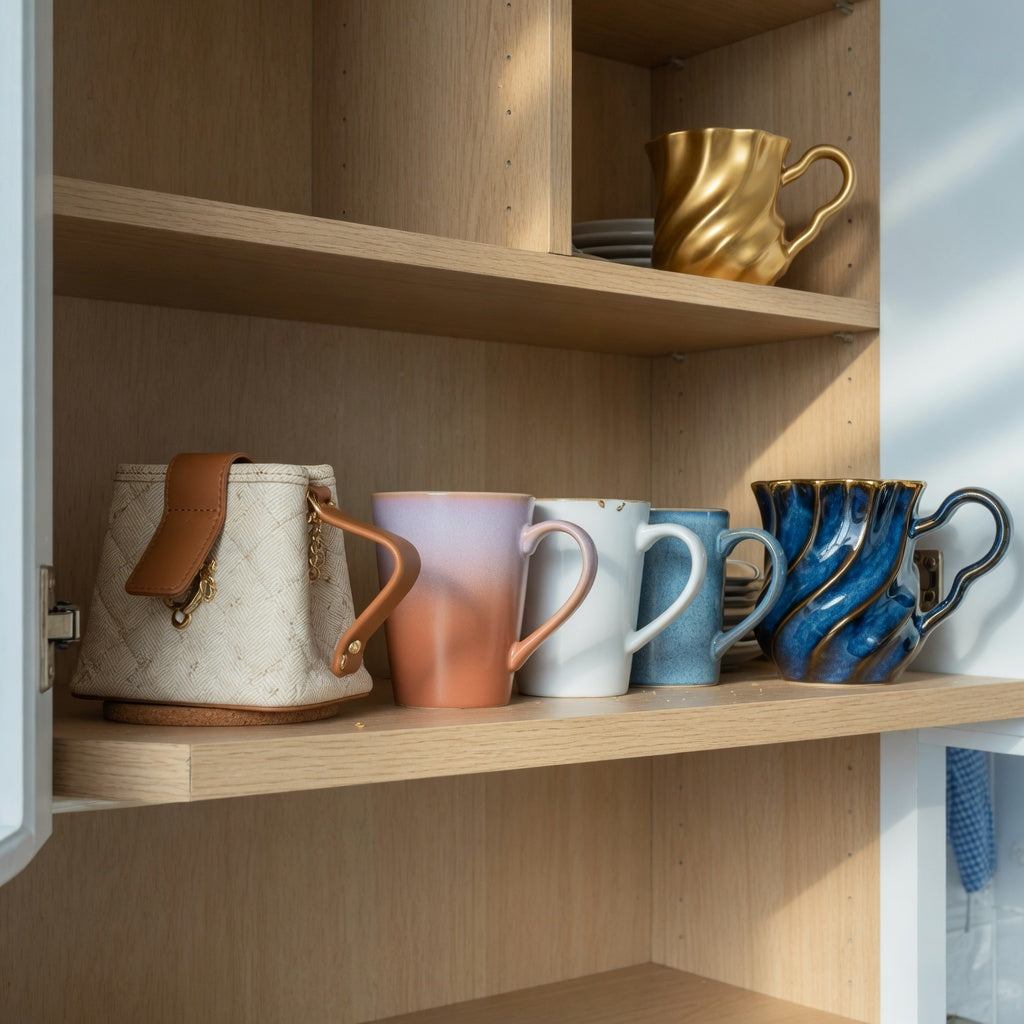
Coffee Mug Birthday Gift Ideas Storage Fit Guide: Shelf Match
Compare three current CoffeifyMug shapes by visible silhouette, handle clearance, stacking limits, and realistic cabinet use. Match a birthday mug to a crowded shelf, open display, office cupboard,...
Read more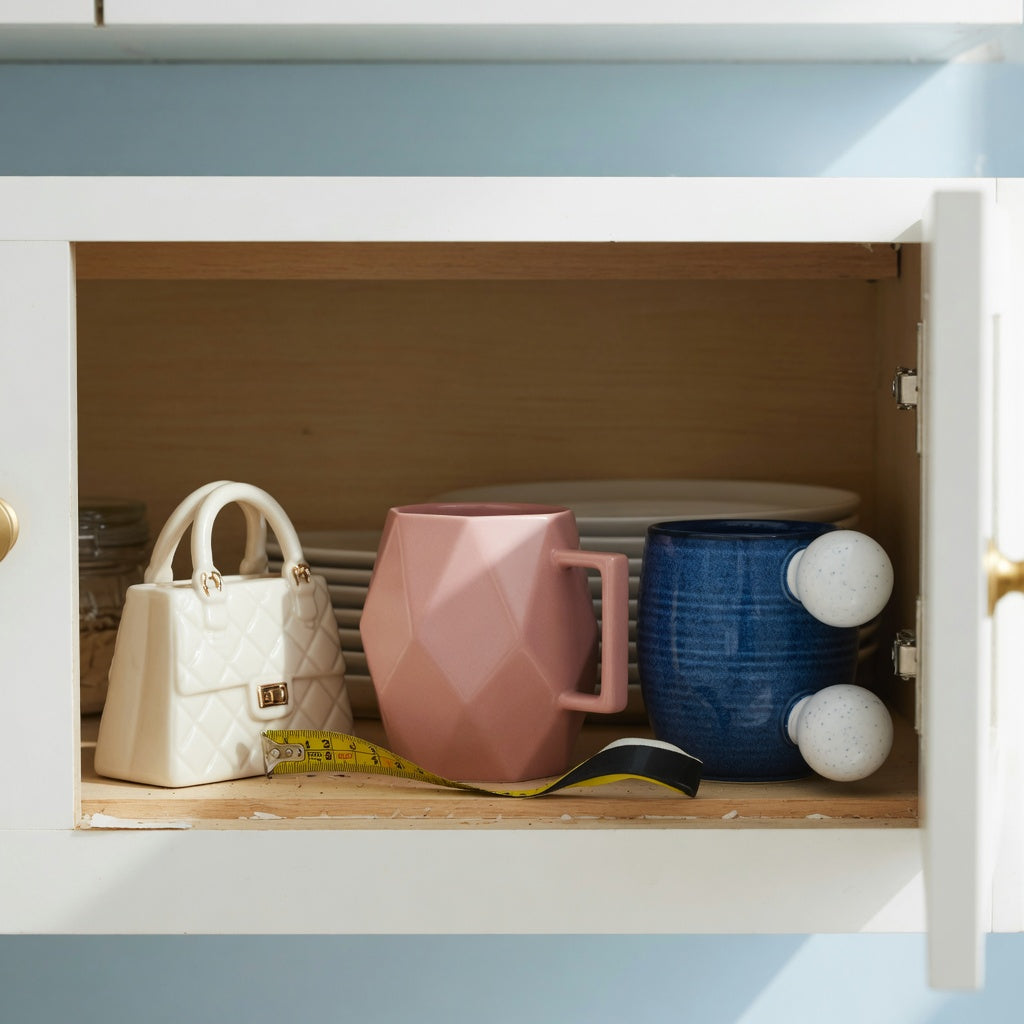
Coffee Mugs Unique Shape Storage Fit Guide for Shelves and Cabinets
Compare the storage needs of CoffeifyMug's handbag, rhombus, and ball-handled ceramic mugs. See what to measure for shelf depth, cabinet doors, racks, and desks without relying on invented dimensions.
Read more
Leave a comment
This site is protected by hCaptcha and the hCaptcha Privacy Policy and Terms of Service apply.