



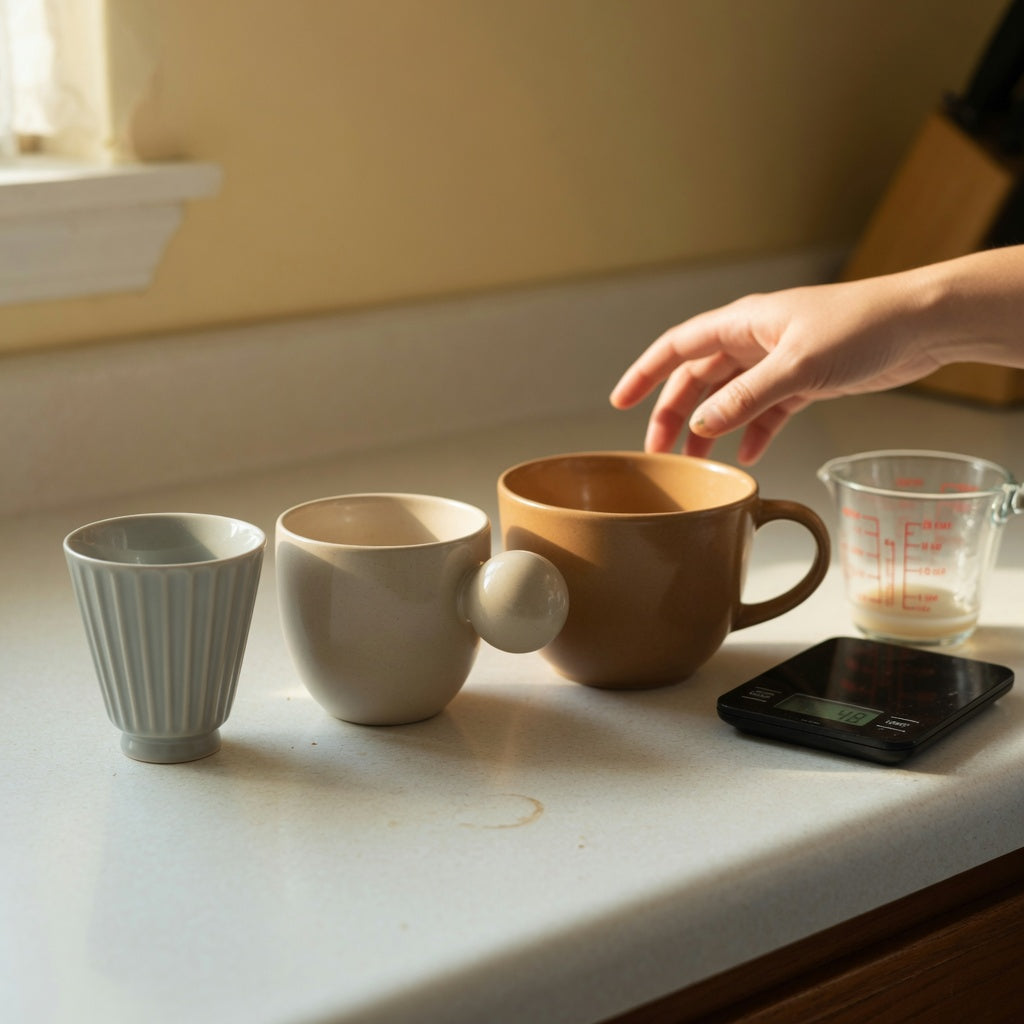
Ceramic Mug Shapes Gift Choice: A Practical Purchase Checklist
Reading time: about 9 minutes
A gift mug fails in the first week, not the first month. It holds too little for the pour, the handle pins two knuckles together, or the rim sends a thin line of coffee down the outside and onto a keyboard. Then it moves to the back of the cabinet and stays there. We sell ceramic drinkware, and this ceramic mug shapes gift choice practical purchase checklist is the exact sequence our team runs before recommending a silhouette to someone buying for a partner, a coworker, or a friend whose coffee order they only half know.
Why does the word mug say nothing about capacity?
U.S. FDA guidance on ceramic hollowware treats cups and mugs as one family of vessel: small ceramic ware for hot drinks such as coffee and tea, normally holding about 240 mL (8 fl oz) and normally fitted with a handle. It then separates them by profile, describing cups as having a base and curved sides and mugs as having cylindrical sides. That is vocabulary, not a size promise. Plenty of retail mugs sit well under 240 mL.
Convert before you compare. NIST lists 1 fluid ounce as 29.57 mL in its approximate customary-to-metric conversion, and its kitchen table rounds a cup to 240 mL. Run our own range through that math and three vessels that all photograph as a mug come out very different:
| Mug | Listed capacity | Approx. US fl oz | Drink scenario it suits |
|---|---|---|---|
| Pleated | 200 ml | ~6.8 | Flat white, cortado, small pot of tea |
| Ball Handle | 250 ml | ~8.5 | Cappuccino, standard tea, modest filter coffee |
| The Flow | 400 ml | ~13.5 | Large filter coffee, big mug of tea, iced drinks |
One holds nearly double the other. Choose on silhouette alone and a 200 ml cup becomes a shelf ornament for the person who fills a 12 oz tumbler every weekday.
Which shape matches the drink they pour most mornings?
Specialty-coffee guidance is fairly consistent about the volumes behind the names: an espresso cup sits at roughly 90 mL or less, while cappuccino, latte, and flat white cluster in about the 150–240 mL band and differ more by milk-to-foam ratio than by cup size. Those numbers filter a gift faster than any style label on a product page.
- Espresso or cortado drinker: small and narrow. A 200 ml cup is already generous.
- Cappuccino or flat white drinker: 200–250 ml lands right; a 400 ml mug makes the drink look stranded.
- Filter coffee or a serious mug of tea: 350–400 ml, where handle strength matters more than elegance.
- All-afternoon tea refiller: mid-size with a narrower opening, so the second cup is still warm.
For the 200 ml slot we steer people toward the Pleated coffee and tea cup. The pleated silhouette reads as a deliberate choice on an open shelf, and at its listed 200 ml it fits a flat white or a small pot of tea rather than a 16 oz pour. When the standing complaint is that a mug is never big enough, The Flow coffee and tea mug lists 400 ml and is the first page to open.
How much handle room does a full mug actually need?
Handle geometry is the detail buyers skip online and notice about four seconds into using the mug. A handle can look elegant and still be wrong: too small for a thumb-and-two-fingers grip, too close to the body for knuckles, or thin enough that a full mug feels like it is rotating in the hand.
- Finger room. Most adults want at least two fingers through the opening, and many want three. If you do not know the recipient's hand size, favor generous over snug.
- Body clearance. Knuckles need air between handle and wall. Tight clearance looks tidy on a shelf and feels cramped in use.
- Balance when full. A heavy handle on a small body tips forward; a thin handle on a large body strains the grip halfway through the drink.
The Ball Handle coffee and tea mug lists 250 ml, and the ball form puts the grip mass right where the fingers close — a geometry that tends to suit people who wrap a hand around the mug rather than hook a single finger through. We will not quote an opening measurement we have not verified, so check the current listing for handle dimensions, especially if the gift is for someone with limited grip strength or arthritis.
Will the rim and opening width earn it a place in daily rotation?
Rim geometry is where comfortable and cheap-feeling part ways. A rounded, slightly thickened lip is pleasant to drink from; a thin, sharp edge feels brittle against the mouth even when the ceramic itself is sturdy. A subtle flare helps direct liquid and reduces the drip that runs down the outside of the body — the small flaw that quietly ends a mug's working life on a desk.
Opening width is a trade you cannot avoid:
- Wide opening: more aroma, easier to add milk or drop in a tea bag, cools faster, splashes more when carried across a room.
- Narrower opening: holds heat longer and resists spills, but makes stirring and rinsing more fiddly.
One caution worth stating plainly. Sellers often claim a particular silhouette makes coffee sweeter, brighter, or more floral. The authoritative sources we reviewed do not establish that, so we will not repeat it. Temperature, fill level, and how long the drink sits in the cup matter far more than the curve of the wall.
Heavily faceted or squared bodies carry a related risk: interior corners are harder to rinse clean, and edges chip more readily than a smooth round wall. If the recipient values objects more than routine, that is a fair trade — just do not buy one for the busiest kitchen in the family.
Does it fit the shelf, the desk, and the space under the spout?
Practical fit decides whether a gift enters rotation or gets moved twice a year. Walk through these before checkout:
- Stacking. Straight-sided bodies stack; bellies and flared rims do not. Tight shelf space favors a cylinder.
- Upside-down storage. A tall handle can hold the mug off the shelf and leave dust inside — measure the gap first.
- Spout clearance. A tall, wide mug may not clear a single-serve machine or a drip spout. Check the height against the space you actually have.
- Weight empty versus full. Thick walls hold heat but add heft. A full 400 ml mug becomes a two-hand object for some people.
- Interior shape. Smooth, rounded interiors rinse cleaner than corners, feet, and deep shoulders where residue collects.
We will not tell you a shape is dishwasher-safe or microwave-safe unless that specific listing says so. In our experience that is a glaze-and-body question rather than a silhouette question, and it changes product by product.
The ceramic mug shapes gift choice practical purchase checklist, in order
Work through these eight checks. If a mug fails two or more, it is the wrong gift no matter how good it looks on the shelf.
- Listed capacity in milliliters, converted to ounces. Match it to the recipient's real pour, not to the name of their favorite drink.
- Silhouette versus their cabinet. Straight sides if they stack; wide or bellied bodies only if they have horizontal space.
- Handle opening and body clearance. Verify dimensions on the listing instead of inferring them from a photo.
- Rim comfort. A rounded lip, no obviously thin edge, and a flare if the mug travels from kitchen to desk.
- Opening width against drinking pace. Narrow for slow tea drinkers, wider for people who add milk and drink quickly.
- Weight when full. Stay near 200–250 ml for a weaker grip; go to 400 ml only for someone who genuinely wants a large pour.
- Food-contact status. Ask for lead and cadmium testing information if the piece is not clearly sold as food-use ware.
- What is actually in the box. Confirm inclusions on the current listing — we do not treat gift packaging or personalization as part of any shape decision.
To compare silhouettes side by side with capacities listed on each page, the unique coffee mugs collection puts the whole range in one place.
What the silhouette cannot tell you: clay body, glaze, and food-contact status
Two mugs with an identical profile can behave nothing alike. Dense, vitrified stoneware and porcelain stand up to daily use; porous earthenware depends on a sound glaze to hold liquid and resist staining. Shape does not tell you which of those you are buying. The listing or the maker does.
On food use, FDA Compliance Policy Guide Sec. 545.450 sets a lead guideline of 0.5 micrograms per milliliter of leaching solution in any one of six units for ceramic cups and mugs, and cites ASTM C738 among the examination methods — an acetic-acid extraction the standard itself describes as a severe test unlikely to be matched in ordinary use. The underlying risk is real: lead in a glaze that has not been properly fired into the ware can leach, and the FDA states there is no known safe level of exposure, with developing fetuses, infants, and children particularly vulnerable.
So if a product page never says the piece is made for food use, ask before you gift it. Decorative ceramics are a separate category, and handmade describes a process, not a safety claim.
Frequently asked questions
Is a 250 ml ceramic mug big enough for a latte?
Usually yes. Specialty-coffee guidance places latte, cappuccino, and flat white in roughly the 150–240 mL band, so 250 ml leaves a little headroom without drowning the drink. If the recipient routinely pours 350 ml or more, size up instead.
What should I check first when buying a ceramic mug as a gift?
Capacity. Start the ceramic mug shapes gift choice practical purchase checklist at item one — the listed volume in milliliters — then convert it, then move to handle room and rim comfort. Volume is the mismatch that cannot be fixed later; most other problems are cosmetic.
Does a straight-sided mug keep coffee hotter than a round one?
Not reliably. Heat loss depends more on total surface area, wall thickness, and the open top than on the name of the profile. Pre-warming the mug or using a lid does more for temperature than switching from a cylinder to a belly shape.
Are handleless ceramic cups a sensible gift for a coffee drinker?
Only for the right person. Without a handle you grip hot ceramic directly, which works for a small espresso or tea finished quickly and feels unpleasant with a large, full mug. Match it to someone who drinks small and fast, not someone who nurses 400 ml for an hour.
Should I buy a square or faceted mug as a gift?
Buy it for someone who enjoys objects more than routine. Corners and facets are harder to rinse clean and more chip-prone than a smooth round wall, which makes them a poor pick for a busy kitchen and a strong one for a desk or display shelf.
If you only take one step from here, take the capacity one: open the unique coffee mugs collection, write down the listed milliliters on each silhouette, and hold that number against the drink the recipient makes most often. Everything else on the checklist gets easier once the volume is right — and the mug stops being a shelf ornament.
More from our blog
Ready to pick your mug? Two ways to save on today's order:
Ordering 1–3 mugs? Get an extra 10% off your 1st order with code 10_OFF Apply 10% Off & Shop Wooden-Handle Mugs →
Gifting 4+ mugs? Buy 3, Get the 4th Free applies automatically at checkout (no code needed; offers do not stack) · Free standard shipping (Nov pre-Christmas delivery: 15–20 calendar days US) · Free replacement if chipped in transit.
Popular mug buying guides: Wooden-Handle Tea Infuser Mugs Compared · Christmas & Secret Santa Mugs 2026 · Espresso & Cortado Cups Guide · Cup & Saucer Gift Sets · All 25 Mugs Spec Table · Mug Size Guide · Shipping & Promo FAQ
FIRST ORDER 10% OFF (CODE: 10_OFF) · OR BUY 3, GET THE 4TH FREE


Read more
Big Latte Mug Gift Choice Product Shortlist Guide: 3 Size Picks
A scenario-based shortlist for gifting a big latte mug: The Flow 400 ml, Morning and Night 440 ml and The Rock 480 ml compared by what the recipient actually pours, plus the fill level, footprint a...
Read more
Ceramic Mug Shapes: First Time Buyer Product Shortlist Guide
A first-purchase shortlist built from three silhouettes we keep in stock — 200 ml, 250 ml, and 400 ml — with plain reasons to choose or skip each one and the listing details worth verifying before ...
Read more
Leave a comment
This site is protected by hCaptcha and the hCaptcha Privacy Policy and Terms of Service apply.