
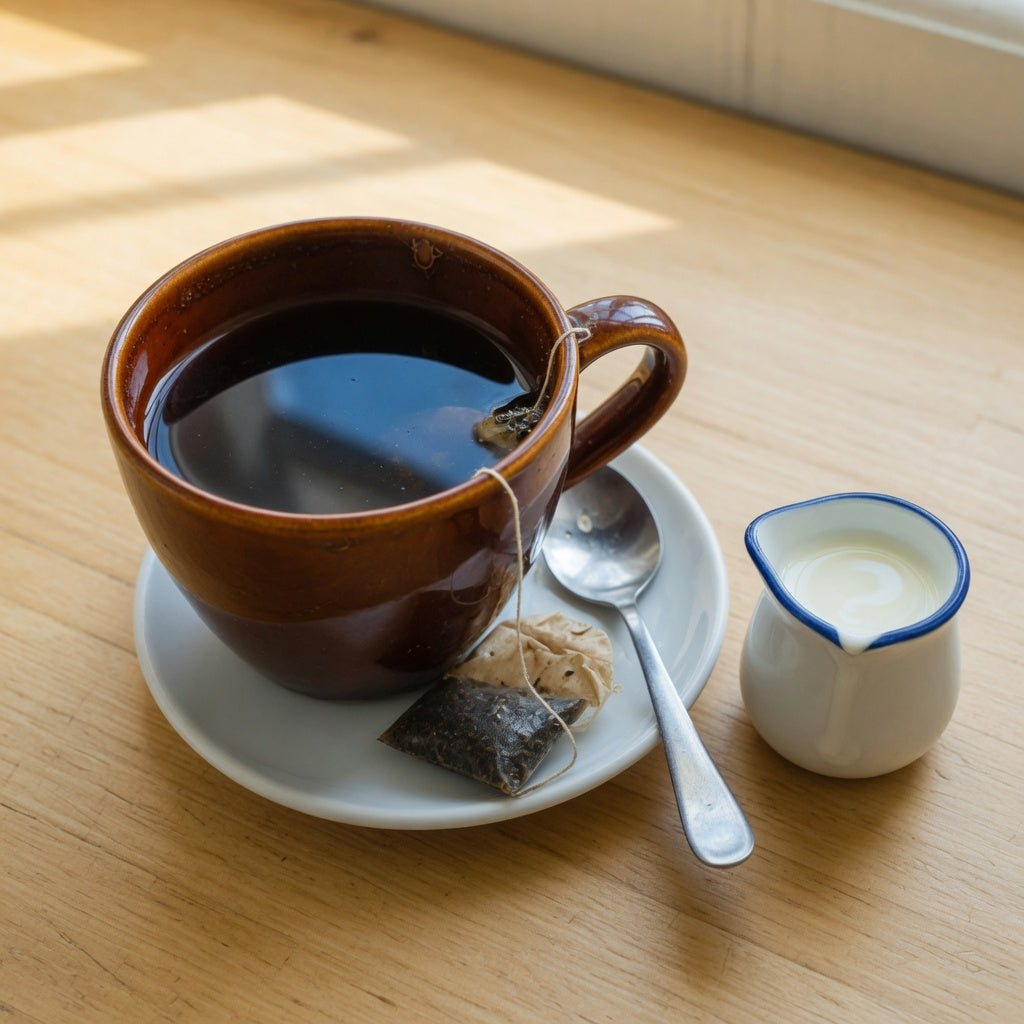
Ceramic Mug for Black Tea: Capacity, Glaze, Desk Fit
Reading time: about 12 minutes
A breakfast tea left beside a laptop does something a fast coffee usually does not. Twenty minutes later a brown tide line sits at the waterline, the handle has taken heat from the bowl, and the last third of the cup is cooler than the first sip. In our store, shoppers often pick a color first, then write back about stains, how much milk still fits, and whether the cup is meant for a hot daily pour. A ceramic mug for black tea has a plain job: hold a tannin-heavy drink while you finish it. Capacity, the interior surface, and how the mug sits on a desk matter more than the pattern on the outside.
What black tea does to a mug during a timed steep
At home, black tea is usually hot water, a few minutes on a timer, then the bag or leaf comes out before milk goes in. The mug has to accept that pour and let you stop the steep when the timer ends. It does not need to be a brewing gadget. Leaf left sitting in the cup is what turns the liquor bitter, whatever the cup is made of.
The surface the tea touches is the part we watch on the counter. We steer a daily drinker toward a fully glazed interior so the liquid meets glaze, not bare clay that can hold odor from yesterday's cup. Porcelain is a dense, glass-like ceramic. Stoneware is often thicker in the hand. Glass shows the color of the liquor, which helps if you are judging strength. A ceramic-lined travel bottle is a different tool: closed, portable, and built to slow heat loss. We do not have measured times for how long black tea stays hot in thin porcelain, thick stoneware, or a lidded cup, so a heavier wall is not a minute count we will sell you.
People who drink from bare stainless travel mugs sometimes describe a metallic edge on tea. That comment is common. It is not a controlled tasting, and we treat it as a reason to prefer a glazed interior, not as proof that every steel bottle ruins the cup. If the real problem is a commute, pick a lining you trust and still pull the leaf on time. An open ceramic cup will not solve a train ride.
Is 390 ml or 400 ml enough once milk goes into black tea?
Listed capacity is the number we can stand behind, and on these three it is close. The Round coffee and tea mug is listed at 390 ml. The Gradient coffee and tea mug and The Flow coffee and tea mug are listed at 400 ml. Their catalog descriptions support tea use. A 10 ml gap is about two teaspoons. It will not change how breakfast tea tastes.
Scale still matters. A lot of loose-leaf instructions are written for a cup near 220 ml, not for a mug this size. Use the same small spoon of leaf in 400 ml and the tea tastes thin. Brew a tea bag in the mug, or make it in a pot and pour. A basket you drop in yourself also steals drinkable volume, and we are not calling these infuser mugs. If a deep basket is the reason you are shopping, read the current page before you assume one is in the box.
Straight black tea does not need the headroom milky tea does. A splash of milk still fits. A mug that is nearly half milk can climb to the lip and spill beside a keyboard. Lemon is a different contact than milk: it is more acidic, and we have no lab comparison of how it marks glaze versus plain black tea. If lemon is your habit, watch the interior and do not scrub a mark with grit. Sugar does not change the mug decision. Leave about a finger of space under the rim either way. Listed capacity is not the fill line you should walk across the kitchen with.
Because volume is almost a tie, match the cup to the drink you already make, then confirm handle shape on the listing. Our notes do not assign a grip to any of the three.
- Desk or counter, straight tea or a splash of milk. The Round at 390 ml is the slightly smaller listed pour. It is not a heat advantage over the other two.
- Same daily tea, and you want the higher listed fill. The Gradient at 400 ml fits that, if the current photos are the look you want. Do not assume an infuser.
- A slow cup you finish in place. The Flow, also 400 ml, belongs on a counter, not in a bag. It is the wrong pick for a locked lid or an hour in a car.
- None of those silhouettes feel right in the hand. Look through the unique coffee mugs collection for other everyday shapes in a similar use.
| Listed mug | Capacity | Everyday fit | Not a reason to pick it |
|---|---|---|---|
| Round | 390 ml | Straight tea or tea with a splash of milk, finished at a desk or counter | A measurable heat edge over the 400 ml cups |
| Gradient | 400 ml | The same daily tea, with a slightly higher listed fill | Loose-leaf control, unless the current listing shows an infuser |
| The Flow | 400 ml | A slow cup you drink where you made it | A commute, a sealed lid, or time in a bag |
Glaze safety when black tea is a hot daily pour
Shoppers ask two questions that sound alike and are not. Does ceramic change the taste of black tea? And is the glaze safe for a hot cup every morning? A sound commercial glaze should be flavor-neutral. When a cup tastes off, we usually find tired leaf, an over-long steep, or dish soap still sitting in the bowl. Taste is not a lead test.
Lead is worth taking seriously, and it is easy to overstate. FDA's contaminant tool lists an action level of 0.5 µg/ml of leaching solution for lead in ceramic cups and mugs, referencing CPG 545.450. That figure comes from a lab leach test. It is not a reading from the tea in your hand. FDA also says lead in a glaze or decoration can move into food or drink if pottery is not made properly, while proper firing binds essentially all the lead into the glaze. The higher-concern pieces they flag are handmade crude ware, antiques, damaged or worn pottery, flea-market or unknown sources, and bright orange, red, or yellow decoration. Everyday commercial factory pottery is much less likely to have a lead problem. Washing or boiling does not remove lead from a bad glaze. A colored retail mug is not automatically on that higher-concern list.
A 2017 pilot study in Food Safety and Risk brewed tea in five mugs already known to contain lead. Lead in the tea ran from below 0.2 to 1.6 µg/L. Levels differed by cup, not by the drink or by how long it sat. The estimated daily dose passed California's 0.5 µg/day MADL for one of the five mugs. Modeled blood lead in that study did not rise above the guidance values the authors used. Read it narrowly. It is not a certificate for every mug on a shelf, and it is not a reason to reject ordinary retail ceramics on sight. We will not call the Round, the Gradient, or The Flow lead-free unless the current listing says so. Look for food-use wording on that page, notice who made the piece, and skip a worn interior or a glaze from a source you cannot identify.
Black tea stains, crazing, and the sink routine we use
Tannins leave a brown line. On a fully glazed interior that line is usually a surface film, not color soaked into the clay. Customers worry it will flavor the next cup. Evidence that a tannin film on sound glaze changes later tea is thin, so we will not claim a taste effect either way. Clean it anyway. A dirty waterline hides chips.
A pale interior shows the line by the second or third cup, which is annoying and also useful: you can see wear. A dark interior hides the same film. Hiding is not a cleaner glaze. In our experience, this is the sink routine that keeps a daily tea mug usable without hazing the surface:
- Rinse soon after you finish. Dried tannin grips harder than a fresh film.
- Wash with warm water, a drop of dish soap, and a soft sponge. Skip steel wool and gritty powder.
- For a set line, rest a baking-soda paste on it for a few minutes, wipe gently, and rinse until the powder smell is gone.
- Use a dishwasher only when that listing says dishwasher safe. Weight is not a care instruction.
- Stop using the mug for hot tea if the interior glaze is chipped through to the body or worn dull.
Intentional crackle is a decorative surface. A new ping when hot water goes in, followed by a line you can catch with a fingernail, is not the same thing. Shoppers talk about stoneware singing as it heats. A sound by itself is not a test result. Damaged or worn pottery is on FDA's higher-concern list, and a crack into the body also traps stains and odor. If the mug pings and a fresh crack shows up, retire it for hot black tea.
Microwave use belongs on the listing, not in a guess from the word ceramic. Some mugs are marked for it. Others have metal that is not. Even a microwave-safe cup can present a hot handle, because the handle shares heat with the bowl of tea. We are not promising a cool grip, a microwave mark, or a dishwasher mark on the Round, the Gradient, or The Flow.
What handle and footprint suit a ceramic mug for black tea on a desk?
Black tea is a slow drink. The handle has to work when the mug is full and again when it is half empty twenty minutes later, often while the other hand stays on a keyboard. Compare finger clearance, whether you are pinching the grip, and whether the base stays put at half volume. A wider base survives a notebook bump better than a tall, narrow cup. Neither 390 ml nor 400 ml makes a mug an office size by itself. The product page is the source for handle shape. Do not assume wood, metal, or a lid unless the current photos and copy say so.
These open cups earn a place on a kitchen counter or a desk. They are a poor gift if the person you are buying for carries tea in a backpack. They slosh, and this comparison does not include a sealed lid. They are also the wrong tool when you need the leaf lifted on a timer and the page shows no infuser, or when you want the drink still hot an hour later in a car. Vacuum steel holds heat for that trip. It is also the material some drinkers blame for a metallic note. Pick the problem you actually have. A pretty glaze will not turn a desk mug into a travel bottle.
Frequently asked questions
Does black tea taste better in ceramic than in bare stainless steel?
A fully glazed interior is there so tea meets glaze, not bare metal or bare clay. Some drinkers report a metallic note from unlined steel travel mugs. That is a common complaint, not a lab tasting, so we will not rank every ceramic cup above every lined bottle. For black tea at a desk or in the kitchen, glazed ceramic is the straightforward choice. A sealed commute is a different job.
Will a ceramic mug for black tea stain permanently?
Black tea leaves a tannin line on most light interiors. On sound glaze it usually sits on the surface. Rinse early, wash with a soft sponge, and use a short baking-soda paste for a set film. Abrasive pads can dull glaze, which is the damage to avoid. We do not have evidence that a cleanable film changes the taste of the next cup.
Is 400 ml too big for straight black tea?
It is a large mug, not a teacup. Many brewing notes are written for a cup near 220 ml, so a 400 ml pour is closer to two small cups unless you add leaf. The Round at 390 ml is in the same band. The extra 10 ml is not a flavor decision. Leave room under the rim if you add milk.
Are small glaze cracks unsafe with hot tea?
Intentional crackle is a decorative surface. A new crack you can feel, a chip through to the clay, or a worn interior is a reason to stop using that mug for hot drinks. FDA guidance treats damaged or worn pottery as higher concern for lead leaching, and washing does not remove lead from a faulty glaze. A ping when hot water hits the cup is something to watch. If a line appears afterward, retire the mug.
Can I microwave these mugs, and will the handle stay cool?
Only if the current listing says microwave safe. We do not assume that from the fact that a mug is ceramic, and we do not claim it here for the Round, the Gradient, or The Flow. A handle can still heat up because it is attached to a hot body of tea. If a cool grip is the priority, that is a separate handle-material decision. Confirm it on the page rather than inferring it from capacity.
A cart check for desk tea, not a commute bottle
Before you treat any cup as your ceramic mug for black tea, run this list on the product page. A missing line means unknown, not yes.
- Capacity: 390 ml on the Round, 400 ml on the Gradient and The Flow. Match it to straight tea or tea with a real pour of milk, and leave a finger of space.
- Interior fully glazed, with no worn patch and no interior decoration you cannot identify.
- Food-use wording on this listing. Do not borrow a lead-free line from another brand or another color.
- Handle opening and a stable base for a one-handed hold while the other hand is on a keyboard.
- Dishwasher, microwave, infuser, lid, or a wood or metal handle only if that page shows them.
- Kitchen or desk use, not a commute bag. If you need a lid and a deep basket, this is the wrong shortlist.
Start with those three capacities, or scan other mug shapes in the collection if the grip is the thing that failed the check. Match the mug to the pour you already make, and leave heat-retention claims for products that publish a test.
More from our blog
Read more

Mocha Mug Gift: Capacity and Care to Compare
A mocha mug gift search mixes team cups, colored ceramics, and drink sets. We compare 400 ml, 440 ml, and 480 ml for everyday coffee-and-cocoa fit, then cover care, glaze, and shipping checks befor...
Read more
Two Tone Ceramic Mugs for Office: What Buyers Compare
Desk mugs fail in ordinary ways: they miss the brewer, stain a light interior, or carry metal into a microwave. Compare capacity, care labels, logo contrast, and food-contact checks before you buy ...
Read more
Leave a comment
This site is protected by hCaptcha and the hCaptcha Privacy Policy and Terms of Service apply.