
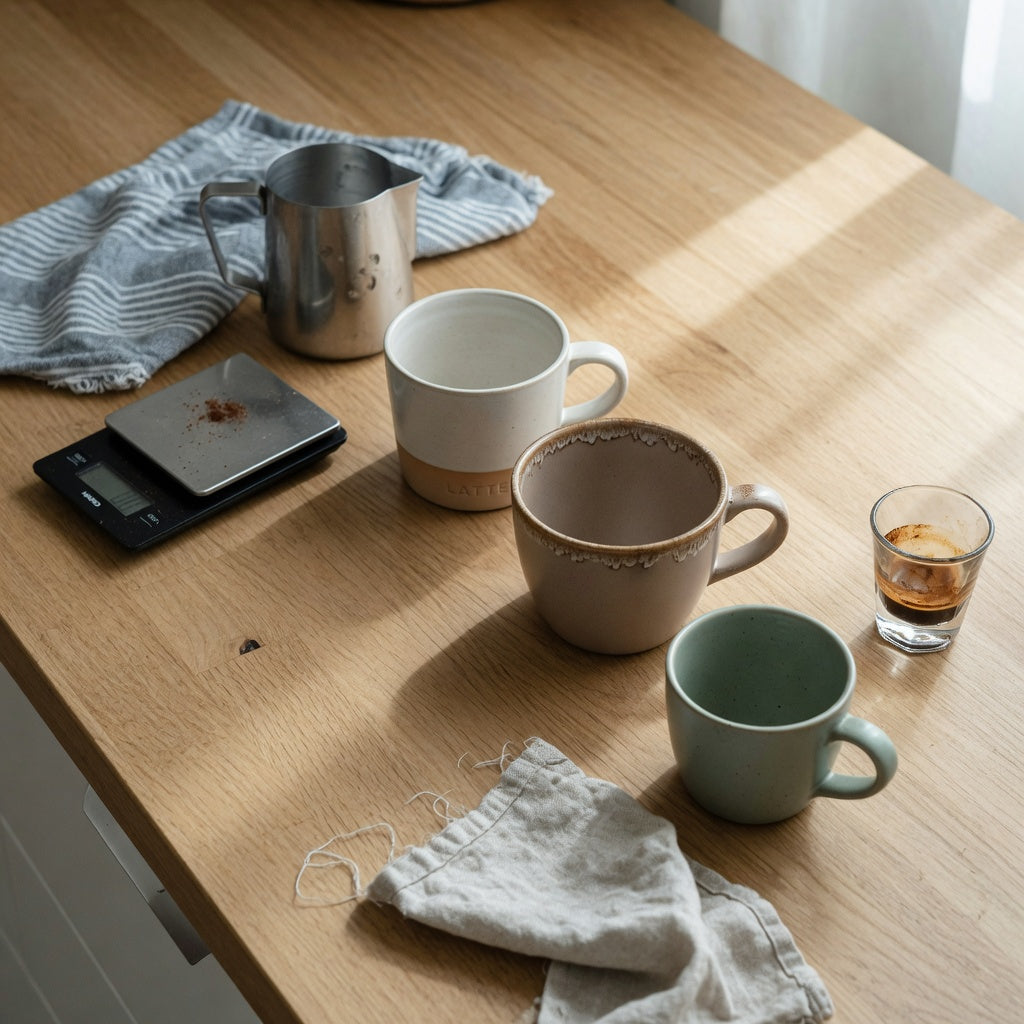
Ceramic Latte Cups Everyday Mug Rotation Practical Purchase Checklist
Reading time: about 10 minutes
The most common return conversation in our store starts with a capacity number that never matched the drink. A cup listed at 400 ml fills closer to 300 ml once you leave foam headroom and a lip you can carry without spilling. That gap is why we built this ceramic latte cups everyday mug rotation practical purchase checklist around the numbers you can actually verify: pour volume, handle clearance, shelf footprint, and care rules for the exact finish.
Why does a 400 ml cup look small next to a 12 oz latte?
Because the number on the box and the number in your glass are measured differently. Some listings quote brim-full volume — the amount the cup takes to the very lip, with no foam head and no room to lift it without spilling. Others quote a fill line a comfortable half-inch below the rim. A few round up. All three can honestly call the same cup a 400 ml cup.
Here is the arithmetic we walk through with shoppers. A standard double shot runs around 60 ml. Add 200 to 240 ml of steamed milk and a foam head and you are pouring roughly 280 to 320 ml of drink. That fits a 400 ml cup with working room. It does not fit a 250 ml cup once foam enters the conversation — at that size you are drinking a cortado whether you call it one or not.
The FDA defines cups and mugs as small ceramic hollowware commonly used for coffee or tea, normally holding about 240 ml (8 fl oz) and made with a handle. That is a regulatory definition for testing, not a rule about what your latte should hold. Treat it as a reminder that cup labels and drink recipes are two different systems.
How many cups does a real rotation actually need?
A rotation implies more than one vessel in play. Most households settle at three to four cups per regular coffee drinker once they stop thinking of it as a single favorite mug. The math is unglamorous:
- One in the sink or dishwasher at any given moment.
- One in active use on the desk, nightstand, or counter.
- One clean standby for the second cup or an unexpected guest.
- Optional fourth if you host, or if two people share the cabinet.
Storage decides the rest. Measure your shelf gap before you buy, not after. A cup needs clearance for the handle plus enough headroom to lift it out without tipping the one beside it. Handles that protrude far from the body eat horizontal space fast; deep, bowl-shaped cups eat vertical space. If your cabinet is tight, wide low cups stack poorly and tall narrow ones beat them on density.
Frequency of use matters more than any single spec. Someone who pulls one latte on weekends should buy one cup they love. Someone at three drinks a day should buy the rotation and accept that the cups will live on the counter, not in the cabinet — which makes footprint the deciding measurement.
Which listed capacity fits your actual pour: 250 ml, 400 ml, or 440 ml?
We stock three ceramic latte cups with plainly listed capacities. What we do not publish is interior radius, wall thickness, or a heat-retention rating, so treat the shape and footprint notes below as buying prompts, not measured performance claims. If a number decides the purchase for you, ask our support team before ordering.
| Cup | Stated capacity | Reader situation it fits |
|---|---|---|
| Ball Handle coffee and tea mug | 250 ml | Smallest listed capacity. A good match for a cortado, flat white, single-shot latte, or tea at a compact desk or nightstand spot. |
| The Flow coffee and tea mug | 400 ml | The middle of a rotation. Enough working room for a double shot plus 200 to 240 ml of milk and a foam head. |
| Morning and Night coffee and tea mug | 440 ml | Largest of the three. A long morning drink, a refill cup, or a pour where you want more headroom than The Flow gives. |
If you routinely drink more than about 440 ml in a sitting, none of these is your cup. Shop a larger vessel or a tumbler instead. Buy for the drink you make on a Tuesday, not the one you make on vacation.
Rounded interior or straight wall — what your pour pattern needs
A straight-sided mug is a fine drinking vessel and a stubborn one to pour into. Milk hits a vertical wall, drops to the bottom, and the contrast you were building collapses into the body of the drink. A rounded, bowl-like interior gives the milk a curved floor to ride forward on, which is why so many cups sold for latte work have that profile.
Three things change with shape:
- Surface area at the rim. A wider mouth gives foam more room to spread, which makes a simple heart or rosetta easier to place. Narrow rims crowd the pour.
- Rim thickness. A thin, slightly tapered lip drinks differently from a thick rolled edge. Neither is wrong, but thick rims read as cocoa mug and thin rims read as bar cup.
- Cleaning access. Tight radius bottoms trap milk film. If the interior curve is sharp, a bottle brush beats a sponge.
If you never pour art and just want coffee to stay put, interior shape matters far less and you should optimize for handle and footprint instead. Our unique coffee mugs collection is organized so you can compare silhouettes side by side rather than guessing from a single hero photo.
Handle geometry and desk footprint: the specs you feel every morning
An empty cup tells you almost nothing about its handle. A full one tells you everything. Two fingers should clear the gap without pressing against the body, and the handle should sit high enough that your knuckles do not brush the counter when you set the cup down.
Capacity drives this more than people expect. A heavier pour needs a larger opening and a thicker grip; a small cup can get away with a decorative, narrow handle. The Ball Handle name tells you the design cue, not the grip width. Ask for the handle opening if you have large hands or arthritis, because a photo will not answer that.
Desk footprint is the other quiet dealbreaker. A 440 ml cup with a wide handle can crowd a keyboard tray; a 250 ml cup can disappear behind a monitor. Measure the spot where the cup actually lives, then add an inch of clearance for your hand. If the cup will sit on a narrow shelf, check the handle projection as well as the base diameter.
Glaze and firing: what a lead free label does and does not prove
This is the section most buying guides skip, and it is the one that should slow you down. The FDA sets an action level of 0.5 micrograms per milliliter for leachable lead in small ceramic hollowware such as cups and mugs, applied to any one of six units tested. Cadmium action levels sit at 0.5 micrograms per milliliter for small hollowware. Those are the numbers a legitimate test result is measured against — not the words lead free printed on a hangtag.
The FDA has reported traditional pottery labeled lead free that still released extractable lead at or above its action levels, and it notes that washing, boiling, or other consumer steps cannot remove lead from a piece. A glaze that was not fired properly may never fuse the lead into the surface in the first place. FDA guidance on ceramic hollowware is the plain-language source we point shoppers to.
What you can actually check as a shopper:
- Whether the seller will share batch test documentation, and against which method. FDA compliance guides cite ASTM C738, an acetic-acid extraction test the agency describes as severe relative to ordinary use.
- Whether the piece is factory production or handmade. The FDA flags handmade, antique, damaged, flea-market, and brightly orange-, red-, or yellow-decorated ware as higher-concern categories, while describing everyday commercial factory pottery as much less likely to have a lead problem.
- Whether decorative-only pieces are clearly marked. Under 21 CFR 109.16, ornamental ceramicware that looks food-safe is treated as food use unless it carries the required warnings.
None of this is a reason to fear a normal retail mug. It is a reason to treat an unverifiable claim as unverified. In our store, we would rather you ask for documentation and wait a day than assume a lead free label settles the question. Crazing, the fine web of cracks in a glaze, is a visual cue to retire a cup from hot drinks.
Microwave, dishwasher, and the trim that quietly rules out both
General statements that ceramic is microwave safe are true only at the material level. The FDA explains that microwaves pass through ceramic and are reflected by metal — which is exactly why a metallic handle, gold rim, or luster decoration changes the answer for that specific cup. If a piece has metal on it, do not assume the ceramic rule applies.
Before a cup joins a rotation, confirm three things on the listing or with the seller: microwave suitability for that exact finish, dishwasher suitability, and whether the maker expects hand washing for decorated surfaces. Dishwasher heat and detergent are hard on luster and on unglazed foot rings. A cup you must hand wash is still a good cup — it just belongs in a smaller rotation than you planned.
Two more practical notes from handling this category. Crazed or chipped glaze should come out of service for hot drinks, not get promoted to the guest shelf. And if you are ordering multiples, ask how the seller packs them; breakage in transit is a shipping problem, not a pottery problem, and it is worth knowing the policy before you need it.
Run this ceramic latte cups everyday mug rotation practical purchase checklist before you add to cart
- Volume, twice. Write down your typical drink in milliliters, then confirm whether the listed capacity is brim-full or working volume.
- Rotation count. Decide how many cups you are actually rotating and whether they will live on a shelf or on the counter.
- Shelf and desk measurement. Handle clearance plus vertical headroom, measured with a tape, not estimated.
- Interior shape against your pour. Rounded for art, straight for simple drinking, wide rim for foam.
- Handle test. Two-finger clearance and knuckle room at counter height, judged on a full cup.
- Glaze documentation. Test results if offered; decorative-ware warnings if the piece is ornamental.
- Care reality check. Microwave, dishwasher, and trim compatibility for that exact finish.
If you want the capacity conversation narrowed further, start with The Flow 400 ml cup as the middle-of-rotation default, then size down to the 250 ml Ball Handle cup for cortados or up to the 440 ml Morning and Night cup for long drinks. The full collection shows all three in one view.
One honest limitation: if you need a cup that keeps a latte hot for an hour, or one you can toss in a bag, a ceramic latte cup is the wrong tool. Buy it for the drinking experience and the rotation, not for travel or heat retention.
Frequently asked questions
Is a 400 ml ceramic latte cup big enough for a standard latte?
Usually yes. A double shot plus 200 to 240 ml of steamed milk lands around 280 to 320 ml, which leaves working room in a 400 ml cup. Confirm whether the seller's 400 ml is brim-full or a fill line, because that changes the answer. The ceramic latte cups everyday mug rotation practical purchase checklist above starts with that exact question.
Why does my 12 oz mug only hold about 8 oz of coffee?
Many listings quote brim-full volume rather than a comfortable pour. Once you leave headspace for foam and for lifting the cup without spilling, usable capacity drops noticeably. Ask the seller which number they are quoting.
Does the interior shape really matter for latte art?
It matters more than the material. A rounded interior gives the milk a curved surface to flow across, and a wider rim gives foam room to spread. A straight-sided mug is harder to pour into but perfectly fine to drink from.
Is lead free on the box enough to trust a ceramic cup?
Not on its own. The FDA has reported pottery labeled lead free that still released extractable lead above its action levels, and it notes washing or boiling cannot remove lead. Ask for batch test documentation if it matters to you.
Can I put a ceramic latte cup with a gold or metallic handle in the microwave?
Do not assume so. Microwaves are reflected by metal, and trim, lusters, and metallic rims change the answer for that specific piece. Check the listing or confirm with the seller before heating.
More from our blog
Read more
Cute Espresso Cups Home Coffee Station Product Shortlist Guide
A scenario-based shortlist for cute espresso cups on a home coffee station: what 170, 200, and 250 ml ceramic cups are actually good for, and what to measure before you buy.
Read more
Ceramic Latte Cups Replacement Purchase Product Shortlist Guide
Replacing a chipped or awkward latte cup is a shortlist problem, not a shopping spree: match capacity to how you actually drink, check handle clearance and desk footprint, then verify glaze and car...
Read more
Leave a comment
This site is protected by hCaptcha and the hCaptcha Privacy Policy and Terms of Service apply.