
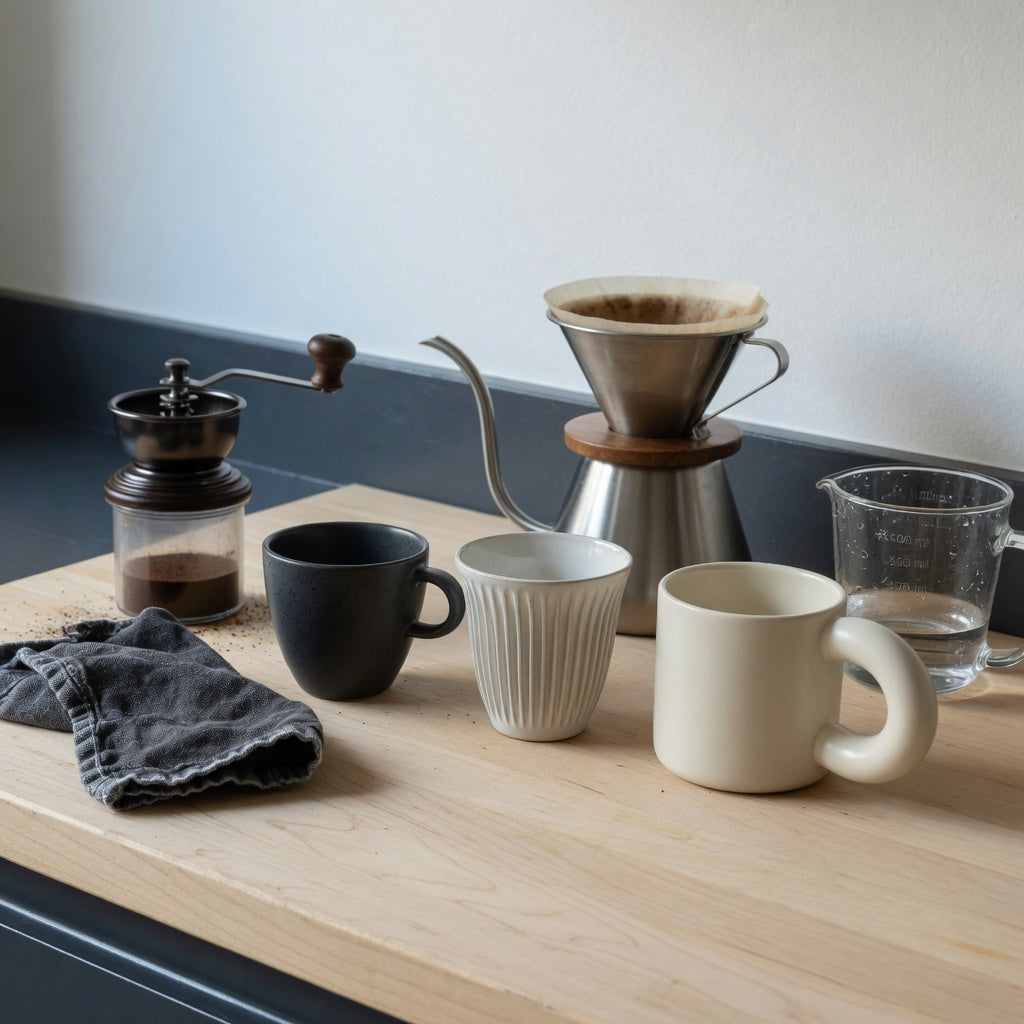
Ceramic Espresso Cup Home Coffee Station Product Shortlist Guide
Reading time: about 9 minutes
An espresso corner exposes a poor cup choice quickly. The finished drink sits too close to the rim, the handle takes up space needed for another tool, or the cup is much larger than the short pour you make every morning. This ceramic espresso cup home coffee station product shortlist guide reduces that decision to three verified options: the Retro at 170 ml, the Pleated at 200 ml, and the Ball Handle at 250 ml.
We sell and handle these ceramic vessels in our store, so we start with the details that can support a sound comparison: material, listed capacity, and visible form. Capacity alone cannot confirm clearance beneath a particular brewer or tell you how a cup will fit a shelf. We will not make those compatibility claims. Instead, this shortlist shows how to connect your normal finished drink, available station space, and preferred cup form to a sensible next step.
Which listed capacity matches your everyday pour?
A demitasse is the small cup traditionally associated with a single espresso service. Each of these three ceramic options may be larger than a traditional single-shot demitasse. That difference is useful for shoppers who add water or milk, make a longer coffee, or prefer extra room below the rim, but it can disappoint someone looking for classic demitasse proportions.
| Option | Listed capacity | Best reason to shortlist it | Reason to pass |
|---|---|---|---|
| Retro | 170 ml | It is the smallest listed capacity in this three-cup comparison. | You want a traditional single-shot demitasse or regularly need more drink volume. |
| Pleated | 200 ml | It offers the middle capacity and a visibly pleated exterior. | You prefer a plain exterior with fewer contours to wipe. |
| Ball Handle | 250 ml | It provides the largest listed capacity and a distinctive handled form. | You want the smallest vessel or an understated, handle-free silhouette. |
Do not use the espresso dose alone to choose a cup. Measure the complete drink after adding any water, milk, or foam. A simple home check is to recreate that amount with water in a measuring jug, pour it into a cup you already own, and decide how much carrying room you prefer above the liquid. Listed capacity describes the vessel; it is not an instruction to fill the cup to its rim.
Ceramic espresso cup home coffee station product shortlist guide: three use cases
These recommendations deliberately stay within the known product details. The situation comes first, the relevant product follows, and each option includes a reason to skip it.
Mostly short coffee, with more room than a demitasse
Start with the Retro 170 ml ceramic coffee and tea cup if your normal drink is at the smaller end of this shortlist. Its 170 ml capacity gives you the lowest-volume option of the three, while the visible retro form suits a station where the cup is left on display between uses.
- Choose it: Your finished drink fits comfortably within 170 ml and you want the smallest listed capacity here.
- Skip it: You want true single-shot demitasse proportions, or your usual milk or water additions call for more capacity.
Do not assume that the lowest capacity also means the smallest external footprint. Millilitres describe volume, not height, width, or handle clearance. Confirm the physical space separately before ordering.
A middle capacity with visible exterior texture
Consider the Pleated 200 ml ceramic coffee and tea cup if 170 ml feels limiting but 250 ml is more cup than you normally use. The pleated exterior is the defining visible difference. It gives the station more surface detail than a plain-sided cup without changing the comparison into an unsupported performance claim.
- Choose it: You want the middle capacity and prefer a visibly contoured ceramic form.
- Skip it: You favour a smooth, minimal exterior or want the quickest possible surface to wipe after coffee and milk splashes.
Pleats create more edges and recesses than an unbroken outer wall. That is not a defect, but it is a real cleaning trade-off on a station positioned close to a steam wand, sink, or drink-preparation area.
Longer drinks and a clearly defined handle
The Ball Handle 250 ml ceramic coffee and tea mug is the most practical shortlist candidate when your finished drink needs the greatest capacity of these three. It is also the one to examine if you prefer holding a defined handle instead of wrapping your hand around the cup body.
- Choose it: You regularly make a longer coffee, add more milk or water, or simply prefer the largest listed vessel.
- Skip it: You want a small espresso presentation, need a restrained silhouette, or cannot confirm enough room for the handled form.
The ball-style handle is visually distinctive, which can suit an open shelf or a gift selected for its form. It also changes the vessel's overall outline. Check the complete width rather than judging station fit from the 250 ml capacity.
Will the cup clear the brewer, shelf, and route to the sink?
A small espresso cup can still be awkward in a specific setup. Coffee equipment, wall shelves, grinders, and drying racks create separate clearance limits, and none can be calculated from capacity alone. Before choosing among the three products, check the station in this order:
- Place your current cup in its normal position and move nearby controls or equipment parts through the range you use during preparation.
- Measure the available width, depth, and height in millimetres at the narrowest points.
- Include the full handle in the width measurement rather than measuring only the cup body.
- Check the path from the station to the sink, especially if you carry the cup past a grinder, kettle, or shelf edge.
- Measure the cabinet shelf and drying-rack opening where the cup will spend more time than it does beneath the brewer.
Compare those limits with confirmed product dimensions before purchase. If a measurement you need is not available, do not infer it from a styled photograph. We are not claiming that the Retro, Pleated, or Ball Handle option fits a named espresso machine, cup warmer, dishwasher, or microwave.
How should ceramic be handled at a busy coffee station?
Ceramic is rigid and can chip when its rim or handle strikes a sink, another cup, or a hard shelf edge. While handling ceramic pieces, we check the drinking rim first, followed by the handle attachment area and the base. Those locations reveal common damage that can make a cup unpleasant or unsafe to keep using.
- Rinse coffee and milk residue before it dries, particularly around the drinking rim.
- Use mild dish soap and a soft sponge when hand washing. A small soft brush can reach the Pleated cup's exterior contours without aggressive scrubbing.
- Avoid abrupt temperature changes, such as moving very cold ceramic directly into very hot conditions, because thermal shock can stress ceramic.
- Inspect the rim for chips and the handle connection for cracks. Stop using a cup if damage affects the drinking edge or handle security.
- Follow the current product care instructions for dishwasher or microwave use. Do not assume compatibility from the ceramic material alone.
We do not claim that these vessels have completed a particular number of dishwasher cycles or any certified drink-specific testing. If automatic cleaning is essential to your routine, verify the published care guidance before making it a deciding factor.
Who should skip all three 170-250 ml options?
A short list is useful only if it also tells you when to leave it. These CoffeifyMug options are not the right match for every espresso station.
- Skip them if you want the proportions of a traditional single-shot demitasse. All three listed capacities may feel oversized for that presentation.
- Choose a purpose-built travel vessel instead if you need a sealed lid, insulation, or a cup intended for commuting. No lid or insulation is claimed here.
- Look for transparent drinkware if seeing the liquid layers from the side is central to how you serve coffee.
- Do not select these on the assumption that they stack, include saucers, or come with other accessories. Those features are not part of this comparison.
- Pause the purchase if exact machine clearance is mandatory and you have not confirmed the relevant external dimensions.
If the capacity or visible form of these three products does not solve your setup, browse CoffeifyMug's unique coffee mugs collection. Use the same volume and clearance checks while comparing the broader range instead of choosing only by colour or first impression.
What should you check during the five minutes before checkout?
- Measure your normal finished drink, including water, milk, and foam rather than only the espresso portion.
- Decide if 170 ml, 200 ml, or 250 ml is the closest useful capacity.
- Choose between the Retro form, Pleated exterior, and Ball Handle silhouette.
- Confirm the available height, width, and depth around the station and storage shelf.
- Read the current product details and care guidance without assuming unlisted accessories or appliance compatibility.
- Use the choose-or-skip notes above to open the matching product page, or return to the collection if none passes every check.
This process keeps style in the decision without allowing it to override practical fit. For a straight or short coffee with extra room, begin with the Retro. For a middle capacity and exterior texture, compare the Pleated. For the largest listed capacity and a prominent handle, inspect the Ball Handle.
Frequently asked questions
Which CoffeifyMug option is closest to a small espresso cup?
The Retro is the smallest of these three options at 170 ml. It may still be larger than a traditional single-shot demitasse, so compare it with your finished drink rather than assuming it will create a classic demitasse presentation. External size also needs to be confirmed separately.
Is a 250 ml ceramic cup too large for espresso?
The Ball Handle at 250 ml is large compared with a traditional single-shot demitasse, but it may suit a longer coffee or a drink with added milk or water. Choose it for the volume you actually serve, not because the word espresso requires one universal cup size. Skip it if compact presentation matters most.
Will these ceramic cups fit beneath my espresso machine?
Capacity cannot answer that question because it does not provide external height, width, or handle clearance. Measure the available area on your equipment and compare it with confirmed cup dimensions before ordering. We do not claim universal or model-specific machine compatibility for these products.
Can I put these ceramic cups in a dishwasher or microwave?
Do not assume dishwasher or microwave compatibility solely because the vessels are ceramic. Follow the current care information supplied for the individual product. If that guidance is unavailable, hand washing with mild soap and a soft sponge is the cautious option.
How do I make a three-cup shortlist for my coffee station?
Use this ceramic espresso cup home coffee station product shortlist guide by measuring your finished drink first, then checking station clearance and preferred form. Compare the Retro 170 ml, Pleated 200 ml, and Ball Handle 250 ml in that order. Remove any option that fails either the volume check or the physical-space check.
Measure the drink and the station now, then open the product page that matches your result. If all three involve a compromise you do not want, move to the unique coffee mugs collection and apply the same checklist to a different form.
More from our blog
Read more
Wassail Mug Gift Choice Practical Purchase Checklist: 400-480 ml
A practical gift checklist that matches a recipient's usual pour and grip to The Flow (400 ml), Morning and Night (440 ml), or The Rock (480 ml), with clear limits on care, material, and gift-extra...
Read more
Ceramic Coffee Mugs With Large Handles: Gift Purchase Checklist
Match a mug to the recipient's grip, cupboard space, drink routine, and care habits. This checklist compares three CoffeifyMug handle styles while identifying the product details you still need to ...
Read more
Leave a comment
This site is protected by hCaptcha and the hCaptcha Privacy Policy and Terms of Service apply.