
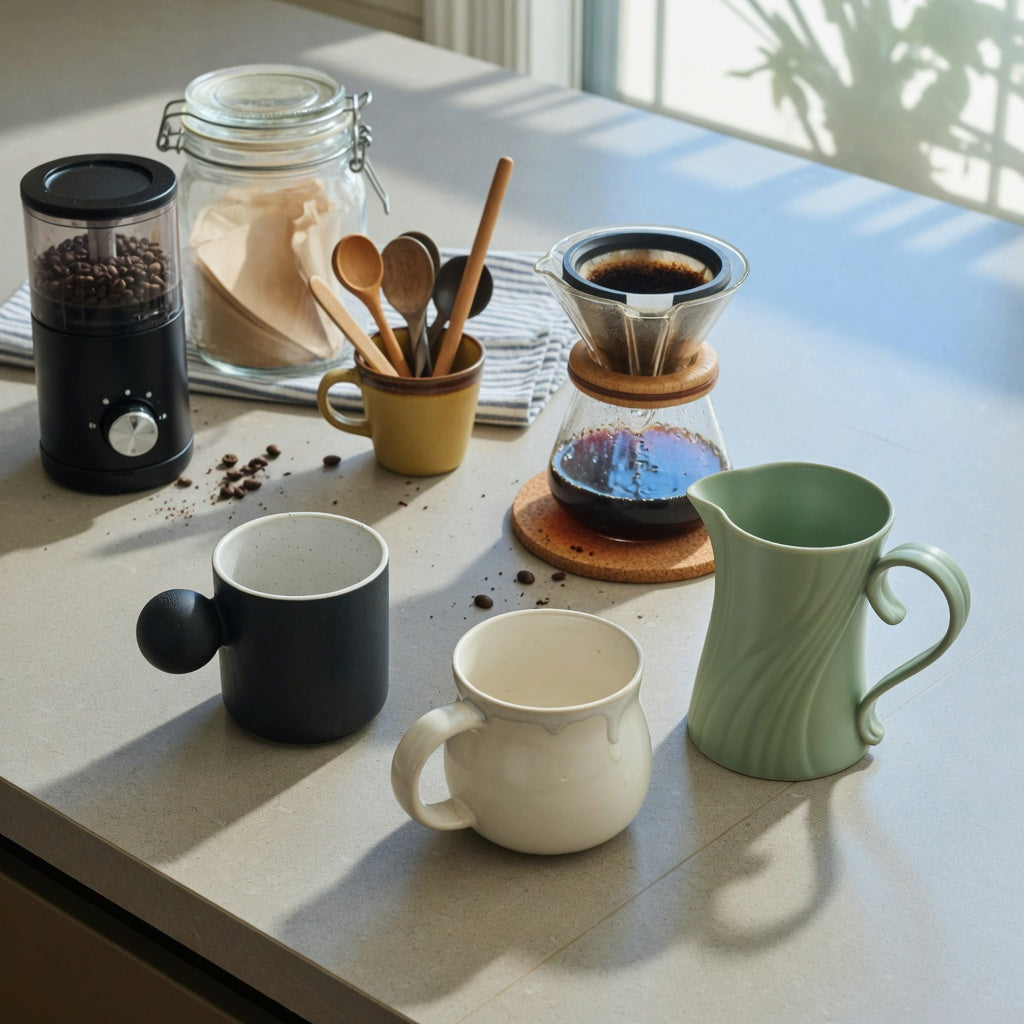
Ceramic Coffee Mug With Handle: Home Coffee Station Product Shortlist
Reading time: about 9 minutes
The grinder sits on one side of the tray, the filter jar on the other, and the mug handle keeps meeting the spoon cup. We see that counter problem more often than a shortage of attractive mugs. This ceramic coffee mug with handle home coffee station product shortlist guide starts with the space the mug must occupy, then compares three ceramic options using details a shopper can verify: visible handle form, vessel shape, and current listed capacity.
We sell and handle mugs in this category, so we know a product photo is useful but incomplete. It cannot prove hand fit, ergonomic comfort, strength, heat retention, appliance clearance, or care compatibility. We keep those claims out of the comparison and show where a tape measure or current product instruction should make the decision.
Four measurements that decide whether a mug fits the station
Measure the usable counter area after the brewer, kettle, grinder, and containers are in their normal positions. Moving everything to make a new mug fit creates a showroom arrangement, not a station that works at 7 a.m.
- Maximum body width: Measure the widest part of the vessel, not only the foot. A rounded body can extend beyond its base.
- Total width with the handle: Record the distance from the far edge of the body to the outermost handle point. This is the number that matters beside a canister or second mug.
- Counter-to-rim height: Compare the full vessel height with any shelf, brewer outlet, or hanging utensil above the intended position.
- Available depth: Measure from the wall or backsplash to the front edge of the tray. Keep the entire foot on the supporting surface.
Use listed product dimensions where they are provided. If a dimension needed for your setup is absent, ask our store rather than estimating scale from a styled photograph.
Ceramic material, listed capacity, and firm claim boundaries
The three products below are listed as ceramic mugs, but ceramic material alone does not establish capacity, care instructions, durability, microwave use, dishwasher use, or thermal performance. Those details must come from the current product listing, selected variant, packaging, or care information.
| Buyer variable | Evidence to use | Shortlist decision |
|---|---|---|
| Material | The current listing identifies the vessel as ceramic | Keep it if ceramic is your required body material |
| Capacity | The capacity stated for the selected product or variant | Compare it with your measured daily serving |
| Footprint | Body dimensions plus the visible handle projection | Eliminate options wider or taller than the station allows |
| Care | Explicit instructions supplied with that item | Do not infer machine or microwave use from the word ceramic |
For a useful capacity check, measure the coffee, milk, or tea that normally goes into your current mug in ounces or milliliters. Include the space occupied by ice if the station serves iced coffee. A vessel that looks larger in a close photograph does not necessarily have a larger listed capacity.
Using our ceramic coffee mug with handle home coffee station product shortlist guide
These are three scenario-based starting points, not a ranking. Each recommendation explains the setup that makes the option worth opening, the reason it may suit that setup, and the condition that should remove it from your shortlist.
Ball-handled mug for a station with dedicated side clearance
Choose it when: The mug sits alone or at the open end of a tray, and you want the handle to be a visible design feature. The ceramic Ball-Handled Coffee Tea Mug has a clearly identifiable ball-form handle, so its side profile differs from a close loop handle.
Why it fits that scenario: An open-ended position gives the projecting handle its own zone instead of placing it against a grinder, wall, or neighboring cup. Check the current listed capacity against your normal serving before letting the handle design decide the purchase.
Skip it when: Mugs must line up tightly, fit inside a narrow cabinet opening, or nest for storage. We do not claim that the ball handle is comfortable for every user or that this mug stacks with another vessel.
Round mug for buyers matching an existing rounded silhouette
Choose it when: A round mug already works on your station and you want a comparable visual outline. The Round Coffee Tea Mug listing shows a ceramic vessel with a rounded profile and visible loop-style handle.
Why it fits that scenario: You can trace the footprint of your current round mug and use that outline as a direct comparison. Measure the widest part of the new vessel rather than assuming the base represents its full width, then verify that its listed capacity matches your drink.
Skip it when: The limiting space is between two straight-sided containers or you specifically want a sculptural handle. A rounded profile can occupy space above its foot, so a base-only measurement is not enough.
The Flow mug for a station built around a curved silhouette
Choose it when: The mug remains on display and you prefer a more continuous, flowing shape over a conventional upright outline. Review The Flow Coffee Tea Mug for its ceramic material, visible handle relationship, vessel profile, and current listed capacity.
Why it fits that scenario: Its silhouette gives the station a distinct shape without relying on color alone. That makes it a relevant candidate for an open shelf or counter where the vessel itself is part of the arrangement.
Skip it when: Your storage plan requires straight sides, confirmed nesting, or a mug that duplicates an existing round set. The Flow name describes the product, but it does not establish cleaner pouring, drip prevention, or compatibility with a particular kettle or brewer.
If all three fail your measurements, browse the wider unique coffee mug collection by silhouette. Check each individual listing for material and capacity instead of assuming every item in a mixed collection has the same specifications.
Handle clearance around a grinder, kettle, and neighboring cups
A handle changes the full footprint even when the vessel base stays inside the tray. We use a simple paper check for crowded counters: place your current mug on paper, trace the body and outer handle edge, cut out the outline, and set that template in the proposed position. Rotate it so the handle faces the direction it will face during daily use.
Mark the grinder door, kettle base, spoon cup, and second-mug boundary with removable tape. If the paper outline crosses one of those boundaries, the comparable handle form needs more room than the station provides. This test evaluates object clearance only; it does not establish grip quality or fit for a particular hand.
Unboxing checks for rims, glaze, handles, and foot rings
Inspect a ceramic mug in direct side light before its first use. In our experience, the useful checkpoints are specific: look for chips or sharp areas at the rim, visible cracks where the handle joins the body, unexpected glaze skips or scratches, and debris or irregular contact at the foot ring. These are inspection points, not claims that a listed mug will arrive with a defect.
Set the empty mug on two known flat, dry surfaces if it appears to rock; that separates an uneven counter from a vessel issue. Keep the packaging until the inspection is complete, and photograph any concern before contacting our store.
Read the product and packaging care directions before placing the mug in a dishwasher cycle or microwave. Do not use either appliance as a trial when the relevant instruction is missing. For a gift, complete this inspection before wrapping and keep the product-specific care information with the mug.
Situations where a different mug category makes more sense
A handled ceramic mug is not the automatic answer for every coffee station. Remove these three options from consideration if your primary requirement falls outside the facts their listings establish.
- You need a sealed lid or documented spill resistance for commuting.
- You need confirmed stackability for a short cabinet or hospitality setup.
- You require exact compatibility with a named coffee machine and cannot verify the available height and width.
- Dishwasher or microwave use is mandatory but is not explicitly addressed by the current product instructions.
- Your coffee, milk, tea, or ice serving exceeds the selected mug's listed capacity.
A lidded travel vessel, a specifically stackable cup, or a straight-sided mug with complete dimensions would be a better purchase in those situations. The right shortlist should exclude attractive products that cannot satisfy the main requirement.
A five-minute comparison before you order
- Measure the amount you normally drink rather than estimating from your current mug's outside size.
- Write down the maximum body width, total width with handle, available depth, and height limit.
- Decide where the handle will point during storage and use.
- Open the three product pages and confirm ceramic material, current listed capacity, and the visible vessel shape.
- Remove any option that lacks a specification required for your setup.
- Use handle design and overall silhouette as tie-breakers only after the practical checks pass.
This sequence keeps a distinctive handle from distracting you from a capacity or clearance mismatch. It also gives you a clear reason for every product that remains on the shortlist.
Frequently asked questions
Which handled ceramic mug is best for a very small coffee station?
There is no reliable smallest choice without current dimensions. Compare each mug's maximum body width, total width including the handle, and height with your available space. The product name or base size alone cannot establish counter fit.
How do I compare mug capacity for my daily coffee?
Our ceramic coffee mug with handle home coffee station product shortlist guide treats listed capacity as a pass-or-fail check. Measure your usual drink in ounces or milliliters, account for milk or ice, and compare that amount with the capacity stated for the selected product or variant.
Are these ceramic mugs dishwasher and microwave safe?
Do not infer dishwasher or microwave safety from ceramic material. Check the current product listing, packaging, and care instructions for an explicit statement. Contact our store before ordering if either use is a firm requirement and the direction is unclear.
Can I use one of these mugs under my coffee machine?
We do not make appliance-compatibility claims for this shortlist. Measure from the supporting surface to the machine outlet and compare that clearance with the mug's full height, while also checking tray width and handle space.
Which mug makes the most practical gift?
Start with the recipient's usual drink volume and available shelf or counter space. Choose the ball-handled mug for a pronounced handle detail, the round mug for a familiar rounded outline, or The Flow for a more sculptural silhouette. If you cannot verify capacity or care requirements, a different style with fully confirmed details is the safer shortlist choice.
Trace your current mug, record the four measurements, and open the three linked product pages side by side. Keep only the options that pass capacity and clearance first; then use the full unique mug selection if none of those shapes earns the available counter space.
More from our blog
Read more
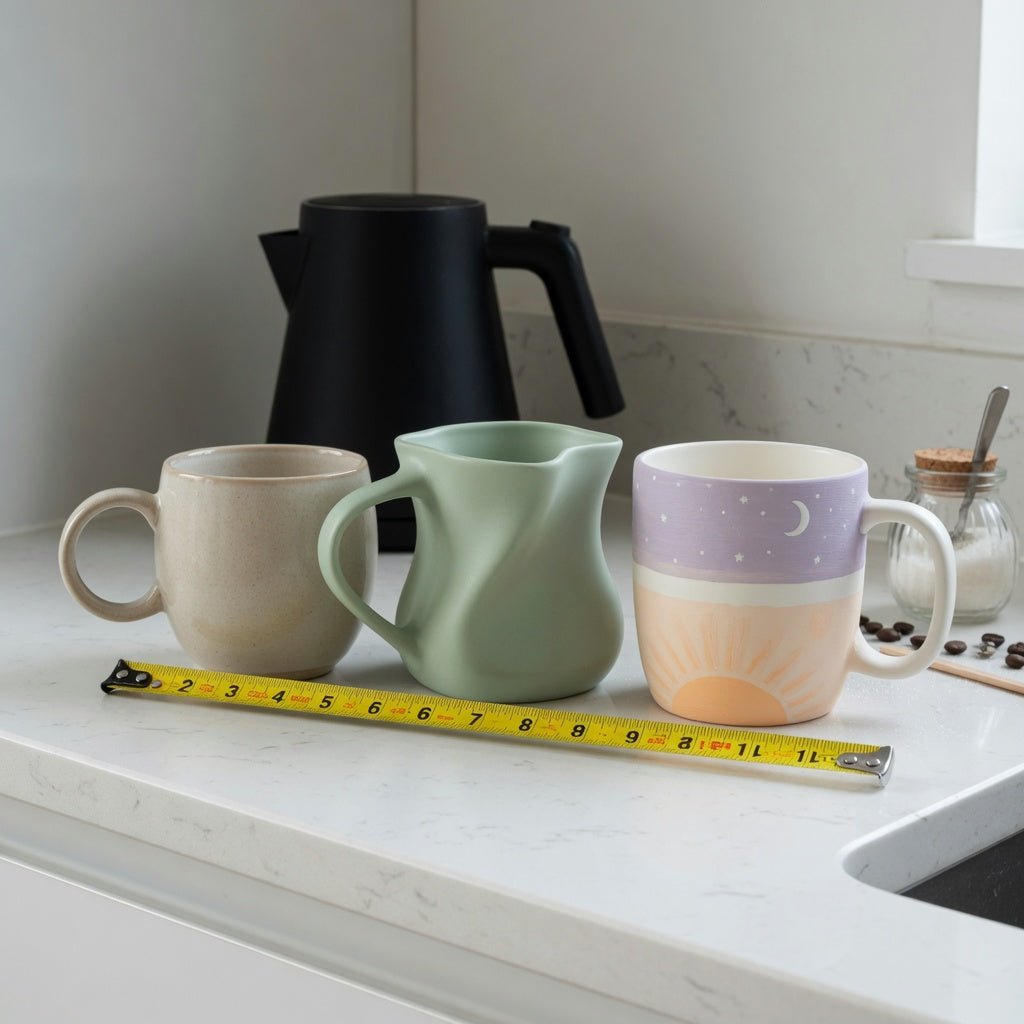
Ceramic Tea Mug Home Coffee Station Practical Purchase Checklist
Use this station-first checklist to compare ceramic material, current listed capacity, visible mug form, and handle shape. It also explains where product photos stop being reliable and when a diffe...
Read more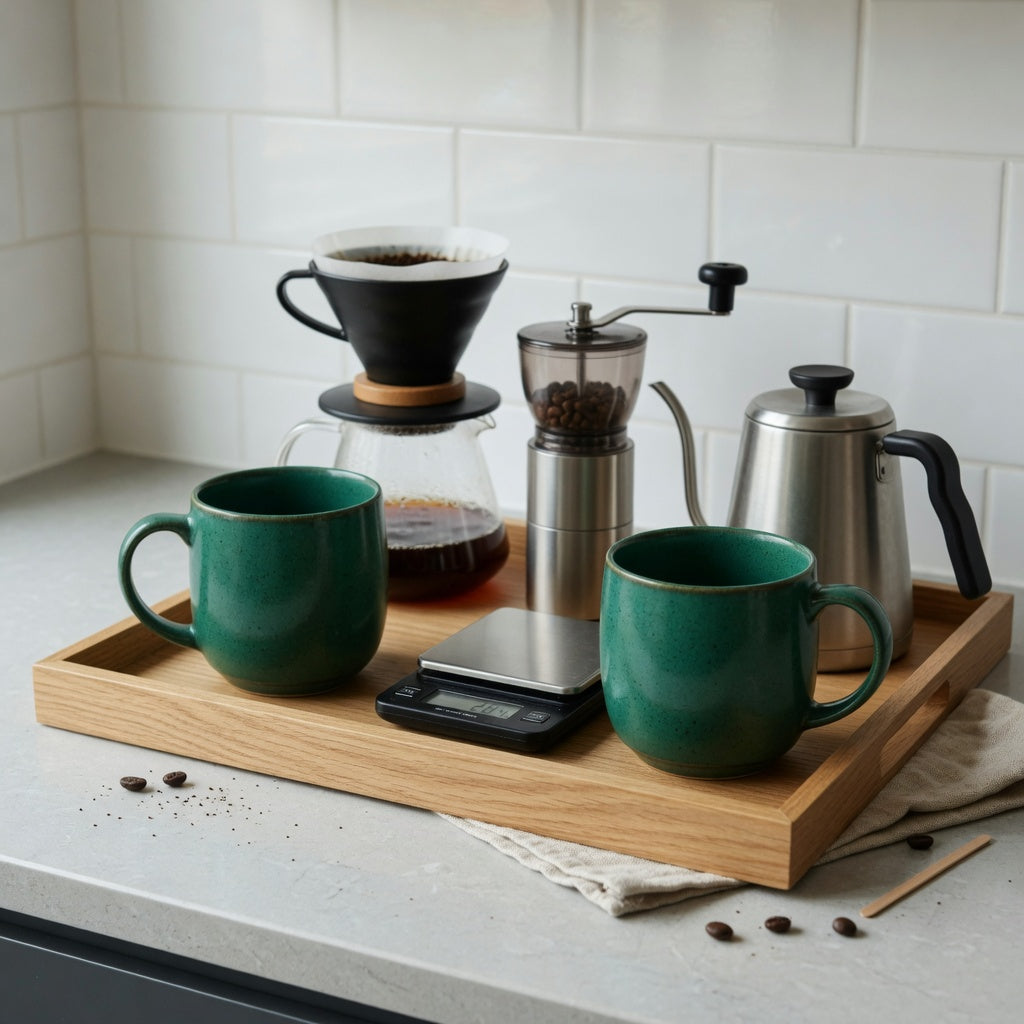
Emerald Green Coffee Mug Home Coffee Station Product Shortlist Guide
Compare two mug forms using current color availability, listed capacity, visible silhouette, and handle shape. This scenario-based shortlist explains which option suits a compact, shared, or gift-f...
Read more
Leave a comment
This site is protected by hCaptcha and the hCaptcha Privacy Policy and Terms of Service apply.