
Ceramic Coffee Mug With Handle: Everyday Rotation Checklist
Reading time: about 9 minutes
A clean mug can still be the wrong mug at 7:30 a.m. It may hold less than your usual pour, catch the mug beside it when you pull it from the cabinet, or occupy the office desk space needed for a notebook. This ceramic coffee mug with handle everyday mug rotation practical purchase checklist is designed around those ordinary friction points, not an arbitrary target for how many mugs you should own.
In our store, we compare handled ceramic mugs using four details that a shopper can verify: the listed ceramic material, the listed capacity, the visible handle form, and the vessel shape shown in the product images. We also keep a firm boundary around what those details cannot establish. A photo does not confirm hand fit, and ceramic material alone does not confirm strength, heat retention, care ratings, or dishwasher and microwave safety.
What job is missing from your current mug rotation?
Start with a seven-day audit. Count the mugs that actually leave the shelf, but pay more attention to why each one gets selected. A rotation can contain three mugs or ten and still have a gap if none fits a particular drink, location, or storage slot.
- Morning coverage: Your usual mug is often waiting to be washed when the next drink is poured.
- Office separation: You need one mug that stays at the desk instead of moving between rooms.
- Pour mismatch: Existing mugs are consistently too small or unnecessarily large for the drink you make.
- Shared-shelf identification: Similar mugs are difficult to distinguish quickly in a household or office kitchen.
- Gift replacement: You are replacing a chipped or retired mug and need the new one to fit an established cabinet slot.
Name one job before browsing. If the only reason for buying is that another design looks appealing, treat it as a collection purchase rather than a practical rotation purchase. That distinction helps prevent an attractive mug from spending most of its time at the back of the cabinet.
Do listed capacity and full footprint match your daily pour?
Capacity is most useful when it is compared with a real pour. Fill your current preferred mug with cool water to the level you normally use, leaving the same headroom you leave for coffee or tea. Transfer that water to a marked measuring cup. You now have a practical reference to compare with the capacity stated on a product page.
Do not assume a listed capacity represents your comfortable fill line unless the listing explains how it was measured. A vessel filled near the rim leaves less room for carrying, milk, foam, or ice. If that distinction will affect your purchase, confirm it before ordering.
Storage requires a second set of numbers. Measure the cabinet opening height, usable shelf depth, and the horizontal space available for one mug. For handled mugs, measure the full width from the far side of the body to the outermost edge of the handle. Body width alone can hide the part most likely to contact a neighboring mug.
| Daily scenario | Compare before buying | Main trade-off |
|---|---|---|
| One standard morning pour | Your normal fill level against listed capacity | Unused capacity can consume shelf space without helping the routine |
| Coffee or tea at an office desk | Base footprint, vessel height, and handle clearance | A larger silhouette leaves less room near a keyboard, cables, or notebook |
| Iced coffee | Capacity, visible opening shape, and required headroom | Ice occupies volume, but an opening diameter cannot be confirmed from photos alone |
| Narrow cabinet row | Full width including the handle | A distinctive handle may require more separation from adjacent mugs |
Ceramic coffee mug with handle everyday mug rotation practical purchase checklist
Use the ceramic coffee mug with handle everyday mug rotation practical purchase checklist as a purchase gate. If a must-have detail is absent from the current product page, mark it as unknown instead of filling the gap with an assumption.
- Define the role. Decide whether the mug is for a first coffee, tea, iced drinks, an office desk, guests, or a gift replacement.
- Verify the material. Confirm that ceramic is listed in the product information rather than relying only on the appearance of the glaze.
- Record the listed capacity. Compare it with your measured normal pour, not with the largest mug in your cabinet.
- Read the vessel silhouette. Note whether the body is round, upright, tapered, or more sculptural. Use photos for visual comparison, not exact dimensions.
- Measure the whole storage slot. Check shelf height, depth, and full mug width including the handle.
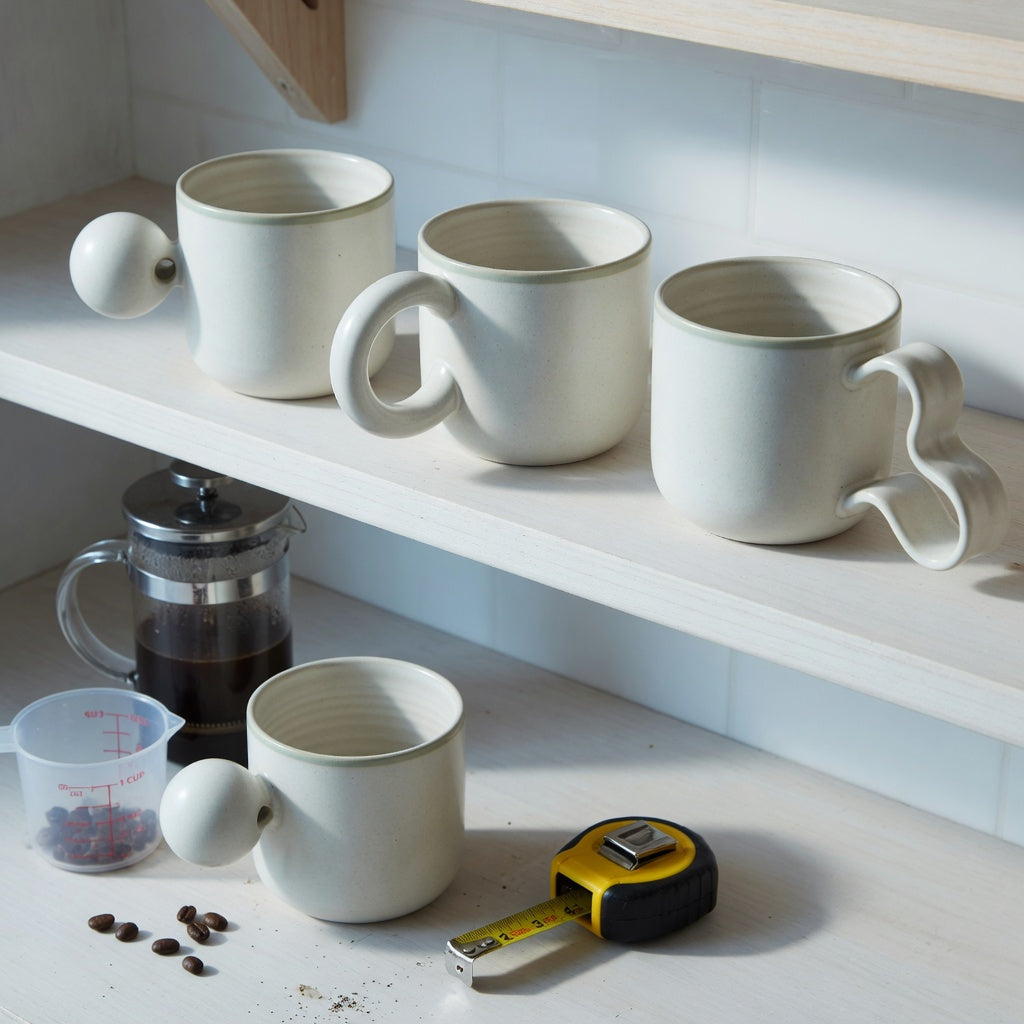
- Compare visible handle forms. A ball detail, round loop, and flowing curve create different silhouettes and clearance needs. None guarantees comfort or hand-size fit.
- Confirm care information. Do not infer dishwasher or microwave safety from ceramic construction. Check the current listing, packaging, or care label.
- Identify any non-negotiable unknown. If you require an exact weight, opening diameter, handle clearance, or care rating and it is not stated, ask before ordering.
- Make room in the rotation. Decide where the new mug will sit and which existing piece, if any, will leave the active row.
Which CoffeifyMug handle form solves the actual gap?
A visual marker for a shared shelf
If several people use similar mugs, the Ball-Handled Coffee Tea Mug is a logical first comparison because its visible spherical handle detail gives the mug an identifiable profile. The fit is situational: that form may also determine the mug's maximum width, so compare its current listing and photos with the space between neighboring mugs. We recommend it for visual distinction, not as a promise of grip comfort.
A round profile for a mixed kitchen set
If your active row already contains conventional rounded forms, compare the Round Coffee Tea Mug. Its visible round vessel and loop-style handle can make sense for a shopper who wants the next mug to relate to an existing set rather than become the shelf's main visual accent. Round does not automatically mean compact, so listed capacity and available dimensions still decide whether it fits.
A contrasting silhouette for open storage
If mugs remain visible on an open shelf and the missing role is a more sculptural piece, review The Flow Coffee Tea Mug. The continuous-looking body and handle line provides a different visual cue from the ball and round forms. Choose it because that silhouette suits the rotation and storage space, not because the shape implies better heat retention, strength, or ergonomics.
Each recommendation starts with a reader situation and ends with a verification step. If none of the three forms fills a named gap, adding another handled mug may not improve the rotation.
Which ceramic and care facts are confirmed, and which remain open?
Ceramic is a material description, not a complete performance specification. This is where careful comparison matters most, especially for a household that depends on regular dishwasher cycles or reheats drinks in a microwave.
| Reasonable comparison point | Detail that needs separate confirmation |
|---|---|
| Ceramic material listed on the page | Strength, chip resistance, or expected service life |
| Capacity stated in the product details | Whether it is a brim measurement or a practical fill level |
| Handle form visible in product images | Comfort, finger clearance, and fit for a particular hand size |
| Round, ball-handled, or flowing silhouette | Exact overall dimensions, weight, and balance unless listed |
| Glaze color and exterior appearance shown | Dishwasher safety, microwave safety, and other care ratings |
If a missing detail affects daily use, pause the decision. For example, shoppers who only run full dishwasher loads should confirm the stated care instructions instead of planning an unverified dishwasher trial. The same restraint applies to microwave use and heat-retention expectations.
What should happen at gift unboxing and first-week use?
Before discarding packaging from a delivery or gift unboxing, inspect the mug in clear light. During our own handling checks, we look beyond color and shape because small finish or transit issues are easier to document before the mug enters service.
- Check the rim, base edge, and handle attachment areas for chips or hairline cracks.
- Look for unexpected glaze gaps, pinholes, or sharp rough areas that were not represented in the product images.
- Place the empty mug on a known flat, dry counter and check for noticeable rocking.
- Confirm that the received handle form, vessel shape, and listed color match the item ordered.
Glaze variation shown or described by the seller may be intentional; transit damage is a separate issue. If you find damage, do not use the mug while resolving it under the store's current policy.
For the first week, place the mug in the front row and use it only according to the stated care directions. Watch four practical details: whether the normal pour leaves enough headroom, whether the handle clears adjacent mugs, whether the base fits its planned desk or shelf position, and whether anyone actually chooses it. This is a rotation test, not a durability test.
When is a different cup style the better purchase?
A handled ceramic mug is not the default answer for every routine. A different vessel is likely more appropriate in these situations:
- Your drinks normally leave the house and require a secure lid.
- Your main concern is keeping a drink hot through a long desk session, which points toward a purpose-listed insulated vessel.
- Your cabinet depends on verified stacking, and the mug listing does not state that the shape is stackable.
- Handles already collide in the available storage row.
- Dishwasher or microwave compatibility is mandatory but not confirmed in the product information.
- Hand-size fit is the deciding factor and no useful handle dimensions are provided.
There is no benefit in forcing a ceramic handled mug into a routine built around portability, insulation, or compact stacking. The useful purchase is the one that matches the actual task, even when that means choosing another cup style.
Frequently asked questions
How do I use a ceramic coffee mug with handle everyday mug rotation practical purchase checklist?
Start by naming the missing role in your current rotation. Then compare ceramic material, listed capacity, vessel shape, and visible handle form with your usual pour and measured storage slot. Treat care, dimensions, comfort, and performance as unknown unless the current product information confirms them.
Does ceramic automatically mean a mug is dishwasher and microwave safe?
No. Ceramic material by itself does not establish either care rating, and glaze or decorative details can have separate restrictions. Check the product listing, packaging, or care label before using a dishwasher or microwave.
Which handle shape is best for small or large hands?
A ball, round loop, or flowing handle cannot be matched reliably to hand size from appearance alone. Look for actual handle and clearance dimensions or ask for them if fit is essential. We do not treat visible handle style as a comfort guarantee.
Is a larger listed capacity better for an everyday rotation?
Only if your normal drink uses that volume. Measure a typical pour with cool water and compare it with the listed capacity while allowing for headroom, milk, foam, or ice. A larger mug can be the wrong choice if it creates unused volume or consumes needed shelf and desk space.
What should I compare immediately before ordering?
Write down your normal pour volume, cabinet height and depth, and available width including handle clearance. Compare those facts with the current product listings, then review the shapes together in the CoffeifyMug unique coffee mugs collection. Order only after one option has a defined role and a confirmed place in the rotation.
More from our blog
Read more
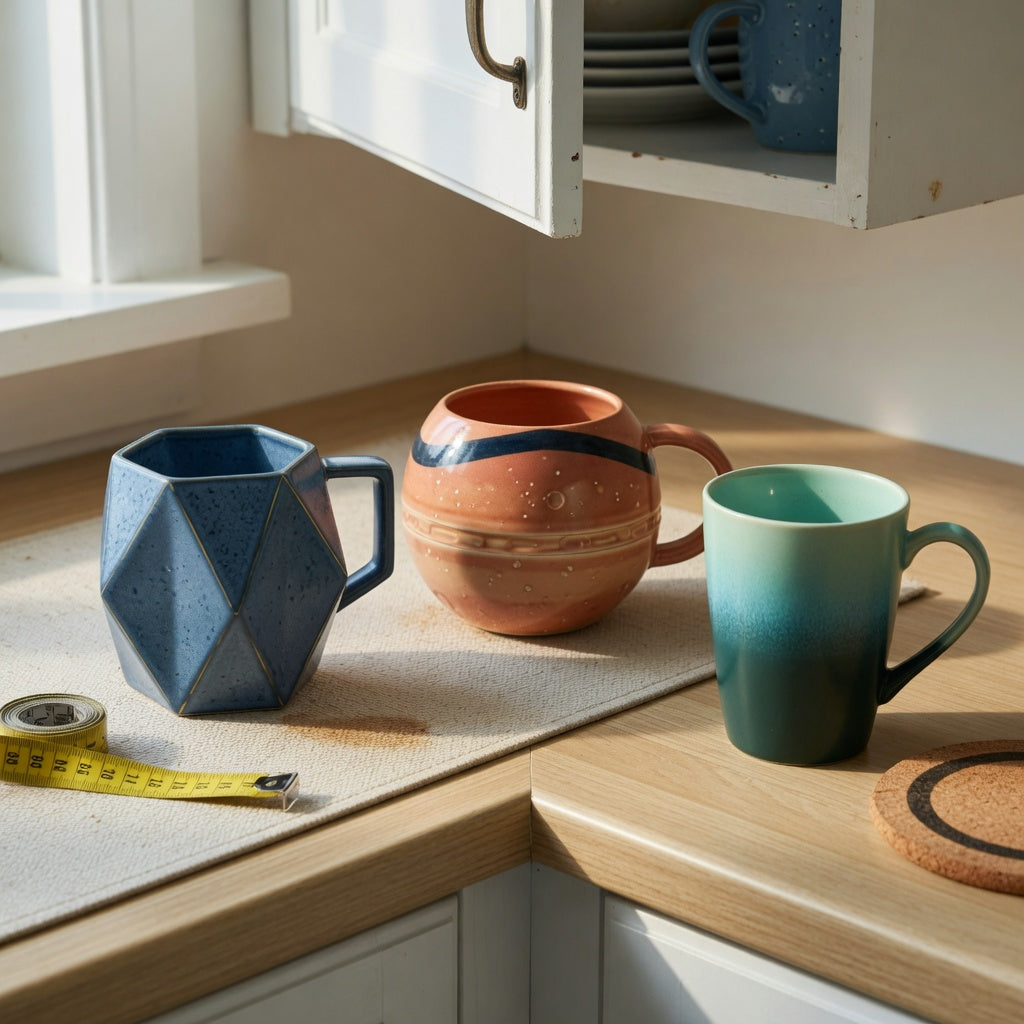
Geometric Coffee Mug Everyday Mug Rotation Product Shortlist Guide
Compare the Rhombus, Planet, and Gradient ceramic mugs by everyday role, listed capacity, shelf fit, care needs, and clear reasons to choose or skip each form.
Read more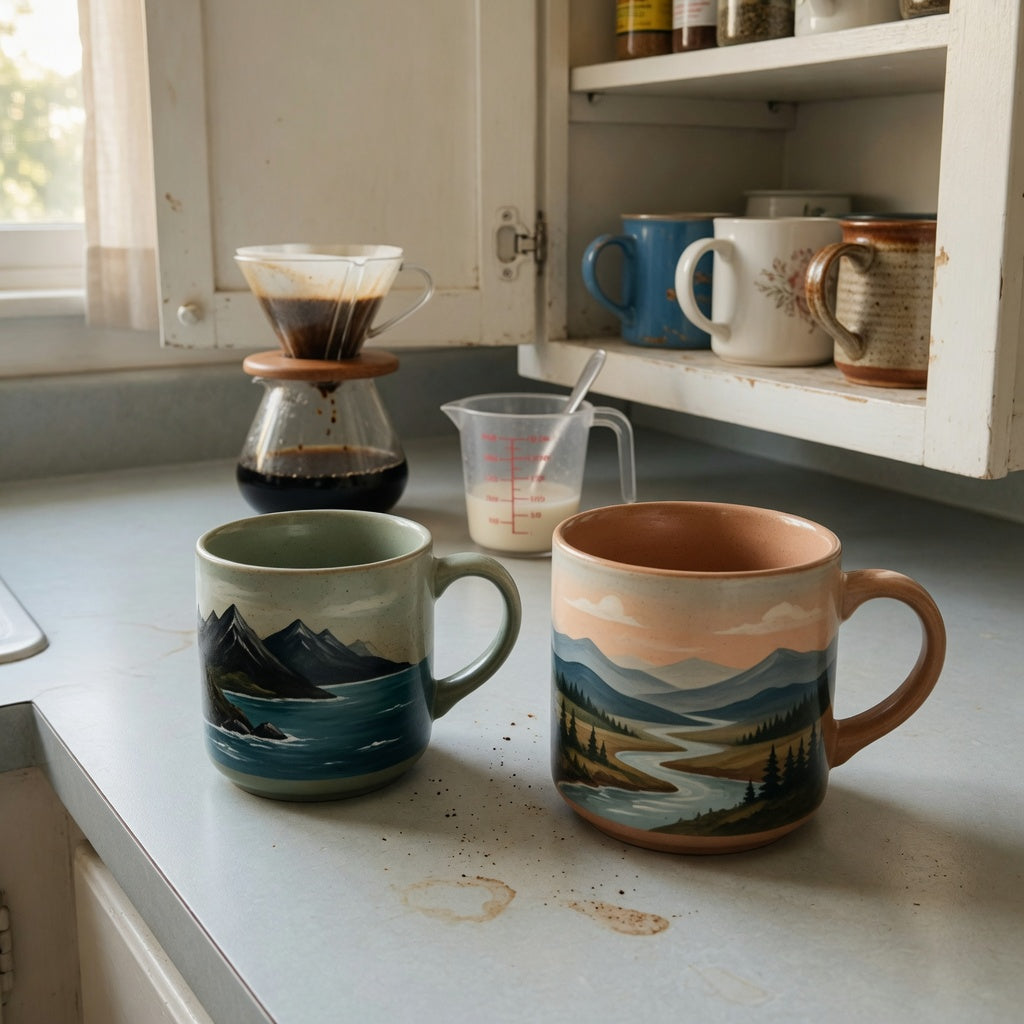
Ocean Coffee Mug Everyday Mug Rotation Product Shortlist Guide
Compare two ocean-inspired mugs by visible scene, photographed form, listed material, capacity, storage fit, and daily use. Each option includes clear reasons to choose it or leave it off your shor...
Read more
Leave a comment
This site is protected by hCaptcha and the hCaptcha Privacy Policy and Terms of Service apply.