
Cappuccino Coffee Mug Storage Fit Guide: Shelf Fit by Shape
Reading time: about 10 minutes
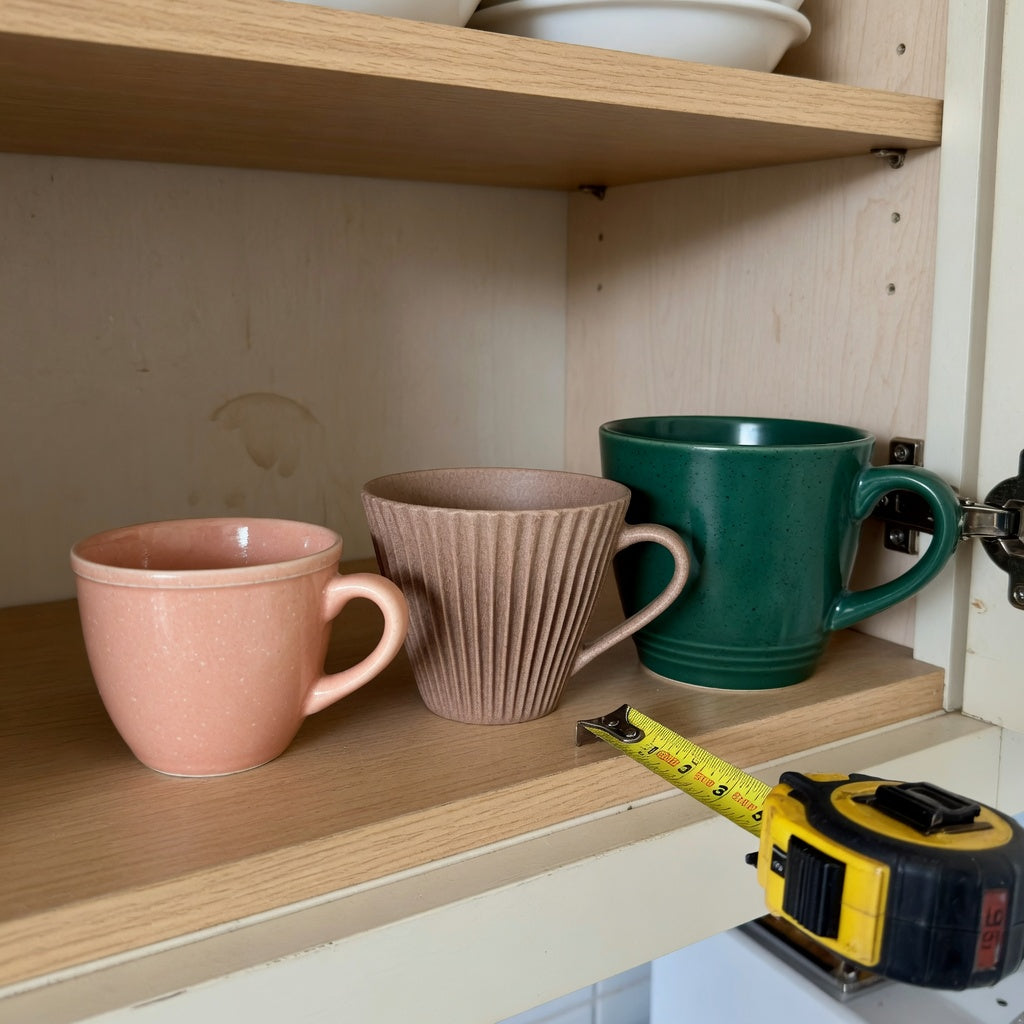
A cupboard can have enough room for a cup body and still fail the door test. The handle catches, the rim sits under a shelf lip, or the cup has to be turned sideways every time it is put away. This cappuccino coffee mug storage fit guide focuses on those practical conflicts across three current CoffeifyMug options: the Retro at 170 ml, the Pleated at 200 ml, and the Emerald at 270 ml.
In our store, storage questions often start with capacity, but capacity is only the first data point. It tells you how much a cup holds, not its total width with the handle, height to the rim, base diameter, or clearance needed to lift it from a crowded shelf. We use the verified capacities and visible forms here without turning them into invented external measurements. None of these products is presented in this guide as designed, tested, or certified specifically for cappuccino.
What does this cappuccino coffee mug storage fit guide compare?
This comparison covers the information that can help a shopper narrow the choice before checking a cabinet. The current verified catalog facts are the listed capacities: Retro coffee tea cup at 170 ml, Pleated coffee tea cup at 200 ml, and Emerald coffee tea mug at 270 ml.
Full external measurements are not part of the supplied comparison facts, so we do not assign estimated widths, heights, or handle projections. Instead, use the visible shape and listed capacity to create a shortlist, then check these five storage variables against the live product information and your own shelf:
- Body footprint: the widest point of the body or rim, not the volume printed on the listing.
- Handle envelope: the total distance from the opposite side of the cup to the outer edge of the handle.
- Usable shelf depth: the distance from the back panel to the inside of the closed door, accounting for any front lip.
- Vertical removal space: the room needed to lift the cup before pulling it forward.
- Access path: nearby plates, hinges, shelf supports, and other handles that can obstruct removal.
These details matter in apartment kitchens, office cupboards, coffee stations, and gift situations where the recipient's storage is unknown. A cup that technically rests on the shelf can still be inconvenient if it must be rotated around another mug every morning.
How do 170 ml, 200 ml, and 270 ml affect shelf planning?
The capacity order gives you a sensible starting point, but it does not prove the same order for external size. A lower, wider cup can occupy more shelf width than a taller cup with greater volume. Handle shape can reverse the expected result again.
| Current option | Listed capacity | Useful storage signal | What capacity cannot confirm |
|---|---|---|---|
| Retro | 170 ml | Smallest listed serving volume of the three | Exact width, height, base size, or handle reach |
| Pleated | 200 ml | Middle capacity with a visibly textured exterior | How much side clearance the outer pleats require |
| Emerald | 270 ml | Largest listed serving volume of the three | Whether the added volume appears mainly in height, width, or both |
A shopper looking for a coffee cup for cappuccino may initially choose by drink volume. For cabinet planning, reverse the process: decide which capacities suit your pour, then eliminate any shape that cannot be verified against the shelf. This prevents a familiar buying mistake, assuming the smallest capacity automatically has the smallest total footprint.
Is the Retro 170 ml the practical starting point for a crowded cabinet?
The Retro has the smallest listed capacity in this group, and its visible presentation is a relatively simple rounded cup form. That makes it the logical first option to inspect if you use a shallow upper cabinet, keep cups in a tightly spaced row, or are buying a gift for someone whose storage setup is unknown.
The reasoning is conservative rather than absolute: less serving volume may correspond to a more compact cup, but only external dimensions can confirm that. Review the live Retro 170 ml cup details and compare any listed measurements with the narrowest usable part of the intended shelf. Include the handle in that check.
The trade-off is drink capacity. The Retro is not the strongest match for someone who prioritizes the largest pour among these three choices. It suits the shopper who is comfortable with 170 ml and wants to begin with the smallest verified capacity before checking the physical fit.
Where does the Pleated 200 ml fit on a shared cup shelf?
The Pleated sits between the other two options at 200 ml. Its most obvious form difference is the pleated exterior. From a storage perspective, the outermost ridges define the contact points, so the cup should be assessed at its widest visible profile rather than treated like a smooth cylinder.
This option makes sense for a shopper who wants more listed capacity than the Retro but does not need the Emerald's 270 ml. It is also relevant when the cup will be displayed on an open shelf, where the textured shape remains visible instead of being pressed into a dense cupboard row. Check the Pleated 200 ml cup if that middle-volume scenario matches your routine.
Do not assume the pleats create a specific amount of extra width, and do not assume they cause problems on every wire or solid shelf. Their practical effect depends on the cup's actual outer dimensions, base contact, and the spacing of nearby items. For a cabinet organized to exact slots or narrow shelf dividers, confirm those measurements before ordering.
When does the Emerald 270 ml justify more storage scrutiny?
The Emerald carries the largest verified capacity at 270 ml and presents as the fullest mug form in this three-product comparison. It is the relevant next step for someone who values the larger listed pour and has an open coffee station, a less crowded shelf, or enough flexibility to give one mug a dedicated position.
Larger capacity does not automatically mean a deeper cup. The additional volume could be distributed through height, width, or the overall body profile, and this guide does not invent which dimension changes most. Treat the Emerald 270 ml mug as the option that deserves the most careful external measurement check, not as a product that is guaranteed to exceed the others in every direction.
The Emerald is not the most cautious selection for an already full kitchenette if you are unwilling to rearrange the shelf. It is better aligned with a shopper who wants the greatest listed capacity of these options and can verify the available space before buying.
How should you measure body, handle, and cabinet-door clearance?
Measure the exact location where the new cup will live, not an empty section of a different shelf. Cabinet interiors vary around hinges, frames, shelf pins, and doors, so a single depth reading at the center can miss the narrowest point.
- Clear the intended position. Remove neighboring cups so you can see shelf lips, supports, and uneven surfaces.
- Measure usable depth. Measure from the back panel to the inside surface of the closed door. If a hinge or frame projects into that path, use the smaller clearance.
- Check usable height. Measure from the shelf surface to the shelf or frame above it. Think about the upward movement needed to clear a shelf lip.
- Account for the full handle. A product's body width does not include handle projection unless the listing explicitly says it is an overall measurement.
- Test the removal path. Use an existing cup to see whether you naturally lift, tilt, or rotate it. A mug can fit at rest but remain awkward to remove.
- Leave functional space. Do not plan a fit that depends on the rim or handle touching the cabinet every time. There is no universal clearance number because shapes and access angles differ.
If the live listing does not provide every external measurement you need for a very tight cabinet, pause before relying on capacity alone. That is especially relevant for under-shelf racks and individual cubbies, where a small difference at the handle can decide the fit.
How do solid shelves, wire risers, hooks, and stacking change the decision?
The same cup can behave differently across storage systems. We look at the contact points first because they determine stability and the risk of repeated knocks.
- Solid cabinet shelf: check total width, handle orientation, and room to lift the cup without striking the shelf above.
- Wire shelf or riser: confirm that the base sits securely across the wire spacing. Exterior texture alone does not determine stability.
- Wall hook or mug tree: verify that the handle opening fits over the hook and that the storage hardware is rated for the intended load.
- Stacked storage: do not assume these three different forms are stackable. A cup should only be stacked if its shape seats securely without pressure on the rim or handle.
- Office cupboard: allow room for other users to return the cup without arranging every handle at a precise angle.
Many shoppers search for a ceramic cappuccino cup. For any glazed ceramic piece, repeated hard contact at the rim, handle, or outer surface can lead to chips or finish damage. Storage should not require forcing pieces together. Dishwasher suitability, microwave suitability, heat retention, and rack-cycle performance are separate product questions and are not established by this storage comparison.
Which current cup matches your shelf and serving preference?
Use the scenario that most closely resembles your setup, then confirm the external fit on the product page before making the final choice:
- Crowded upper cabinet and a 170 ml serving works for you: start with the Retro because it has the smallest verified capacity, then confirm its total handle width.
- Regular shelf and a middle 200 ml serving: inspect the Pleated because it sits between the other two capacities and offers the visibly textured form. Check the widest outer profile.
- Open or flexible storage and preference for 270 ml: consider the Emerald because it provides the largest listed capacity. Give its body and handle measurements extra attention.
- None of these silhouettes suits the available space: compare other body and handle forms in our unique coffee mugs collection instead of forcing a poor cabinet fit.
This selection logic separates serving preference from storage evidence. It also gives gift buyers a defensible next step: choose a capacity that suits the recipient, but avoid promising that a cup will fit an unknown cupboard.
Frequently asked questions
How do I use a cappuccino coffee mug storage fit guide for a shallow cabinet?
Measure usable depth with the cabinet door closed, then compare it with the cup's full front-to-back dimension, including any handle orientation that points toward the door. Also measure vertical clearance and the space needed to lift the cup. Capacity alone cannot confirm a shallow-cabinet fit.
Which current CoffeifyMug cup should I check first for limited space?
The Retro is the reasonable starting point because its verified 170 ml capacity is the smallest of the three. That does not guarantee the smallest external footprint, so confirm body and handle measurements before treating it as a fit.
Does the Emerald 270 ml always need a deeper shelf than the Retro?
No. Capacity measures internal volume, not cabinet depth. The Emerald has the largest listed capacity, but only its external dimensions can show whether that volume is expressed through added height, width, depth, or a combination.
Can the Retro, Pleated, and Emerald cups be stacked together?
Do not assume they can. They are not treated here as a verified stacking set, and different rims, bases, bodies, and handles may prevent secure nesting. Side-by-side storage is the safer planning assumption unless the live product information confirms otherwise.
Does this cappuccino coffee mug storage fit guide confirm dishwasher or microwave safety?
No. This guide compares verified capacities, visible form, and the measurements relevant to shelf storage. It does not establish dishwasher safety, microwave safety, heat retention, foam performance, or suitability for professional barista use.
Before ordering, write down four figures from the intended storage spot: usable depth with the door closed, clear height, available side-to-side width, and the narrowest access point. Compare those figures with the live product details, choose the capacity that suits your usual pour, and use the collection link above if the handle or body shape still looks too demanding for the shelf.
More from our blog
Read more
12 Oz Ceramic Coffee Mugs Size Decision Guide: Size Up or Down?
Compare a 12 oz mug with smaller and larger capacities using your measured pour, milk or ice, brewer clearance, storage, and refill routine. Then match the result to CoffeifyMug's current tall and ...
Read more
Mocha Mug Size Decision Guide: 400, 440, or 480 ml?
Compare CoffeifyMug's verified 400 ml, 440 ml, and 480 ml options by your measured pour, preferred headroom, refill habits, storage, and care constraints. The guide also explains when none of the t...
Read more
Leave a comment
This site is protected by hCaptcha and the hCaptcha Privacy Policy and Terms of Service apply.