
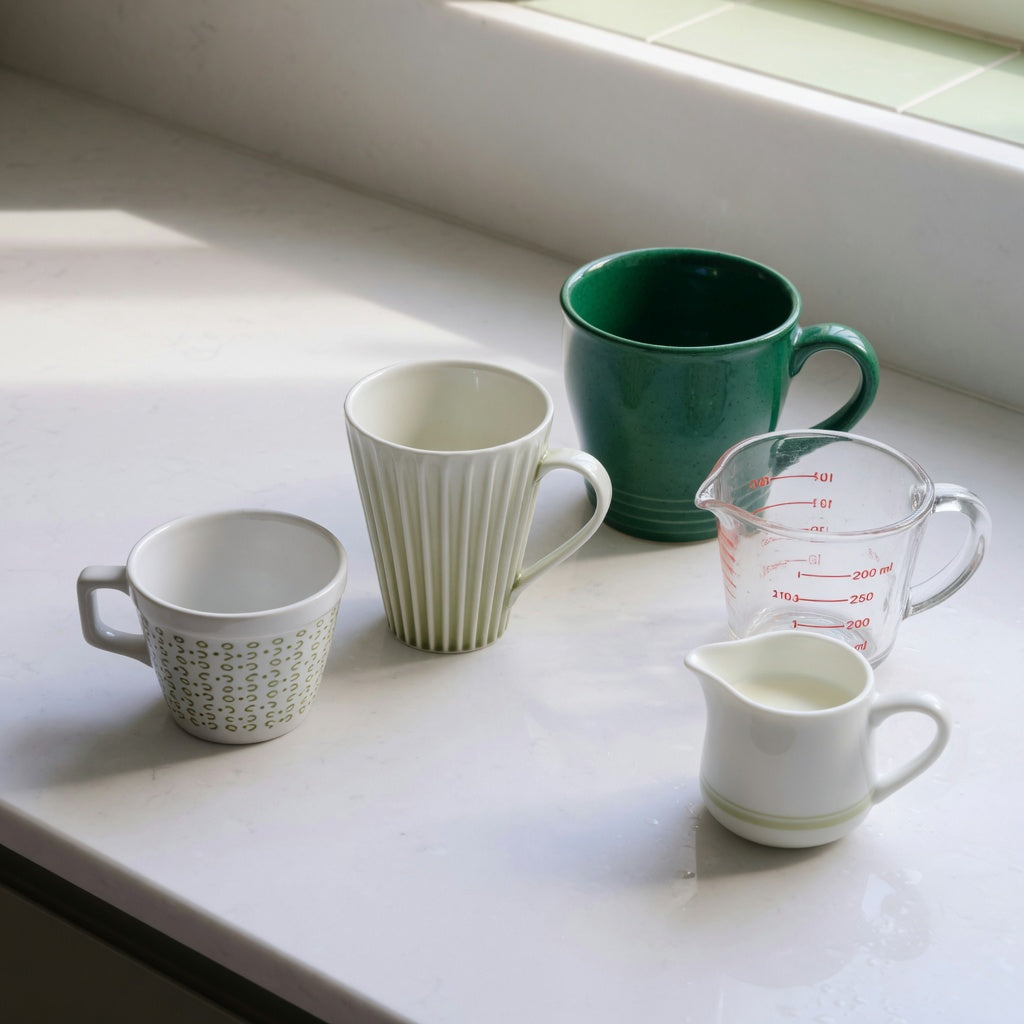
Cappuccino Coffee Mug Size Decision Guide: 170, 200 or 270 ml
Reading time: about 10 minutes
A measured 180 ml drink exposes the size trade-off immediately. On paper, it is 10 ml above the Retro's listed 170 ml capacity, leaves 20 ml within the Pleated's 200 ml listing, and leaves 90 ml within the Emerald's 270 ml listing. That simple comparison is the starting point for this cappuccino coffee mug size decision guide, because product photos cannot show how your own pour relates to a listed capacity.
In our store, the most useful size conversations happen before an order reaches the packing table. Shoppers often settle on a color or profile before measuring the drink they make every morning. We handle the choice in the opposite order: finished drink volume first, preferred unused capacity second, then style. We also keep the claim boundary clear. Capacity does not prove external dimensions, empty weight, material, heat retention, foam behavior, microwave safety, dishwasher safety, or professional barista use.
Cappuccino coffee mug size decision guide: start with one measured pour
Your usual finished drink is the only useful baseline. Do not estimate from the amount of coffee grounds, capsule size, or milk container because those details do not show the final volume in the cup.
- Prepare the drink exactly as you normally do, including milk, water, or any regular top-up.
- Transfer the finished drink into a kitchen measuring jug and record the volume in milliliters.
- Repeat the check on another day if your weekday and weekend pours differ.
- Use the larger of your normal measurements, then decide how much unused capacity you personally want above it.
If your current cup has no volume marking, a measuring jug is enough. This is more reliable than comparing a coffee cup for cappuccino by image alone, especially because camera angle and vessel shape can obscure scale. There is no prescribed buffer in this guide. Some shoppers prefer the drink to occupy most of the listed capacity, while others want more numerical room for carrying the cup or adding milk later.
What do 170 ml, 200 ml, and 270 ml leave after your pour?
The table below subtracts three example drink volumes from the current listed capacities. It is arithmetic, not a recommended recipe or fill line.
| Measured finished drink | Retro 170 ml | Pleated 200 ml | Emerald 270 ml |
|---|---|---|---|
| 140 ml | 30 ml nominal difference | 60 ml nominal difference | 130 ml nominal difference |
| 180 ml | 10 ml over listed capacity | 20 ml nominal difference | 90 ml nominal difference |
| 240 ml | 70 ml over listed capacity | 40 ml over listed capacity | 30 ml nominal difference |
A nominal difference is not a promise of practical headroom. It only shows the gap between your measured drink and the listed capacity. Your preferred fill level, the shape of the vessel, and how the manufacturer states capacity still matter.
- The Retro is 30 ml lower in listed capacity than the Pleated and 100 ml lower than the Emerald.
- The Pleated adds 30 ml over the Retro but remains 70 ml below the Emerald.
- The Emerald is the only one of these three with a listed capacity above a measured 200 ml drink.
When is the Retro 170 ml the practical lower-capacity choice?
If your own finished drink regularly measures around 130 to 150 ml, the Retro Coffee Tea Cup at 170 ml gives a nominal difference of 20 to 40 ml. That makes it the relevant first comparison for someone who wants the lowest-capacity option and does not routinely add more liquid after leaving the kitchen.
The limitation is just as clear. A drink that reaches 170 ml before a late milk or water top-up already matches the full listed capacity numerically. The Retro is not a practical choice for a measured 180 ml routine, and it is not the safer gift guess simply because the recipient sometimes drinks a short coffee.
Do not infer outside dimensions from the 170 ml figure. A lower capacity does not automatically prove that a cup is shorter, narrower, easier to stack, or lighter when empty. Check the current product details separately if cabinet clearance or hand feel is decisive.
Which routine points to the Pleated 200 ml option?
The Pleated Coffee Tea Cup at 200 ml is the numerical middle option. It makes sense for a measured drink around 160 to 180 ml when you want more listed capacity than the Retro without moving directly to 270 ml. Within that example range, the nominal difference is 20 to 40 ml.
This middle capacity also suits a household that uses the same cup for two drinks of similar volume, such as coffee in the morning and tea later. Measure both finished drinks and compare the larger result. The product name alone does not tell you which beverage volume will fit your routine.
The Pleated is not a universal default. If your regular pour reaches 200 ml, the numbers leave no unused capacity. If some days run to 210 or 220 ml, choosing the middle option because it looks balanced in a photo will not solve the volume mismatch.
When does the Emerald 270 ml become the sensible larger choice?
A finished drink around 210 to 240 ml points toward the Emerald Coffee Tea Mug at 270 ml. The other two current capacities fall below that range, while the Emerald provides a nominal difference of 30 to 60 ml. This is the practical route for someone who measures a larger drink or includes a regular milk or water top-up before sitting down.
The extra listed capacity is not automatically better. If your usual drink is only 120 to 140 ml and you dislike substantial unused capacity, the Emerald may feel mismatched to the routine. Filling a higher-capacity mug with more liquid also means carrying more liquid weight, although the 270 ml figure does not reveal the mug's empty weight.
Capacity also says nothing about heat retention or the way milk and foam will behave. We do not treat the Emerald, or either smaller option, as designed, tested, or certified for cappuccino based on its volume.
How do office desks, cabinet shelves, and gifts affect the decision?
The same capacity can be right for one setting and awkward in another. In our experience, these practical checks settle close decisions faster than styling alone:
- Kitchen-to-desk use: Measure the drink after every normal addition, then choose the amount of unused capacity that feels comfortable for your walk. No open cup should be treated as spill-proof.
- Cabinet storage: Compare exterior height, width, base, and handle clearance using current listing details if those measurements are provided. Milliliters measure capacity, not shelf footprint.
- Shared kitchens: Measure the largest normal drink among the people who will use the cups. One capacity can simplify a set, but mixed sizes are more practical if household pours differ substantially.
- Gift selection: Fill the recipient's favorite cup with water, transfer that water to a measuring jug, and dry the cup afterward. A similar capacity is a more defensible gift choice than assuming bigger will be more useful.
- Iced drinks: Measure the complete drink with its usual ice because ice occupies cup capacity. Then verify material, care, and intended use separately rather than relying on volume alone.
Gift unboxing does not fix a capacity mismatch. If the recipient normally makes 230 ml, neither the 170 ml Retro nor the 200 ml Pleated accommodates that measured volume on paper. The Emerald is the only one of these three that does.
What should you verify about material, care, and condition?
A shopper seeking a ceramic cappuccino cup may care as much about material and cleaning as capacity. Those are separate checks. This comparison does not assert that all three products use the same material, and a 170 ml, 200 ml, or 270 ml label cannot establish any care method.
Our team treats the current product page and any information supplied with the item as the source of truth. Before first use:
- Confirm the stated material and care directions on the live listing or included packaging.
- Inspect the rim under direct light for chips and check any handle connections for visible hairline cracks.
- Place the empty vessel on a flat, dry counter and confirm that the base sits steadily.
- Do not start a microwave or dishwasher cycle unless that use is stated explicitly. Contact our store if the instruction is absent or unclear.
These checks are especially useful after shipping or during a gift unboxing. They are general drinkware inspection steps, not a claim that a particular defect is expected in any of the three products.
What if none of these three capacities matches your routine?
Do not force the choice. A measured drink above 270 ml falls outside all three listed capacities, while a much smaller serving may leave more unused room than you want in every option except the Retro. Material requirements, cabinet measurements, care needs, and preferred styling can also rule out a product after capacity has been settled.
In that situation, browse the current unique coffee mug collection and verify each listing against the same measured-pour test. The collection is the better next step if you need a different capacity or style, but each product still needs its own material and care check.
A 60-second size check before checkout
Use this cappuccino coffee mug size decision guide as a filter, not as a universal drink standard. Before ordering, confirm each point:
- You measured the finished drink rather than estimating from the recipe.
- You included normal milk, water, and other top-ups.
- Your selected capacity is above the measured volume by an amount you personally accept.
- You checked exterior dimensions separately if desk or cabinet space is limited.
- You verified current material and care details instead of inferring them from appearance.
- You chose the Retro for a lower-capacity routine, the Pleated for the numerical middle, or the Emerald for a larger measured drink.
Frequently asked questions
How do I use this cappuccino coffee mug size decision guide if my pour changes daily?
Measure the drink on two or three representative days and use the highest normal result. Compare that number with 170 ml, 200 ml, and 270 ml, then add whatever unused capacity you prefer. Do not base the purchase on an unusually small serving if larger pours are part of your regular routine.
What current option makes sense for a measured 180 ml drink?
The Retro's listed capacity is 10 ml below that drink. The Pleated leaves a nominal 20 ml difference, while the Emerald leaves 90 ml. Compare the Pleated if you prefer a closer capacity match and the Emerald if you intentionally want substantially more unused capacity.
Is a 170 ml cup automatically smaller outside than a 270 ml mug?
No. Capacity describes how much the vessel holds, not its exact height, width, wall thickness, base diameter, or handle clearance. Check current exterior dimensions separately whenever physical storage or hand fit matters.
Can I assume these cups are ceramic, microwave-safe, or dishwasher-safe?
No. The three verified figures in this comparison are their listed capacities, and those figures do not establish material or care compatibility. Read the current product page and included instructions, then contact our store before use if a care detail is not explicit.
Which CoffeifyMug page should I open after measuring my drink?
Open the 170 ml Retro page for a drink comfortably below 170 ml, the 200 ml Pleated page for a middle-capacity match, or the 270 ml Emerald page for a larger measured pour. Confirm the live material, dimensions, and care information before checkout; if all three miss your routine, continue with the full unique coffee mug collection instead of forcing a poor fit.
More from our blog
Read more
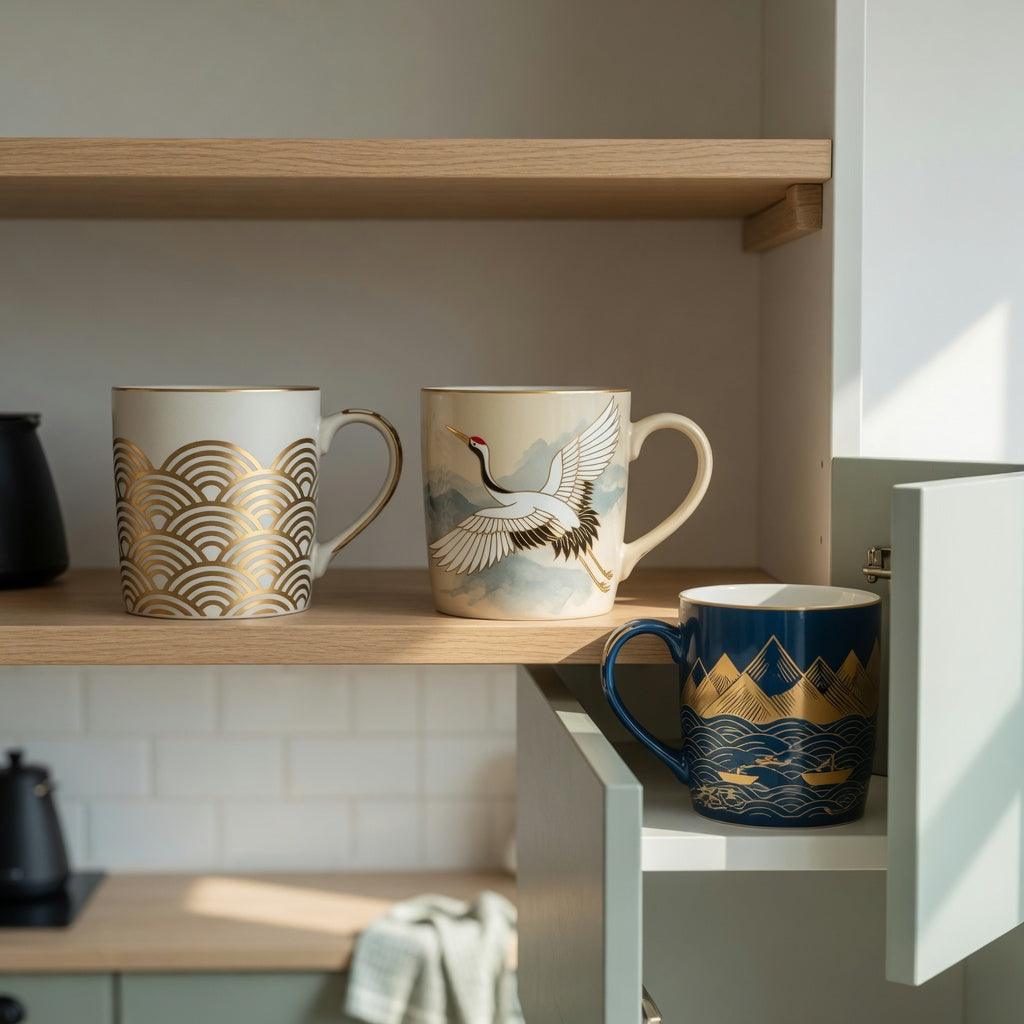
Coffee Mug Gift Idea Storage Fit Guide for Cabinets and Shelves
Compare the visible forms of Golden Waves Kio, The Crane, and Mountain Sea, then check shelf height, usable depth, handle clearance, and cabinet openings before choosing a gift.
Read more
Hot toddy mug buying priorities: Capacity, shape, and space
Compare The Gradient and The Flow at a listed 400 ml with The Rock at 480 ml, then use handle shape and real desk, nightstand, and cabinet space to find the better fit.
Read more
Leave a comment
This site is protected by hCaptcha and the hCaptcha Privacy Policy and Terms of Service apply.