
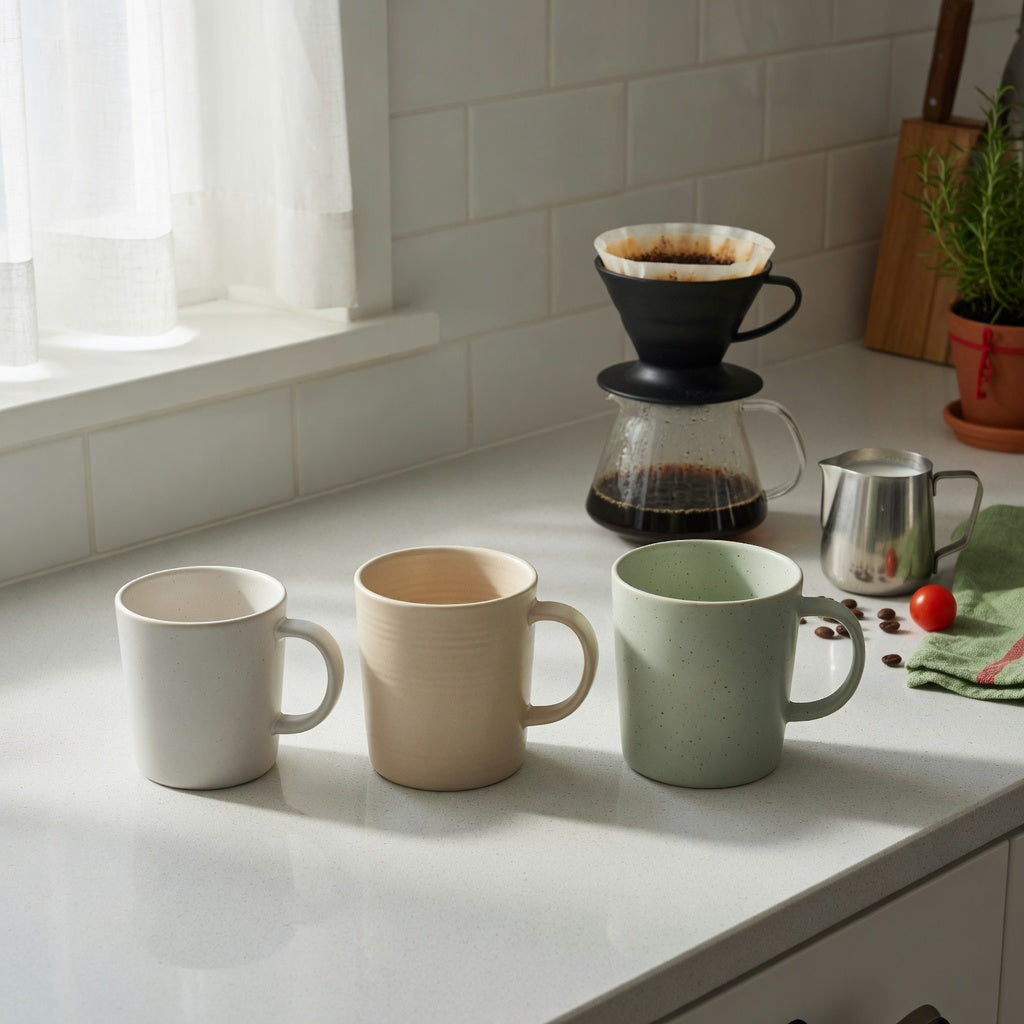
Cafe Au Lait Mug Home Coffee Station Product Shortlist Guide
Reading time: about 10 minutes
A mug can look right beside a brewer and still fail on the first busy morning: your normal coffee-and-milk pour reaches the rim, your knuckles have no room around the handle, or the mug cannot be parked without moving the pitcher. Our cafe au lait mug home coffee station product shortlist guide starts at that exact moment, with the pour, grip, and counter space that determine whether a mug works every day.
In our store, we narrow this decision using facts we can verify. The Flow is listed at 400 ml, Morning and Night at 440 ml, and The Rock at 480 ml. Capacity gets each mug onto the shortlist, but it does not prove height, width, handle clearance, stackability, or compatibility with a particular brewer. Those details must be checked against your station and the current product listing.
What must fit around the brewer, pitcher, and storage shelf?
Capacity is not the same as external size. Before comparing designs, map the spot where the mug will sit during brewing and between uses. A home station usually has several competing objects within reach, so the usable area may be smaller than the open counter suggests.
- Parking space: Measure the clear width and depth where the mug will rest without shifting the brewer, milk pitcher, spoon holder, or other daily equipment.
- Vertical clearance: Check the distance below any shelf or cabinet, including the room needed to lift the mug rather than merely slide it underneath.
- Handle access: Leave space for your fingers as well as the handle. A mug may fit physically while still being awkward to pick up.
- Brewing route: Follow the movement from pouring to stirring to serving. Note any appliance edge, cord, or tool that forces you to rotate the mug.
Compare those notes with the body shape and handle profile shown on each product page. If exact external dimensions are essential and the listing does not provide enough information, do not guess from the capacity. The same caution applies to under-spout clearance and other appliance-specific fit claims.
Which listed capacity matches the drink you actually make?
Shoppers often estimate their serving from the size printed on an old mug or from the amount of coffee brewed before milk is added. We get a more useful answer by measuring the finished drink. This takes a few minutes and prevents a mug from being chosen solely because 480 ml sounds more generous than 400 ml.
- Prepare the cafe au lait you normally drink, using your usual amounts of coffee and milk.
- Stop at the fill level that feels comfortable to carry and stir. Do not fill to the rim just to reach a stated capacity.
- Pour the finished drink into a graduated measuring jug and record the volume.
- Repeat on a second day if your weekday and weekend servings are noticeably different.
The result gives you a practical first cut. The Flow provides 400 ml, Morning and Night adds 40 ml for a listed 440 ml capacity, and The Rock adds another 40 ml for 480 ml. Leave some working room below the rim, but set that margin according to how you pour and carry rather than following an invented universal rule.
Cafe au lait mug home coffee station product shortlist guide by scenario
Each recommendation below begins with a specific reader situation. The reason to choose or skip a mug is based on its verified capacity and the checks you can make for shape, handle comfort, and everyday fit.
A measured pour below 400 ml: The Flow
Reader situation: Your normal finished drink sits comfortably within a 400 ml mug, and you do not want to buy capacity that will go unused. Why it fits: The The Flow 400 ml coffee tea mug is the lowest-capacity option in this three-mug shortlist. It is the logical starting point for a smaller daily serving or for someone who regularly leaves part of a larger drink behind. Why to skip it: Move on if milk, foam, or stirring already pushes your usual drink close to the rim of a 400 ml vessel. Do not assume its lower capacity automatically makes it the shortest or narrowest option; verify the visible profile and any listed measurements.
A 400 ml mug feels close: Morning and Night
Reader situation: Your usual pour makes 400 ml feel restrictive, but you have no clear need for the largest option. Why it fits: The Morning and Night 440 ml coffee tea mug sits exactly between the other two listed capacities, with 40 ml more than The Flow and 40 ml less than The Rock. That makes it a sensible middle candidate for a shared station or for someone whose serving changes slightly from one day to the next. Why to skip it: It adds little value if your measured drink already fits comfortably at 400 ml, and it may still be too close if a 440 ml mug leaves no carrying room below the rim.
A 440 ml mug still feels tight: The Rock
Reader situation: Your measured drink crowds a 440 ml vessel, or you deliberately want more room above the usual fill line. Why it fits: The The Rock 480 ml coffee tea mug has the largest verified capacity here, offering 80 ml more than The Flow and 40 ml more than Morning and Night. That extra listed volume is useful when the finished recipe, not the idea that bigger is better, justifies it. Why to skip it: A fuller 480 ml mug may be less appealing if you prefer lower-volume servings or dislike carrying more liquid in one hand. Tight stations also require a separate shape and dimension check because capacity alone does not establish counter footprint.
If the capacity works but the visible body or handle shape does not, continue through our unique coffee mugs collection. That is a better next step than forcing one of these three options into a station where it will be awkward to reach or store.
How do handle clearance and mug shape affect everyday fit?
In our experience handling mugs, grip problems become obvious during movement rather than while the mug is empty on a shelf. Hand size, finger position, and the amount of liquid all affect comfort, so we do not label one handle universally best without knowing how the buyer holds a mug.
- Recreate the load: Fill your current mug to the volume you intend to serve, then carry it from the station to the place where you normally drink.
- Notice the grip: Check how many fingers you use, whether your knuckles press against the mug body, and whether your thumb must pinch to keep the mug level.
- Check handle projection: Compare the outer edge of the handle with nearby equipment. The mug body can fit while the handle extends into the working area.
- Review the whole silhouette: Look at the base, widest point, rim, and handle together. Similar capacities can be distributed across different shapes.
- Do not assume stackability: A profile that appears tapered in a photograph is not proof that multiple mugs will nest securely.
A comfortable station lets you pick up the mug without threading your fingers around another object or turning the handle before every pour. Product photos can help you reject an unsuitable shape, but actual measurements are the stronger evidence whenever clearances are tight.
What should you inspect after unboxing?
We use a consistent receiving check because small finish or alignment problems are easier to spot before a mug enters daily rotation. These checks are useful for a personal purchase and especially useful before wrapping a mug as a gift.
- Place the empty mug on a dry, flat counter and check whether the base sits steadily without rocking.
- Run a finger carefully around the rim and inspect it for a rough spot, chip, or visible surface damage.
- Look at both handle attachment points for a visible hairline crack, separation, or irregular joint.
- Compare the received mug with the product listing, including its stated capacity, material information, and care directions.
These are routine inspection points, not claims that a linked mug normally has those defects. Care also needs the same factual restraint: confirm the instructions on the exact product page or with the mug itself before starting a dishwasher cycle or using a microwave. This shortlist does not make claims about dishwasher safety, microwave safety, or heat retention.
Who should skip this larger milk-coffee shortlist?
The three listed capacities cover a useful range for generous coffee-and-milk drinks, but they are not the right answer for every station or routine.
- If a sealed lid is non-negotiable for commuting, choose a purpose-built travel vessel unless a product page explicitly confirms the feature you need.
- If you mostly serve short espresso-sized drinks, a 400 to 480 ml mug may feel unnecessarily large.
- If a mug must fit beneath a specific machine component, choose only after confirming the machine clearance and the mug's external dimensions.
- If secure stacking is essential, do not infer it from photographs. Look for an explicit listing detail or select another shape with confirmed storage information.
- If microwave or dishwasher use determines the purchase, verify those care claims on the individual listing before ordering.
Gift buyers should also resist choosing 480 ml simply because the larger number appears more generous. Measuring the recipient's most-used mug or asking about their usual drink volume produces a more useful gift than guessing from capacity alone.
A five-minute shortlist before checkout
- Measure the finished coffee-and-milk drink you make most often.
- Allow enough room below the rim for your normal carrying and stirring habits.
- Match that working volume to 400 ml, 440 ml, or 480 ml.
- Measure the mug's intended parking space and vertical clearance.
- Review the linked product for body shape, handle profile, material, and current care information.
- Reject any option that depends on an unverified assumption about appliance fit, stacking, or care.
This process should leave one clear capacity candidate and one final visual-fit check. It also gives you a specific reason to skip the other options, which is more useful than ranking all three as broadly suitable.
Frequently asked questions
How do I use a cafe au lait mug home coffee station product shortlist guide?
Start by measuring your usual finished drink, then compare it with the verified 400 ml, 440 ml, and 480 ml capacities. After capacity narrows the field, check the linked listing for body shape, handle profile, external fit, material, and care details before ordering.
Is a 400 ml mug large enough for cafe au lait at home?
It can be if your normal coffee-and-milk pour sits comfortably below the rim. If your current 400 ml mug feels crowded after the drink is finished, compare the 440 ml and 480 ml options rather than relying on a brim-full fit.
Does a 480 ml capacity mean The Rock takes more counter space?
Not necessarily. Capacity tells you how much the mug is listed to hold, not its height, base width, widest point, or handle projection. Compare external measurements if the listing provides them and review the complete shape before deciding it will fit a tight station.
Can I assume these mugs are dishwasher or microwave safe?
No such assumption is made in this article. Check the exact product listing and any care information supplied with the mug before using a microwave or starting a dishwasher cycle.
Which mug should I compare first for my home coffee station?
Measure the finished drink you make most often. Start with The Flow at 400 ml if that volume leaves comfortable room, Morning and Night at 440 ml if 400 ml is close, or The Rock at 480 ml if 440 ml still feels tight; then compare the handle and body shape in the unique coffee mugs collection before ordering.
More from our blog
Read more
Unique Design Coffee Mugs Home Coffee Station Product Shortlist Guide
Compare the Handbag, Rhombus, and Crane mugs for a visible home coffee station. Use counter measurements, storage limits, material labels, and care instructions to decide which design belongs on yo...
Read more
Unique Pottery Coffee Mugs: Practical Home Coffee Station Checklist
Measure station clearance, verify capacity and care details, compare three CoffeifyMug design directions, and inspect the rim, handle, finish, and foot before putting a pottery mug into daily rotat...
Read more
Leave a comment
This site is protected by hCaptcha and the hCaptcha Privacy Policy and Terms of Service apply.