
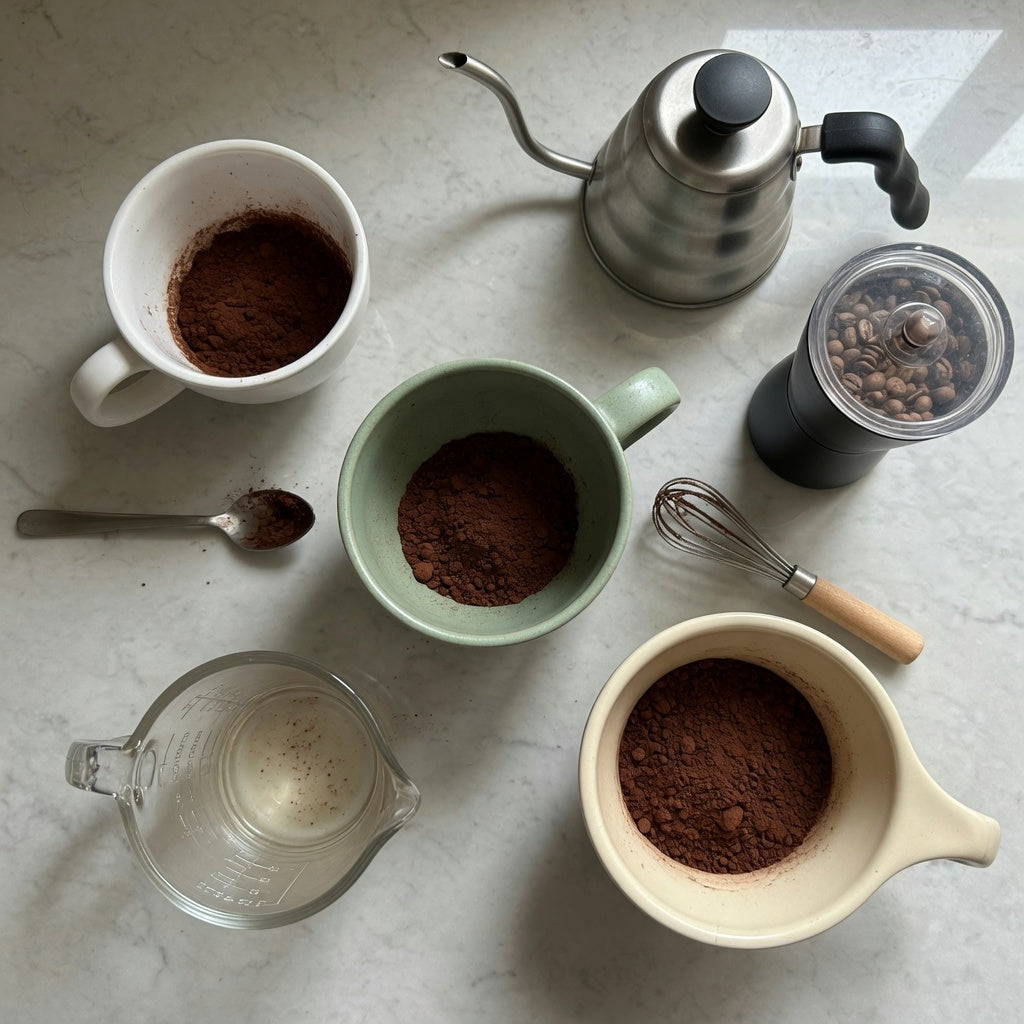
Cacao Cup Home Coffee Station Practical Purchase Checklist
Reading time: about 10 minutes
A cacao drink that looks comfortably below the rim can surge upward as soon as a spoon or whisk starts moving. On a compact counter, that leaves splashes beside the scale and cacao residue around the cup instead of a cleaner morning setup. This cacao cup home coffee station practical purchase checklist starts with the facts we can stand behind: the Ball Handle at 250 ml with a listed 11.2 cm diameter, the Round at 390 ml, and the Spittoon at 400 ml.
We sell and handle this drinkware category, and our experience is that the best choice usually comes from measuring the drink and the station before comparing colors or silhouettes. We are treating these as everyday coffee and tea cups that may suit cacao because of their capacities and visible openings. We are not presenting them as traditional, ritual, certified, or purpose-built cacao vessels, and we do not infer appliance compatibility from their shapes.
250 ml, 390 ml, or 400 ml: how much headroom does cacao need?
A listed capacity is not the same as a comfortable mixing level. Cacao powder, milk, foam, ice, and toppings all use space, while stirring requires an additional margin below the rim. There is no universal headroom number because a slow teaspoon stir creates less movement than a whisk or handheld frother.
Measure the recipe you actually make instead of estimating from your current mug:
- Measure the liquid ingredients with a graduated jug before pouring them into your current cup.
- Add the usual cacao, sweetener, foam, or other toppings and observe the finished level.
- Note how much clear space you need to stir without touching the rim or splashing the counter.
- Compare that finished volume with the three listed capacities, allowing for your preferred working margin.
| Option | Verified catalog fact | Reader situation | Trade-off to check |
|---|---|---|---|
| Ball Handle 250 ml cup | 250 ml capacity and listed 11.2 cm diameter | Your measured cacao serving sits comfortably below 250 ml and you want the ball-handle profile | It has 140 ml less nominal capacity than the Round; confirm what the listed diameter includes |
| Round 390 ml cup | 390 ml capacity | Your recipe needs substantially more room than the 250 ml option, but 400 ml is not a deciding requirement | No additional dimension is established in the facts used here; verify the current listing against your space |
| Spittoon 400 ml cup | 400 ml capacity | You want the largest listed option for a generous serving, foam, or a cold recipe that includes ice | It holds only 10 ml more than the Round, so profile and visible opening may matter more than capacity |
If your measured finished drink is 200 ml, the Ball Handle has a nominal 50 ml difference before the listed capacity is reached. At 300 ml, the Round has a nominal 90 ml difference and the Spittoon has 100 ml. Those are arithmetic comparisons, not recommended fill lines; the usable level depends on cup geometry and how vigorously you mix.
The Spittoon name identifies the catalog style. In this comparison, it remains everyday drinkware for cacao, coffee, or tea rather than a claim about a specialized use.
Does the Ball Handle's listed 11.2 cm diameter clear your station?
The Ball Handle is the only one of these three with a dimension established in the supplied comparison facts: 11.2 cm in diameter. That number is useful, but it does not tell us whether the measurement refers to the rim, body, base, or widest point, or whether the handle is included. Treat it as a first-pass measurement rather than proof of fit.
- Mark an 11.2 cm span on paper and place it where the cup will sit.
- Check that the full landing area stays on the counter or shelf without overhang.
- Allow side room for the handle and your fingers, even if that space is not included in the listed diameter.
- Check the vertical path used to lift the cup from beneath a shelf, not just the resting height.
- Keep the cup outside appliance doors, grinder chutes, kettle movement, and other clearance zones specified by each appliance manufacturer.
Do not use the 11.2 cm figure as evidence that the cup fits a brewer drip tray, warming plate, or other appliance. Confirm the cup's current total width and height against the appliance manual before ordering for that purpose. That measurement discipline is a central part of this cacao cup home coffee station practical purchase checklist.
Visible opening, spoon clearance, and cacao clumps
Cacao often needs more movement than a finished black coffee. A spoon has to reach the lower curve of the cup, and a small whisk needs lateral room without repeatedly striking the rim. From handling open drinkware, we check three contact points: the tool reaching the bottom, the shaft clearing the rim, and the user's fingers staying clear of the hot drink.
The product shapes let you compare their visible openings, but listing photographs are not rulers. The Ball Handle's listed 11.2 cm diameter should not automatically be treated as its rim-opening measurement. The verified facts used here also do not provide measured opening widths for the Round or Spittoon.
If you use a handheld frother, measure its head and check the manufacturer's required liquid depth. None of the cup facts here establish frother or steam-wand compatibility. A separate, purpose-rated frothing pitcher is the better choice if direct frothing is the main task; the cup can then receive the finished drink.
An open shape also has trade-offs. All else being equal, more exposed liquid surface can lose heat faster and gives an energetic stir more room to splash. Slow drinkers who prioritize heat retention or commuters who need spill control should consider a narrower insulated vessel with a suitable lid instead.
Kitchen counter, office desk, or gift: which cup fits the job?
The same capacity can work well in one setting and feel awkward in another. Match the reader situation to a verified difference rather than assuming the largest option is automatically better.
- Short morning cacao on a measured station: The Ball Handle 250 ml is the relevant next step when your completed recipe stays comfortably below 250 ml. Its 11.2 cm listed diameter still needs to be mapped on the counter, so lower capacity does not automatically mean the smallest footprint.
- Fuller drink on a stable office desk: The Round 390 ml provides 140 ml more nominal capacity than the Ball Handle. It makes sense for a longer desk drink if you have clear elbow space, but an open cup is not the right choice for walking between meetings or working beside spill-sensitive equipment.
- Generous cacao, foam, or cold ingredients: The Spittoon 400 ml is the largest listed option. Because it exceeds the Round by only 10 ml, choose between those two by visible profile, opening, and station fit rather than expecting a major serving-size difference.
- A gift for someone whose serving size is unknown: First find out what volume they use now and how much shelf room they have. Then compare the profiles in our unique coffee mugs collection; a distinctive handle is not useful if it conflicts with the recipient's grip or storage space.
For a shared kitchen, different capacities can be more practical than a matching set if one person drinks a compact cacao and another uses milk, foam, or ice. For a tightly styled station, compare all visible profiles first, but let measured fit break the tie.
Material, microwave, dishwasher, and daily care checks
The facts used to compare these cups establish capacities, one listed diameter, and visible form. We are not using an unverified material composition, finish, microwave rating, dishwasher rating, freezer rating, or cup-warmer claim to rank them. Read the current product page and any care information supplied with the cup. If a method is not stated, ask our store before exposing the cup to an appliance cycle or sudden temperature change.
Our team recommends a simple arrival and care routine for drinkware:
- Inspect the rim, interior, handle attachment, and foot under direct light before first use. A chip, hairline crack, loose-feeling handle, or pronounced wobble deserves attention before a hot drink is added.
- Wash the cup according to its current care instructions before using it. Do not assume dishwasher or microwave suitability from appearance alone.
- Rinse cacao residue soon after drinking, then complete the recommended wash. A quick rinse is not a substitute for washing, especially after recipes containing milk or sweetener.
- Use a nonabrasive cloth or sponge unless the care guidance allows something else. Dried powder around the lower curve may need soaking rather than aggressive scraping.
- If dishwasher use is explicitly permitted, leave enough rack space that the rim and handle cannot knock neighboring drinkware during the cycle.
- Avoid moving a cup directly between very hot and very cold conditions unless its care information specifically supports that use.
These checks matter during gift unboxing as well as daily kitchen use. Inspect the cup before the first pour rather than discovering transport damage after it has been filled.
When should you choose a different vessel?
These cups are candidates for stationary cacao, coffee, or tea service. They are not the strongest match for every routine.
- Choose a sealed travel tumbler if the drink will move through a commute or between rooms.
- Choose a smaller cup if your main drink is a short espresso-based serving and a wide pool of liquid is undesirable.
- Choose a purpose-rated pitcher if you need to steam or froth milk directly in the vessel.
- Choose an insulated cup if keeping a drink hot through a long work session matters more than an open profile.
- Choose a vessel with documented provenance if traditional or ritual use is part of your purchase. These three products are not presented with those claims.
Stacking, lid fit, and appliance fit are also not established by capacity alone. If any one of those is essential, verify it explicitly before choosing among the three.
Cacao cup home coffee station practical purchase checklist: seven checks
Use the cacao cup home coffee station practical purchase checklist in this order. Stopping at the first unknown prevents an attractive profile from hiding a capacity, fit, or care problem.
- Measure the drink: Record the finished volume of your usual cacao, including milk and regular additions.
- Allow working room: Decide how much space your spoon, whisk, foam, or ice needs below the rim.
- Choose the capacity band: Compare 250 ml, 390 ml, and 400 ml without treating nominal capacity as a fill recommendation.
- Map the footprint: Mark the Ball Handle's listed 11.2 cm diameter and verify full width, handle extension, and height on the current page.
- Check the mixing tool: Compare the visible opening with your spoon or frother dimensions; do not infer compatibility.
- Confirm care and material facts: Look for explicit cleaning, microwave, and temperature guidance before using those features.
- Match the setting: Use open drinkware on a stable counter or desk, and choose a lidded or insulated alternative when movement or heat retention is the priority.
Start with your measured recipe. If it sits well below 250 ml, review the Ball Handle; if it needs substantially more room, compare the Round and Spittoon by visible shape because their capacities differ by only 10 ml. The collection view is the practical next stop when none of those profiles clears every box.
Frequently asked questions
What belongs in a cacao cup home coffee station practical purchase checklist?
Record your finished drink volume, desired stirring headroom, available counter area, shelf clearance, and mixing-tool size. Then confirm the cup's current material and care information. Capacity alone cannot establish opening width, dishwasher suitability, or appliance fit.
Is a 250 ml cup large enough for cacao with milk and foam?
It can be if your measured finished recipe remains comfortably below 250 ml after the cacao and milk are combined. A 200 ml drink leaves a nominal 50 ml difference, but foam and stirring still use that room. Measure one normal serving before selecting the Ball Handle.
Is the 400 ml Spittoon meaningfully larger than the 390 ml Round?
The listed capacity difference is only 10 ml. That is unlikely to be the strongest reason to choose one over the other, so compare the visible opening, profile, and fit within your station. The Spittoon is simply the largest listed option in this three-cup comparison.
Can these cacao cups go in a microwave or dishwasher?
Do not assume that from the cup name, appearance, or capacity. Check the current product page and supplied care instructions for an explicit microwave or dishwasher statement. If the guidance is absent, contact our store before using either appliance.
Which cacao cup should I choose for a small home coffee station?
Measure both your serving and the space first. Choose the Ball Handle only if a 250 ml capacity and its listed 11.2 cm diameter suit the setup; compare the 390 ml Round and 400 ml Spittoon if the drink needs more room. Then use the CoffeifyMug cup collection to check the current profiles and product details side by side.
More from our blog
Read more
Clay Pottery Coffee Mugs: Everyday Rotation Practical Purchase Checklist
Use wash frequency, cabinet measurements, handle clearance, rim feel, base stability, and care instructions to build a practical clay pottery mug rotation. We also map three CoffeifyMug designs to ...
Read more
High Quality Ceramic Coffee Mugs: Home Station Purchase Checklist
Measure the mug parking space, inspect glaze and handle details, and confirm care instructions before buying. This checklist maps three CoffeifyMug designs to compact counters, taller storage, disp...
Read more
Leave a comment
This site is protected by hCaptcha and the hCaptcha Privacy Policy and Terms of Service apply.