
Breakfast Coffee Cup Gift Choice Product Shortlist Guide: 3 Fits
Reading time: about 10 minutes
At a narrow breakfast bar, a cup competes with a plate, a phone, and the edge of the counter. A larger cup can still be the wrong gift if the recipient prefers a quick pour, while a smaller option can frustrate someone who does not want to leave the table for a refill. That is why our breakfast coffee cup gift choice product shortlist guide begins with the person's actual morning routine.
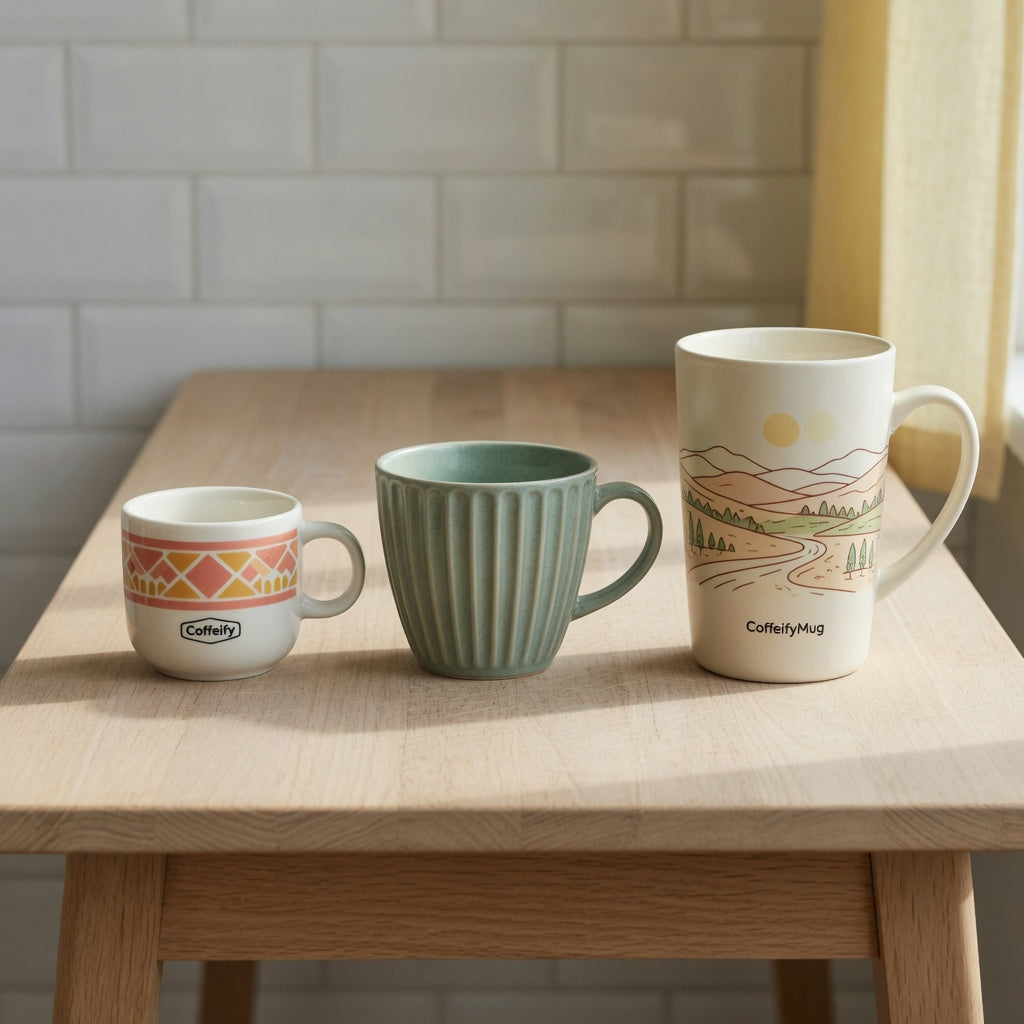
At CoffeifyMug, we use the product facts we can verify: the Retro is listed at 170 ml, the Pleated at 200 ml, and the Landscape Tall at 350 ml. Those capacities create three distinct choices. They do not, by themselves, confirm external width, material, care requirements, gift packaging, or personalization, so we keep those details separate and direct shoppers back to the current product listing before ordering.
Which morning details narrow three cups to one?
The most useful clue is not the recipient's favorite color. It is what happens between the first pour and the end of breakfast. From the gift questions we handle in our store, shoppers often focus on how substantial a cup looks and overlook how frequently the recipient refills it.
Use these four observations to define the recipient's routine:
- Usual pour: Do they drink a short coffee or fill a larger mug close to the top?
- Refill tolerance: Is the coffee pot within reach, or do they avoid getting up once breakfast starts?
- Table space: Does the cup sit on a full dining table, a narrow counter, or a home-office desk beside breakfast?
- Storage: Will it go inside a cabinet, under a low shelf, or on an open rack where external height and handle width matter?
If the gift needs to remain a surprise, look at the cup already used most mornings. Its fill level, the amount left behind, and the number of refills provide better evidence than guessing from a product photograph. A polished gift reveal cannot make an inconvenient capacity useful.
A breakfast coffee cup gift choice product shortlist guide by routine
Each recommendation below starts with a recipient situation, explains why the listed capacity fits, and includes a reason to skip it. That last part matters. In our experience, a shortlist becomes useful only after unsuitable choices have been removed.
Retro 170 ml: for a short pour and an easy refill
Choose the Retro 170 ml coffee and tea cup for someone who drinks a modest amount with breakfast, likes a fresh second pour, or regularly leaves part of a larger mug unfinished. Its 170 ml listed capacity is the lowest of these three, making it the first candidate for a lighter coffee or tea routine.
It is also the logical option to investigate first for a crowded breakfast setting, but capacity is not the same as external footprint. Check the current listing for dimensions or visual scale before assuming that its base and handle will fit a particular shelf. Skip the Retro for a recipient who already complains about small cups or wants to carry one long pour from the kitchen to a desk.
Pleated 200 ml: for a modest cup without a large jump in volume
The Pleated 200 ml coffee and tea cup sits in the middle by listed capacity. It holds 30 ml more than the Retro, so it suits a recipient who wants slightly more room without moving to the much larger 350 ml option. This is a practical match for a conventional sit-down breakfast where one modest pour may be enough.
Choose it when the recipient's existing cup seems close to this volume and neither frequent refills nor oversized servings define the routine. Skip it if the person clearly prefers one large drink, or if the small difference from 170 ml would not solve their current refill complaint. Middle capacity does not automatically mean middle external dimensions, so confirm the footprint separately.
Landscape Tall 350 ml: for a longer pour with fewer interruptions
The Landscape Tall 350 ml coffee and tea mug is the clear large-capacity choice. It holds 150 ml more than the Pleated and 180 ml more than the Retro. That extra volume makes sense for a slow breakfast reader, someone who moves from the table to a home-office desk, or a recipient who regularly returns to the coffee pot because smaller cups run out too soon.
The trade-off is the tall format. Check cabinet and shelf clearance, especially if the recipient keeps cups under a low shelf. A larger pour also offers little benefit to someone who drinks only 170 to 200 ml and leaves the rest. Skip this option for quick breakfasts, very limited storage, or any routine that requires a travel lid or verified insulation; those features are not established by the facts used in this comparison.
How do 170 ml, 200 ml, and 350 ml change the decision?
Listed capacity is the firmest comparison point in this group. Refill behavior follows from how much the recipient normally drinks, while footprint still needs an external-dimension check. We use the table below to keep those separate.
| Product | Listed capacity | Best routine match | Likely refill pattern | Footprint check |
|---|---|---|---|---|
| Retro | 170 ml | Short coffee or tea with breakfast | More suitable for someone comfortable with a second pour | Check total width including the handle; low capacity does not prove a narrow base |
| Pleated | 200 ml | One modest breakfast serving | May reduce a refill compared with 170 ml, depending on the person's pour | Verify base, handle, and shelf dimensions rather than treating it as automatically medium-sized |
| Landscape Tall | 350 ml | Longer breakfast or table-to-desk routine | Offers the most volume before a refill | Check external height and overhead storage clearance |
A listed 350 ml capacity does not guarantee that the recipient will drink 350 ml, and a 170 ml cup is not automatically inconvenient. The right number is the one closest to the amount they actually finish. This is the central product-selection rule in our breakfast coffee cup gift choice product shortlist guide.
How much breakfast-table and shelf space does the cup need?
Capacity measures how much the vessel holds. Footprint describes the space the complete cup occupies, including its base and handle. Two cups with similar capacities can have different external proportions, so a milliliter figure should never substitute for a dimension check.
- Place the recipient's usual plate or bowl in its normal position and note the clear space left for a cup.
- Measure the available width and include room for fingers to reach the handle without striking another item.
- Check the cabinet or shelf opening from the storage surface to the obstruction above it. This is especially relevant to the Landscape Tall.
- Compare those measurements with any external dimensions shown on the live product page. If dimensions are not stated, do not infer them from capacity alone.
This quick exercise is more reliable than deciding that the smallest listed capacity must have the smallest footprint. It also catches a common gift mismatch: a cup may fit on the table but still be awkward to store because its handle or height exceeds the available space.
What care and condition checks belong in a cup gift?
A recipient who runs a daily dishwasher cycle needs confirmed dishwasher guidance. Someone who reheats coffee needs equally clear microwave guidance. The verified facts supplied for this shortlist do not establish either point, so read the care instructions on the current product page instead of assuming that appearance or capacity reveals how a cup should be cleaned or heated.
After delivery, inspect the item before presenting it. Our practical check covers the areas that matter during normal handling:
- Look along the rim under good light for chips or rough damage.
- Inspect the body and the handle joints for visible hairline cracks.
- Check the base for damage, then place the empty cup on a flat, dry counter to confirm that it sits steadily.
- Follow the listed first-use and washing instructions; do not substitute a dishwasher cycle unless the product guidance permits it.
These are arrival checks, not a claim that any of the three products commonly has those problems. We also do not claim that a gift box, saucer, drink, food, personalization, or other tableware is included. Treat the cup and the facts shown on its listing as the purchase, and plan any wrapping separately.
Which recipients should skip all three options?
None of these three should be forced into a routine it does not serve. A different product style is more appropriate if the recipient primarily drinks iced coffee from a large tumbler, needs a sealed lid for commuting, requires confirmed insulation, or wants a matching saucer and coordinated tableware. The same applies if personalization is the main reason for the gift; personalization is not a verified feature in this shortlist.
If the capacity choices are reasonable but none of the three shapes suits the recipient's kitchen or desk, browse our collection of unique coffee mugs for other designs. Use the same routine test on each listing: match the person's normal pour, confirm the external fit, read the care guidance, and verify exactly what is included.
How do we settle a close call between the three cups?
We reduce the decision in a fixed order. Capacity comes first because it affects every breakfast. Storage comes second because a cup that does not fit the usual shelf creates friction before it reaches the table. Appearance is the final tie-breaker, based on the current product photographs and the recipient's taste.
- Remove the 170 ml Retro if the recipient actively avoids refills or regularly uses a much larger cup.
- Remove the 350 ml Landscape Tall if they favor short pours, leave coffee unfinished, or have limited vertical storage.
- Keep the 200 ml Pleated only if a modest middle capacity genuinely matches the routine; do not select it merely because it sits between two numbers.
- Compare the remaining product photographs with cups the recipient already chooses to use.
If the choice is between 170 ml and 200 ml, remember that the listed difference is only 30 ml. Refill preference and design taste may matter more than that small volume change. If 350 ml remains on the list, there should be a clear reason for the extra 150 ml over the Pleated, such as a known preference for a longer single pour.
Five checks before adding a breakfast cup to the cart
- Match the usual drink amount to 170 ml, 200 ml, or 350 ml.
- Confirm width, handle clearance, and height against the recipient's table and storage space.
- Read the current material and care details instead of assuming dishwasher or microwave suitability.
- Verify what the listing includes without expecting gift packaging, personalization, food, drink, or bundled tableware.
- Choose a design the recipient would use on an ordinary weekday, not only one that looks substantial as a gift.
A strong shortlist should leave one obvious fit or two defensible finalists. If all three require an excuse, return to the collection and select a different shape or capacity rather than ordering a cup that is likely to stay in the cupboard.
Frequently asked questions
How do I use a breakfast coffee cup gift choice product shortlist guide without asking the recipient?
Observe the cup they already use, how full they pour it, and whether they return for more. Also note the available table and shelf space. Those clues can eliminate obvious mismatches while preserving the surprise.
Is a 170 ml breakfast coffee cup too small for a gift?
Not for someone who prefers short coffee or tea servings and is comfortable making another pour. It can be too small for a recipient who wants one large drink or already finds modest cups frustrating. Gift value comes from routine fit, not maximum volume.
Will the Landscape Tall 350 ml stop the recipient from needing refills?
It provides the largest listed capacity of these three, so it can reduce refills for someone whose total drink fits within 350 ml. It cannot guarantee no refill because serving size varies by person. Choose it only when the larger pour and tall format both suit the routine.
Do these cups include gift packaging, saucers, or personalization?
This guide does not claim any of those extras. The verified comparison covers the three named cups and their listed capacities only. Check the individual product page for the current description of included items before planning the gift presentation.
What should I verify on the product page before ordering?
Confirm the listed capacity, external dimensions if provided, material, care instructions, included items, and current product photographs. Compare those facts with the recipient's pour, refill habit, table space, and shelf clearance. If no cup clears every check, use the unique coffee mugs collection to restart the shortlist with a better-fitting shape.
More from our blog
Read more
Unique Pottery Coffee Mugs Gift Choice Practical Purchase Checklist
Use the recipient's favorite mug, daily routine, storage space, and care habits to compare pottery mug gifts. This checklist separates verified product details from the measurements and care claims...
Read more
Cute Ceramic Coffee Mugs Gift Choice Practical Purchase Checklist
Use recipient routines, cabinet and desk measurements, care tolerance, and verified product-page details to compare handbag, pleated, and gradient ceramic mug gifts without assuming unlisted specs ...
Read more
Leave a comment
This site is protected by hCaptcha and the hCaptcha Privacy Policy and Terms of Service apply.