
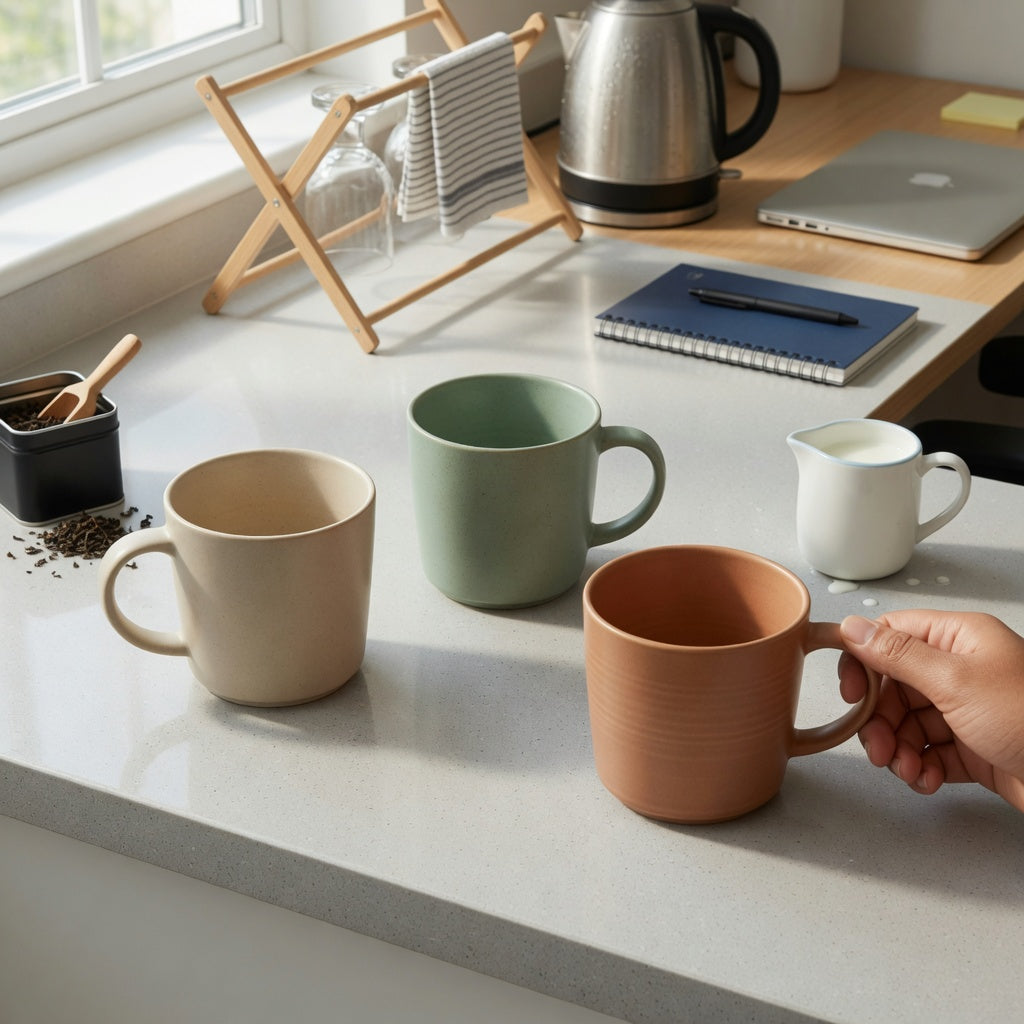
black tea mug shared household product shortlist guide: 3 options
Reading time: about 11 minutes
The kettle clicks off, and two people reach for different mugs: one wants a moderate black tea with milk, while the other wants a fuller plain pour to take to an office desk. That ordinary split is why a black tea mug shared household product shortlist guide should begin with finished drink size and hand fit, not a universal winner.
At CoffeifyMug, our team handles these mugs while answering product questions and checking orders. The practical questions tend to surface around kitchen counters, office desks, gift unboxings, and the first dishwasher cycle. The verified catalog details for this comparison are deliberately narrow: the Round coffee tea mug is listed at 390 ml, The Gradient coffee tea mug at 400 ml, and The Flow coffee tea mug at 400 ml. Their descriptions support tea use. We compare those capacities, the handle shapes shown in the listings, and ordinary household fit. We do not infer an infuser, insulation, special temperature behavior, origin, or professional-service performance.
The three mugs are individual choices for this guide, not a recommendation to buy a matching set. That leaves room for a shared home to match each drinker instead of making everyone accept the same volume and grip.
Why does a shared kettle need more than one mug preference?
A shared household has several drinkers, one kettle, one drying area, and often one crowded shelf. The person who drinks beside the kettle may want a restrained serving; the person at a desk may want a fuller cup and a handle that feels different in the hand. A gift buyer may know the recipient drinks black tea but have no reliable way to guess their grip preference.
We start with four observations:
- Finished drink volume: compare what reaches the mug after milk, lemon, or sugar rather than the amount boiled in the kettle.
- Handle contact: note whether the drinker prefers a familiar closed loop, a broader grip profile, or a more contoured shape.
- Parking place: decide if the mug spends most of its day beside the kettle, on a desk, or moving between rooms.
- Care routine: check the individual listing and packaging for material and care directions before choosing a dishwasher routine.
These questions create a shortlist around behavior rather than decoration. They also expose a limitation early: a mug can look right in a gift unboxing and still be wrong for the recipient's usual pour.
What should a black tea mug shared household product shortlist guide compare first?
A useful black tea mug shared household product shortlist guide should put every option against the same evidence. For these listings, start with the capacity number, then inspect the handle profile, then test the everyday scenario in which the mug will be used.
| Mug | Listed capacity | Handle shape to compare | Starting scenario |
|---|---|---|---|
| Round coffee tea mug | 390 ml | Conventional closed-loop profile shown in the listing | Moderate pour or milk addition |
| The Gradient coffee tea mug | 400 ml | Broader handle profile shown in the listing | Fuller plain-tea serving |
| The Flow coffee tea mug | 400 ml | More contoured loop profile shown in the listing | Counter-to-desk routine |
The 10 ml difference is measurable, but it is not a reason to promise a dramatic change in use. A listed capacity is not a fill instruction, a temperature rating, or a guarantee that the handle will suit every hand. Use the table to narrow the choice, then check the product page images and care details.
Which listed capacity fits milk, plain tea, or a second pour?
Capacity matters most at the moment additions go in. A person who pours black tea, adds milk, and stops well below the rim may prefer the 390 ml Round. Someone who wants a plain cup close to the larger listed volume may prefer either 400 ml option. The difference is 10 ml on the catalog listing, so treat it as a small tie-breaker rather than a precision promise.
- Milk or lemon: start with Round if the finished drink is usually below 390 ml and the drinker prefers a moderate serving. Skip it if they regularly want the largest listed pour.
- Plain black tea: start with The Gradient or The Flow if 400 ml better matches the amount poured. Skip either if a fuller mug routinely comes back half-finished.
- Second pours: decide first between one larger cup and two smaller cups. A larger listing cannot fix a habit mismatch on its own.
If the mug will also be used for iced coffee, record that finished volume separately. Ice and extra drink components can change the space a person needs, so do not assume the black-tea choice automatically suits every cold drink.
How does handle shape change a kitchen-counter or office-desk choice?
Handle shape is a practical comparison point in a home where mugs move from a kettle to a sofa or office desk. Look at the opening, the loop thickness, and the clearance between the handle and the mug body. Those details affect how a person places their fingers; they do not prove that a mug is spill-proof or universally ergonomic.
The Round's conventional loop is the clearest starting point for someone replacing a familiar everyday mug. The Gradient's broader handle profile is worth comparing for a person who wants more visible room around the fingers. The Flow's contoured loop is worth comparing for someone who prefers a shaped grip during a counter-to-desk routine. In our store, we advise checking the actual hand and route rather than choosing from the product name alone.
Dishwasher racks add a practical spacing question. A mug may fit by volume yet touch a neighboring handle or sit awkwardly between rack tines. We do not make a blanket dishwasher claim for these products; check the individual care information, and if dishwasher use is permitted, load with clearance around the handle and rim.
Which mug fits the milk drinker, full-pour drinker, or desk user?
Here is the short scenario-based shortlist we use for a shared home. Each choice starts with a person, gives a reason, and names the condition that should make you skip it. Review the individual product page for current details; this side-by-side comparison does not present the three mugs as a bundled set.
- The milk-and-black-tea drinker who stays near the kettle. Choose the Round coffee tea mug, listed at 390 ml. It fits the shortlist when the finished drink is usually below the larger listing and the person prefers a conventional loop that can be compared with a familiar mug. Skip it if they regularly want the fullest listed pour; compare a 400 ml option instead.
- The plain-tea drinker who wants one fuller pour. Choose The Gradient coffee tea mug, listed at 400 ml. Its broader handle profile is the relevant shape comparison for someone who wants more room around the fingers, while the listed capacity suits a fuller serving. Skip it if the drinker prefers a smaller serving or a conventional loop; start with Round after checking the listing.
- The person who carries tea from the counter to a desk. Choose The Flow coffee tea mug, listed at 400 ml. Its contoured loop is the profile to inspect for someone who prefers a shaped grip during that route. Skip it if the recipient prefers a conventional handle or usually fills less than 390 ml; Round may be the better starting point.
- The gift buyer who knows the tea habit but not the hand. Start with the unique coffee mugs collection to compare the styles visually, then open the individual product page whose listed capacity best matches the recipient's likely serving. Skip guessing a matching set when you do not know the recipient's volume or grip preference.
The list is intentionally short. It gives a first choice for three household routines without suggesting that one handle suits everyone or that visual uniformity should outrank daily comfort.
What should you verify before the first wash and office trip?
Care is a place where comparison articles often overstate. The verified brief establishes tea use, listed capacities, and handle-shape comparisons; it does not give us a material distinction or blanket dishwasher or microwave instruction. Check the individual product page and any packaging for those details rather than treating a product name, finish, or lifestyle photo as evidence.
- Inspect the unboxing: check the rim, handle-to-body join, and base under good light. A chip, hairline crack, or rough join is a reason to pause use and contact the seller before the first wash; this is an inspection step, not a claim that these mugs have a recurring defect.
- Load carefully: if the care instructions permit a dishwasher, leave space so handles do not touch neighboring pieces or sit under heavy items. Do not force a handle into a rack slot.
- Check the real storage spot: measure shelf height, drying-rack width, or desk space if the kitchen is tight. Millilitres describe capacity, not the mug's external height or footprint.
- Plan for open-cup use: on a desk near electronics, place the mug where it will not be knocked during normal work. If it must travel in a bag, compare a sealed travel style instead.
These checks prevent a common buying error: treating millilitres as a proxy for physical size or assuming that tea-use language tells you how to care for the mug.
When is a different mug style the better purchase?
These are everyday mug comparisons for tea. They are not the right answer for every beverage routine.
- Commuting with a bag: choose a lidded travel mug or sealed bottle category. An open-mug comparison cannot promise leak protection.
- Loose-leaf steeping in the vessel: choose a mug specifically listed with a compatible infuser or basket. The verified descriptions here support tea use but do not establish special steeping equipment.
- Small children or limited grip: compare a smaller vessel or an accessibility-focused handle. We have not verified these three for child-sized hands or reduced grip strength.
- Large iced coffee: compare a vessel designed around the finished drink, ice, and any straw rather than assuming a black tea mug has the required clearance.
- Professional service: use serviceware with documented commercial requirements. These listings are not being presented as professional-performance products.
Knowing the skip conditions protects the purchase. A product page can be attractive and still not fit the job the mug needs to do.
What should each drinker write down before checkout?
Before opening a product page, write down four facts for each regular drinker:
- the finished drink size they actually consume;
- whether milk, lemon, sugar, or ice changes that volume;
- the handle profile they already find comfortable;
- where the mug will sit or travel, plus the household's permitted care routine.
Then make a simple comparison: 390 ml with a conventional loop points toward Round, while 400 ml with a broader or contoured loop points toward The Gradient or The Flow. If two people differ, let the shortlist differ too. The aim is a more useful daily match, not an assumed uniform shelf.
Frequently asked questions
What should a black tea mug shared household product shortlist guide include?
It should compare the drinker's finished volume, the listed mug capacity, handle shape, and the place where the mug will be used. For this CoffeifyMug comparison, the verified capacity choices are 390 ml for Round and 400 ml for The Gradient and The Flow. Add care checks from the individual product listing before ordering.
Is 390 ml or 400 ml better for black tea with milk?
Choose based on the finished drink, not the kettle size. Round's 390 ml listing is a sensible starting point for a moderate milk tea, while a 400 ml listing gives 10 ml more stated capacity for a fuller pour. Neither number guarantees a particular amount of room because mug shape and fill level matter.
Which handle shape should I choose for a mug that moves from a kitchen counter to an office desk?
Compare the conventional loop on Round, the broader profile on The Gradient, and the contoured loop on The Flow against the user's finger clearance and grip. The Flow is the profile to inspect first for someone who prefers a shaped handle, but it is not a promise of spill-free carrying. If the mug will travel in a bag, choose a sealed travel style instead.
Can I put the Round, Gradient, and Flow mugs in the dishwasher?
Do not assume a blanket answer from this comparison. Check the care instructions on the individual product page and the packaging; if dishwasher use is permitted, load with room around handles and inspect the rim and handle join after the cycle. The listed capacities and tea-use descriptions do not establish dishwasher or microwave safety.
Are the Round, The Gradient, and The Flow intended as a matching household set?
This guide does not present them as a matching set. Treat the Round, The Gradient, and The Flow as separate product choices and match each drinker to capacity and handle profile; the individual listings are the right next step for checking current purchase details.
For the quickest next step, start with the household member whose current mug is most often left unfinished or avoided. Compare the Round coffee tea mug at 390 ml with The Gradient coffee tea mug and The Flow coffee tea mug at 400 ml, then use the unique coffee mugs collection if style is still the deciding factor. Keep handle shape, physical placement, and stated care instructions beside capacity before you buy.
More from our blog
Read more
Ceramic Glazed Coffee Mugs Shared Household Product Shortlist Guide
Shared kitchens rarely need identical mugs; they need clear ownership, workable storage, and realistic care expectations. This scenario-based shortlist compares Gradient, Golden Waves Kio, and Emer...
Read more
Hot Cocoa Mug Gift Choice Practical Purchase Checklist for Daily Use
Compare The Rock at 480 ml with The Gradient and The Flow at 400 ml. This checklist matches verified capacity to recipient routines, then flags the dimensions, care, and gift details that still nee...
Read more
Leave a comment
This site is protected by hCaptcha and the hCaptcha Privacy Policy and Terms of Service apply.